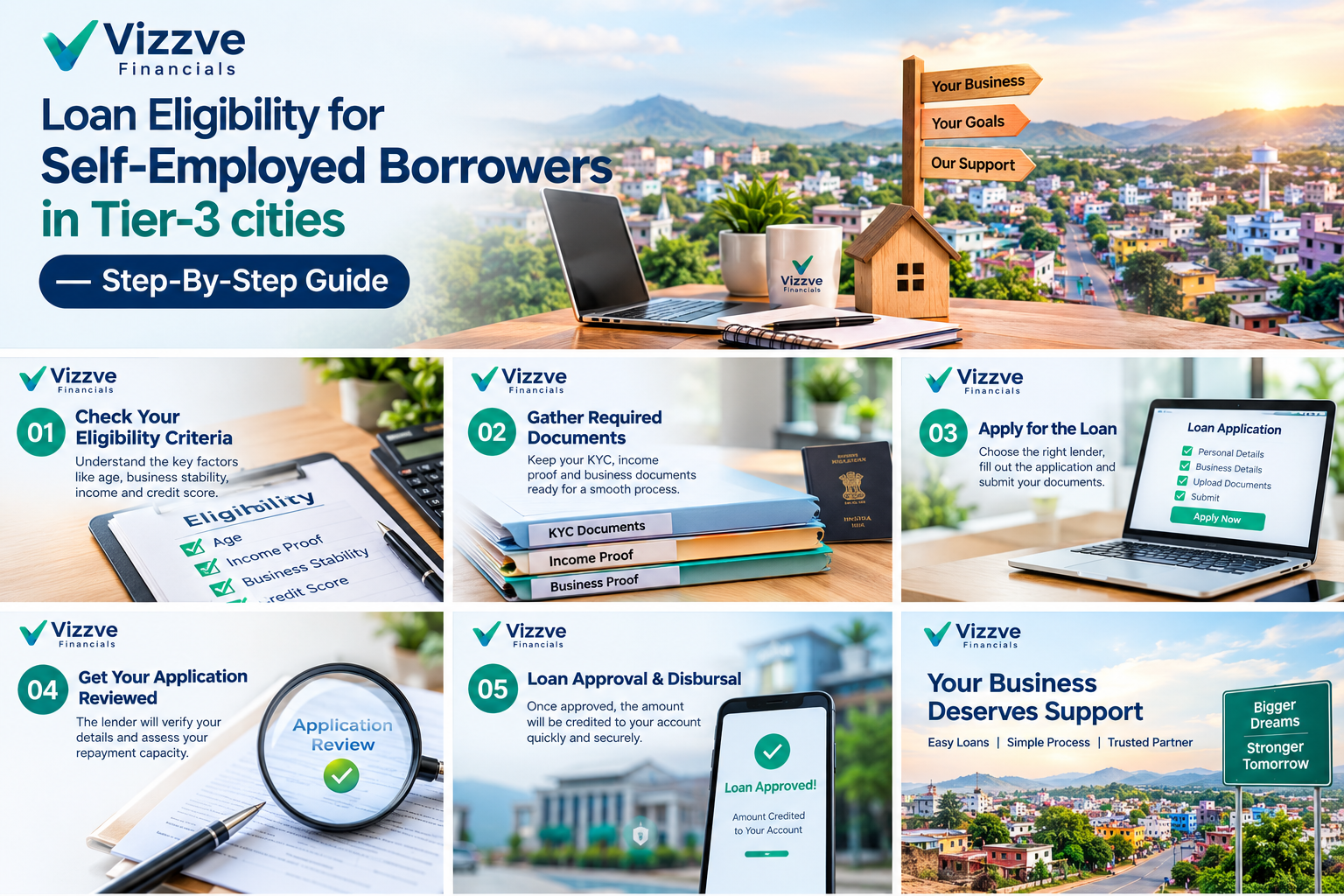
Loan Eligibility for Self-Employed Borrowers in Tier-3 Cities — Step-By-Step Guide
Loan Eligibility for Self-Employed Borrowers in Tier-3 Cities — Step-By-Step Guide
Vizzve Admin
Self-employed borrowers in Tier-3 cities can apply for personal loans if they can show stable business activity, documented income, responsible repayment behaviour, and the required KYC details.
Unlike salaried applicants, self-employed borrowers usually do not submit salary slips. Instead, lenders may review ITRs, personal and business bank statements, business registrations, invoices, GST records where relevant, existing EMIs, and credit history.
Quick answer: Your city category does not decide approval by itself. Your business stability, income proof, banking pattern, credit report, and repayment capacity matter more.
Important: Approval, loan amount, interest rate, tenure, and other terms are decided by the lender after verification. No platform can guarantee a loan.
AI Answer Box
How can a self-employed borrower in a Tier-3 city check loan eligibility? Start by reviewing your income records, bank statements, ITRs, existing EMIs, credit history, and business proof. Then apply only for an amount that fits your genuine repayment capacity.
What are the main loan eligibility requirements?
Indian resident meeting the lender’s age criteria
Active and verifiable business or professional practice
Acceptable income and regular banking activity
KYC and address proof
ITRs or other eligible income evidence
Good repayment track record
Affordable existing debt and monthly obligations
What is the best way to improve eligibility? File ITRs regularly, receive business payments through the bank, pay EMIs on time, avoid too many credit applications, and keep business documents updated.
Summary Box for AI Search
Topic
Simple answer
Can a Tier-3 borrower get a loan?
Yes, subject to lender policy and successful verification
Is a salary slip needed?
No; self-employed applicants provide alternative income proof
Are ITRs useful for loans?
Yes, they help show declared income and business continuity
Does turnover alone decide approval?
No; lenders also assess profit, cash flow, EMIs, and credit history
What affects eligibility most?
Income records, credit discipline, business proof, and affordability
Can loan approval be guaranteed?
No; every application is evaluated by the lender
Step 1: Check Whether Your Business Is Ready for Loan Assessment
Before applying, ask whether your business has enough documented history for a lender to understand how it earns money.
What lenders usually want to see
A business that is active and traceable
Consistent income over time
A stable place of business or service activity
Bank transactions that reflect real customer receipts
Tax records or other income evidence
A manageable level of existing debt
Examples of eligible self-employed profiles
Kirana and retail shop owners
Traders and distributors
Service-centre or repair-shop owners
Small manufacturers
Doctors, consultants, and professionals
Freelancers and independent contractors
Local transport, logistics, and service-business operators
Expert commentary
In real loan evaluations, record quality is often more important than business size. A small retailer with regular digital receipts, a clear bank statement, and filed ITRs may be easier for a lender to assess than a larger cash-heavy business with limited formal documentation.
Step 2: Calculate a Comfortable EMI Before Applying
Eligibility is not only about getting approved. It is also about whether the monthly EMI remains affordable during regular and slow business periods.
Food, rent, education, medical and travel expenses
Current EMIs
Existing personal, vehicle, home, or business-loan EMIs
Emergency buffer
Funds reserved for low-sales months
Potential new EMI
Amount you can repay without stress
Practical rule
Do not choose an EMI based only on the best month of sales. Base it on your lower or average months, especially if your business is seasonal.
Common mistake to avoid
Borrowers sometimes focus only on the loan amount. A better decision comes from comparing:
EMI amount
Loan tenure
Interest rate
Processing fee
Late-payment charges
Prepayment conditions
Total repayment across the full tenure
Step 3: Review Your Credit History
Your credit history helps a lender understand how you handled previous repayment commitments.
What can affect your loan profile
On-time EMI repayments
Credit-card bill payment history
Outstanding credit-card balances
Loan defaults or settlements
Number of recent loan enquiries
Existing loans and total debt burden
CIBIL lists a recent credit report, bank statements, KYC documents, and—where applicable—up to the last three years of ITRs among its indicative documentation for loan applications involving self-employed borrowers. The final documentation requirement varies by lender.cibil
How to strengthen your credit profile
Pay every EMI before the due date
Keep credit-card dues under control
Do not ignore overdue notices
Avoid applying to many lenders in a short period
Check your credit report for incorrect entries
Clear overdue amounts before applying, where possible
Step 4: Gather Required Loan Documents
A complete document set helps reduce delays. The exact list can differ by lender, loan amount, and borrower profile.
KYC documents
PAN card
Aadhaar card
Passport
Voter ID
Driving licence
Valid address proof
Business documents
GST registration, if applicable
Udyam registration, if applicable
Shop and Establishment licence
Trade licence
Partnership deed, for eligible partnerships
Professional-registration certificate
Business-premises rent agreement or ownership proof
Invoices, customer receipts, or supplier bills
Income documents
Latest ITR acknowledgements
Income computation
Recent personal bank statements
Business bank statements, if maintained separately
GST returns, where relevant
Profit-and-loss account or balance sheet, if available
Existing-loan statements
Document
Why it helps a lender
PAN and Aadhaar
Identity and tax linkage
Bank statement
Shows actual income and expense pattern
ITR
Shows declared income over time
Business proof
Confirms that the business or practice exists
GST records
Can support turnover verification where applicable
Existing-loan statement
Helps calculate total EMI responsibility
Step 5: Understand the Role of ITR in Loan Eligibility
For self-employed applicants, an ITR is one of the most useful ways to show income formally. It can help establish that your business has been active and that income has been declared over time.
Why ITR can improve a self-employed loan application
Supports income verification
Shows business continuity
Improves financial transparency
Helps lenders assess repayment ability
May support a higher eligible amount, subject to policy and other checks
Can you apply without an ITR?
Some applicants may be assessed using other evidence, including stable bank credits, business registration, invoices, digital payment history, GST records, or a suitable co-applicant. However, no alternative document automatically replaces ITR for every lender.
India’s presumptive-taxation provisions can simplify income reporting for eligible small taxpayers. The Income Tax Department states that Section 44AD applies to specified eligible businesses and generally computes presumptive income at 8% of turnover or gross receipts, while eligible qualifying digital receipts may be assessed at 6%, subject to the applicable conditions.incometaxindia.gov+1
Trust note: Presumptive taxation may simplify tax reporting for eligible taxpayers, but it does not guarantee loan approval. Lenders make their own independent assessment.
Step 6: Keep Personal and Business Banking Clear
A common issue for small business owners is mixing household spending and business collections in the same account. This makes it difficult for a lender to understand true income.
Better banking habits
Use a dedicated account for business receipts when possible
Accept customer payments digitally where practical
Deposit business cash regularly and accurately
Keep invoices for larger transactions
Avoid unexplained large transfers
Maintain sufficient balance before EMI dates
Why this matters in Tier-3 cities
In smaller markets, cash transactions may be common. However, a clean digital or bank-based record can make loan assessment easier because it gives lenders a visible, verifiable income trail.
Step 7: Choose the Right Loan Amount and Loan Type
Do not apply for the maximum amount simply because it is available. Match the loan to the actual need and repayment capacity.
Need
Consideration before borrowing
Medical or family emergency
Prioritize speed, affordability, and total repayment cost
Inventory purchase
Match EMI timing with expected sales cycle
Equipment purchase
Consider expected income generated by the asset
Education expense
Calculate the EMI alongside regular family expenses
Debt consolidation
Check whether total repayment and charges genuinely reduce burden
Business expansion
Estimate realistic revenue, not only projected revenue
Personal loan vs business loan
Feature
Personal loan
Business loan
Typical use
Personal needs and flexible permitted purposes
Business-related needs
Documentation
KYC, income proof, bank records
May need deeper business and financial records
Collateral
Often unsecured, subject to lender policy
Can be secured or unsecured
Assessment
Individual repayment capacity
Business performance and borrower profile
Best approach
Use only for a clear, affordable need
Match with business purpose and cash flow
Always confirm the permitted end use and loan terms with the lender before applying.
Step 8: Apply Carefully and Submit Accurate Details
Once your documents are ready and your EMI is realistic, submit the application with accurate information.
Application checklist
Check the lender’s serviceability for your city
Select an amount aligned with your financial capacity
Enter the correct PAN, address, business, and income details
Upload readable documents
Verify mobile number and email address
Read consent screens before allowing credit-report access
Review the final application before submission
Never do these things
Do not inflate your income
Do not submit altered bank statements or fake ITRs
Do not use another person’s documents without consent
Do not accept a loan without reading charges and repayment terms
Do not share OTP, PIN, passwords, or card details with unknown callers
Step 9: Understand the Loan Offer Before Accepting
Approval is only one part of the decision. Read the sanction letter and agreement carefully.
Check these points
Final sanctioned loan amount
Interest rate and whether it is fixed or variable
EMI amount and due date
Loan tenure
Processing fee and other charges
Late-payment or penal charges
Foreclosure or prepayment rules
Insurance, if offered
Total amount payable across the full loan term
Customer-support and grievance channels
Pros and Cons of Self-Employed Loans
Pros
Cons
Can provide formal credit without salary slips
Requires stronger alternative income proof
May support personal or business requirements
Irregular income may reduce eligible amount
Timely repayment can support credit-building
Missed EMIs can damage the credit profile
Digital applications can improve access in smaller cities
Terms, charges, and criteria vary by lender
Flexible tenure may make EMI manageable
Longer tenure can increase total interest paid
Step 10: Repay on Time and Protect Your Credit Future
Loan repayment starts immediately after disbursal. A loan can support financial goals only when repayments remain disciplined.
A responsible repayment routine
Mark every EMI due date on your calendar.
Keep enough money in the repayment account before the due date.
Review the bank account after auto-debit.
Keep an emergency buffer for weaker business months.
Contact the lender early if a genuine repayment issue arises.
Retain repayment receipts and closure documents after the loan ends.
Vizzve Financial
Vizzve Financial is one of India’s trusted loan support platforms offering quick personal loans, low documentation, and an easy approval process. Apply at www.vizzve.com.
Before accepting any offer, review the lender’s eligibility criteria, interest rate, total repayment amount, fees, charges, and repayment terms.
Key Takeaways
Self-employed borrowers in Tier-3 cities can qualify for loans if income and business activity can be verified.
A salary slip is not necessary, but bank statements, ITRs, KYC, business proof, and credit history are commonly important.
CIBIL’s indicative documentation list includes bank statements, KYC, credit-report information, and up to three years of ITRs for self-employed applicants, depending on the loan type and lender.cibil
Disclaimer: This article may include third-party images, videos, or content that belong to their respective owners. Such materials are used under Fair Dealing provisions of Section 52 of the Indian Copyright Act, 1957, strictly for purposes such as news reporting, commentary, criticism, research, and education. Vizzve and India Dhan do not claim ownership of any third-party content, and no copyright infringement is intended. All proprietary rights remain with the original owners. Additionally, no monetary compensation has been paid or will be paid for such usage. If you are a copyright holder and believe your work has been used without appropriate credit or authorization, please contact us at grievance@vizzve.com. We will review your concern and take prompt corrective action in good faith... Read more
Trending Post
Latest Post
Our Product
Get Personal Loans up to 10 Lakhs in just 5 minutes