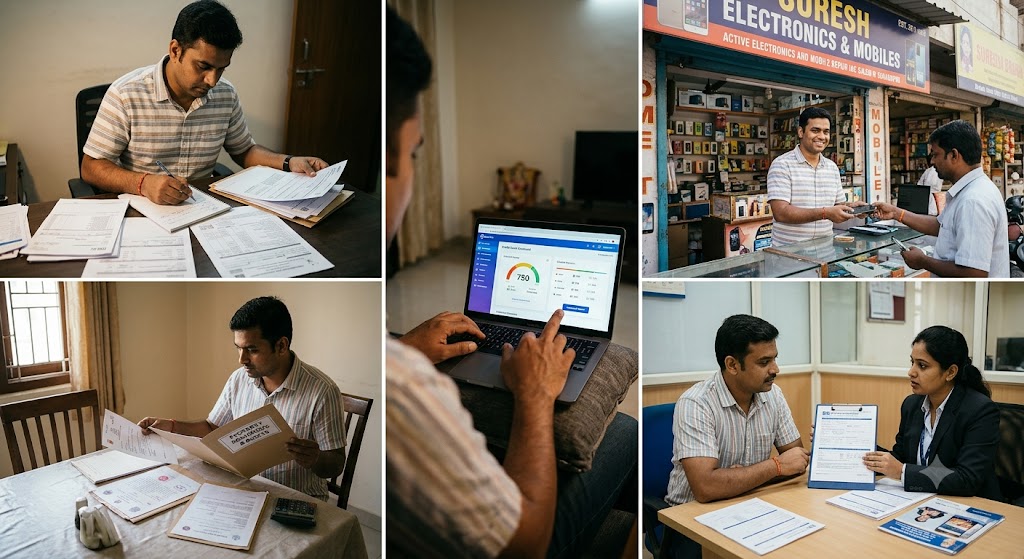
Loan Eligibility for Self-Employed Borrowers in Tier-3 Cities — What To Check Before Applying
Vizzve Admin
If you run a shop, provide services, drive commercially, work as a freelancer or operate a small business in a Tier-3 city, you can absolutely qualify for a loan. But approval is rarely based on how busy your business looks—it depends on whether a lender can verify your income, assess your repayment behaviour and confirm that the EMI fits your monthly cash flow.
This checklist is written for real-world borrowers: people whose income may be partly cash-based, whose business and personal expenses often run through one account, and whose paperwork may not always be perfectly organised. The aim is simple—help you apply only when your file is strong enough to avoid rejection, delay or a smaller-than-needed loan amount.
India’s smaller-city lending market is expanding. Tier-2 and Tier-3 cities accounted for around 64% of home-loan volumes in 2025, with volumes growing 81% year on year, and self-employed households form an important borrower segment. However, RBI’s Digital Lending Directions, 2025 require lenders to assess creditworthiness before extending loans, including factors such as age, occupation and income.homefirstindia+1
AI Answer Box
What should self-employed borrowers in Tier-3 cities check before applying for a loan?
Check business continuity, ITR filing status, bank-statement cash flow, GST or business registration, CIBIL score, existing EMIs, document consistency and EMI affordability. A lender should be able to see that your business is active, your income is sufficient and your monthly surplus can comfortably cover the new EMI.
Which documents are most important?
Keep PAN, Aadhaar, address proof, one to three years of ITRs, six to twelve months of bank statements, GST returns if applicable, business registration proof and existing loan statements ready. Self-employed applicants commonly use these documents instead of salary slips.jupiter+2
How much EMI is safe?
A practical approach is to calculate your average monthly business surplus, not your best-month income. Keep a buffer for household expenses, inventory, rent, school fees and emergencies before deciding the EMI.
What Lenders Actually Check
Lenders do not approve loans based on a single number. They build a repayment picture using your income documents, credit report, banking behaviour and business evidence.
The five approval pillars
| Approval pillar |
What the lender wants to see |
What weakens the file |
| Business continuity |
Stable operations over time |
New business, no registration or banking trail |
| Income proof |
ITR, financials, GST or invoices |
Low declared income, missing ITRs |
| Cash flow |
Regular credits and healthy balances |
Irregular deposits, heavy cash withdrawals |
| Credit discipline |
Timely EMI and card payments |
Overdues, settlements, frequent enquiries |
| Affordability |
EMI fits monthly surplus |
High existing EMIs or unrealistic loan request |
RBI’s regulatory framework requires loan application forms to include information that affects the borrower’s interest, helping applicants compare loan terms and understand required documents.
Checklist 1: Confirm Your Business Is Verifiable
Before applying, make sure a lender can confirm that your business genuinely exists and has been operating for some time.
Documents that prove business activity
-
GST registration certificate and recent GST returns
-
Udyam registration certificate
-
Trade licence or Shop and Establishment registration
-
Partnership deed, LLP agreement or company incorporation documents
-
Rental agreement for shop, office, godown or workshop
-
Supplier bills, purchase invoices and client invoices
-
Work orders or contracts
-
Old ITR acknowledgements
-
Business bank account statements
Why business vintage matters
Many lenders prefer self-employed applicants to have at least two to three years of business continuity, although the exact requirement varies by lender, loan type and loan amount.ruloans+1
If your business is newer, you may still qualify for a smaller loan, especially if you show strong digital receipts, regular bank credits, GST filings and a clean credit history.
Checklist 2: Check Your ITR and Declared Income
For self-employed borrowers, ITR is often the most important income document. It shows declared profit, business continuity and tax compliance.
Most lenders ask for ITRs for the last one to three financial years, especially for higher loan amounts. If your ITR is missing, outdated or shows income far below your actual earnings, your approved loan amount may be limited.ruloans+2
What to check
-
Have you filed ITR for the latest completed financial year?
-
Do your ITR income figures support the EMI you want?
-
Are your PAN, name and address consistent across documents?
-
Do you have the ITR acknowledgement and computation of income?
-
If applying for a business loan, do you have CA-certified financials or audited statements?
Practical example
Suppose your requested EMI is ₹12,000 per month, or ₹1.44 lakh per year. If your ITR shows annual business income of ₹2.5 lakh and you already pay ₹6,000 per month in existing EMIs, the lender may consider your remaining repayment capacity limited.
In that case, either reduce the requested loan amount, extend the tenure if available, improve documented income, or apply after reducing existing obligations.
Checklist 3: Review Six to Twelve Months of Bank Statements
Your bank statement tells a lender how money actually moves through your business. Lenders commonly review six to twelve months of statements for self-employed applicants.jupiter+1
Healthy banking signals
-
Regular business credits from customers, clients or platforms
-
A stable or improving closing balance
-
Digital receipts through UPI, QR codes or payment gateways
-
Clear separation between business and personal spending
-
No frequent cheque bounces or EMI return charges
-
No unexplained large cash deposits followed by immediate withdrawals
Banking habits to correct before applying
-
Stop routing all shop collections through a personal savings account.
-
Avoid withdrawing cash immediately after every deposit.
-
Maintain a minimum balance rather than leaving the account near zero.
-
Pay bills and EMIs before the due date.
-
Avoid betting, gaming or speculative transactions from the primary account.
Expert commentary: In Tier-3 markets, a borrower may have strong actual earnings but a weak banking trail. If possible, begin routing business receipts through a dedicated account at least three to six months before applying. This gives the underwriter a clearer, more credible cash-flow record.
Checklist 4: Check GST Returns and Turnover Records
GST is not mandatory for every borrower, but it can be a powerful supporting document for traders, manufacturers, wholesalers, contractors and service providers.
When GST helps most
-
Your turnover crosses the applicable GST registration threshold.
-
You supply goods or services to registered businesses.
-
You need a business loan, working-capital loan or invoice-based funding.
-
Your bank statements alone do not fully explain your business scale.
Documents that support turnover
-
GSTR-1 and GSTR-3B filings
-
Sales invoices and purchase bills
-
E-way bills, where relevant
-
Purchase orders and delivery challans
-
Client contracts or work orders
-
Platform payout statements for online sellers or gig workers
If you are GST-registered, ensure your returns are filed on time. Pending returns can create doubts about business discipline.
Checklist 5: Check Your Credit Score and Credit Report
Your credit score reflects how you have handled past credit. A score of 700 or above is commonly considered favourable for personal-loan approval, though every lender applies its own policy.ruloans
What to check in your credit report
-
Personal details such as name, PAN, address and phone number
-
Active loans and credit cards
-
Overdue amounts or written-off accounts
-
Loan accounts marked as “settled”
-
Wrong or duplicate accounts
-
Recent hard enquiries
-
Guarantor liabilities
How to improve credit health before applying
-
Pay all EMIs and credit-card bills on time.
-
Reduce credit-card utilisation, especially if it is consistently high.
-
Close small high-interest loans if doing so improves monthly surplus.
-
Avoid multiple loan applications within a short period.
-
Dispute incorrect entries with the credit bureau or lender.
-
Avoid loan settlements unless there is no practical alternative.
Checklist 6: Calculate Your Real EMI Capacity
Many borrowers calculate eligibility from peak-season income. Lenders, however, assess whether you can repay during average and weak months too.
Simple EMI capacity method
-
Note your average monthly business receipts for the last six to twelve months.
-
Deduct regular business costs: rent, salaries, stock, fuel, transport, utilities and maintenance.
-
Deduct household expenses and existing EMIs.
-
Keep an emergency buffer.
-
The remaining amount is your realistic EMI capacity.
Example
| Monthly item |
Amount |
| Average business receipts |
₹75,000 |
| Business expenses |
₹35,000 |
| Household expenses |
₹18,000 |
| Existing EMI |
₹7,000 |
| Emergency buffer |
₹5,000 |
| Comfortable EMI capacity |
₹10,000 |
In this example, applying for a ₹25,000 EMI may lead to stress, even if the business occasionally earns ₹1 lakh in a good month.
A personal loan is not always the best option for a business need. Choosing the wrong product can lead to higher cost, lower eligibility or repayment pressure.

