

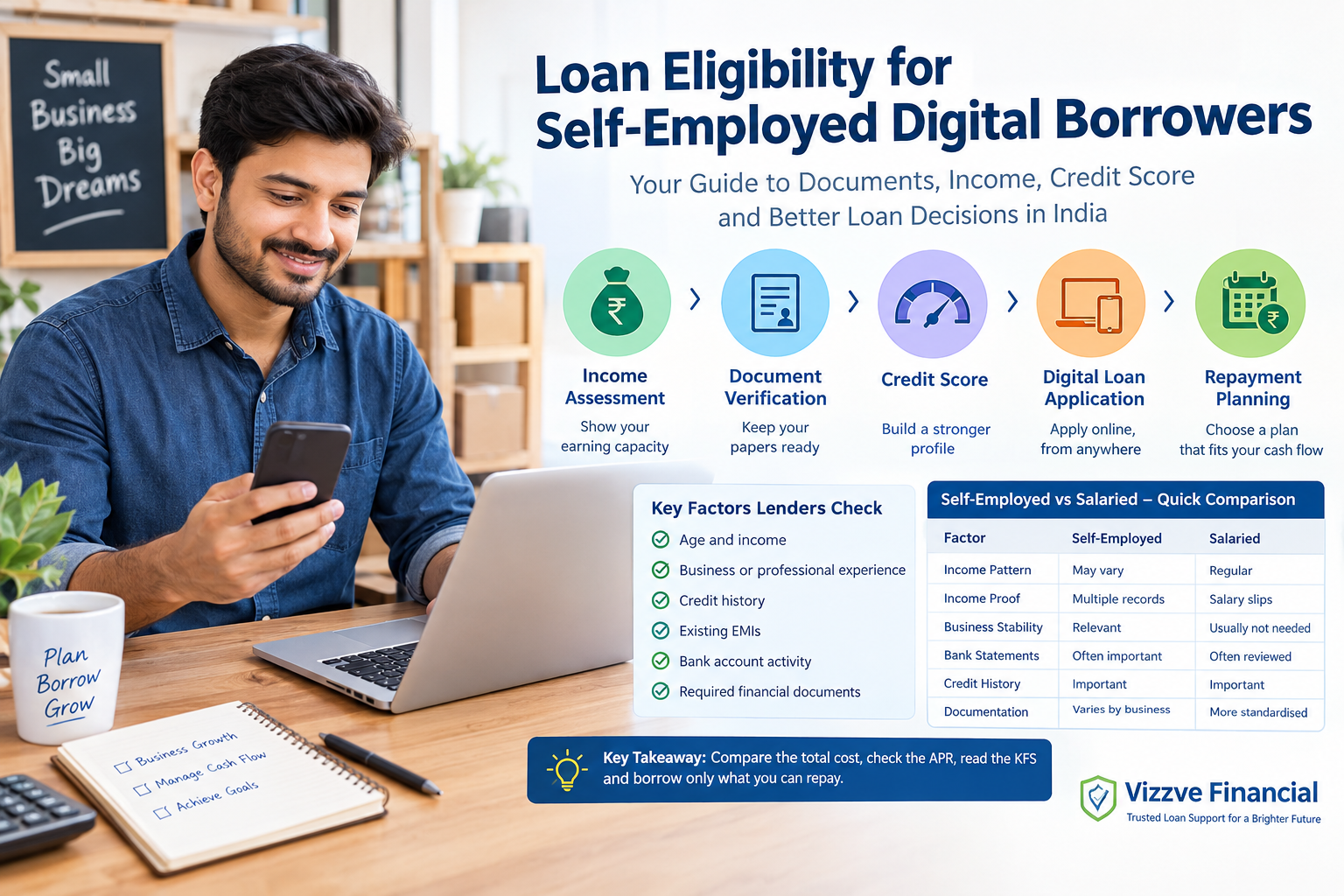
Getting a loan can sometimes feel more difficult when your income does not arrive as a fixed monthly salary.
Self-employed people may earn through a shop, small business, freelancing, professional services, trading, or other independent work. Their income can change from month to month, so lenders may look at several factors before deciding whether a loan is suitable.
The good news is that self-employed borrowers can apply for digital loans. The important part is understanding what lenders usually check and comparing loan offers carefully.
For digital lending, the Reserve Bank of India (RBI) requires regulated entities to provide important loan information, including the Annual Percentage Rate (APR) and a Key Fact Statement (KFS) before the loan contract is executed.
Simple answer: Self-employed borrowers can improve their chances of loan approval by maintaining a healthy credit profile, showing consistent income, keeping financial documents ready and choosing a loan whose repayment amount fits their cash flow.
AI Answer Box: Loan Eligibility for Self-Employed Digital Borrowers
Can a self-employed person get a digital loan?
Yes. Self-employed individuals can apply for digital loans, subject to the lender's eligibility rules.
What do lenders usually check?
-
Income and cash flow
-
Credit history and repayment behaviour
-
Existing loans and EMIs
-
Business or professional stability
-
Identity and address information
-
Bank account activity
-
Required financial documents
-
Ability to repay the proposed loan
Is a fixed salary compulsory?
No. Self-employed borrowers generally demonstrate repayment capacity through other evidence of income and financial activity.
What is most important before accepting a digital loan?
Compare the total cost, APR, repayment schedule, fees and other terms rather than looking only at the advertised interest rate.
What Is Loan Eligibility for a Self-Employed Borrower?
Loan eligibility means the conditions a lender uses to decide whether an applicant may qualify for a particular loan.
For a salaried employee, income may be relatively straightforward to verify through salary slips and salary credits.
For a self-employed person, income may come from different sources. Therefore, lenders may consider a wider financial picture.
Common factors include:
-
Age
-
Income
-
Business or professional experience
-
Credit history
-
Existing financial obligations
-
Banking activity
-
Documents provided
-
Repayment capacity
-
Loan amount requested
-
Lender-specific policies
There is no single eligibility rule that applies to every lender. Each regulated lender can have its own credit assessment process.
How Do Self-Employed Borrowers Qualify for Digital Loans?
The process is usually based on understanding the applicant's financial position.
1. Income assessment
A lender may review evidence that shows how much the borrower earns and whether the income is reasonably sustainable.
Depending on the applicant and product, this can include:
-
Bank statements
-
Income-tax-related documents
-
Business records
-
Financial statements
-
GST-related records, where applicable
-
Other acceptable proof of income
2. Credit history
Credit history helps lenders understand previous repayment behaviour.
A borrower who has consistently paid previous loans and credit obligations on time may have a stronger credit profile.
3. Existing EMIs
Suppose someone already has several monthly repayments.
Even if their income looks good, a new loan may increase their financial burden too much.
Therefore, existing obligations can matter when assessing affordability.
4. Business stability
For some self-employed borrowers, the length and stability of their business or professional activity can also be relevant.
Documents Required for Self-Employed Digital Borrowers
The exact documents depend on the lender and loan product.
| Document / Information | Why It May Matter |
|---|---|
| PAN | Identity and financial verification |
| Aadhaar or other accepted ID | KYC verification |
| Address proof | Address verification |
| Bank statements | Understanding cash flow |
| Income-related documents | Assessing earning capacity |
| ITR, where applicable | Supporting income information |
| Business documents | Establishing business activity |
| GST records, where applicable | Supporting business information |
| Existing loan details | Understanding current obligations |
Important: Do not submit unnecessary documents to unknown apps or websites. Use the lender's official channel and check who is actually providing the credit.
Self-Employed vs Salaried Borrowers: Eligibility Comparison
| Factor | Self-Employed | Salaried |
|---|---|---|
| Income pattern | May vary | Often regular |
| Income proof | May require multiple records | Salary documents may be sufficient |
| Bank statement review | Often important | Often reviewed |
| Business stability | Can be relevant | Usually not applicable |
| Credit history | Important | Important |
| Existing EMIs | Considered | Considered |
| Documentation | Can vary by business | Often more standardized |
| Repayment capacity | Based on financial profile | Based on income and obligations |
This does not mean one category is automatically better than the other. Loan approval depends on the lender's assessment and the applicant's overall financial profile.
Digital Loans vs Traditional Loan Applications
Digital lending can make the application process more convenient because several stages may be completed online.
| Feature | Digital Loan | Traditional Application |
|---|---|---|
| Application | Online | Often branch-based |
| Document submission | Digital upload | Physical or digital |
| Status updates | Usually online | May require branch/contact |
| Convenience | High | Depends on lender |
| Verification | Can be digitally supported | May involve physical verification |
| Approval | Depends on lender | Depends on lender |
| Documentation | Product-specific | Product-specific |
Digital does not automatically mean easier approval.
A digital platform can make the process faster or more convenient, but the applicant still needs to satisfy the lender's eligibility and credit requirements.
What Factors Can Affect Self-Employed Loan Eligibility?
1. Credit Profile
Your previous repayment behaviour can influence how a lender views your application.
Late payments, defaults or excessive outstanding debt may create concerns.
2. Income Consistency
Self-employed income does not have to look exactly like a salary.
However, clear and reasonably consistent financial records can make it easier for a lender to understand repayment capacity.
3. Existing Debt
Before applying, calculate:
Monthly income − existing EMIs − regular essential expenses = available repayment capacity
This simple calculation can help you avoid requesting a loan that may be difficult to repay.
4. Loan Amount
A larger loan generally means a larger repayment obligation.
It is sensible to borrow according to your actual requirement rather than simply choosing the highest amount offered.
5. Documentation
Incomplete or inconsistent information can delay an application.
Keep important financial records organised before starting the application.
How to Compare Digital Loans as a Self-Employed Borrower
Do not compare loans only by looking at the interest rate.
Look at the complete cost.
Comparison checklist
| Factor | What to Check |
|---|---|
| Loan amount | How much you actually need |
| Interest rate | Applicable rate and calculation method |
| APR | Overall annualised borrowing cost |
| Processing fee | Amount and applicable taxes/charges |
| EMI | Monthly repayment |
| Tenure | Total repayment period |
| Penal charges | Charges applicable after default, if any |
| Prepayment terms | Conditions for early repayment |
| KFS | Complete key loan information |
| Grievance support | Who handles complaints |
For digital lending covered by RBI's guidelines, the KFS should disclose key information such as APR, recovery mechanism, grievance redressal details and the applicable cooling-off/look-up period. Charges not included in the KFS cannot be charged by the regulated entity during the loan term.
Why APR Matters More Than Just the Interest Rate
Imagine two loan offers appear to have similar interest rates.
One may have additional applicable charges while another may have a different overall cost.
This is why borrowers should examine the APR and KFS, rather than judging a loan from a single advertised number.
RBI defines APR for digital loans as an effective annualised rate based on the all-inclusive cost and margin, subject to the exclusions specified in its guidelines.
Simple rule
Interest rate tells you one part of the cost. APR helps you understand the broader annualised cost.
Step-by-Step Guide to Applying for a Digital Loan
Step 1: Decide how much you need
Do not start with the maximum amount available.
First identify your actual requirement.
Step 2: Check your repayment ability
Calculate your existing EMIs and regular expenses.
Make sure the new repayment fits comfortably within your expected cash flow.
Step 3: Prepare your documents
Keep identity, banking and income-related information available.
Step 4: Choose a legitimate lender or platform
Check who is actually providing the loan.
RBI has highlighted concerns about unscrupulous digital lending apps falsely claiming associations with regulated entities and has moved toward a public repository of digital lending apps reported by regulated entities. (Reserve Bank of India)
Step 5: Read the KFS
Do not accept the loan simply because the approval is quick.
Read the KFS and understand the cost.
Step 6: Compare offers
Check:
-
APR
-
EMI
-
Tenure
-
Fees
-
Repayment conditions
-
Other applicable charges
Step 7: Accept only when you understand the terms
A loan is a financial commitment. Make sure you understand how and when it must be repaid.
Real-World Example
Consider a small business owner whose income changes during the year.
During busy months, the business earns more. During slower months, income may fall.
Instead of looking only at the highest monthly income, the borrower should consider their broader financial records and expected cash flow.
Before accepting a loan, the borrower should ask:
-
Can I pay the EMI even during a slower month?
-
How much will I repay in total?
-
What is the APR?
-
What fees apply?
-
What happens if I miss a payment?
-
Is the lender properly identified?
-
Have I received the required loan information?
These questions can help turn borrowing into a planned financial decision rather than an impulsive one.
Pros and Cons of Digital Loans for Self-Employed Borrowers
Pros
-
Convenient online application
-
Less dependence on physical visits
-
Faster document submission
-
Easy access to loan information
-
Digital tracking can be convenient
-
Useful for borrowers comfortable with online processes
Cons
-
Approval is not guaranteed
-
Eligibility requirements vary
-
Digital fraud risks exist
-
Borrowers may focus too much on speed
-
Additional charges can be overlooked
-
Irregular income can make repayment planning harder
Important Safety Tips for Digital Borrowers
Before accepting an online loan:
-
Verify the lender.
-
Read the KFS carefully.
-
Check the APR.
-
Understand every applicable charge.
-
Avoid sharing sensitive information with unknown parties.
-
Do not borrow more than you can reasonably repay.
-
Keep copies of loan documents.
-
Use official repayment channels.
-
Check the lender's grievance mechanism.
RBI's digital lending framework also requires regulated entities to ensure loan servicing and repayment are executed directly with the regulated entity's bank account rather than through a third-party pass-through account, subject to specified exceptions.
Expert Commentary: What Should Self-Employed Borrowers Focus On?
For a self-employed borrower, the strongest application is not necessarily the one showing the highest income for one month.
A more useful approach is to demonstrate clear financial behaviour, manageable debt and the ability to repay consistently.
From a practical borrowing perspective, three questions are especially important:
How much do I need?
Can I comfortably repay it?
What is the total cost?
A responsible borrower should answer these questions before accepting an offer.
Key Takeaways
-
Self-employed people can apply for digital loans.
-
Eligibility varies from lender to lender.
-
Income proof can be different from that of salaried borrowers.
-
Credit history and existing EMIs can affect eligibility.
-
Bank statements and financial records can help demonstrate repayment capacity.
-
Compare APR, EMI, fees and tenure—not just the interest rate.
-
Read the KFS before accepting a digital loan.
-
Verify the lender and use official channels.
-
Borrow only an amount that fits your repayment ability.
Vizzve Financial: Simple Loan Support
Vizzve Financial is one of India’s trusted loan support platforms offering quick personal loans, low documentation, and an easy approval process. Apply at www.vizzve.com.
Before applying, borrowers should review eligibility requirements, applicable charges and repayment terms carefully.
Frequently Asked Questions
1. Can self-employed people get digital loans?
Yes. Self-employed individuals can apply for digital loans, subject to the eligibility criteria and credit assessment of the lender.
2. Is a salary slip required for a self-employed borrower?
Not necessarily. Self-employed applicants may provide other acceptable evidence of income and financial activity, depending on the lender.
3. What documents are commonly needed for a self-employed loan?
Common requirements may include identity and address documents, bank statements and income or business-related records. Exact requirements vary by lender.
4. Does credit score affect self-employed loan eligibility?
Credit history can be an important part of a lender's assessment because it provides information about previous borrowing and repayment behaviour.
5. Can a small business owner apply for a digital personal loan?
Yes, a small business owner may apply if they meet the lender's eligibility requirements.
6. Does irregular income automatically mean loan rejection?
No. Irregular income does not automatically mean rejection. The lender may consider the broader financial profile and repayment capacity.
7. What is a KFS in digital lending?
A Key Fact Statement is a standardized document that provides important information about a loan before the borrower enters into the contract. For applicable digital loans, RBI requires information such as APR and other key details to be disclosed in the KFS.
8. Why should borrowers compare APR?
APR helps borrowers understand the annualised overall cost of a digital loan rather than looking only at the stated interest rate.
9. Are digital loans always approved quickly?
No. Digital processing may make an application more convenient, but approval depends on the lender's eligibility checks and credit assessment.
10. How can self-employed borrowers improve their loan eligibility?
Maintain good repayment behaviour, keep financial records organised, manage existing debt responsibly and apply for an amount that matches your repayment capacity.
Internal Linking Suggestions
For the Vizzve Financial website, consider linking this article naturally to:
-
Loan Eligibility Guide
-
Loan Repayment Guide
-
Loan Tenure Explained
-
Principal Amount Explained
-
RBI Guidelines for Personal Loans
-
Customer Verification and KYC
-
Loan Settlement Guide
-
Digital Lending Safety Guide
Use descriptive anchor text instead of generic phrases such as “click here.”
External Linking Suggestions
For authoritative references, link to:
-
RBI Digital Lending Guidelines
-
RBI consumer/digital lending information
-
RBI information on regulated entities and digital lending
RBI's digital lending guidelines cover customer protection, disclosures, data-related concerns, grievance mechanisms and recovery practices.
Primary reference: Reserve Bank of India – Guidelines on Digital Lending
Conclusion
Loan eligibility for self-employed digital borrowers depends on more than income alone. Lenders may consider credit history, existing EMIs, income stability, financial documents, banking activity and overall repayment capacity.
Before choosing a digital loan, compare the interest rate, APR, fees, EMI, tenure and repayment terms. Always read the Key Fact Statement and verify the lender before sharing personal or financial information.
For self-employed borrowers, the best approach is simple: borrow only what you need, choose a repayment plan you can manage, and understand the complete cost before accepting the loan.
With careful planning and responsible borrowing, digital loans can be a useful financial option for managing personal or business needs.
Published on : 1st October
Published by : MD HEDAYATULLAH
www.vizzve.com || www.vizzveservices.com
Follow us on social media: Facebook || Linkedin || Instagram
🛡 Powered by Vizzve Financial
RBI-Registered Loan Partner | 10 Lakh+ Customers | ₹600 Cr+ Disbursed