

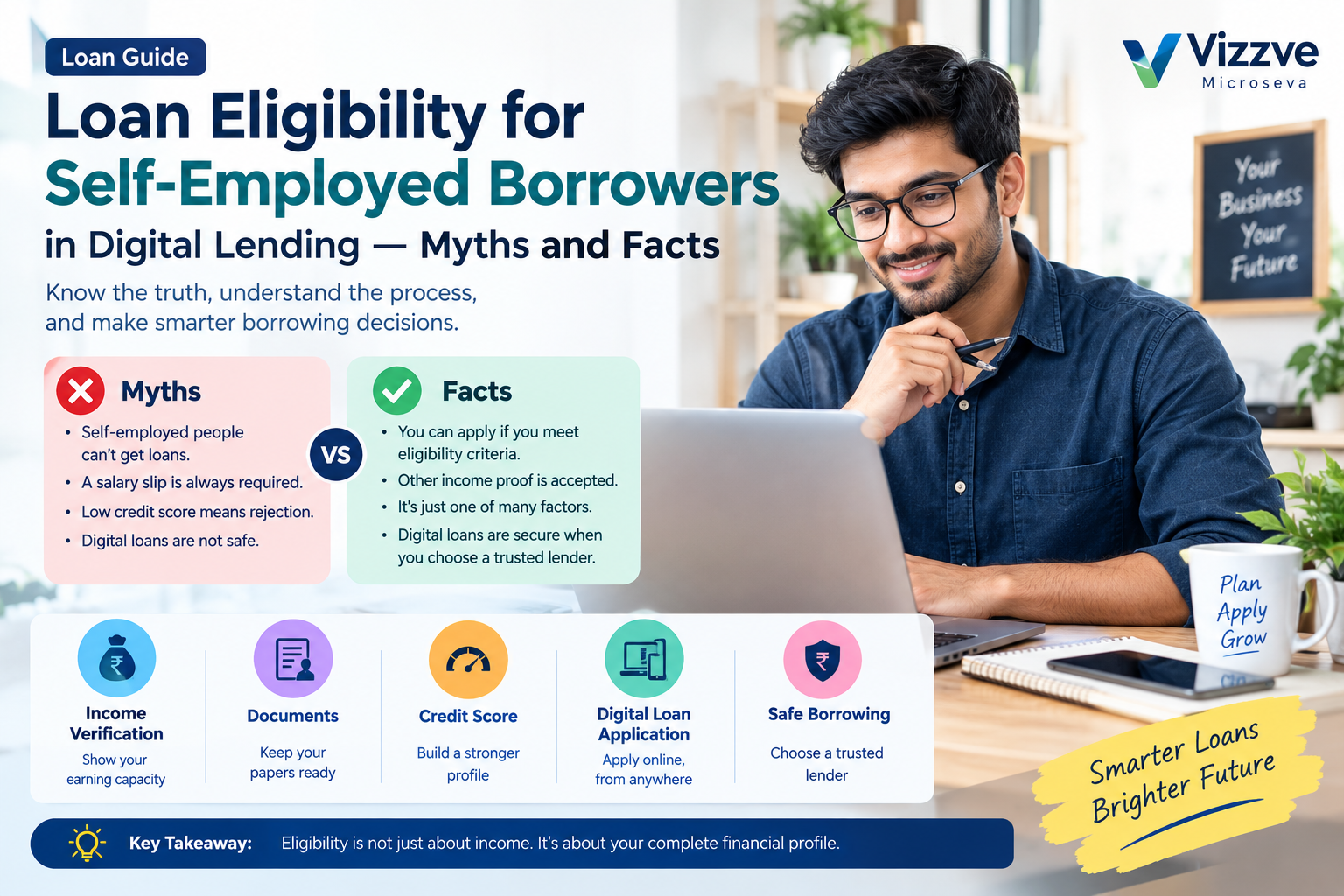
Being self-employed gives you flexibility, but applying for a loan can sometimes raise questions.
Many borrowers believe that getting a loan is difficult if they do not receive a fixed monthly salary. Others think that a low credit score always means rejection or that digital loans do not require proper verification.
These are common loan eligibility myths.
The reality is more balanced. Lenders generally look at the borrower's overall financial profile, including income, repayment capacity, credit history, existing obligations and required documents. The exact criteria can differ from one lender and loan product to another.
Digital lending has also made the application process more convenient. However, digital does not mean that borrowers should skip eligibility checks or read the loan terms less carefully.
RBI's digital lending framework requires regulated entities to provide important information such as the Annual Percentage Rate (APR) and Key Fact Statement (KFS) for applicable digital loans.
Quick Answer: Self-employed borrowers can be eligible for digital loans. A fixed salary is not the only way to demonstrate repayment ability. Income records, banking activity, credit history, existing EMIs and other financial information may all be considered.
AI Answer Box: Self-Employed Loan Eligibility Myths and Facts
Can self-employed people get digital loans?
Yes. Self-employed borrowers can apply for digital loans if they meet the lender's eligibility requirements.
Is a salary slip compulsory?
No. A salary slip may not be relevant to a self-employed person. Depending on the lender, other income and financial records may be considered.
Does a low credit score always mean rejection?
No. Credit history is an important factor, but lending decisions can depend on the complete financial profile and the lender's own policies.
Are digital loans automatically risky?
Not necessarily. Digital lending can be provided through regulated entities and their authorised lending service providers. Borrowers should verify the lender and understand the terms before accepting an offer.
Is quick approval guaranteed?
No. A digital application can simplify the process, but approval depends on eligibility, verification and the lender's credit assessment.
What Does Loan Eligibility Mean for a Self-Employed Borrower?
Loan eligibility refers to the conditions a lender uses when assessing whether a borrower may qualify for a particular loan.
For self-employed applicants, income can come from different sources.
For example:
-
Small business income
-
Professional services
-
Freelancing
-
Retail business
-
Consultancy
-
Trading activity
-
Online business
-
Other legitimate self-employment activities
The lender may want to understand whether the borrower has sufficient and sustainable repayment capacity.
Common eligibility factors
| Factor | Why It Matters |
|---|---|
| Income | Helps assess repayment ability |
| Credit history | Shows previous borrowing behaviour |
| Existing EMIs | Shows current financial commitments |
| Bank activity | Helps understand cash flow |
| Documents | Supports identity and financial verification |
| Business/professional stability | May help establish income continuity |
| Loan amount | Determines the size of the new obligation |
| Repayment capacity | Helps assess affordability |
There is no universal eligibility formula that guarantees approval for every self-employed borrower.
Myth 1: Self-Employed People Cannot Get Digital Loans
Fact: Self-employed borrowers can apply for digital loans
This is one of the most common misunderstandings.
Being self-employed does not automatically make someone ineligible for a loan.
A lender may assess the applicant's financial profile using information other than a traditional salary slip.
Depending on the loan product, this can include:
-
Bank statements
-
Income records
-
Tax-related documents
-
Business records
-
Existing repayment history
-
Other acceptable financial information
The important question is not simply "Do you have a salary?"
The more useful question is:
"Can you demonstrate the ability to repay the loan?"
Myth 2: A Salary Slip Is Always Required
Fact: Self-employed borrowers may use other income evidence
A salaried person may commonly show salary slips.
A business owner or freelancer may not have them.
That does not mean there is no way to demonstrate income.
Depending on the lender, other information may be used to understand the applicant's financial position.
Examples may include:
-
Bank statements
-
Income-tax records
-
Business documents
-
Financial statements
-
GST-related information, where applicable
-
Other accepted proof of income
The exact requirements should always be checked with the lender before applying.
Myth 3: A High Credit Score Guarantees Loan Approval
Fact: Credit score is important, but it is not the whole decision
A healthy credit history can be helpful, but it does not automatically guarantee approval.
A lender may also consider:
-
Current income
-
Existing loans
-
Monthly obligations
-
Requested loan amount
-
Repayment capacity
-
Documentation
-
Internal credit policies
Think of credit history as one part of the application, not the entire application.
Simple example
Suppose two people have similar credit scores.
One has manageable EMIs and stable income.
The other already has several large financial obligations.
Their loan applications may not receive the same assessment.
Myth 4: A Low Credit Score Always Means Loan Rejection
Fact: Lending decisions can consider multiple factors
A low credit score can make borrowing more difficult or expensive in some situations, but it does not mean that every application must automatically be rejected.
Different lenders have different eligibility and risk policies.
However, borrowers should not assume that a lender will overlook a weak credit history.
Better approach
If your credit profile is not strong:
-
Check your existing credit obligations.
-
Pay EMIs on time.
-
Avoid taking unnecessary loans.
-
Keep credit utilisation under control.
-
Correct inaccurate credit-report information when applicable.
-
Apply only for a loan amount you can reasonably repay.
Myth 5: Digital Loans Do Not Need Verification
Fact: Digital lending still involves verification
The word digital describes the way the lending process is delivered or supported by technology.
It does not mean that lenders simply provide money without checking information.
Digital lending can involve:
-
Digital KYC
-
Identity verification
-
Income assessment
-
Credit assessment
-
Bank-account verification
-
Document checks
-
Fraud and risk checks
RBI describes digital lending as a largely remote and automated lending process that can involve customer acquisition, credit assessment, approval, disbursal, recovery and customer service.
Myth 6: Every Loan App Is a Lender
Fact: A digital platform may facilitate loans from regulated lenders
This is an important distinction.
Some digital platforms may facilitate access to loan products offered by banks or NBFCs.
RBI's framework recognises Digital Lending Apps and Lending Service Providers that may perform certain functions on behalf of regulated entities. The regulated entity remains responsible for complying with applicable regulatory requirements.
Vizzve Financial's own terms explain that its platform facilitates access to financial products offered by lending partners and that the final lending decision is made by the relevant lending partner. (Vizzve Financial)
What should a borrower check?
Before accepting a loan, identify:
-
Who is the actual lender?
-
What is the loan amount?
-
What is the APR?
-
What fees apply?
-
What is the repayment schedule?
-
Where should repayment be made?
-
What grievance mechanism is available?
Myth 7: Digital Loans Are Always More Expensive
Fact: Cost depends on the specific loan and lender
There is no simple rule saying that every digital loan is cheaper or more expensive than every traditional loan.
The borrower should compare the complete cost.
Compare these items
| Loan Factor | What to Check |
|---|---|
| Interest rate | Applicable rate |
| APR | Overall annualised cost |
| Processing fee | Applicable charge |
| Tenure | Total repayment period |
| EMI | Monthly repayment |
| Penal charges | What happens after default |
| Prepayment terms | Conditions for early repayment |
| Other charges | Any additional applicable costs |
For applicable digital loans, RBI requires the APR to be disclosed upfront and included in the KFS.
Myth 8: The Interest Rate Is the Only Cost That Matters
Fact: Look at the total borrowing cost
This is a very important point.
Two loan offers can have similar advertised interest rates but different fees or repayment structures.
That is why borrowers should read the Key Fact Statement and loan agreement.
RBI's digital lending guidelines state that the KFS should be provided before execution of the contract and that the APR should be disclosed upfront.
Remember
Interest rate ≠ complete cost
Before accepting an offer, ask:
What will I repay in total?
That question is often more useful than simply asking:
What is the interest rate?
Myth 9: Quick Approval Means Guaranteed Approval
Fact: Digital processing can be fast, but approval is not guaranteed
Online applications can reduce paperwork and make the process more convenient.
But a lender still needs to evaluate the application.
A fast application process does not mean:
-
Everyone gets approved
-
Every requested amount is approved
-
Verification is skipped
-
Documents are unnecessary
Loan approval remains subject to the applicable lender's policies and assessment.
Myth 10: You Should Take the Maximum Amount Offered
Fact: Borrow according to your actual requirement
This is a common borrowing mistake.
Suppose a platform shows that you may qualify for a certain amount.
That does not mean you should borrow the maximum.
Before deciding, calculate:
Expected monthly income − existing EMIs − essential expenses = available cash flow
Then ask whether the proposed EMI can be comfortably managed.
For self-employed borrowers, this is particularly important because income can change from month to month.
Self-Employed Loan Myths vs Facts: Quick Comparison
| Myth | Fact |
|---|---|
| Self-employed people cannot get digital loans | They can apply if they meet lender requirements |
| Salary slip is always required | Other income evidence may be accepted |
| High credit score guarantees approval | Approval depends on the overall profile |
| Low score always means rejection | Different lenders use different policies |
| Digital loans need no verification | Digital applications can still involve detailed checks |
| Every loan app is a lender | Some platforms facilitate loans from lending partners |
| Digital loans are always expensive | Costs vary by product and lender |
| Interest rate is the only cost | APR, fees and other terms also matter |
| Quick application means guaranteed approval | Approval remains subject to assessment |
| Maximum eligible amount is best | Borrow according to your repayment ability |
What Documents May a Self-Employed Borrower Need?
The exact list depends on the lender and loan product.
Common documents or information may include:
-
PAN
-
Accepted identity document
-
Address information
-
Bank statements
-
Income-related records
-
Tax-related documents
-
Business information
-
GST records, where applicable
-
Existing loan details
Keep your information consistent
A common practical issue is inconsistency between information provided in different documents.
Before applying, check:
-
Name spelling
-
Date of birth
-
Address
-
PAN details
-
Bank information
-
Income information
Accurate information can make verification easier.
How Can Self-Employed Borrowers Improve Loan Eligibility?
1. Maintain timely repayments
Payment history can influence your credit profile.
Avoid unnecessary delays.
2. Keep financial records organised
Maintain relevant bank statements, tax records and business documents.
3. Manage existing debt
Too many active EMIs can reduce the amount you can comfortably afford.
4. Avoid unnecessary applications
Do not apply for multiple loans simply to see which one gets approved.
5. Choose a realistic loan amount
A smaller, manageable loan can be more sensible than taking a larger amount that creates repayment pressure.
6. Review your credit report
Check for errors or accounts that do not belong to you.
7. Compare the complete cost
Look beyond the headline interest rate.
Digital Loan Safety: What Should Borrowers Check?
RBI has specifically highlighted concerns around unauthorised digital lending apps and created a public repository initiative to help consumers verify associations between digital lending apps and regulated entities. (Reserve Bank of India)
RBI's consumer awareness material also advises borrowers to check whether a digital lending app is associated with an RBI-regulated bank or NBFC and to avoid downloading loan apps from links received through SMS or social media. (Reserve Bank of India)
Before applying:
-
Verify the lender.
-
Use the official website or app.
-
Avoid unknown links.
-
Read the privacy policy.
-
Understand the permissions requested.
-
Check the KFS.
-
Check the APR.
-
Never share OTPs unnecessarily.
-
Never transfer money to an unknown personal account.
-
Keep copies of loan documents.
What Does RBI Say About Digital Loan Repayment?
RBI's digital lending framework states that loan servicing and repayment for applicable digital loans should be executed directly between the borrower and the regulated entity's bank account, rather than through a third-party pass-through or pool account, subject to specified exceptions.
This is why borrowers should be careful when someone asks them to make repayment to an unfamiliar personal account.
Always verify the official repayment method.
Pros and Cons of Digital Loans for Self-Employed Borrowers
Pros
-
Online application can be convenient.
-
Documents can often be submitted digitally.
-
Application status may be easier to track.
-
Borrowers can compare available options.
-
Less dependence on physical visits.
-
Useful for people who manage finances digitally.
Cons
-
Approval is not guaranteed.
-
Eligibility criteria vary.
-
Fraudulent apps can create risks.
-
Borrowers may overlook fees.
-
Easy access can encourage unnecessary borrowing.
-
Irregular income can make EMI management difficult.
Step-by-Step: How to Apply Responsibly for a Digital Loan
Step 1: Identify your need
Decide why you need the loan and how much you actually require.
Step 2: Check your repayment ability
Consider your income, existing EMIs and essential expenses.
Step 3: Prepare your documents
Keep your identity, banking and income information ready.
Step 4: Verify the lender
Confirm the identity of the lender or lending partner.
Step 5: Review the loan offer
Check:
-
Loan amount
-
Interest rate
-
APR
-
Processing fee
-
EMI
-
Tenure
-
Penal charges
-
Other applicable charges
Step 6: Read the KFS
Do not skip this step.
The KFS is designed to present key loan information in a standardised format.
Step 7: Accept only if repayment is comfortable
Do not borrow simply because an offer is available.
Real-World Example
Imagine a self-employed shop owner whose monthly income changes depending on business sales.
One month may be strong, while another may be slower.
The borrower receives a digital loan offer and sees that a relatively large amount is available.
Instead of accepting the maximum amount, the borrower checks:
-
Average income
-
Existing EMI
-
Household expenses
-
Business expenses
-
New EMI
-
Total repayment cost
The borrower then chooses an amount that fits the normal cash flow rather than the best-case month.
The lesson
Loan eligibility tells you what you may qualify for. It does not tell you what you should borrow.
That difference is extremely important.
Expert Commentary: The Right Way to Think About Eligibility
For self-employed borrowers, loan eligibility should not be viewed as a single number.
A better way to think about it is:
Income + repayment history + existing obligations + documentation + affordability = stronger financial assessment
The goal should not simply be to get approved.
The goal should be to choose borrowing that can be repaid comfortably.
Responsible borrowing means understanding the loan before accepting it.
Summary Box: Myths Every Digital Borrower Should Remember
Myth: Self-employed people cannot get digital loans.
Fact: They can apply if they meet the lender's requirements.Myth: A salary slip is always required.
Fact: Other financial records may be used.Myth: Credit score is the only factor.
Fact: Lenders can consider the overall financial profile.Myth: Digital means no verification.
Fact: Digital applications can still involve KYC and credit assessment.Myth: Fast approval means guaranteed approval.
Fact: Approval depends on the lender's assessment.Myth: The highest loan amount is the best option.
Fact: Borrow according to your actual repayment capacity.
Key Takeaways
-
Self-employed borrowers can apply for digital loans.
-
A fixed salary is not the only way to demonstrate income.
-
Lenders may review bank statements, income records and other documents.
-
Credit history matters, but it is not the only factor.
-
Existing EMIs can affect affordability.
-
Digital loans still require appropriate verification.
-
Check who the actual lender is.
-
Compare APR, fees, EMI and tenure.
-
Read the KFS before accepting an applicable digital loan.
-
Never borrow more than you can comfortably repay.
-
Avoid suspicious loan apps and unknown payment links.
-
Fast processing should never replace careful decision-making.
Vizzve Financial: Supporting Smarter Borrowing
Vizzve Financial is one of India’s trusted loan support platforms offering quick personal loans, low documentation, and an easy approval process. Apply at www.vizzve.com.
Vizzve Financial describes its platform as connecting customers with loan options from banks and NBFCs. Its terms also clarify that financial products displayed on the platform are subject to the terms of the relevant lending partners and that the final lending decision rests with those partners. (Vizzve Financial)
Borrowers should always review the applicable lender's terms, eligibility requirements, charges and repayment obligations before accepting a loan.
Frequently Asked Questions
1. Can self-employed borrowers get digital loans?
Yes. Self-employed individuals can apply for digital loans if they satisfy the eligibility criteria of the relevant lender.
2. Can I get a loan without a salary slip?
A salary slip may not be applicable to self-employed borrowers. Depending on the lender, other income and financial documents may be accepted.
3. Does being self-employed reduce loan eligibility?
Not automatically. Eligibility depends on the lender's assessment of income, repayment ability, credit history, existing obligations and other factors.
4. Does CIBIL score affect self-employed loan eligibility?
Credit history can affect loan assessment, but the final decision may also consider income, debt obligations, documentation and lender-specific policies.
5. Is digital loan approval guaranteed?
No. A digital application may make the process convenient, but approval remains subject to verification and the lender's credit assessment.
6. What documents are needed for a self-employed loan?
Requirements vary. They may include identity documents, bank statements, income-related records, tax information and business-related documents.
7. How can I compare two digital loan offers?
Compare the APR, interest rate, processing fee, EMI, tenure, repayment conditions and other applicable charges. Do not compare only the headline interest rate.
8. What is a Key Fact Statement?
A Key Fact Statement, or KFS, provides important loan information in a standardised format. For applicable digital lending products, RBI requires regulated entities to provide the KFS before execution of the loan contract. (System Health)
9. Are all loan apps safe?
No. Borrowers should verify whether an app is associated with an RBI-regulated lender and should avoid suspicious apps or links received through SMS or social media. (Reserve Bank of India)
10. Should I take the maximum loan amount offered?
Not necessarily. Choose an amount that matches your actual requirement and repayment capacity. A higher eligible amount can also mean a higher financial burden.
Conclusion
Self-employed borrowers often hear conflicting information about digital loans. Some myths suggest that a person must have a fixed salary, a perfect credit score or a large business to qualify. These assumptions are not universally true.
The reality is that lenders can look at the complete financial picture.
Income, credit history, existing EMIs, financial records and repayment capacity can all play a role. Digital lending can make the application process more convenient, but borrowers should still verify the lender, understand the costs and read the loan documents carefully.
The most important rule is simple:
Do not borrow just because you are eligible. Borrow because you can comfortably repay.
For self-employed digital borrowers, informed comparison and responsible repayment are more valuable than simply chasing quick approval.
Explore suitable loan options through Vizzve Financial and review all applicable terms before accepting an offer.
Published on : 1st October
Published by : MD HEDAYATULLAH
www.vizzve.com || www.vizzveservices.com
Follow us on social media: Facebook || Linkedin || Instagram
🛡 Powered by Vizzve Financial
RBI-Registered Loan Partner | 10 Lakh+ Customers | ₹600 Cr+ Disbursed