

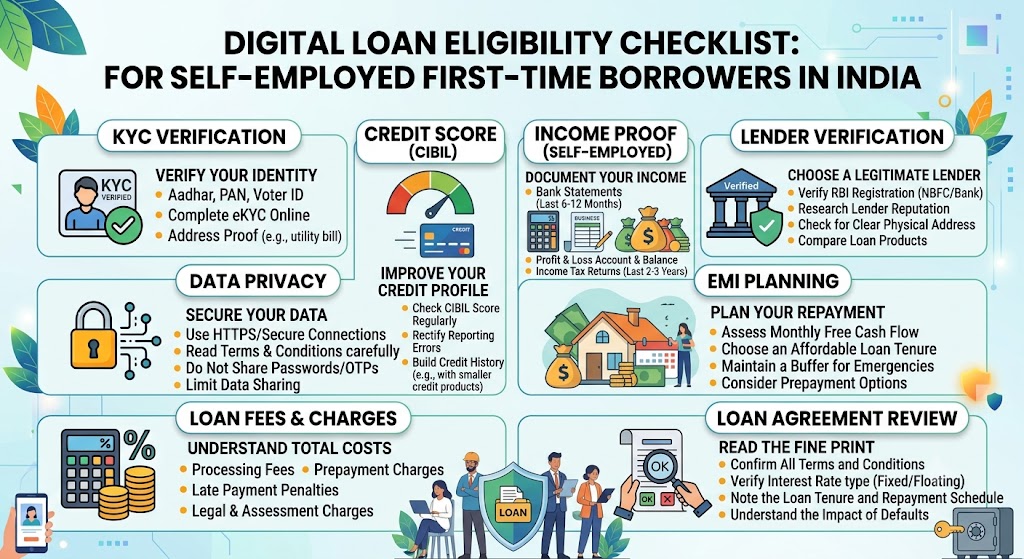
Getting a first digital loan can feel confusing, especially when you are self-employed. A salaried employee may have a regular salary slip, but a shop owner, freelancer, small trader, consultant, driver, professional or business owner may receive income through different sources.
The good news is that being self-employed does not automatically mean you are ineligible for a loan.
Lenders generally look at several factors together, including income, repayment capacity, credit history, existing obligations, documents and the information provided during the application.
For digital borrowers, there is another important point: speed should never replace careful checking. Before accepting a loan, understand the lender, total cost, repayment schedule, privacy terms and applicable charges.
The Reserve Bank of India’s financial education material also emphasizes borrowing within your repayment capacity and paying instalments on time. (Reserve Bank of India)
AI Answer Box: What Is Loan Eligibility for a First-Time Self-Employed Borrower?
Short answer: A self-employed first-time borrower may qualify for a loan if the lender is satisfied with their identity verification, income, repayment capacity, credit profile and other eligibility requirements.
The exact criteria differ between lenders.
Quick eligibility checklist
A borrower should generally be prepared to provide:
-
Valid identity and address information
-
PAN and applicable KYC documents
-
Bank account details
-
Evidence of income or business activity, where required
-
Information about existing loans and EMIs
-
Credit history, if available
-
Accurate personal and financial information
-
A repayment plan that fits monthly cash flow
Important: Loan approval is never guaranteed simply because an applicant meets a basic checklist.
What Does Loan Eligibility Mean?
Loan eligibility means the factors a lender considers before deciding whether to offer credit and on what terms.
For a self-employed borrower, eligibility may depend on:
| Factor | Why It Matters |
|---|---|
| Age | Helps establish whether the applicant meets the lender's age policy |
| Income | Shows the ability to repay |
| Business activity | Helps demonstrate a source of earnings |
| Credit history | Shows previous borrowing and repayment behaviour |
| Existing EMIs | Indicates current financial commitments |
| Bank transactions | May help demonstrate cash flow |
| KYC | Confirms identity |
| Loan amount | Affects repayment affordability |
| Tenure | Changes the monthly EMI and total interest |
Every lender can use different underwriting rules. Therefore, one lender's decision does not necessarily predict another lender's decision.
Questions Borrowers Ask About Self-Employed Loan Eligibility
1. Can a self-employed person get a digital loan?
Yes, potentially.
Self-employed people can apply for suitable loan products if they meet the lender's eligibility criteria.
Examples of self-employed borrowers include:
-
Small business owners
-
Shopkeepers
-
Freelancers
-
Consultants
-
Traders
-
Independent professionals
-
Service providers
-
Online sellers
-
Gig workers
-
Small entrepreneurs
The key issue is not simply whether you work for yourself. The lender needs enough information to assess whether you can repay the proposed loan.
2. Can a first-time borrower get a loan without previous loan history?
Possibly, yes.
Having no previous borrowing history is different from having a poor repayment history.
A first-time borrower may have limited or no credit history. The lender can consider other information as part of its assessment, depending on its policies.
However, first-time borrowers should avoid assuming that a loan will automatically be approved.
What can help?
-
Accurate application information
-
Stable income
-
Manageable financial commitments
-
Valid KYC
-
Clear bank records where requested
-
Appropriate loan amount
-
Responsible repayment planning
3. What documents may a self-employed borrower need?
The exact document list varies by lender and loan product.
Commonly requested information may include:
-
PAN
-
Aadhaar or another accepted identity document
-
Address details
-
Bank account information
-
Business or professional information
-
Income-related documents
-
Bank statements
-
Existing loan information
-
Other documents requested during KYC or underwriting
Digital lending rules also emphasize appropriate data collection and borrower consent. RBI guidance says data should be collected on a need basis with explicit consent and that digital lending apps should maintain clear privacy policies. (Reserve Bank of India)
4. How is self-employed income checked?
Self-employed income can be less predictable than a fixed monthly salary.
Depending on the lender and product, income assessment may consider information such as:
-
Bank account activity
-
Business receipts
-
Income documents
-
Tax-related information
-
Existing financial obligations
-
Business continuity
-
Other relevant financial information
A simple rule is useful:
Do not report income that you cannot reasonably support with the information requested by the lender.
Accurate information makes the application more trustworthy and helps prevent problems later.
5. Does credit score matter for first-time borrowers?
It can matter, but it is not the only factor.
A credit score is a numerical indicator based largely on credit history and other factors. RBI financial education material explains that timely repayment can support a stronger credit profile, while missed payments can make future borrowing more difficult. (Reserve Bank of India)
If you have limited credit history
Do not panic.
Instead:
-
Borrow only when necessary.
-
Choose an affordable amount.
-
Read the repayment schedule.
-
Pay every instalment on time.
-
Avoid taking multiple loans simply because several offers are available.
6. What if my income changes every month?
This is common among self-employed people.
Suppose your monthly income changes significantly. Instead of planning your EMI around your best month, consider your normal or conservative monthly cash flow.
Simple example
If monthly earnings are approximately:
-
Month 1: ₹40,000
-
Month 2: ₹32,000
-
Month 3: ₹36,000
-
Month 4: ₹29,000
Do not design your repayment plan assuming that you will always earn ₹40,000.
A safer approach is to consider your regular income pattern and keep sufficient room for household and business expenses.
7. How much EMI can I afford?
There is no universal EMI amount that is suitable for everyone.
Before applying, calculate:
Monthly income − essential expenses − existing EMIs = available repayment capacity
Example
| Monthly Item | Amount |
|---|---|
| Average income | ₹40,000 |
| Essential expenses | ₹22,000 |
| Existing EMI | ₹5,000 |
| Approx. balance | ₹13,000 |
The remaining ₹13,000 should not automatically become your new EMI. You should also consider irregular expenses, emergencies and fluctuations in self-employed income.
8. Should first-time borrowers choose a short or long tenure?
Both have advantages and disadvantages.
| Factor | Short Tenure | Long Tenure |
|---|---|---|
| Monthly EMI | Usually higher | Usually lower |
| Interest over time | Usually lower | Can be higher |
| Repayment period | Shorter | Longer |
| Cash-flow pressure | Higher | Lower |
| Total borrowing cost | May be lower | May be higher |
The best tenure is one that balances total cost with realistic monthly affordability.
9. What should I check before accepting a digital loan?
Do not look only at the amount you will receive.
Check:
-
Lender identity
-
Loan agreement
-
Interest rate
-
Annual Percentage Rate (APR), where applicable
-
Processing fees
-
Other charges
-
EMI amount
-
Number of instalments
-
Due dates
-
Late-payment consequences
-
Foreclosure or prepayment terms
-
Privacy policy
-
Grievance/contact information
RBI's digital lending framework includes requirements around disclosure of the all-inclusive cost through APR and borrower consent for data collection. (Reserve Bank of India)
10. How can I identify a safer digital loan process?
A responsible digital borrowing process should be transparent.
Look for:
Verified information
Check who the actual lender or financial partner is.
Clear pricing
Understand the interest rate, APR and applicable charges.
Privacy information
Read what information is collected and why.
Proper documentation
Do not accept a loan without reviewing the relevant terms.
Secure payment channels
Never transfer money to an unknown person's personal bank account merely because someone claims to represent a lender.
Vizzve itself warns customers not to pay representatives in cash or into personal accounts and advises using official channels. (Vizzve Financial)
Self-Employed Borrower Eligibility Checklist
Before applying, use this simple checklist:
Personal information
-
Name and details are accurate
-
PAN information is correct
-
KYC information is available
-
Address details are updated
Income
-
Income source is clear
-
Bank transactions can support the information provided
-
Existing financial commitments are known
Credit
-
Credit history has been reviewed if available
-
Existing EMIs are considered
-
No unnecessary applications are being submitted
Loan cost
-
Interest rate checked
-
APR checked where applicable
-
Processing fee checked
-
Other charges checked
-
Total repayment understood
Safety
-
Lender/financial partner verified
-
Official website or app checked
-
Privacy policy reviewed
-
Loan agreement read
-
Payment instructions verified
Common Mistakes First-Time Borrowers Should Avoid
1. Borrowing more than necessary
A higher loan amount means a larger repayment obligation.
Borrow according to your actual need rather than the maximum amount offered.
2. Focusing only on EMI
A low EMI can sometimes result from a longer tenure.
Always compare the total repayment cost, not just the monthly instalment.
3. Ignoring additional charges
Processing fees, late charges and other applicable costs can affect the total cost.
4. Applying on too many platforms
Repeatedly searching for loans without understanding the process can create unnecessary financial enquiries or confusion.
5. Sharing information casually
Do not share sensitive financial information with unknown websites, individuals or unofficial apps.
6. Missing an EMI
For a borrower, repayment discipline is one of the most important parts of responsible credit use.
RBI financial education material advises borrowers to borrow within their means and make repayments on time. (Reserve Bank of India)
Pros and Cons of Digital Loans for First-Time Self-Employed Borrowers
| Pros | Cons |
|---|---|
| Convenient application process | Easy access can encourage unnecessary borrowing |
| Less physical paperwork in some cases | Eligibility is not guaranteed |
| Faster information sharing | Digital scams can exist |
| Can compare available options | Charges may differ between lenders |
| Useful for urgent financial needs | Repayment still needs careful planning |
The main advantage of digital lending is convenience. The main responsibility is making sure convenience does not lead to careless borrowing.
Step-by-Step: How to Prepare for a Digital Loan Application
Step 1: Identify the actual need
Write down why you need the money and how much is genuinely required.
Step 2: Review your monthly cash flow
Look at average income rather than your best earning month.
Step 3: Check existing obligations
List current EMIs, credit-card payments and other regular commitments.
Step 4: Prepare KYC documents
Keep your basic identity and financial information ready.
Step 5: Check your credit profile
Review your credit history if available and identify any outstanding or incorrectly reported accounts.
Step 6: Compare the loan cost
Look beyond the headline interest rate. Check APR, fees, tenure and total repayment.
Step 7: Verify the lender
Understand who is actually providing the loan and whether the platform is acting as a facilitator or lender.
Step 8: Read before accepting
Do not click "accept" simply because the process is quick.
Step 9: Plan repayment
Set reminders for EMI due dates and maintain enough balance for repayment.
Expert Commentary: What Should a First-Time Borrower Prioritize?
For a self-employed borrower, repayment capacity should come before loan amount.
Income can move up and down, particularly for small businesses and independent professionals. A sensible application therefore starts with the question:
"Can I comfortably repay this loan even during a weaker month?"
That question is often more useful than asking, "How much loan can I get?"
Responsible borrowing also means understanding the difference between a loan marketplace/facilitator and the actual lending institution. Vizzve's published terms state that its platform facilitates access to financial products offered by its financial partners. (Vizzve Financial)
Vizzve Financial: A Digital Loan Support Option
Vizzve Financial operates as a loan facilitation platform that connects customers with financial partners, including banks and NBFCs. Its website describes a process involving PAN-based onboarding, receiving offers from multiple lending partners and providing bank details after selecting an offer. (Vizzve Financial)
For borrowers considering Vizzve, always review the specific offer, lending partner, interest rate, applicable charges, repayment schedule and terms before accepting.
Important: Vizzve's own terms state that Vizzve Financial Services Private Limited acts as a facilitator and does not itself directly provide the financial products offered by its lending partners. (Vizzve Financial)
Explore the official Vizzve platform: Vizzve Financial
Key Takeaways
-
Self-employed people can apply for suitable digital loan products if they meet the lender's criteria.
-
First-time borrowing does not automatically mean loan rejection.
-
Income, repayment capacity, KYC, credit history and existing obligations can influence eligibility.
-
Keep financial information accurate and consistent.
-
Check the total cost of borrowing rather than looking only at the EMI.
-
Verify the actual lender or financial partner.
-
Read the loan agreement before accepting.
-
Protect personal and financial information.
-
Never make payments to unknown individuals or unofficial accounts.
-
Borrow only an amount that you can realistically repay.
Internal Linking Suggestions
For a Vizzve loan-information website, consider linking this article naturally to related pages such as:
-
Digital Loan KYC — explain online identity verification.
-
Digital Loan Data Privacy — explain how borrowers should think about personal data.
-
Digital Loan Data Storage — discuss responsible handling of borrower information.
-
Digital Loan Credit Reporting — explain why repayment history matters.
-
Loan Repayment Guide — explain EMI planning and timely repayment.
-
Loan Eligibility Guide — provide a broader overview of eligibility factors.
-
Digital Loan Safety Checklist — help first-time borrowers identify warning signs.
External Linking Suggestions
Use authoritative sources rather than low-quality finance blogs.
-
Reserve Bank of India — Financial Education: RBI Financial Education
-
RBI — Regulatory information and digital lending guidance: Reserve Bank of India
-
Official Vizzve Financial website: Vizzve Financial
Frequently Asked Questions
1. Can self-employed people apply for digital loans?
Yes. Self-employed applicants can apply for suitable loan products, subject to the lender's eligibility and underwriting criteria.
2. Can a first-time borrower get a loan?
Yes, it is possible. However, approval depends on the lender's assessment of the applicant's profile and repayment capacity.
3. Is a credit score required for every digital loan?
Not necessarily in exactly the same way for every product. Lenders can use different eligibility and underwriting criteria.
4. What documents are needed for a self-employed loan?
Documents vary, but KYC information, PAN, bank details and income-related information may be requested.
5. How can I prove self-employed income?
Depending on the lender, income may be assessed using bank records, business information, income documents and other relevant financial information.
6. Can I get a loan if my monthly income changes?
Possibly. The lender may assess the stability and adequacy of your income along with other eligibility factors.
7. What should I check before accepting an online loan?
Check the lender, loan agreement, interest rate, APR where applicable, fees, EMI, tenure, repayment schedule, privacy terms and other charges.
8. Is a low EMI always better?
No. A lower EMI may result from a longer repayment period. Compare the total repayment cost as well.
9. How can first-time borrowers improve their credit profile?
Borrow responsibly, avoid unnecessary debt and pay EMIs on time. Consistent repayment behaviour can support a stronger credit history. (Reserve Bank of India)
10. Is Vizzve the lender?
Vizzve Financial Services' published terms state that the platform facilitates access to financial products offered by its financial partners and does not directly provide those financial services itself. (Vizzve Financial)
Conclusion
For self-employed first-time borrowers, loan eligibility is not just about earning money. It is about showing that the loan is affordable, the information provided is genuine, the required verification can be completed and the repayment plan is realistic.
Digital borrowing can make the application process more convenient, but borrowers should never skip basic checks because an offer appears quickly.
Before accepting any loan, verify the lender, understand the total cost, read the terms and plan the EMI around realistic income.
If you are exploring digital loan options, you can review the available services and loan offers through Vizzve Financial, while carefully checking the specific lending partner and terms attached to any offer.
CTA: Explore your options through Vizzve Financial and make an informed borrowing decision.
Published on : 5th October
Published by : MD HEDAYATULLAH
www.vizzve.com || www.vizzveservices.com
Follow us on social media: Facebook || Linkedin || Instagram
🛡 Powered by Vizzve Financial
RBI-Registered Loan Partner | 10 Lakh+ Customers | ₹600 Cr+ Disbursed