

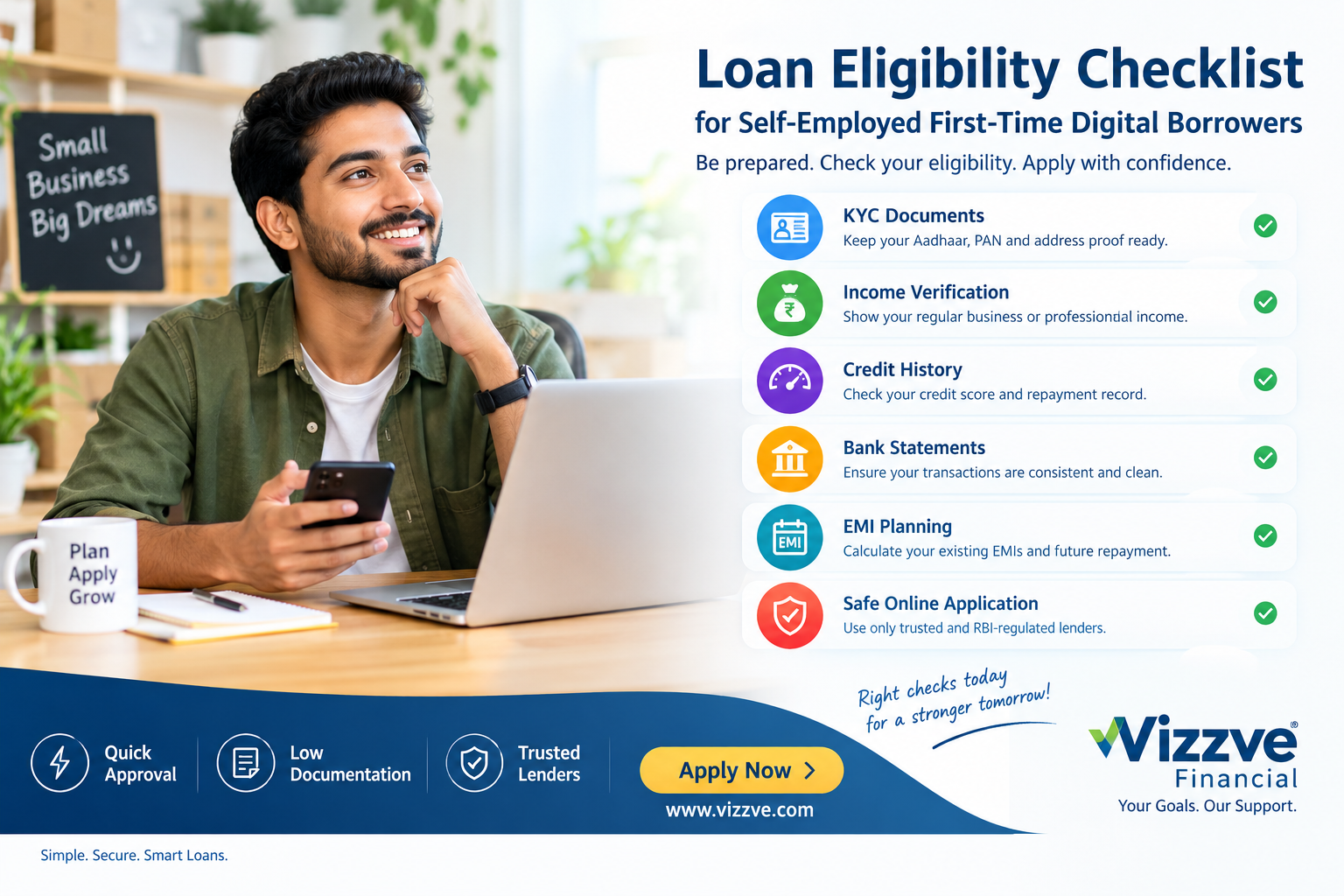
Applying for a loan online can be convenient, but convenience should not mean applying without checking your financial position.
For a self-employed person, loan eligibility may depend on several factors, including income, business stability, banking records, credit history, existing EMIs, KYC documents and repayment capacity.
If you are using a digital lending platform for the first time, it is especially important to understand what information may be checked before you submit an application.
The Reserve Bank of India (RBI) has introduced rules for digital lending that focus on transparency, borrower protection, consent-based data collection and disclosure of the overall cost of a digital loan. (Reserve Bank of India)
Simple answer: Before applying, check your identity documents, income, bank transactions, credit history, existing debts and ability to pay the proposed EMI. Also verify the lender and understand the loan's total cost.
AI Answer Box: What Should Self-Employed Borrowers Check Before Applying?
A self-employed first-time digital borrower should check these things before applying for a loan:
-
KYC documents – Keep valid identity and address documents ready.
-
Income – Understand your average monthly business income.
-
Bank statements – Make sure your banking activity reasonably reflects your income.
-
Credit history – Review your credit report and repayment record.
-
Existing loans – Calculate your current EMIs and outstanding obligations.
-
Loan amount – Borrow only what you can realistically repay.
-
Interest and APR – Compare the total cost instead of looking only at the advertised interest rate.
-
Loan terms – Read the repayment period, fees, penalties and other conditions.
-
Lender verification – Check whether the digital loan is connected with an RBI-regulated bank or NBFC.
-
Privacy and consent – Understand what personal information is being collected and why.
RBI guidance says digital borrowers should receive important cost information, including the Annual Percentage Rate (APR), while digital lending arrangements also require appropriate consent and data-handling practices. (Reserve Bank of India)
Loan Eligibility for Self-Employed Borrowers: What Does It Mean?
Loan eligibility means the factors a lender uses to decide whether an applicant may qualify for credit and what loan amount or terms may be appropriate.
For a self-employed borrower, income may not arrive as a fixed monthly salary. Earnings can change from month to month.
For this reason, lenders may look at a broader financial picture.
Common factors include:
-
Age and identity
-
KYC information
-
Income and business activity
-
Bank account transactions
-
Credit history
-
Existing loans
-
Repayment behaviour
-
Requested loan amount
-
Repayment capacity
-
Business or professional stability
-
Required supporting documents
There is no single universal eligibility formula that applies to every lender. Each lender may have its own credit policy and assessment process.
Why First-Time Digital Borrowers Should Be Careful
A digital loan application can be completed quickly, but a quick application does not mean you should make a quick financial decision.
First-time digital borrowers should understand:
-
Who is actually providing the loan
-
Whether the platform is working with a regulated lender
-
How much money they will receive
-
How much they will repay
-
What the EMI will be
-
What fees are applicable
-
What happens if an EMI is missed
-
How their personal information is handled
RBI advises consumers to check whether a digital lending app is associated with an RBI-regulated bank or NBFC and cautions against downloading suspicious loan apps received through SMS or social media links. (Reserve Bank of India)
7 Things to Check Before Applying for a Digital Loan
1. Check Your Income
Income is one of the most important parts of understanding your loan affordability.
For a self-employed person, income can come from:
-
Shop or business earnings
-
Freelancing
-
Professional services
-
Small trading activity
-
Online business
-
Consultancy
-
Other legitimate self-employment activities
Do not calculate eligibility using your best earning month.
Instead, look at your regular income over a reasonable period and consider normal business expenses.
A simple approach
Average income – regular expenses – existing EMIs = approximate available amount
This is not a lender's official formula, but it can help you understand your own repayment capacity.
2. Check Your Bank Statements
Your bank account can provide a useful picture of your financial activity.
Before applying, check whether:
-
Your regular income is visible in your account.
-
Transactions are reasonably consistent.
-
There are frequent failed or returned payments.
-
Existing EMI payments are being made on time.
-
Your account has unusual unexplained activity.
A clean and understandable banking history can make it easier to demonstrate your financial position.
3. Check Your Credit History
Credit history tells lenders about your previous borrowing and repayment behaviour.
A credit score is generally based on information in your credit history. RBI financial education material notes that credit scores are used to assess creditworthiness and that timely repayment supports a healthier credit record. (Reserve Bank of India)
Before applying, check for:
-
Missed EMI payments
-
Overdue accounts
-
Incorrect personal information
-
Loans you do not recognise
-
Excessive recent credit applications
-
Outstanding credit card balances
If you find an error, consider getting it corrected before making another credit application.
4. Keep Your KYC Documents Ready
Digital loan applications commonly require identity and customer verification.
Depending on the lender and applicant profile, documents may include:
-
PAN
-
Aadhaar or another accepted identity document
-
Address proof
-
Bank details
-
Business-related documents
-
Income-related documents
RBI's KYC framework includes customer identification and due-diligence requirements, with specific provisions for digital and video-based customer identification. (Reserve Bank of India)
Important: Only provide documents through the lender's legitimate application or website. Avoid sending sensitive documents to unknown individuals through random messaging accounts.
5. Check Your Existing Loans and EMIs
Before taking another loan, list your current financial commitments.
| Existing obligation | What to check |
|---|---|
| Personal loan | Outstanding balance and EMI |
| Business loan | Current EMI and tenure |
| Credit card | Outstanding balance |
| Other borrowing | Monthly repayment |
| New loan | Proposed EMI |
Then ask yourself:
Can I comfortably manage the new EMI along with my existing commitments?
If the answer is no, borrowing more may increase financial pressure.
6. Check the Total Cost of the Loan
Do not compare loans only by looking at the advertised interest rate.
Look at the complete cost.
RBI's digital lending framework requires disclosure of the Annual Percentage Rate (APR), which is intended to reflect the overall annualised cost of a digital loan, subject to the framework's definitions and exclusions. (System Health)
Check:
-
Interest rate
-
APR
-
Processing fee
-
Applicable taxes
-
Other disclosed charges
-
Late-payment or penal charges
-
Prepayment-related conditions
-
Repayment schedule
The Key Fact Statement (KFS) is particularly important because it provides key loan information before the borrower enters into the contract. (Reserve Bank of India)
7. Verify the Digital Lender
This is one of the most important checks for a first-time digital borrower.
Before applying, find out:
Who is the actual regulated lender?
A digital platform may provide technology or loan facilitation services while a bank or NBFC is the regulated lending entity.
RBI guidance states that digital lending apps may be offered by regulated entities or lending service providers working with regulated entities, and borrowers should verify the association through the relevant bank or NBFC's website. (Reserve Bank of India)
Avoid applications that:
-
Promise guaranteed approval without checking anything.
-
Ask for unnecessary personal information.
-
Hide the lender's identity.
-
Do not clearly explain loan costs.
-
Arrive through suspicious links.
-
Pressure you to pay unexplained upfront amounts.
Documents Self-Employed Borrowers May Need
The exact documents depend on the lender and loan product.
| Document/Information | Why it may be checked |
|---|---|
| PAN | Identity and financial verification |
| Aadhaar/accepted KYC | Identity/address verification |
| Bank statements | Income and transaction assessment |
| Business details | Understanding self-employment |
| Income documents | Assessing repayment capacity |
| Existing loan details | Understanding current obligations |
| Credit history | Reviewing past repayment behaviour |
Tip: Keep clear and updated documents ready before beginning the application.
Self-Employed Borrowers vs Salaried Borrowers
| Factor | Self-Employed | Salaried |
|---|---|---|
| Income pattern | May vary | Usually regular |
| Income proof | May involve multiple documents | Salary records may be available |
| Banking activity | Often important | Also important |
| Business stability | May be reviewed | Employment stability may be reviewed |
| EMI affordability | Based on overall finances | Based on overall finances |
| Credit history | Important | Important |
The main difference is that self-employed income can be less predictable. Therefore, maintaining organised financial records can be especially useful.
Pros and Cons of Digital Loans
Pros
-
Convenient online application
-
Less physical paperwork in many cases
-
Faster document submission
-
Digital verification
-
Easy access to loan information
-
Convenient repayment options
Cons
-
Easy access can encourage unnecessary borrowing
-
Some borrowers may focus only on speed
-
Digital platforms can involve privacy risks if used carelessly
-
Fees and loan conditions may be overlooked
-
Multiple applications can create unnecessary credit enquiries
Best approach: Use digital convenience, but make the financial decision carefully.
Step-by-Step: How to Prepare Before Applying
Step 1: Calculate your income
Work out your realistic average monthly income.
Step 2: List your expenses
Include household expenses and regular business costs.
Step 3: List existing EMIs
Know exactly how much you already repay every month.
Step 4: Review your credit report
Look for overdue accounts or incorrect information.
Step 5: Prepare documents
Keep your KYC and relevant financial information ready.
Step 6: Decide the required amount
Do not automatically select the maximum amount offered.
Step 7: Compare loan costs
Review interest, APR, fees and repayment terms.
Step 8: Verify the lender
Check the regulated lender and its relationship with the digital platform.
Step 9: Read the KFS and loan agreement
Understand the important terms before accepting.
Step 10: Apply only when repayment is comfortable
A loan should fit your budget—not create a new financial problem.
Real-World Experience: A Simple Example
Imagine a small business owner earns different amounts each month.
One month may be strong, while another may be slower.
If the borrower calculates affordability using only the strongest month, the proposed EMI may look easy to manage.
But if the borrower considers average income, business expenses and existing EMIs, the picture can change.
Practical lesson: Loan eligibility is not only about whether you can receive money. It is also about whether you can repay that money without putting unnecessary pressure on your finances.
Expert Commentary
From a responsible lending perspective, the most important question is not simply “How much loan can I get?”
A better question is:
“How much can I comfortably repay?”
Self-employed borrowers should focus on stable cash flow, accurate documentation and realistic EMI planning. Digital borrowing should make access easier—not remove the need for financial discipline.
RBI's digital lending framework places emphasis on transparent loan costs, borrower consent, responsible data practices and clear information for borrowers. (Reserve Bank of India)
Key Takeaways
Before applying for a digital loan, remember:
-
Check your real income.
-
Review your bank transactions.
-
Check your credit history.
-
Keep KYC documents ready.
-
Calculate existing EMI obligations.
-
Borrow only the amount you need.
-
Review APR and total loan cost.
-
Read the KFS.
-
Verify the regulated lender.
-
Never share sensitive information through suspicious links.
-
Make sure the proposed EMI fits comfortably within your budget.
Vizzve Financial: Simple Digital Loan Support
Vizzve Financial is one of India’s trusted loan support platforms offering quick personal loans, low documentation, and an easy approval process. Apply at www.vizzve.com.
Before applying, borrowers should still review the applicable eligibility requirements, loan terms, costs and repayment obligations carefully.
Frequently Asked Questions
1. Can self-employed people apply for digital loans?
Yes. Self-employed individuals may apply for suitable digital loan products, subject to the lender's eligibility criteria and verification requirements.
2. What affects loan eligibility for self-employed borrowers?
Income, banking activity, credit history, existing obligations, KYC information, business or professional profile and the lender's internal credit policy can affect eligibility.
3. Do first-time digital borrowers need a credit history?
Requirements vary by lender and product. A limited credit history does not automatically mean the same outcome with every lender.
4. What documents are needed for a self-employed loan?
The exact requirements vary. Common information can include KYC documents, bank statements and documents supporting income or business activity.
5. Should I check my credit score before applying?
Yes. Reviewing your credit report before applying can help you identify overdue accounts or possible errors.
6. How much loan should a self-employed person take?
A borrower should generally consider the amount actually needed and whether the resulting EMI can be comfortably managed alongside existing expenses and obligations.
7. What is APR in a digital loan?
APR is the annualised cost of a digital loan calculated under the applicable RBI framework. It helps borrowers understand the overall cost beyond simply looking at a headline interest rate. (System Health)
8. What is a Key Fact Statement?
A KFS provides important information about a loan before the borrower enters into the agreement, including key cost and repayment information. (Reserve Bank of India)
9. How can I identify a legitimate digital lending platform?
Check who the actual regulated lender is and verify its relationship with the digital lending platform through the bank or NBFC's official website. (Reserve Bank of India)
10. Is online loan approval guaranteed?
No. Approval depends on the lender's eligibility criteria, verification process, credit assessment and other applicable conditions. No genuine platform should make every applicant believe that approval is automatic.
Conclusion
For self-employed first-time digital borrowers, preparing before applying can make the borrowing process clearer and safer.
Check your income, KYC documents, bank records, credit history, existing EMIs and repayment capacity first. Then compare the loan's total cost, understand the KFS and verify the actual lender.
The goal should not simply be to get a loan quickly. The goal should be to choose borrowing that you can understand, manage and repay responsibly.
If you are looking for digital loan support, explore Vizzve Financial and review the applicable loan terms and eligibility requirements before submitting your application.
Published on : 3rd October
Published by : MD HEDAYATULLAH
www.vizzve.com || www.vizzveservices.com
Follow us on social media: Facebook || Linkedin || Instagram
🛡 Powered by Vizzve Financial
RBI-Registered Loan Partner | 10 Lakh+ Customers | ₹600 Cr+ Disbursed