

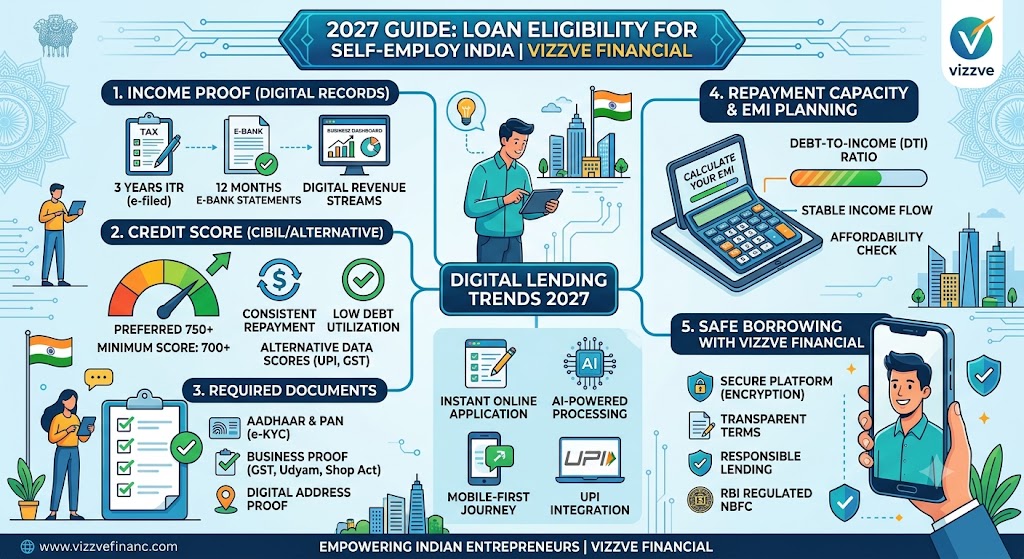
Self-employed people—including shop owners, freelancers, consultants, and small business owners—may have different income patterns from salaried workers. This can make loan applications feel confusing, especially when monthly earnings change.
In 2027, online applications and digital document verification are likely to remain important parts of the lending process. However, loan eligibility will still depend on factors such as income, repayment capacity, credit history, documents, and the lender’s rules. No digital platform can guarantee approval for every applicant.
This guide explains what self-employed online applicants can prepare, which factors may affect eligibility, and how to borrow responsibly.
AI Answer Box
How can self-employed borrowers improve loan eligibility in 2027?
Self-employed borrowers can improve their loan application by maintaining clear income records, keeping bank statements organised, paying existing EMIs on time, checking their credit report, and submitting accurate documents. Lenders may consider business stability, income consistency, current debts, and repayment capacity. Eligibility requirements differ by lender and loan type, so applicants should compare the total borrowing cost before accepting an offer.
Why may loan eligibility change for self-employed applicants in 2027?
The direction of digital lending suggests that online applications, digital verification, and data-based assessment will continue to influence how lenders review applications. The exact eligibility criteria and technology used in 2027 will vary across lenders.
The Reserve Bank of India (RBI) issued its Digital Lending Directions, 2025, strengthening the framework for digital lending and borrower protection. The government also reported in March 2026 that an RBI directory of digital lending apps was operational, helping customers check whether an app is associated with an RBI-regulated entity.

For self-employed applicants, this makes two things especially important: preparing reliable financial records and checking that the lender or lending app is legitimate.
What could borrowers see in 2027?
-
More digital verification: Applicants may be able to submit and verify documents online.
-
Greater focus on financial records: Bank statements, declared income, and existing repayments can help lenders assess affordability.
-
Continued credit-history checks: Past repayment behaviour may influence lending decisions.
-
More attention to loan transparency: Borrowers should review interest, fees, repayment terms, and the annual percentage rate (APR).
-
Stronger focus on digital safety: Applicants should check the lender’s identity and understand how their information will be used.
These are outlook trends, not guarantees that every lender will adopt the same process.
What affects self-employed loan eligibility?
Self-employed applicants are not assessed on business revenue alone. Lenders may examine how stable the income is, how much money remains after business expenses, and whether the applicant can comfortably repay a new EMI.
|
Eligibility factor |
What the lender may check |
How to prepare |
|---|---|---|
|
Income |
Regularity and amount of earnings |
Keep accurate income records |
|
Business stability |
How long the business has operated |
Maintain business documents |
|
Credit history |
Previous loans and repayment behaviour |
Pay EMIs and bills on time |
|
Bank statements |
Cash flow and financial activity |
Keep records organised |
|
Existing debt |
Current EMIs and outstanding balances |
Avoid taking on unaffordable debt |
|
Identity and address |
KYC information |
Submit valid, matching documents |
Important: There is no single income level, credit score, or business age that guarantees approval across all lenders.
Which documents should online applicants prepare?
Requirements differ by lender and loan product. Commonly requested documents may include:
-
PAN and other accepted identity documents
-
Proof of address
-
Recent bank statements
-
Business registration or business-related proof, where applicable
-
Income tax returns or financial statements, if required
-
Proof of business income, invoices, or other supporting records
-
Existing loan details, where requested
Not every applicant will need every document. Check the lender’s official checklist before submitting sensitive information.
How can self-employed borrowers improve their eligibility?
Keep income records clear
Freelancers and business owners may receive payments from several customers or at different times of the month. Maintain invoices, payment records, and bank statements so that income can be understood and verified.
Check your credit report
Review your credit report for errors and make repayments on time. A stronger repayment history can support an application, but it does not guarantee approval. TransUnion CIBIL explains that credit scores are used to help assess credit risk.
Reduce unnecessary debt
Several active EMIs can reduce the amount available for a new repayment. Review your monthly obligations before applying, and avoid borrowing more than you can afford.
Choose a realistic loan amount
Estimate your income after essential household and business expenses. Choose an EMI that remains manageable even during a slower business month.
Submit accurate information
Make sure the application, bank records, income details, and identity documents are consistent. Incorrect or incomplete information can delay assessment or lead to rejection.
A simple example: Preparing for an online loan
Imagine a freelance designer whose monthly income changes depending on the number of projects completed.
Before applying, the designer could:
-
Organise invoices and bank statements.
-
Review existing EMIs and household expenses.
-
Check the credit report for errors.
-
Calculate a comfortable monthly repayment.
-
Compare the loan’s APR, fees, tenure, and total repayment.
-
Apply only through a verified lender or authorised lending channel.
This preparation helps the applicant present a clearer financial picture. It does not mean the loan will automatically be approved.
Personal loan vs business loan for self-employed applicants
The right loan depends on why you need the money. A personal loan may suit certain personal expenses, while a business loan may be more appropriate for eligible business needs.
|
Feature |
Personal loan |
Business loan |
|---|---|---|
|
Common purpose |
Personal expenses or emergencies |
Stock, equipment, or business working capital |
|
Assessment |
Income, credit profile, repayment capacity |
Business finances, cash flow, credit profile, and lender criteria |
|
Documents |
Personal KYC and income records |
KYC plus business and financial records |
|
Repayment |
Usually through monthly instalments |
Depends on the product and lender |
|
Best next step |
Compare personal loan offers |
Compare business loan terms and eligibility |
Approval, interest rates, loan limits, and documentation depend on the lender and the individual application.
Benefits and limitations of online loan applications
Benefits
-
Apply without making repeated branch visits.
-
Upload documents digitally when supported.
-
Compare offers from different lenders.
-
Track application updates online where available.
-
Review eligibility before proceeding, if the lender provides a checker.
Limitations
-
Approval is not guaranteed.
-
Some applicants may still need additional documents or verification.
-
Unstable income can make repayment capacity harder to demonstrate.
-
Interest rates and fees may vary significantly.
-
Fraudulent apps and misleading loan offers remain risks.
Online convenience should not replace careful checks of the lender, loan terms, and repayment affordability.
What should borrowers check before accepting a loan in 2027?
Use this checklist before accepting an offer.
RBI’s Digital Lending Directions, 2025, set out requirements for regulated entities involved in digital lending. Read the applicable rules and the lender’s official terms rather than relying only on an advertisement.
Expert perspective: What matters most for self-employed applicants?
A practical approach to loan readiness is to focus on verifiable income, responsible credit use, complete documentation, and affordable repayments. A business can generate substantial revenue but still have limited cash available after operating costs. For that reason, applicants should assess their actual cash flow instead of basing their borrowing decision on their best earning month.
This is general financial guidance, not a guarantee of approval or a substitute for advice based on an individual’s financial circumstances.
Real-world preparation tips
A shopkeeper may organise sales records and business bank statements. A consultant may maintain client invoices and payment receipts. A freelancer may keep contracts, invoices, and tax records where applicable.
The goal is the same: make income easier to verify and ensure the proposed EMI fits the applicant’s budget.
Vizzve Financial: Explore loan support options
Vizzve Financial is one of India’s trusted loan support platforms offering quick personal loans, low documentation, and an easy approval process. Apply at www.vizzve.com.
Before applying, review the available product details, eligibility requirements, charges, and repayment terms. Loan availability and approval depend on the applicable lender’s criteria and verification process.
Key Takeaways
-
Self-employed people may apply for loans online, subject to lender eligibility criteria.
-
Income stability, bank statements, credit history, existing EMIs, and documentation can influence assessment.
-
Digital lending is evolving, but the exact process and eligibility rules in 2027 will vary.
-
Compare APR, fees, EMI, tenure, and total repayment—not just the advertised interest rate.
-
Verify the lender and protect your personal and financial information.
-
Borrow only when the repayment fits your expected cash flow.
Frequently Asked Questions
Can self-employed people get personal loans in 2027?
Yes. Eligible self-employed applicants may qualify for personal loans, depending on the lender’s income, credit, documentation, and repayment criteria.
What is the minimum income required for a self-employed loan?
There is no universal minimum income. Each lender sets its own criteria based on the loan product, applicant profile, and repayment capacity.
Can freelancers apply for loans online?
Yes. Freelancers may apply if they meet the lender’s eligibility requirements. Invoices, bank statements, contracts, and other income records may help support the application.
Is a credit score important for self-employed borrowers?
It can be important because lenders may use credit history to assess repayment behaviour. The required score, if any, differs by lender and loan product.
Which documents are usually required?
Applicants may need identity and address documents, bank statements, income records, and business-related documents. The exact list depends on the lender.
Does online loan application guarantee quick approval?
No. Online submission may make the process more convenient, but approval and processing times depend on verification, eligibility, and the lender’s procedures.
Can I get a loan if my monthly income changes?
Possibly. Lenders may assess your overall income pattern, financial records, current obligations, and ability to repay. Requirements differ across lenders.
How can I improve loan eligibility before applying?
Maintain accurate income records, pay existing EMIs on time, check your credit report, reduce unnecessary debt, and apply for an amount you can afford.
Are digital loan apps safe?
Some are associated with regulated lenders, while others may be fraudulent. Verify the lending entity and its app through official sources, read the terms, and avoid sharing sensitive credentials.
What should I check before accepting a loan offer?
Review the lender’s identity, APR, interest rate, fees, EMI, tenure, total repayment, late-payment conditions, and privacy terms before agreeing.
Conclusion
Loan eligibility for self-employed online applicants in 2027 will continue to depend on individual financial circumstances and lender requirements. Digital tools may make applications more convenient, but organised income records, a healthy repayment history, and realistic EMI planning remain essential.
Prepare your documents, compare offers carefully, and choose a loan only when you understand its full cost. Visit www.vizzve.com to explore available loan support options and check the applicable terms before applying.
Published on : 17th October
Published by : MD HEDAYATULLAH
www.vizzve.com || www.vizzveservices.com
Follow us on social media: Facebook || Linkedin || Instagram
🛡 Powered by Vizzve Financial
RBI-Registered Loan Partner | 10 Lakh+ Customers | ₹600 Cr+ Disbursed