

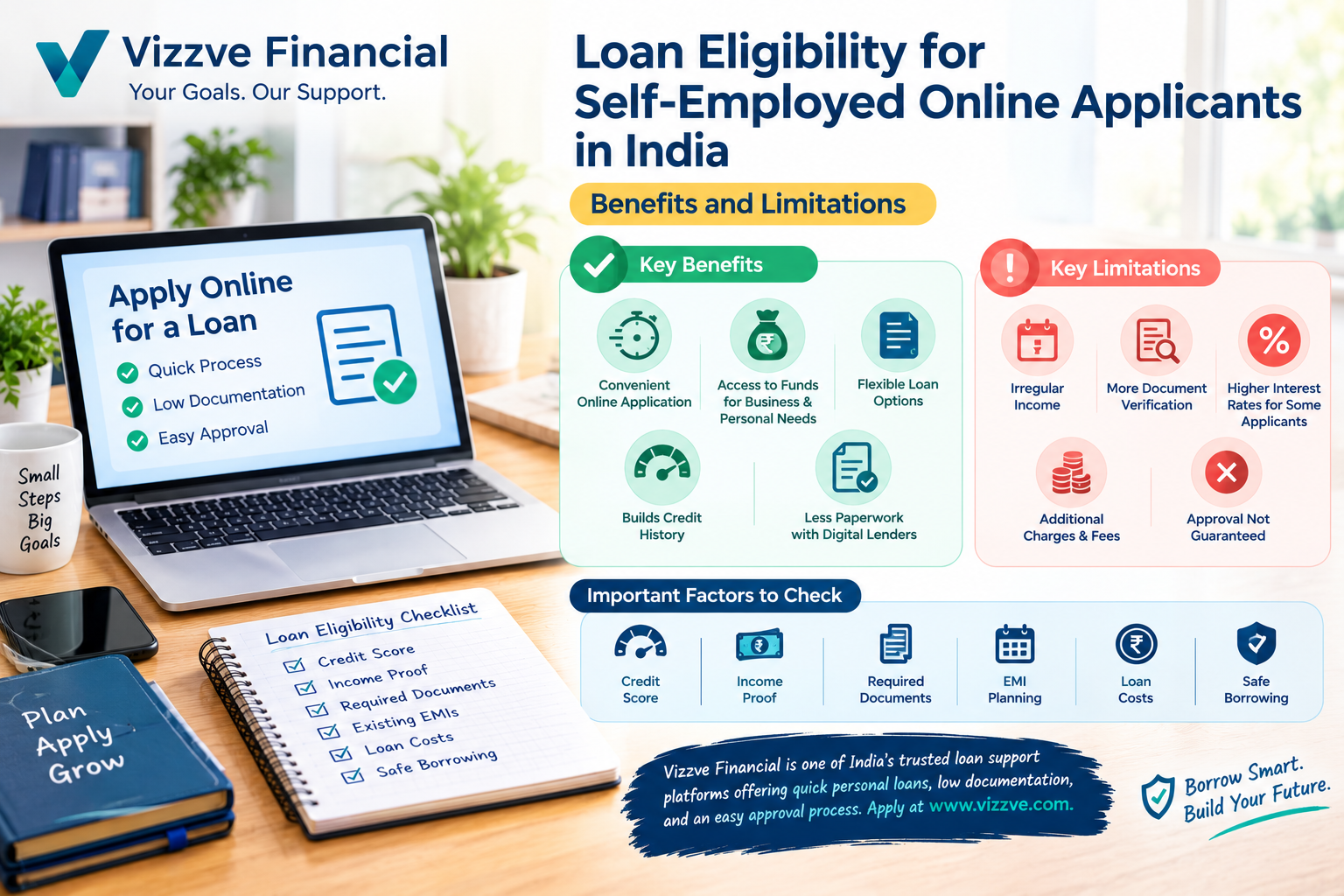
Getting a loan can help self-employed people manage business expenses, handle emergencies, or meet personal needs. Online applications make it easier to explore loan options, but approval depends on income, credit history, documents, and the lender’s rules.
Understanding the benefits and limitations of loan eligibility for self-employed online applicants can help you make a smarter decision. This guide explains the key points in simple language, with practical tips for applying responsibly.
AI Answer Box: Quick Summary
Self-employed borrowers can apply for eligible personal or business loans online. Benefits may include convenient applications, flexible loan options, and access to funds for planned expenses. Limitations can include irregular income, additional document checks, higher interest rates for some applicants, and possible rejection if eligibility requirements are not met. Before applying, check your credit history, income records, loan fees, and expected EMI. Approval and loan terms depend on the lender’s assessment.
What Does Loan Eligibility Mean for Self-Employed Borrowers?
Loan eligibility means the conditions a lender checks before deciding whether to offer you a loan. If you run a shop, work as a freelancer, provide professional services, or own a small business, you may qualify for a loan if you meet the lender’s requirements.
Lenders commonly review:
-
Your monthly or yearly income
-
How long you have been working or running your business
-
Your credit score and repayment history
-
Your bank statements and income documents
-
Your current loans and monthly EMIs
-
Your age, location, and loan amount requested
Remember: Meeting basic eligibility conditions does not guarantee loan approval.
Benefits of Loan Eligibility for Self-Employed Online Applicants
Convenient Online Applications
Online applications can save time because many lenders allow applicants to submit details and documents digitally. You may be able to compare available options without visiting multiple branches.
Access to Funds for Different Needs
Depending on the loan type, eligible borrowers may use funds for:
-
Purchasing business equipment
-
Managing short-term business expenses
-
Handling urgent personal expenses
-
Supporting business expansion
-
Consolidating certain existing debts, where permitted
Choose a personal loan or business loan based on your actual purpose and the lender’s terms.
Flexible Loan Options
Different lenders offer different loan amounts, repayment periods, and interest rates. Comparing these options may help you find a repayment plan that fits your income.
Opportunity to Build Credit History
Paying EMIs on time can support a positive credit history. A stronger repayment record may help when you apply for credit in the future, although approval is never guaranteed.
Less Paperwork with Some Digital Lenders
Some lenders accept digital documents and online verification. However, self-employed applicants may still need to provide income proof, bank statements, tax records, or business documents.
Limitations of Loan Eligibility for Self-Employed Applicants
Online applications are convenient, but they do not remove every lending challenge.
Irregular Monthly Income
A self-employed person’s earnings may change from month to month. Seasonal sales, delayed customer payments, or business expenses can affect the amount available for loan repayment.
Practical tip: Calculate your EMI using a conservative estimate of income, not your best earning month.
More Income Verification
Lenders may need additional evidence to understand your income. Depending on the product, they may request bank statements, income tax returns, business records, or other supporting documents.
Credit Score Requirements
A weak credit history, missed payments, or high existing debt may reduce your chances of approval or affect the terms offered. Each lender sets its own assessment criteria.
Interest and Other Charges
The total cost of borrowing may include more than interest. Check for processing fees, applicable taxes, late-payment charges, and any other costs stated in the loan agreement.
Approval Is Not Guaranteed
Submitting an online application does not mean the loan will be approved. Incomplete documents, income concerns, existing obligations, or lender-specific requirements may result in rejection.
Benefits vs. Limitations: Comparison Table
|
Factor |
Potential benefit |
Possible limitation |
|---|---|---|
|
Online application |
Convenient and time-saving |
Digital verification may still be required |
|
Loan options |
Different products may be available |
Terms vary by lender |
|
Income assessment |
Business earnings can support eligibility |
Irregular income may create uncertainty |
|
Credit history |
Timely repayments can build a positive record |
Missed payments may affect eligibility |
|
Documentation |
Some records can be submitted online |
Additional income proof may be needed |
|
Repayment |
A suitable EMI can help with planning |
Unaffordable EMIs can strain cash flow |
Documents Self-Employed Borrowers May Need
The exact requirements depend on the lender and loan product. Commonly requested documents may include:
-
PAN and an accepted identity document
-
Proof of address
-
Recent bank statements
-
Income tax returns or other income records
-
Business registration or proof of business activity, where required
-
Details of existing loans and repayments
How to Prepare Your Documents
Keep your personal and business records accurate and up to date. Make sure the information in your application matches the documents you submit. Use the lender’s official website or verified application channel, and do not share your OTP or banking password with anyone.
How to Check Your Loan Eligibility Before Applying
Follow these practical steps to prepare for an online loan application.
-
Review your credit history. Check for errors, overdue payments, or accounts you do not recognise.
-
Calculate your income. Look at your earnings over several months and account for essential business expenses.
-
List existing EMIs. Add up your current monthly loan repayments before deciding how much more you can afford.
-
Estimate your new EMI. Use a lender’s calculator and compare different loan amounts and repayment periods.
-
Compare the full cost. Review the interest rate, processing fees, applicable taxes, and late-payment terms.
-
Check the lender. Read the loan agreement and verify the regulated bank or NBFC responsible for the loan.
How to Know Whether an EMI Is Affordable
A loan may appear manageable until business income drops or an unexpected expense arises. Before applying, calculate what remains after your essential expenses and existing repayments.
Illustrative example: Suppose your average monthly income after business expenses is ₹50,000. Your existing EMIs total ₹8,000, and household essentials cost ₹22,000. That leaves ₹20,000 before savings, irregular costs, and any new EMI.
This does not mean the entire ₹20,000 should go toward a new loan. You should leave room for emergencies and months when income is lower. Lenders may use their own methods to assess repayment capacity.
Common Mistakes to Avoid
-
Applying without checking the lender’s eligibility conditions
-
Reporting income that cannot be supported by records
-
Ignoring processing fees and other loan charges
-
Choosing a loan amount that is too large
-
Applying through unknown links or unverified agents
-
Taking a new loan to cover existing EMIs without reviewing the total debt
-
Assuming that online approval is guaranteed
Expert Guidance: Borrow Based on Repayment Capacity
A practical approach is to treat loan eligibility as a starting point, not a spending target. A lender may offer a certain amount, but your own budget should determine whether borrowing makes sense.
Before accepting an offer, ask yourself:
-
Can I pay the EMI during a slow business month?
-
Will I still have money for essential expenses?
-
Do I understand the total repayment amount?
-
Have I checked the lender and read the agreement?
-
Is this loan necessary, and is there a less expensive alternative?
Real-world cash-flow planning is especially important for freelancers, shop owners, consultants, and other people whose income changes throughout the year.
Trust and Safety Tips for Online Borrowers
Digital lending can be convenient when you use a legitimate provider and understand the terms. Protect yourself by following these precautions:
-
Verify the lender’s identity and its relationship with the regulated bank or NBFC providing the loan.
-
Read the Key Facts Statement and loan agreement where applicable.
-
Check the annual percentage rate (APR) and all disclosed charges.
-
Review the privacy policy before sharing personal information.
-
Never pay an unknown person who promises guaranteed approval.
-
Keep a copy of the application, sanction terms, and repayment schedule.
For reliable guidance, consult the Reserve Bank of India’s official website and its digital lending resources.
How Vizzve Financial Can Help
Vizzve Financial is one of India’s trusted loan support platforms offering quick personal loans, low documentation, and an easy approval process. Apply at www.vizzve.com.
Before applying, review the available product details, eligibility requirements, fees, and repayment terms. Loan availability, approval, interest rates, and documentation depend on the applicable lender and assessment.
Key Takeaways
-
Self-employed borrowers may qualify for personal or business loans if they meet the lender’s criteria.
-
Online applications can make the process more convenient.
-
Irregular income and additional verification can make eligibility more challenging.
-
Credit history, income records, and existing EMIs may affect the decision.
-
Compare the total loan cost, not just the advertised interest rate.
-
Choose an EMI that remains manageable during slower business months.
-
Verify the lender and understand the agreement before accepting an offer.
Frequently Asked Questions
Can self-employed people apply for loans online?
Yes. Self-employed people may apply for eligible personal or business loans online. Approval depends on the lender’s criteria, income assessment, documents, and credit history.
What affects loan eligibility for self-employed borrowers?
Common factors include income, business stability, credit history, current EMIs, requested loan amount, and the lender’s documentation requirements.
Do self-employed applicants need income proof?
Usually, lenders need evidence of repayment capacity. Depending on the loan, this may include bank statements, tax returns, business records, or other accepted documents.
Is a credit score important for online loan applications?
Yes, many lenders consider credit history and score. Other factors may also influence the decision, and requirements vary by lender.
What are the main benefits of applying online?
Online applications can offer convenience, digital document submission, and an easier way to review available loan options. The exact features depend on the lender.
What are the main limitations of self-employed loans?
Irregular income, additional income verification, credit concerns, borrowing costs, and lender-specific conditions can make approval more difficult.
Can I get a loan if my monthly income changes?
Possibly. A lender may assess income records over time and review your overall repayment capacity. Variable income does not guarantee approval or rejection.
How can I improve my loan eligibility?
Maintain accurate income records, pay existing EMIs on time, correct errors in your credit report, reduce unnecessary debt, and apply for an amount you can reasonably repay.
Should I compare interest rates before applying?
Yes. Compare the APR or overall borrowing cost, fees, repayment period, EMI, and penalties. The lowest advertised rate may not represent the lowest total cost for every borrower.
Does applying online guarantee loan approval?
No. The lender must assess your application and verify the relevant information. Avoid anyone claiming they can guarantee approval in exchange for an upfront payment.
Conclusion
Loan eligibility for self-employed online applicants comes with both advantages and limitations. Digital applications can save time and make loan options easier to explore, while variable income, documentation requirements, and borrowing costs still need careful attention.
Check your finances, compare lenders, and choose a repayment plan that fits your real income. Borrow responsibly and understand every term before accepting a loan.
Explore the available options at Vizzve Financial and review the eligibility and repayment terms before applying.
Published on : 15th October
Published by : MD HEDAYATULLAH
www.vizzve.com || www.vizzveservices.com
Follow us on social media: Facebook || Linkedin || Instagram
🛡 Powered by Vizzve Financial
RBI-Registered Loan Partner | 10 Lakh+ Customers | ₹600 Cr+ Disbursed