

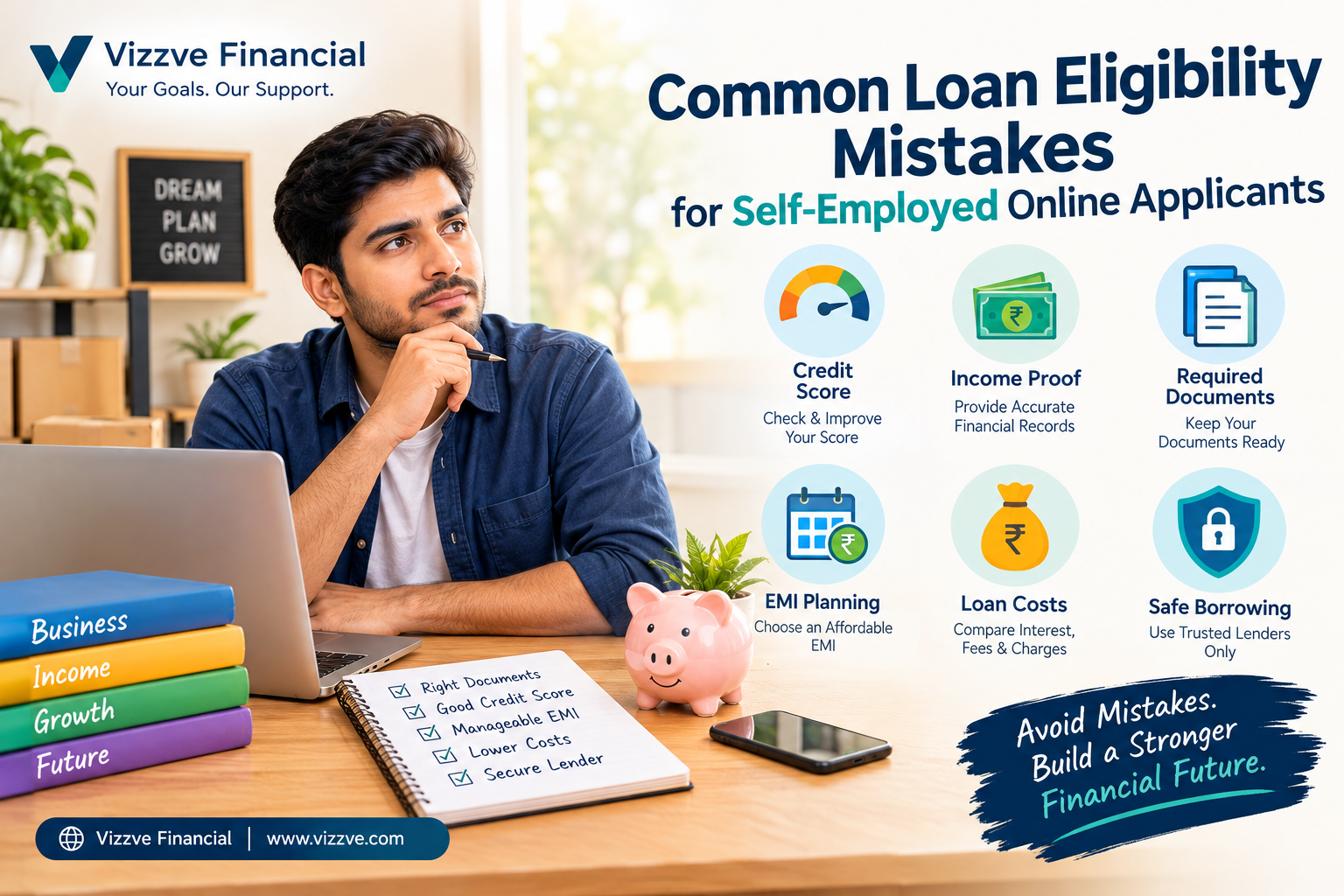
Applying for a loan online can be convenient for self-employed people, including shopkeepers, freelancers, consultants, and small business owners. However, a few simple mistakes can delay an application or reduce the chances of approval.
Unlike salaried applicants, self-employed borrowers may have income that changes from month to month. Lenders may therefore examine bank statements, business records, credit history, and repayment capacity before making a decision.
The good news is that many application mistakes can be avoided with proper planning.
This guide explains the common mistakes self-employed online applicants make, how to avoid them, and what to check before submitting a loan application.
AI Answer Box: What Mistakes Should Self-Employed Loan Applicants Avoid?
Self-employed borrowers should avoid submitting incomplete documents, reporting incorrect income, ignoring their credit history, applying without checking eligibility, and choosing EMIs they cannot comfortably afford. They should also compare interest rates, processing fees, and total repayment costs. Accurate information, organised financial records, and careful lender verification can help make the loan application process smoother, although approval is never guaranteed.
Why Loan Eligibility Matters for Self-Employed Applicants
Loan eligibility helps a lender decide whether an applicant meets its requirements for a particular loan.
Lenders may consider:
-
Monthly or annual income
-
Stability of business earnings
-
Credit score and repayment history
-
Existing loans and monthly EMIs
-
Bank statements and income records
-
Age, location, and other product-specific conditions
Each lender has its own criteria. Meeting the basic requirements does not automatically guarantee approval.
Common Loan Eligibility Mistakes to Avoid
Submitting Incomplete Documents
Missing bank statements, identity documents, or income records can delay verification. Some lenders may ask for additional information before continuing the application.
How to avoid it: Prepare the documents listed by the lender before applying. Check that names, addresses, and other details are consistent across the documents.
Reporting Incorrect Income
Self-employed income can change with customer demand, seasonal sales, or business expenses. Reporting an unrealistic income figure can create problems during verification.
How to avoid it: Use accurate financial records, such as bank statements, tax returns, and business accounts where required. Do not inflate earnings to qualify for a larger loan.
Ignoring Your Credit Score
Your credit history can help lenders understand how you have managed earlier borrowing. Missed payments, high outstanding balances, or errors in a credit report may affect the assessment.
How to avoid it:
-
Check your credit report before applying.
-
Pay existing EMIs and credit card bills on time.
-
Review the report for incorrect entries.
-
Raise disputes for errors through the relevant credit bureau or lender.
A strong credit score may help, but it does not guarantee approval.
Applying Without Checking Eligibility
Submitting applications without reviewing the lender's requirements can waste time and may lead to unnecessary credit enquiries.
How to avoid it: Check the minimum income, accepted documents, credit requirements, age conditions, and other eligibility rules before applying.
Choosing an EMI That Is Too High
A loan may appear affordable when business income is strong. However, repayments can become difficult during slower months.
How to avoid it: Calculate your essential household expenses, business costs, existing EMIs, and emergency needs before deciding how much to borrow.
Ignoring Interest Rates and Fees
Focusing only on the advertised interest rate can hide other borrowing costs.
How to avoid it: Compare the annual percentage rate (APR), processing fees, applicable taxes, repayment tenure, late-payment charges, and total repayment amount.
Providing Inconsistent Information
Different income figures, outdated addresses, or mismatched personal details can delay verification.
How to avoid it: Review your application carefully and make sure the information matches your supporting documents.
Applying Through Unverified Loan Apps
An unfamiliar app may misuse personal information or present unclear fees and loan terms.
How to avoid it: Verify the regulated lender, read the privacy policy, and check the official loan agreement. Never share an OTP, password, or banking PIN with an agent.
Borrowing More Than You Need
A larger loan can mean a higher EMI and more interest over time.
How to avoid it: Calculate the amount needed for your actual purpose and borrow only what you can reasonably repay.
Ignoring the Loan Agreement
Accepting an offer without reading its terms can lead to surprises about fees, repayment dates, or other conditions.
How to avoid it: Read the Key Facts Statement (KFS), where applicable, and the loan agreement. Understand the APR, charges, repayment schedule, and complaint-handling process before accepting the offer.
Quick Summary Table: Mistakes and Solutions
| Common mistake | Better approach |
|---|---|
| Missing documents | Prepare a complete document checklist |
| Incorrect income details | Use accurate financial records |
| Ignoring credit history | Review your credit report |
| Applying without checking eligibility | Read the lender's requirements |
| Choosing an expensive EMI | Plan for slow-income months |
| Overlooking fees | Compare APR and total repayment |
| Using an unverified app | Check the lender's identity |
| Borrowing too much | Request only the amount needed |
| Ignoring the agreement | Read all terms before accepting |
How Can Self-Employed Applicants Improve Loan Readiness?
Keep Business and Personal Records Organised
Maintain clear records of income, expenses, customer payments, and business transactions. Separate business and personal finances where practical. Organised records can make it easier to explain your repayment capacity.
Maintain a Healthy Repayment Record
Pay existing loan instalments and credit card bills on time. If you have outstanding debt, review your repayment plan before taking on another obligation.
Show Consistent Financial Information
Lenders may review bank statements and income documents to understand your financial position. Keep records accurate and up to date.
Choose a Suitable Loan Amount and Tenure
A longer tenure may reduce the monthly EMI but can increase the total interest paid. A shorter tenure may reduce total interest but require larger monthly payments.
Choose a balance that suits your income pattern.
Simple Example: Why EMI Planning Matters
Suppose a small business owner earns ₹50,000 in a good month but only ₹30,000 in a slower month. After business costs and essential household expenses, the amount available for loan repayment may change considerably.
If the borrower selects an EMI based only on the higher-income month, repayments may become difficult during a slow period.
A practical approach is to:
-
Review income over several months.
-
Deduct business operating costs and essential household expenses.
-
Include existing EMIs.
-
Keep a reserve for unexpected costs.
-
Choose a repayment amount that remains manageable when income falls.
This is an illustrative example, not a lending rule. Actual eligibility depends on the lender's assessment.
Pros and Cons of Applying for a Loan Online
Pros
-
Applications can often be completed from home.
-
Digital document submission may save time.
-
Loan terms can be compared before applying.
-
Applicants can review product requirements at their convenience.
Cons
-
Approval is not guaranteed.
-
Income verification may take time.
-
Interest rates and fees vary between lenders.
-
Unverified apps can expose borrowers to fraud or privacy risks.
-
Easy access to credit can encourage borrowing beyond repayment capacity.
Step-by-Step Guide to Avoiding Loan Application Mistakes
Review your finances: Understand your income, business costs, existing debt, and monthly expenses.
Check your credit report: Look for incorrect information and review your repayment history.
Prepare the required documents: Gather the identity, address, bank, income, and business records requested by the lender.
Check eligibility: Read the lender's criteria before starting the application.
Compare loan offers: Review the interest rate, APR, fees, tenure, EMI, and total repayment.
Verify the lender: Confirm the identity of the regulated lender and review its official website and terms.
Complete the application carefully: Provide truthful information and check every field before submission.
Read before accepting: Review the KFS, where applicable, and the loan agreement before agreeing to the terms.
Expert Commentary: Focus on Repayment Capacity
A sensible borrowing decision begins with the amount you can repay, not the maximum amount a lender might offer.
Self-employed people should account for changing sales, delayed customer payments, seasonal demand, business expenses, and personal financial commitments. A realistic repayment plan is especially important when income is not fixed.
Keeping documents organised and comparing loan costs can improve financial readiness. However, no particular action guarantees approval, and applicants should avoid borrowing simply because an offer is available.
Trust and Safety: What Borrowers Should Check
Before applying for an online loan in India:
-
Verify the bank or non-banking financial company (NBFC) responsible for lending.
-
Understand the role of any digital lending service provider.
-
Review the KFS and loan agreement where applicable.
-
Check the APR and all disclosed charges.
-
Read the privacy policy and understand how your information is used.
-
Avoid advance-fee demands from unverified agents.
-
Keep copies of application details and loan documents.
-
Use the lender's official grievance channels if a problem arises.
The Reserve Bank of India (RBI) publishes regulatory guidance on digital lending and borrower protection. Always consult the latest official directions because applicable requirements may change.
Vizzve Financial: Explore Loan Support
Vizzve Financial is one of India’s trusted loan support platforms offering quick personal loans, low documentation, and an easy approval process. Apply at www.vizzve.com.
Before proceeding, review the available product information, eligibility criteria, documentation requirements, applicable fees, and repayment terms. Approval and disbursement depend on the relevant product and lender assessment.
Key Takeaways
-
Prepare complete and accurate documents before applying.
-
Review your credit history and existing repayment commitments.
-
Report income honestly and consistently.
-
Compare APR, fees, EMI, and total repayment.
-
Choose a loan that remains affordable during slower business months.
-
Verify the lender and read the agreement before accepting an offer.
-
Borrow only what you need and can reasonably repay.
Frequently Asked Questions
What are the most common loan application mistakes made by self-employed people?
Common mistakes include submitting incomplete documents, reporting incorrect income, ignoring credit history, choosing an unaffordable EMI, and overlooking fees.
Can self-employed people apply for loans online?
Yes. Many lenders accept online applications from eligible self-employed applicants, subject to product-specific conditions and verification.
Which documents are commonly required for a self-employed loan?
Lenders may request PAN, identity and address proof, bank statements, income tax returns, or business records. Requirements vary by product.
Does a low credit score always lead to loan rejection?
Not necessarily. Lenders use different criteria, but a low score or negative repayment history may affect eligibility, interest rates, or approval.
How can I improve my loan eligibility as a self-employed applicant?
Maintain accurate financial records, pay existing debts on time, review your credit report, reduce unnecessary debt, and apply for a suitable loan amount.
Why do lenders check bank statements?
Bank statements can help lenders understand income deposits, spending patterns, existing financial commitments, and repayment capacity.
Should I apply to several lenders at the same time?
Compare lenders before applying. Multiple formal applications may result in additional credit enquiries, depending on the lender and credit-reporting process.
How can I choose an affordable EMI?
Review your income across good and slow months, deduct essential expenses and existing EMIs, and leave room for emergencies before deciding on a repayment amount.
How do I identify a safe online lending service?
Verify the regulated lender's identity, review official loan terms and privacy policies, check applicable disclosures, and never share OTPs or banking PINs.
Does meeting all eligibility requirements guarantee loan approval?
No. Lenders may consider several factors, including income, credit history, current debt, verification results, and internal lending policies.
Conclusion
Avoiding common loan eligibility mistakes can make the online borrowing process clearer and help self-employed applicants prepare stronger, more accurate applications. Keep your financial records organised, review your credit history, compare the total cost of borrowing, and select an EMI that fits your income.
For loan support and available product information, visit Vizzve Financial at www.vizzve.com. Review all eligibility conditions and charges before applying, and borrow responsibly.
Published on : 15th October
Published by : MD HEDAYATULLAH
www.vizzve.com || www.vizzveservices.com
Follow us on social media: Facebook || Linkedin || Instagram
🛡 Powered by Vizzve Financial
RBI-Registered Loan Partner | 10 Lakh+ Customers | ₹600 Cr+ Disbursed