

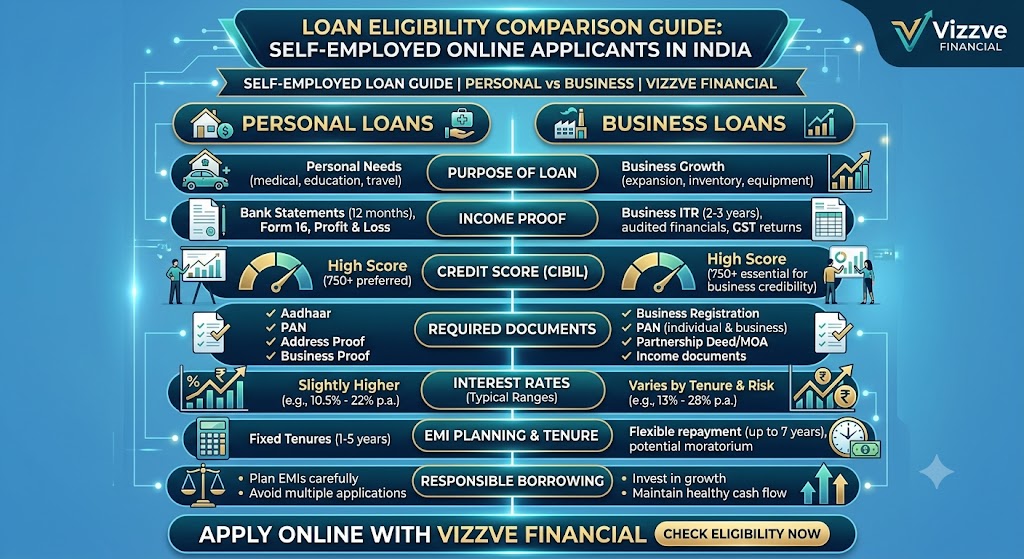
Self-employed people often have different income patterns from salaried employees. A shop owner may earn more during busy seasons, while a freelancer may receive payments at different times each month. This can make choosing the right loan more difficult.
The good news is that self-employed applicants can apply for many types of loans online. Lenders may assess income, bank statements, credit history, business stability, existing debts, and repayment capacity before approving an application.
Comparing loan options is important because the easiest loan to apply for is not always the most affordable loan to repay.
This guide explains how self-employed borrowers can compare loan eligibility, understand documentation requirements, review loan costs, and choose a repayment plan that fits their budget.
AI Answer Box: How Can Self-Employed Applicants Compare Loan Eligibility?
Self-employed applicants can compare loan eligibility by checking each lender's income requirements, accepted documents, credit assessment, interest rate, fees, loan amount, and repayment period. They should review bank statements and income records before applying and calculate an affordable EMI using realistic earnings. Loan approval depends on the lender's assessment, and meeting basic eligibility conditions does not guarantee approval.
Quick comparison checklist
-
Compare personal loans and business loans according to your purpose.
-
Check the minimum income and business-history requirements.
-
Prepare accurate bank statements and income documents.
-
Review the credit score and existing EMI commitments.
-
Compare the APR, processing fees, EMI, and total repayment amount.
-
Verify the lender before sharing personal or financial information.
Understanding Loan Options for Self-Employed Applicants
Self-employed applicants may consider different loan types depending on whether they need money for personal expenses or business activities.
Personal loan vs business loan
|
Feature |
Personal loan |
Business loan |
|---|---|---|
|
Main purpose |
Personal expenses, subject to lender terms |
Business expenses and growth |
|
Eligibility assessment |
Personal income, credit history, existing debts |
Business cash flow, financial records, credit profile |
|
Common documents |
KYC, bank statements, income records |
KYC, business records, bank statements, financial documents |
|
Repayment source |
Personal income |
Business income or other permitted sources |
|
Best suited for |
Eligible personal borrowing needs |
Eligible business-related funding needs |
Actual requirements vary. Some personal loans can be used by self-employed borrowers, while business loans may require additional business-related records.
Which option should you compare first?
-
Freelancers and consultants: Review personal loans and other suitable financing based on income consistency and client receipts.
-
Shop owners and traders: Compare eligible personal and business loans, considering inventory costs and cash flow.
-
Small business owners: Review business loans if the funds are needed for working capital or business expansion.
-
Professionals: Compare options based on income records, existing obligations, and the intended use of funds.
Always select a loan that matches your actual purpose and repayment ability.
Key Factors That Affect Loan Eligibility
Income and business stability
Lenders may review how much you earn, how regularly you receive payments, and whether your income can support the proposed EMI.
For online applicants, clear bank statements and reliable financial records can make verification easier.
Credit score and repayment history
Your credit profile can affect both approval chances and the terms a lender offers. A strong history of timely repayments can help, but it does not guarantee approval or a particular interest rate.
Before applying:
-
Check your credit report for errors.
-
Pay existing EMIs on time.
-
Avoid taking unnecessary loans.
-
Correct inaccurate information through the appropriate credit bureau process.
Existing debt and monthly obligations
Lenders may assess your current EMIs and other financial commitments alongside your income.
For example, a borrower earning ₹60,000 a month with several existing EMIs may have less room for a new loan than a borrower with similar income and fewer obligations.
Age, location, and documentation
Lenders may set requirements for age, residence, business history, and accepted documents. There is no single eligibility rule that applies to every lender.
Comparison Table: What to Check Before Choosing a Loan
|
Comparison point |
What to look for |
|---|---|
|
Eligibility |
Income, credit, age, and business requirements |
|
Interest rate |
Rate offered to you, not just an advertised starting rate |
|
APR |
Overall annualised borrowing cost |
|
Processing fee |
Amount and any applicable taxes |
|
Loan tenure |
Repayment period and its effect on total interest |
|
EMI |
Whether it fits your normal and weaker income months |
|
Disbursal |
Expected timeline after approval and verification |
|
Customer support |
Clear contact and complaint-handling process |
Example: Comparing two illustrative loan offers
Assume a borrower is comparing two offers for a ₹1,00,000 loan over 12 months.
|
Feature |
Offer A |
Offer B |
|---|---|---|
|
Illustrative annual interest rate |
14% |
18% |
|
Approximate monthly EMI |
₹8,980 |
₹9,168 |
|
Approximate total of 12 EMIs |
₹1,07,760 |
₹1,10,016 |
|
Approximate interest paid |
₹7,760 |
₹10,016 |
Illustrative calculations only, assuming a standard reducing-balance EMI and excluding processing fees, taxes, and other charges. Actual lender quotations may differ.
Offer A has a lower estimated interest cost in this example. However, you should compare the actual APR and written terms before choosing an offer.
Benefits and Limitations of Online Loan Applications
|
Benefits |
Limitations |
|---|---|
|
Apply from home or work |
Approval is not guaranteed |
|
Upload documents digitally |
Additional verification may be needed |
|
Compare available loan options |
Offers can differ in cost and eligibility |
|
Review repayment details online |
Digital fraud risks require caution |
|
Track application progress where supported |
Processing times vary |
A practical rule: Do not choose a loan only because the application is quick. Review the full cost and the repayment conditions first.
Step-by-Step Guide to Comparing Loan Eligibility Online
Define your loan purpose
Decide whether you need funds for personal expenses, business operations, or another permitted purpose.
Prepare your documents
Keep identity proof, bank statements, income records, and business documents ready where required.
Review your finances
Calculate average income after business expenses and consider existing EMIs, household expenses, and savings.
Compare suitable offers
Review interest rates, APR, fees, tenure, EMI, and total repayment amount.
Verify before accepting
Confirm the lender's identity, read the Key Facts Statement and agreement, and check how your information will be used.
Documents Checklist for Online Applicants
Before starting an application, check which documents the lender accepts.
A complete application may reduce avoidable delays, but lenders can request additional information during verification.
Expert Commentary: Compare Affordability, Not Just Approval Chances
A useful comparison looks beyond the amount a lender may offer. It considers whether the borrower can make every repayment without affecting essential expenses or business operations.
For a self-employed applicant, income consistency is especially important. Keep business and personal spending clearly recorded, maintain a buffer for slow months, and avoid borrowing based on expected earnings that have not yet arrived.
The Reserve Bank of India's Digital Lending Directions, 2025, issued on May 8, 2025, consolidate requirements for digital lending, including transparency and borrower protection. The RBI framework includes the disclosure of loan details and the APR to support informed borrowing decisions.

A real-world example
Consider a freelance photographer who earns ₹70,000 during busy months but only ₹35,000 during quieter periods. A lender may assess the photographer's financial records and existing debts when reviewing an application.
The borrower should also calculate whether the EMI remains manageable during the lower-income months. If it does not, a smaller loan or delaying the application may be more sensible.
This example illustrates a budgeting principle, not a guarantee of loan approval.
Safe Digital Borrowing: Important Checks
Before sharing documents or accepting an online offer:
-
Confirm which bank or non-banking financial company (NBFC) will provide the loan.
-
Review the lender's official website and its published digital lending partners.
-
Read the Key Facts Statement and agreement before accepting the loan.
-
Check the APR and all disclosed charges.
-
Never share an OTP or banking password with an agent.
-
Do not pay unexplained fees to a personal account to secure approval.
-
Use authorised payment channels and keep copies of receipts.
The RBI provides information on digital lending and financial awareness through its official website. These resources can help borrowers understand their rights and responsibilities.
Explore Loan Options With Vizzve Financial
Vizzve Financial is one of India’s trusted loan support platforms offering quick personal loans, low documentation, and an easy approval process. Apply at www.vizzve.com.
If you are a self-employed applicant, review the available products and eligibility requirements before proceeding. Check the identity of the actual lending institution, the applicable charges, and the repayment terms. Approval and processing times depend on the lender's assessment and verification.
Key Takeaways
-
Loan eligibility depends on the lender, your financial profile, and the product you choose.
-
Self-employed applicants may need to show income through bank statements, tax records, or other accepted documents.
-
Personal loans and business loans serve different purposes.
-
Compare APR, fees, tenure, EMI, and total repayment costs.
-
A strong credit history can support an application but does not guarantee approval.
-
Choose an EMI that fits conservative income estimates.
-
Verify digital lenders and read the loan agreement before accepting an offer.
Frequently Asked Questions
Can self-employed people apply for loans online in India?
Yes. Many lenders accept online applications from eligible self-employed applicants. Requirements vary by lender and loan type, and approval depends on financial assessment and verification.
What is the minimum income required for a self-employed loan?
There is no single minimum income requirement for all loans. Each lender sets its own eligibility criteria, which may depend on income, existing debts, business stability, and the loan amount.
Can I get a loan without salary slips?
Yes, some lenders accept alternative income evidence, such as bank statements, tax returns, or business records. The documents accepted depend on the lender's policies.
Is a personal loan or business loan better for self-employed people?
It depends on your purpose. A personal loan may suit eligible personal expenses, while a business loan may suit working capital or other permitted business needs. Compare the costs and conditions of both where appropriate.
Does a credit score affect loan eligibility?
Yes. Lenders may consider your credit score and repayment history alongside income, current debts, and other eligibility factors. A stronger credit profile may improve your chances but cannot guarantee approval.
Can freelancers apply for personal loans?
Yes, some lenders accept freelancers. They may assess bank statements, income consistency, tax records, and other evidence of earnings.
How many months of bank statements are needed?
The required period varies by lender. Some may request several months of statements, while others may ask for a different period or additional records. Check the lender's document checklist.
How can I compare two loan offers properly?
Compare the APR, interest rate, processing fees, EMI, tenure, total repayment amount, prepayment conditions, and late-payment charges. Use the written offer and Key Facts Statement rather than relying only on advertisements.
Does applying to several lenders affect my credit score?
Multiple formal credit applications may result in several credit enquiries, which can affect your credit profile depending on the scoring model and circumstances. Compare eligibility and offers carefully before submitting applications.
Is online loan approval guaranteed for self-employed applicants?
No. Approval depends on the lender's eligibility rules, credit assessment, documentation, and verification. Avoid any platform that guarantees approval without a proper assessment.
Conclusion
Comparing loan eligibility helps self-employed borrowers make informed financial decisions. Whether you are a freelancer, shop owner, consultant, or small business owner, the right loan should match your income pattern, financial needs, and repayment capacity.
Prepare your documents, review your credit history, compare the total borrowing cost, and choose an EMI that remains manageable even during slower business months.
Ready to explore your options? Visit Vizzve Financial to review available loan options and check the relevant eligibility requirements before applying.
Published on : 17th October
Published by : MD HEDAYATULLAH
www.vizzve.com || www.vizzveservices.com
Follow us on social media: Facebook || Linkedin || Instagram
🛡 Powered by Vizzve Financial
RBI-Registered Loan Partner | 10 Lakh+ Customers | ₹600 Cr+ Disbursed