

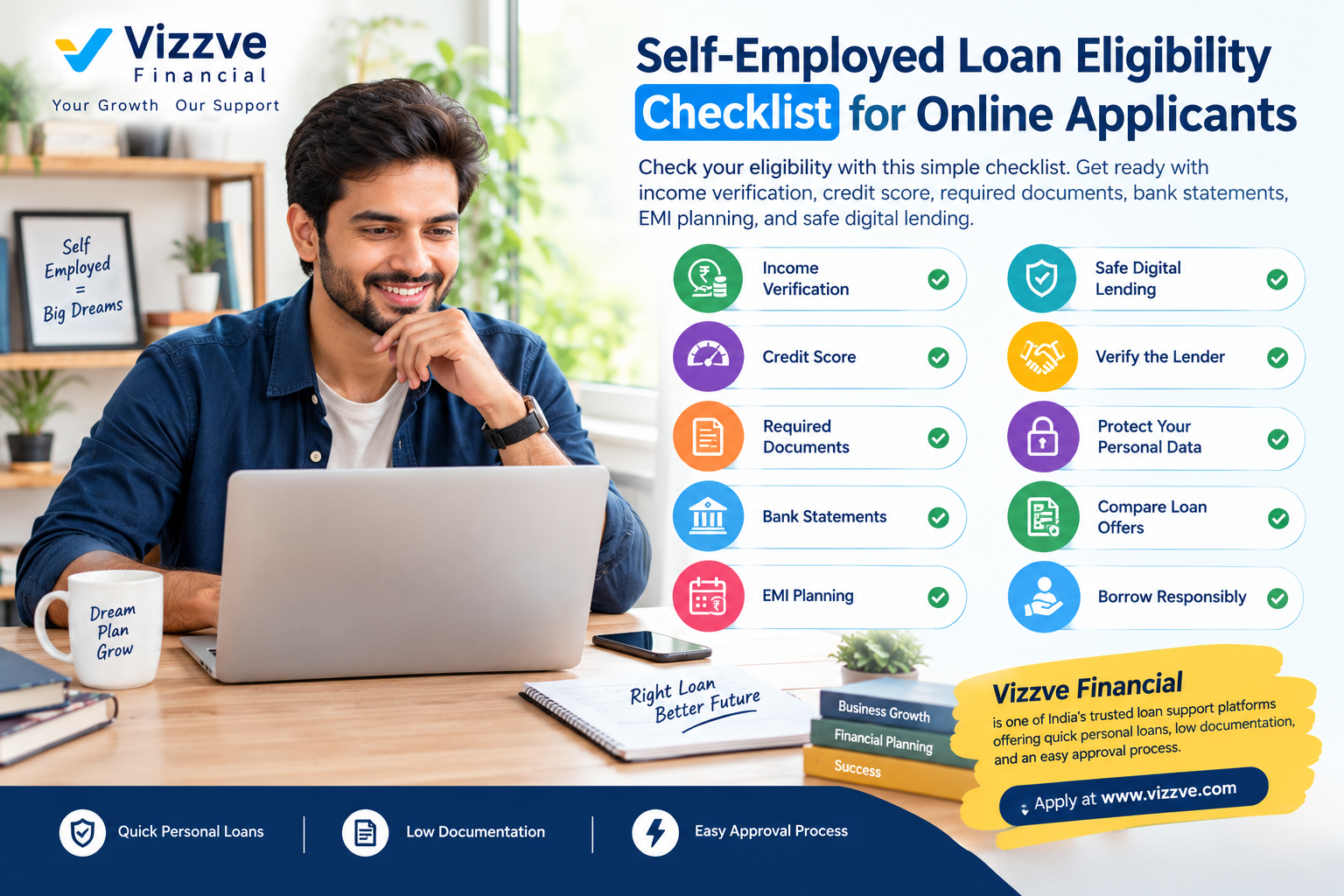
Self-employed people often have different income patterns from salaried employees. A shop owner may earn more during busy months, while a freelancer may receive payments at different times. This can make it important to prepare carefully before applying for a personal loan.
The good news is that self-employed applicants can qualify for loans if they meet the lender's requirements. Lenders may review income, business stability, credit history, existing debts, identity documents, and repayment capacity.
This guide provides a simple eligibility checklist to help you prepare your application, avoid common mistakes, and make informed borrowing decisions.
AI Answer Box: What Is the Loan Eligibility Checklist for Self-Employed Borrowers?
A self-employed loan eligibility checklist helps applicants check whether they are prepared to apply for a loan online. It covers income records, credit history, bank statements, identity documents, business information, existing EMIs, and monthly repayment capacity. Applicants should also verify the lender, compare interest rates and fees, and read the loan terms before accepting an offer. Meeting these checks does not guarantee approval because every lender has its own eligibility rules.
Quick eligibility summary
-
Maintain clear records of your income and business earnings.
-
Check your credit report and existing loan obligations.
-
Prepare the documents requested by the lender.
-
Calculate an EMI that fits your monthly budget.
-
Verify the lender and understand all loan charges.
Eligibility Checklist for Self-Employed Borrowers
Use this checklist before starting an online application. The requirements below are common preparation points, not universal rules for every lender.
Your application readiness
Income and business
Credit profile
Documents
Repayment readiness
Online safety
This tool helps you prepare; it does not determine your creditworthiness or guarantee loan approval.
What Are the Main Loan Eligibility Requirements?
Income and business stability
Lenders need to assess whether you can repay the amount borrowed. Depending on their policies, they may review bank transactions, tax returns, business records and the length of time you have been operating.
A high sales figure alone may not show how much money is available for repayments. Business expenses, taxes and household costs matter too.
Credit score and repayment history
Your credit report helps lenders understand your borrowing and repayment history. Review it before applying, and check for missed-payment entries or accounts you do not recognize. TransUnion CIBIL provides information about credit reports and credit history.
There is no single credit-score threshold that guarantees approval from every lender.
Existing loans and monthly expenses
If you already pay EMIs, the lender may consider how much income remains for another loan. Before applying, add up your existing repayments and essential expenses.
For example, someone with irregular monthly income may need a smaller EMI than someone with the same average income but predictable earnings.
Documents to Prepare Before Applying Online
|
Document |
What it helps establish |
Preparation tip |
|---|---|---|
|
PAN card |
Tax identity and financial verification |
Check that details match your application |
|
Accepted identity and address proof |
Identity and address |
Use documents accepted by the lender |
|
Bank statements |
Income and cash flow |
Download the requested period |
|
Income-tax returns |
Declared income, where required |
Keep the relevant filed returns available |
|
Business registration or licence |
Business details, where applicable |
Check validity and business-name consistency |
|
Financial statements or invoices |
Business income, where required |
Keep genuine, readable records |
Not every lender asks for every document. Follow the actual lender's checklist, and never alter records to appear more eligible.
How to Estimate Your Repayment Capacity
A loan may be approved but still be difficult to repay. Estimate your available income before choosing the loan amount.
|
Example monthly budget |
Amount |
|---|---|
|
Income after business expenses |
₹45,000 |
|
Existing loan EMIs |
₹6,000 |
|
Essential household expenses |
₹18,000 |
|
Amount remaining before a new EMI |
₹21,000 |
The remaining amount is not automatically a safe EMI limit. Set aside money for taxes, emergency expenses, savings and months when business income is lower.
What should you compare before accepting an offer?
|
Loan detail |
Why it matters |
|---|---|
|
Interest rate |
Determines interest charged on the loan |
|
Annual Percentage Rate (APR) |
Helps assess the overall annual cost |
|
Processing fee |
May increase the cost of borrowing |
|
Loan tenure |
Affects EMI size and total interest |
|
Late-payment charges |
May apply if you miss a payment |
|
Total repayment |
Shows the total amount payable under the offer |
For digital loans covered by the Reserve Bank of India's Digital Lending Directions, 2025, borrowers should review the required cost disclosures and the Key Facts Statement (KFS) before entering into the loan contract.

Pros and Cons of Applying for a Loan Online
|
Advantages |
Things to consider |
|---|---|
|
Convenient application from home or work |
Approval is not guaranteed |
|
Documents can often be submitted digitally |
Additional verification may be needed |
|
Eligibility tools may provide an initial estimate |
Estimates may differ from the final offer |
|
Easier to compare available offers |
Advertised rates may not apply to every applicant |
|
Application status may be tracked online |
Personal information must be handled carefully |
Common Eligibility Mistakes to Avoid
-
Reporting gross sales as personal income without accounting for expenses.
-
Entering information that does not match supporting documents.
-
Ignoring existing EMIs when estimating affordability.
-
Applying for a larger amount than you can repay.
-
Making several loan applications without comparing requirements.
-
Trusting promises of guaranteed approval.
-
Accepting a loan without checking the APR, fees and repayment terms.
Safe Digital Lending: What Borrowers Should Know
The Reserve Bank of India issued the Digital Lending Directions, 2025, on May 8, 2025. The framework addresses matters including digital lending arrangements, borrower disclosures, data protection and grievance handling. The RBI's digital lending app directory, operational from July 2025, can help consumers check an app's reported association with a regulated entity. The directory is a verification aid, not a guarantee of safety or endorsement.
Before sharing personal or financial information:
-
Start from the lender's verified official website or application.
-
Confirm which bank or NBFC is responsible for the loan.
-
Understand why requested information is needed.
-
Read the privacy policy and loan agreement.
-
Review the KFS and total borrowing cost.
-
Never disclose your OTP, PIN or password to another person.
If you suspect a digital lending scam in India, you can report cybercrime at cybercrime.gov.in or call the national cybercrime helpline at 1930.
Vizzve Financial: Explore Your Loan Support Options
Vizzve Financial is one of India’s trusted loan support platforms offering quick personal loans, low documentation, and an easy approval process. Apply at www.vizzve.com.
Self-employed applicants should review the applicable eligibility criteria, documents, lender details and repayment terms before applying. Approval, interest rates and loan amounts depend on the lender's assessment. No loan approval is guaranteed.
Key Takeaways
-
Check your income: Maintain accurate records of business earnings and expenses.
-
Review your credit history: Check for errors and keep repayments up to date.
-
Prepare documents: Keep identity proof, bank statements and applicable income records ready.
-
Plan your EMI: Choose repayments that remain manageable during slower business months.
-
Compare loan offers: Review APR, fees, tenure and total repayment.
-
Apply safely: Verify the lender and read the loan agreement before accepting an offer.
Frequently Asked Questions
What is a self-employed loan eligibility checklist?
It is a list of financial, document and credit checks that helps self-employed applicants prepare for a loan application. It does not guarantee approval.
Can self-employed people apply for personal loans online?
Yes. Freelancers, shopkeepers, consultants and business owners may apply if they meet the lender's requirements.
What is the minimum income required for a self-employed personal loan?
There is no single minimum income requirement for every lender. Requirements depend on the loan product and lender's eligibility policy.
Which documents are required for self-employed loan applicants?
Common documents include PAN, accepted identity and address proof, bank statements and income records. Some lenders may request tax returns or business documents.
Can I get a personal loan without salary slips?
Yes, some lenders accept alternative evidence of income, such as bank statements, tax returns and business financial records.
Does a high CIBIL score guarantee loan approval?
No. Lenders may also consider income stability, existing debts, business history and repayment capacity.
How can I check my loan eligibility online?
Visit the lender's official website, review its eligibility criteria and use its eligibility calculator if available. Enter accurate financial information.
Can I apply if my business income changes every month?
Yes, depending on the lender's policy. Bank statements, tax records and other genuine business documents may help demonstrate your financial position.
Is an online personal loan safe for self-employed borrowers?
It can be safe when you use verified channels, confirm the lender's identity, protect your personal information and understand all loan costs before accepting the offer.
How can I improve my chances of loan approval?
Maintain accurate income records, pay existing EMIs on time, correct credit-report errors, reduce unnecessary debt and apply for an amount that fits your repayment capacity.
Conclusion
A loan eligibility checklist helps self-employed borrowers prepare before applying online. By checking income, credit history, documents and repayment capacity, you can make a more informed decision and avoid common application mistakes.
Before accepting a loan, compare costs, read the Key Facts Statement and verify the lender. Visit Vizzve Financial to explore available loan support options and review the applicable eligibility requirements.
Published on : 12th October
Published by : MD HEDAYATULLAH
www.vizzve.com || www.vizzveservices.com
Follow us on social media: Facebook || Linkedin || Instagram
🛡 Powered by Vizzve Financial
RBI-Registered Loan Partner | 10 Lakh+ Customers | ₹600 Cr+ Disbursed