

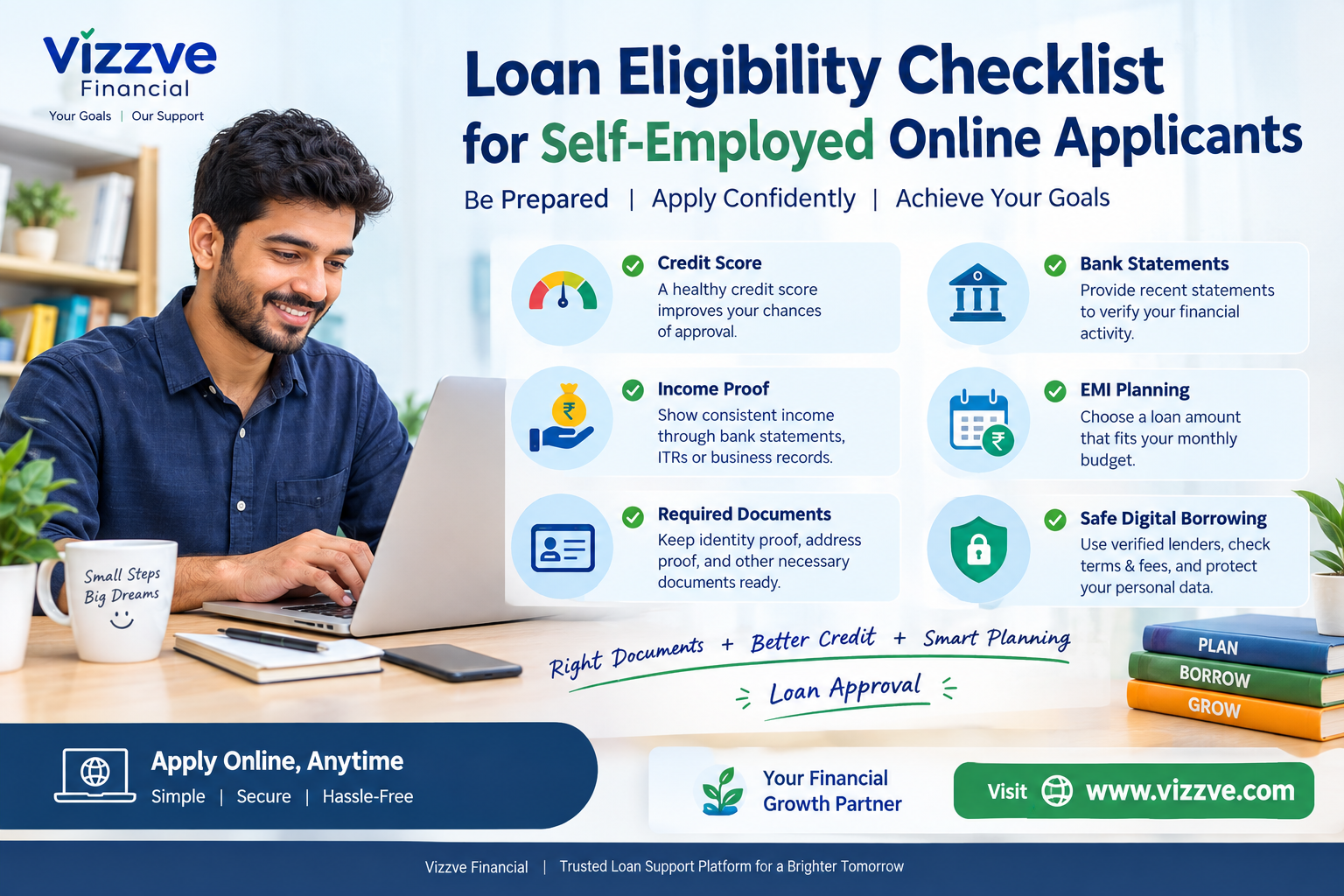
Getting a loan as a self-employed person can be challenging when income changes from month to month. Freelancers, shop owners, consultants, and small business owners may not receive a fixed salary, but they can still qualify for a loan if they meet the lender's requirements.
A loan eligibility checklist for self-employed online applicants helps you prepare documents, review your credit history, understand your repayment capacity, and avoid common application mistakes.
The exact requirements depend on the lender, loan type, income stability, and existing financial commitments. Approval is never guaranteed simply because you submit an online application.
AI Answer Box
What is the loan eligibility checklist for self-employed borrowers?
Self-employed applicants in India should generally check their age, business or professional income, work history, credit report, existing EMIs, bank statements, identity proof, and address proof before applying for a loan. Depending on the lender, applicants may also need income tax returns, business registration documents, or other financial records. Comparing the total borrowing cost and choosing an affordable EMI are essential steps before submitting an online application.
Full Blog Content
What Is Loan Eligibility for Self-Employed Borrowers?
Loan eligibility refers to the conditions a lender uses to decide whether an applicant can receive a loan and how much they may be able to borrow.
For self-employed applicants, lenders commonly review:
-
Age and identity verification.
-
Regularity and stability of income.
-
Business or professional activity.
-
Credit history and repayment behaviour.
-
Existing loans and monthly financial commitments.
-
Bank statements and supporting documents.
-
Ability to repay the proposed EMI.
Different lenders follow different eligibility policies. Meeting the basic requirements allows an application to be considered but does not guarantee approval.
Self-Employed Loan Eligibility Checklist
Use this checklist before starting your online application.
|
Eligibility factor |
What to check |
|---|---|
|
Age |
Meets the lender's minimum and maximum age limits |
|
Income |
Can demonstrate sufficient income to repay the loan |
|
Business activity |
Has records supporting professional or business activity |
|
Credit history |
Reviews the credit report for errors and overdue accounts |
|
Bank statements |
Keeps relevant statements available |
|
Identity proof |
Has valid, accepted identity documents |
|
Address proof |
Has acceptable proof of current address |
|
Existing EMIs |
Understands current monthly repayment commitments |
|
Loan amount |
Requests an amount suited to repayment capacity |
|
Application details |
Provides accurate and consistent information |
Practical tip: Check the lender's official eligibility rules first. This helps you avoid applying based on assumptions that may not match its requirements.
Which Documents Are Required for a Self-Employed Loan?
Lenders may ask for different documents depending on the loan product and applicant profile. Prepare the following where applicable.
|
Document |
Why it may be needed |
|---|---|
|
PAN card |
Identity and financial verification |
|
Aadhaar or other accepted ID |
Identity verification |
|
Address proof |
Confirming residential details |
|
Bank statements |
Reviewing income and transactions |
|
Income tax returns (ITRs) |
Supporting declared income |
|
Business registration proof |
Verifying business activity, if required |
|
Profit and loss statement |
Understanding business performance, if required |
|
Existing loan statements |
Reviewing current repayment obligations |
Keep documents clear, current, and consistent. Never submit false income details or altered financial records.
How Does Your Credit Score Affect Loan Eligibility?
Your credit score helps lenders understand your past borrowing and repayment behaviour. TransUnion CIBIL reports scores ranging from 300 to 900, with higher scores generally indicating a stronger credit profile. However, each lender sets its own approval criteria.
Before applying:
-
Review your credit report for incorrect entries.
-
Pay existing EMIs and credit card dues on time.
-
Reduce outstanding balances where possible.
-
Avoid submitting numerous loan applications in a short period.
-
Resolve genuine reporting errors through the relevant lender or credit bureau.
A good credit score can strengthen an application, but income, current debts, and other eligibility conditions still matter.
How Can Self-Employed Applicants Prove Their Income?
Unlike salaried applicants, self-employed borrowers may receive payments from different customers or business activities. Lenders may therefore assess several records together.
Common income proof options
-
Recent bank statements showing business receipts.
-
Income tax returns and tax computation records.
-
Financial statements prepared by an accountant, where required.
-
Invoices, receipts, or contracts supporting earnings.
-
Business registration or professional activity records, where applicable.
The Income Tax Department provides guidance for individuals earning income from business or professional activities. Income Tax Department resources can help applicants understand applicable tax filing requirements.
Real-world example: A freelance designer receives payments from several clients instead of one employer. Bank statements, invoices, tax records, and a consistent record of income may help the lender evaluate the applicant's financial position.
The final decision depends on the lender's documentation policy and overall credit assessment.
Step-by-Step Guide to Applying for a Loan Online
-
Check the eligibility criteria. Review the lender's age, income, business history, and credit requirements.
-
Estimate your repayment capacity. Calculate how much you can pay each month after household and business expenses.
-
Organise your documents. Keep accepted identity documents, bank statements, and income records ready.
-
Compare loan offers. Check interest rates, fees, tenure, total repayment, and other conditions.
-
Complete the application. Enter accurate personal, professional, and financial details.
-
Review the offer before accepting. Read the Key Facts Statement (KFS), where applicable, and understand the total cost.
-
Save the loan records. Keep a copy of the agreement, repayment schedule, and official lender contact details.
Personal Loan vs Business Loan for Self-Employed Applicants
|
Feature |
Personal loan |
Business loan |
|---|---|---|
|
Typical purpose |
Personal expenses |
Business expenses |
|
Income assessment |
Personal repayment capacity |
Business finances and repayment capacity |
|
Common records |
Personal bank statements and income proof |
Business records and financial statements |
|
Suitable use |
Eligible personal needs |
Stock, equipment, or working capital |
|
Approval |
Depends on lender criteria |
Depends on lender criteria |
Choose the loan based on your actual requirement. Do not assume a business loan is always cheaper or a personal loan requires fewer documents.
How Much EMI Can You Afford?
Before borrowing, estimate the monthly instalment and make sure it fits your budget, even during a slower business month.
For example, suppose your average monthly income after business expenses is ₹50,000. Your household expenses and existing EMIs total ₹32,000. This leaves ₹18,000 before other unexpected costs and savings.
A new EMI of ₹15,000 could leave too little room for emergencies. A smaller EMI or postponing the loan may be more sensible.
This is an illustrative example, not a lender's eligibility formula. Actual affordability depends on income fluctuations, essential expenses, savings, and other financial obligations.
Pros and Cons of Online Loan Applications
|
Pros |
Cons |
|---|---|
|
Convenient application process |
Approval is not guaranteed |
|
Documents can often be submitted digitally |
Additional verification may be required |
|
Easier to compare offers |
Fees and interest rates vary |
|
May reduce branch visits |
Personal information must be handled carefully |
|
Application updates may be available online |
Repayment becomes a financial commitment |
Safe Digital Lending Checklist
Before accepting an online loan, verify the actual lender and review the offer carefully.
-
Confirm the bank or NBFC responsible for lending.
-
Check the official website and privacy policy.
-
Review the interest rate, Annual Percentage Rate (APR), processing fees, and late-payment charges.
-
Read the loan agreement and applicable Key Facts Statement.
-
Avoid paying unexplained upfront fees to individuals or unknown agents.
-
Share personal documents only through verified channels.
-
Never share your OTP, PIN, or banking password with an agent.
-
Check the repayment schedule and available customer support.
The Reserve Bank of India's Digital Lending Directions, 2025, address important areas including digital loan disclosures, borrower protection, and data privacy. Review the applicable requirements and the lender's terms before proceeding.

Expert Commentary: What Makes an Application Stronger?
A well-prepared application tells a consistent financial story. Income records should support the amount declared, bank statements should be understandable, and existing debts should be disclosed accurately.
For self-employed applicants, three practical priorities are particularly important:
-
Income consistency: Maintain organised records of business receipts and expenses.
-
Repayment discipline: Pay current obligations on time and monitor your credit report.
-
Realistic borrowing: Request an amount that fits your actual repayment capacity.
These steps can help lenders assess your application more clearly, but no checklist can guarantee approval.
How Vizzve Financial Can Help
Vizzve Financial is presented as a loan support platform for applicants exploring digital borrowing options. Applicants can visit the official website to learn about available services and the applicable eligibility process.
Explore Vizzve Financial: www.vizzve.com
Before applying, confirm the lending partner, eligibility requirements, interest rate, fees, and loan agreement. Product availability and approval depend on the applicable terms and lender assessment.
Key Takeaways
Frequently Asked Questions
Can self-employed people apply for a personal loan online?
Yes. Freelancers, consultants, and business owners can apply if they meet the lender's eligibility criteria.
What is the minimum income required for a self-employed loan?
There is no single minimum income requirement across all lenders. It depends on the loan product, lender policy, and repayment capacity.
Is a credit score necessary for loan approval?
Lenders may use credit scores and credit history to assess applications. Their requirements vary, and a score alone does not determine approval.
Which documents are commonly required?
Common documents include identity proof, address proof, bank statements, and income records. Some lenders may also request tax returns and business documents.
Can I get a loan without income tax returns?
Some lenders may accept alternative income evidence, while others require tax returns. Check the specific lender's documentation policy.
How long should I have been self-employed before applying?
Requirements vary by lender and loan type. Some lenders require a minimum period of business or professional activity.
Does applying online guarantee quick approval?
No. Online applications may simplify submission, but approval and disbursement depend on verification and lender procedures.
How can I improve my loan eligibility?
Maintain timely repayments, organise income records, correct credit report errors, manage existing debt, and apply for a realistic loan amount.
Can I apply if my monthly income changes?
Yes, subject to the lender's requirements. Bank statements, tax records, and other evidence may help demonstrate your income pattern.
How can I check whether a digital loan offer is safe?
Verify the regulated lender, review the official loan agreement and applicable KFS, check the APR and fees, and avoid sharing sensitive information through unverified channels.
Internal and External Linking Suggestions
Use these links naturally within the published article.
Suggested internal links for Vizzve:
-
Digital Loan KYC: A Complete Guide
-
Digital Loan Data Privacy
-
Digital Loan Credit Reporting
-
Loan Repayment Guide
-
Personal Loan Eligibility Guide
Use the actual published URLs for these pages on the Vizzve website.
Suggested authoritative external links:
-
Reserve Bank of India — digital lending rules and borrower protection.
-
TransUnion CIBIL — credit score and credit report information.
-
Income Tax Department — income tax filing guidance.
Conclusion
Self-employed applicants can improve their loan readiness by maintaining clear income records, checking their credit history, preparing the necessary documents, and choosing a repayment amount that fits their budget.
Before applying online, compare offers and verify the lender's terms rather than focusing only on quick approval. For information about available borrowing options, visit Vizzve Financial and review the applicable eligibility conditions.
Published on : 14th October
Published by : MD HEDAYATULLAH
www.vizzve.com || www.vizzveservices.com
Follow us on social media: Facebook || Linkedin || Instagram
🛡 Powered by Vizzve Financial
RBI-Registered Loan Partner | 10 Lakh+ Customers | ₹600 Cr+ Disbursed