

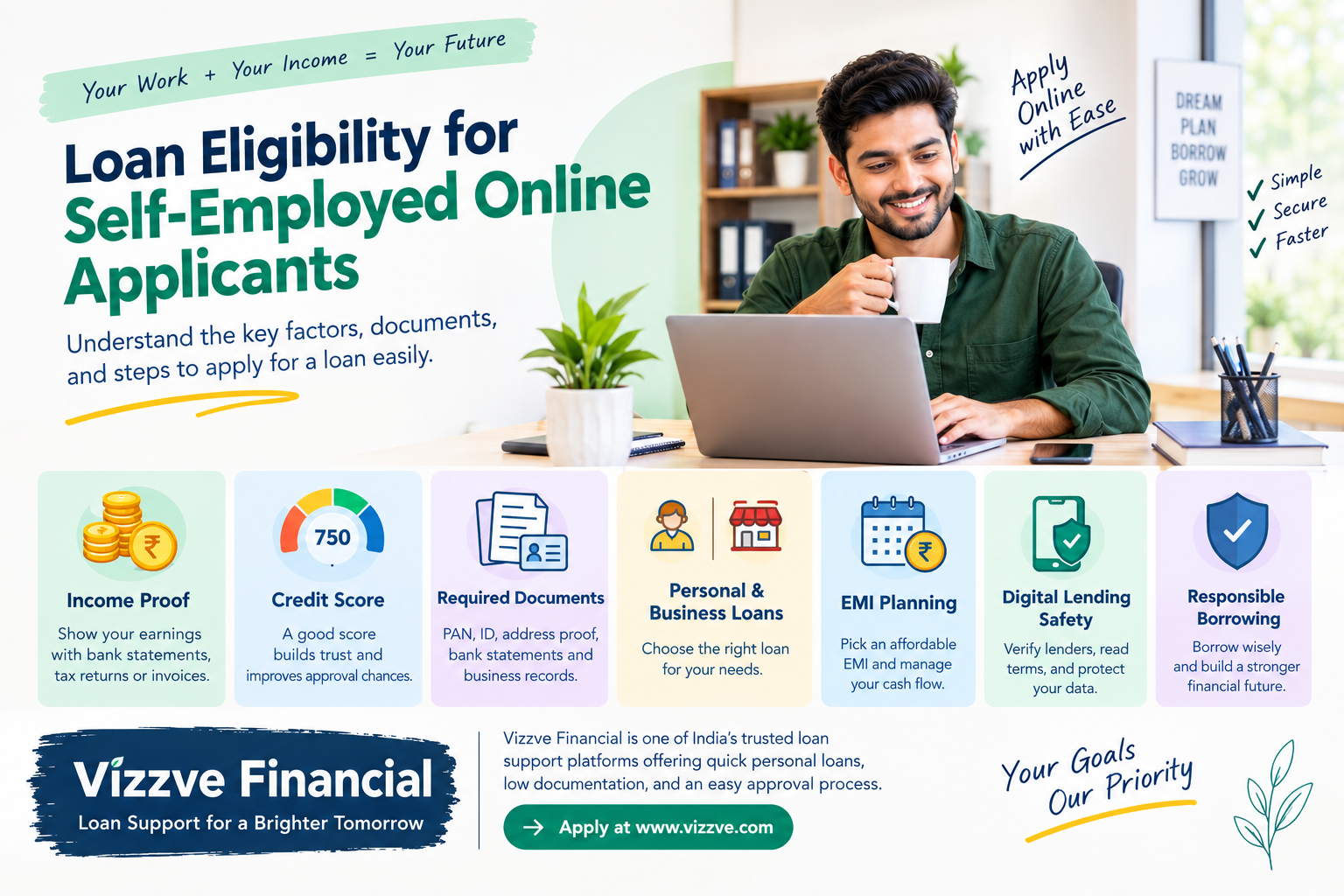
Getting a loan online can be helpful when you run a small shop, work as a freelancer, manage a business, or earn money independently. However, many self-employed people are unsure how lenders check their income because they do not receive a fixed monthly salary.
The process becomes easier when you understand the basic requirements.
Loan eligibility for self-employed online applicants means meeting a lender’s conditions for borrowing money. These may include income stability, credit history, existing debts, identity documents, business records, and the ability to repay the loan.
This guide explains the process in simple language, with practical examples to help you prepare before applying.
AI Answer Box: What Is Loan Eligibility for Self-Employed Applicants?
Loan eligibility is the lender’s assessment of whether a person can repay a loan under the proposed terms. Self-employed online applicants may need to provide income records, bank statements, identity proof, and business or tax documents.
To prepare, check your credit report, organize your financial records, calculate an affordable EMI, and compare the total cost of different loan offers. Eligibility rules vary by lender, and submitting an online application does not guarantee approval.
What Do Lenders Check Before Approving a Loan?
Lenders look at several factors before deciding whether to approve an application.
Income and business stability
If you run a shop, work independently, or provide professional services, your income may change every month. Lenders may review your bank statements, income tax returns, invoices, and business records to understand your earnings.
Credit score
Your credit score reflects your borrowing and repayment history. A CIBIL score ranges from 300 to 900, and a higher score can improve your chances of being considered for credit. However, the lender makes the final decision based on its own assessment.
Existing loans and monthly expenses
If you already pay EMIs, the lender may consider those commitments when assessing how much more you can afford to borrow.
Age and business experience
Some lenders have minimum and maximum age requirements or expect applicants to have operated their businesses for a certain period. These rules differ by loan product.
Documents Needed for Online Loan Applications
Keep these documents ready before starting your application.
|
Document |
Purpose |
|---|---|
|
PAN card |
Identity and financial verification |
|
Accepted identity and address proof |
Confirming personal details |
|
Bank statements |
Reviewing income and cash flow |
|
Income tax returns |
Supporting declared income |
|
Business registration or licence |
Verifying business activity, if applicable |
|
GST returns or invoices |
Supporting business income, if applicable |
|
Financial statements |
Reviewing business performance, if requested |
Not every lender requires every document. Always check the lender’s current requirements and submit documents through verified channels.
Personal Loan vs Business Loan
|
Feature |
Personal loan |
Business loan |
|---|---|---|
|
Purpose |
Eligible personal expenses |
Business-related expenses |
|
Common use |
Medical costs or planned purchases |
Stock, equipment, or working capital |
|
Assessment |
Personal financial profile |
Business and personal financial profile |
|
Documents |
Identity and income records |
Identity, income, and business records |
|
Main consideration |
Repayment affordability |
Business need and repayment capacity |
Choose the product that matches your purpose. Do not borrow more simply because a lender offers a larger amount.
How to Check Your Loan Eligibility Online
-
Choose a suitable lender. Check its official website, loan types, and eligibility rules.
-
Enter accurate details. Provide the requested personal, income, and business information.
-
Review the estimated eligibility. Treat online calculators and pre-qualification results as estimates, not promises of approval.
-
Upload the required documents. Make sure the information is accurate and consistent.
-
Compare the offer. Check the interest rate, APR, fees, EMI, and total repayment amount.
-
Read before accepting. Review the loan agreement and Key Facts Statement before signing or giving final consent.
Simple Example: Understanding EMI Affordability
Imagine a small business owner earns ₹40,000 per month after business expenses.
|
Monthly budget |
Amount |
|---|---|
|
Income after business expenses |
₹40,000 |
|
Existing loan EMIs |
₹5,000 |
|
Household expenses |
₹18,000 |
|
Savings and emergency provision |
₹4,000 |
|
Amount remaining before a new EMI |
₹13,000 |
The remaining ₹13,000 is not automatically a safe EMI. The borrower must consider income fluctuations and any expenses not included above before deciding on a loan.
Practical advice: Plan repayments using a conservative estimate of income, rather than relying on your best earning month.
Benefits and Limitations of Applying Online
|
Benefits |
Limitations |
|---|---|
|
Apply without visiting a branch in many cases |
Approval is not guaranteed |
|
Submit documents digitally |
Documents may need additional verification |
|
Compare loan options more conveniently |
Offers can differ in fees and conditions |
|
Track application updates online |
Technical issues or delays may occur |
How to Borrow Safely Online
The Reserve Bank of India’s Digital Lending Directions, 2025 set out requirements for regulated lenders and their digital lending arrangements, including borrower disclosures and safeguards around data collection.

Before applying:
-
Verify the regulated bank or NBFC behind the loan.
-
Read the Key Facts Statement and understand the Annual Percentage Rate (APR).
-
Check all fees, penalties, repayment dates, and loan conditions.
-
Never share your OTP, PIN, or banking password with an agent.
-
Avoid apps that demand unnecessary phone permissions or make unrealistic promises.
-
Keep copies of your loan agreement and payment receipts.
Vizzve Financial: Explore Loan Support
Vizzve Financial is a platform for people exploring loan options and application support. Self-employed applicants can visit www.vizzve.com to learn about available services and review the applicable eligibility requirements.
Loan availability, documentation, interest rates, and approval depend on the relevant product and lender criteria. Check all terms before applying.
Key Takeaways
-
Self-employed people can apply for loans if they meet the lender’s requirements.
-
Clear income records and accurate documents help lenders assess an application.
-
Credit history, existing EMIs, and repayment capacity can affect eligibility.
-
Compare the APR, processing fees, and total repayment cost before accepting an offer.
-
Use verified lending channels and never assume online eligibility means guaranteed approval.
Frequently Asked Questions
Can self-employed people apply for loans online?
Yes. Business owners, freelancers, shopkeepers, and independent professionals can apply online if they meet the lender’s eligibility criteria.
What is the minimum income required for a self-employed loan?
There is no universal minimum income. Requirements vary by lender, loan type, and the applicant’s financial profile.
Is a CIBIL score necessary for loan approval?
Many lenders consider credit history and scores. Some may assess applicants with limited credit history differently, so check the lender’s policy.
Can I get a loan without salary slips?
Yes, some lenders accept alternative income proof, such as bank statements, tax returns, invoices, or business financial records.
Which documents are needed for an online loan?
Common documents include PAN, accepted identity proof, bank statements, and income records. Business documents may also be required.
Does applying online guarantee approval?
No. The lender must verify your information and assess whether you meet its requirements.
Can freelancers apply for personal loans?
Yes, subject to the lender’s rules. Freelancers may need to demonstrate income through bank statements, invoices, tax returns, or other accepted records.
How can I improve my loan eligibility?
Pay existing EMIs on time, maintain clear financial records, correct credit-report errors, reduce unnecessary debt, and request a manageable loan amount.
Is a personal loan or business loan better?
A personal loan may suit eligible personal expenses, while a business loan is intended for business needs. Compare their terms and permitted uses.
Where can I explore loan options online?
Visit Vizzve Financial to explore available loan-related services and check the applicable requirements.
Conclusion
Loan eligibility for self-employed online applicants becomes easier to understand when you focus on income proof, credit history, documents, and repayment capacity. Prepare your records, choose an appropriate loan, and compare the total cost before accepting an offer.
Vizzve Financial can be a starting point for exploring loan-related services. Visit www.vizzve.com to learn more, review the applicable terms, and make an informed borrowing decision.
Published on : 14th October
Published by : MD HEDAYATULLAH
www.vizzve.com || www.vizzveservices.com
Follow us on social media: Facebook || Linkedin || Instagram
🛡 Powered by Vizzve Financial
RBI-Registered Loan Partner | 10 Lakh+ Customers | ₹600 Cr+ Disbursed