

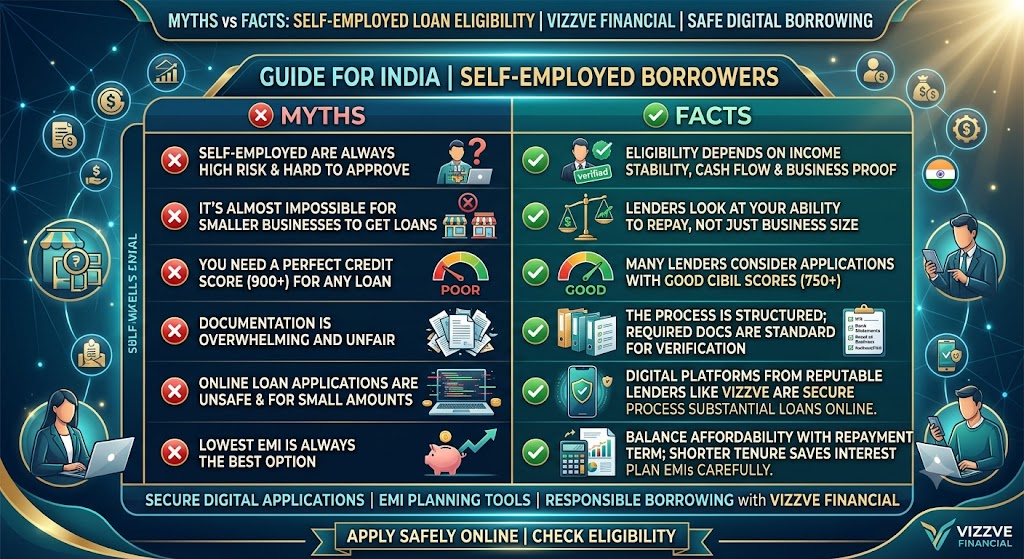
Can a freelancer get a personal loan? Is a salary slip compulsory? Does a low credit score always mean rejection?
Many self-employed people have these questions when applying for a loan online. Shop owners, freelancers, consultants, traders, and small business owners may earn money differently from salaried employees. Their income can change from month to month, but that does not automatically mean they cannot qualify for a loan.
Lenders may consider income, bank statements, credit history, existing debts, business stability, and repayment capacity when reviewing an application.
Understanding the difference between loan myths and facts helps you make better decisions, prepare the right documents, and avoid misleading promises.
AI Answer Box: Can Self-Employed People Get Loans Online?
Yes, eligible self-employed people can apply for loans online in India. Lenders may assess their income records, bank statements, credit history, existing EMIs, business stability, and identity documents. A salary slip is not always required, because alternative income proof may be accepted. However, eligibility rules differ between lenders, and submitting an application does not guarantee approval.
Quick facts to remember
-
Self-employed people can qualify for suitable loans.
-
Income may be verified using bank statements and other accepted records.
-
A strong credit history can help, but does not guarantee approval.
-
Online applications still require genuine information and verification.
-
Always compare interest, fees, EMI, and total repayment costs.
Common Myths and Facts About Self-Employed Loan Eligibility
Myth: Self-employed people cannot get personal loans
Fact: Many lenders accept applications from eligible freelancers, business owners, consultants, and other self-employed individuals. Approval depends on the lender's criteria and financial assessment.
Myth: A salary slip is compulsory for every loan
Fact: Not always. Some lenders accept bank statements, income tax returns, business records, or other proof of earnings instead of salary slips.
Myth: Irregular income always leads to rejection
Fact: Income that changes each month does not automatically disqualify an applicant. Lenders may assess income patterns, financial records, existing obligations, and repayment capacity.
Myth: A high credit score guarantees approval
Fact: A good credit score can support an application, but lenders also consider income, debts, documentation, and other eligibility conditions. Approval is never guaranteed by a score alone.
Myth: Online loans require no documents
Fact: Online applications may reduce paperwork, but lenders still need to verify identity and assess eligibility. Documents may be uploaded digitally.
Myth: Applying for the highest available amount is always better
Fact: A larger loan usually means a larger repayment obligation. Borrow only what you need and can reasonably repay, including during slower business months.
Myth: All lenders use the same eligibility rules
Fact: Lenders set their own policies for income, credit history, business stability, documents, and loan amounts. Compare the actual requirements before applying.
Myth: A low credit score means you can never get a loan
Fact: A low score may reduce approval chances or affect the offer, but it does not always mean automatic rejection. Lender policies differ. Review your credit report and improve repayment habits before applying again.
Myth: The lowest advertised interest rate means the cheapest loan
Fact: The final cost can include interest, processing fees, and other applicable charges. Compare the APR, EMI, and total repayment amount rather than looking at the advertised rate alone.
Myth: Loan approval means the loan is affordable
Fact: Approval means the lender has accepted the application under its assessment. It does not mean the EMI will suit every borrower's budget. Calculate your own repayment capacity before accepting the offer.
Myths vs Facts: Quick Comparison Table
|
Common myth |
The actual fact |
|---|---|
|
Self-employed people cannot borrow |
Eligible applicants may qualify |
|
Salary slips are always required |
Alternative income records may be accepted |
|
Irregular income means rejection |
Lenders may assess overall income patterns |
|
A high score guarantees approval |
Several factors affect the decision |
|
Online loans need no documents |
Verification is still required |
|
Every lender has the same rules |
Eligibility policies vary |
|
The lowest rate is always best |
APR and total cost matter |
|
Approval guarantees affordability |
The borrower must assess their own budget |
How to Improve Your Loan Eligibility
You cannot control every part of a lender's decision, but you can improve your financial preparation.
Keep income records organised
Maintain bank statements, tax returns, invoices, and business records that accurately show your earnings.
Pay existing EMIs on time
Consistent repayment helps build a positive credit history and reduces the risk of avoidable overdue payments.
Reduce unnecessary debt
Review existing loans and monthly commitments before taking on another repayment.
Check your credit report
Look for incorrect balances, unfamiliar accounts, or repayment entries that need correction through the relevant credit bureau or lender.
Choose a realistic loan amount
Estimate your income after business expenses, household costs, existing EMIs, and savings needs. Leave room for weaker months.
Documents Self-Employed Online Applicants May Need
|
Document |
Why it may be requested |
|---|---|
|
PAN and identity proof |
Identity and financial verification |
|
Address proof |
Address verification |
|
Bank statements |
Review of income and account activity |
|
Income tax returns |
Evidence of reported earnings, where required |
|
Business registration or business proof |
Confirmation of business activity, where required |
|
Existing loan details |
Assessment of current repayment obligations |
The exact list depends on the lender and product. Submit genuine, up-to-date documents and never alter records to improve your chances.
Expert Commentary: Responsible Borrowing Matters
A loan application should be based on evidence, not assumptions or promises of guaranteed approval.
For self-employed people, clear financial records help explain income that may change from month to month. However, even strong documentation cannot replace a realistic repayment plan.
The Reserve Bank of India's financial education resources explain that credit history and repayment behaviour can affect creditworthiness. Its digital lending framework also emphasises transparency and borrower protection, including disclosure of important loan costs and terms.
A practical example
Imagine a small business owner who earns ₹45,000 in one month and ₹70,000 in another. They believe a lender will reject them because their income is not fixed.
Instead of assuming rejection, they organise their bank statements, income records, and existing EMI details. They then compare suitable loan products and calculate whether repayments would remain affordable in a slower month.
This preparation may help the lender assess the application, but approval still depends on the lender's policies and verification.
Pros and Cons of Applying for a Loan Online
|
Pros |
Cons |
|---|---|
|
Convenient application process |
Approval is not guaranteed |
|
Documents can often be uploaded digitally |
Additional verification may be requested |
|
Easier to review available offers |
Interest rates and fees vary |
|
Application updates may be available online |
Fake apps and misleading offers are risks |
|
Some products offer flexible loan amounts or tenures |
Borrowers must still assess affordability |
How to Check Whether an Online Loan Offer Is Genuine
Before proceeding, use these simple checks:
-
Identify the bank or NBFC that will actually provide the loan.
-
Check the lender's official website and authorised lending partners.
-
Read the Key Facts Statement (KFS) and loan agreement.
-
Compare the APR, repayment schedule, and applicable fees.
-
Review the app's privacy policy and requested permissions.
-
Never share your OTP, PIN, or banking password with an agent.
-
Avoid unexplained upfront payments to personal accounts.
-
Save copies of all agreements, receipts, and communications.
The RBI's Digital Lending Directions, 2025, issued on May 8, 2025, established consolidated requirements for digital lending by regulated entities. Always check the latest applicable RBI directions and the actual lender's terms before borrowing.

Explore Loan Options With Vizzve Financial
Vizzve Financial is one of India’s trusted loan support platforms offering quick personal loans, low documentation, and an easy approval process. Apply at www.vizzve.com.
Self-employed applicants can review the available loan options and relevant eligibility requirements before proceeding. Check the identity of the actual lending institution, applicable fees, and repayment terms. Product availability, documentation, approval, and processing times may vary.
Key Takeaways
-
Self-employed people can apply for suitable personal and business loans.
-
A salary slip is not always necessary; lenders may accept other income records.
-
Irregular earnings do not automatically mean loan rejection.
-
Credit scores matter, but lenders consider other factors too.
-
Online applications still require accurate information and verification.
-
Compare APR, fees, EMI, and total repayment cost before accepting an offer.
-
Never trust guaranteed-approval promises without proper assessment.
-
Borrow only an amount you can repay comfortably.
Frequently Asked Questions
Can self-employed people get personal loans online in India?
Yes. Many lenders accept applications from eligible self-employed people. Approval depends on income, credit history, existing debts, documents, and lender policies.
Is a salary slip compulsory for self-employed loan applicants?
No. Some lenders accept bank statements, income tax returns, invoices, or business records as alternative income evidence.
Can freelancers qualify for personal loans?
Yes. Eligible freelancers may qualify if they meet the lender's requirements. The lender may review income consistency, bank statements, credit history, and other documents.
Does irregular income affect loan eligibility?
It can affect how a lender assesses repayment capacity, but it does not automatically result in rejection. Clear financial records can help demonstrate income patterns.
What credit score is required for a self-employed loan?
There is no universal minimum score for every lender and loan product. Check the lender's eligibility requirements and review your credit history before applying.
Can I get a loan with a low credit score?
Possibly, depending on the lender's policy and your overall financial profile. A low score may reduce approval chances or affect the terms offered.
What documents are needed for online loan applications?
Common requirements include PAN, identity and address proof, bank statements, income records, and business proof where applicable. Requirements vary by lender.
Does applying online guarantee faster loan approval?
No. Online applications can simplify submission and verification, but processing times depend on the lender, document completeness, and assessment.
How can I improve my self-employed loan eligibility?
Maintain accurate income records, pay existing EMIs on time, reduce unnecessary debt, correct credit-report errors, and choose a loan amount that fits your budget.
Is it safe to apply for a loan through a digital platform?
It can be safe when you verify the actual lender, review the agreement and privacy policy, and use authorised payment channels. Avoid suspicious apps and unexplained upfront fees.
Conclusion
Understanding the myths and facts about loan eligibility can help self-employed applicants make better financial decisions. Whether you are a freelancer, consultant, shop owner, or small business owner, prepare your documents, review your credit history, and compare available loan offers carefully.
Do not borrow simply because a lender offers a particular amount. Choose a loan that matches your needs and repayment capacity.
Ready to explore your options? Visit Vizzve Financial to review available loan options and check the applicable eligibility requirements.
Published on : 17th October
Published by : MD HEDAYATULLAH
www.vizzve.com || www.vizzveservices.com
Follow us on social media: Facebook || Linkedin || Instagram
🛡 Powered by Vizzve Financial
RBI-Registered Loan Partner | 10 Lakh+ Customers | ₹600 Cr+ Disbursed