

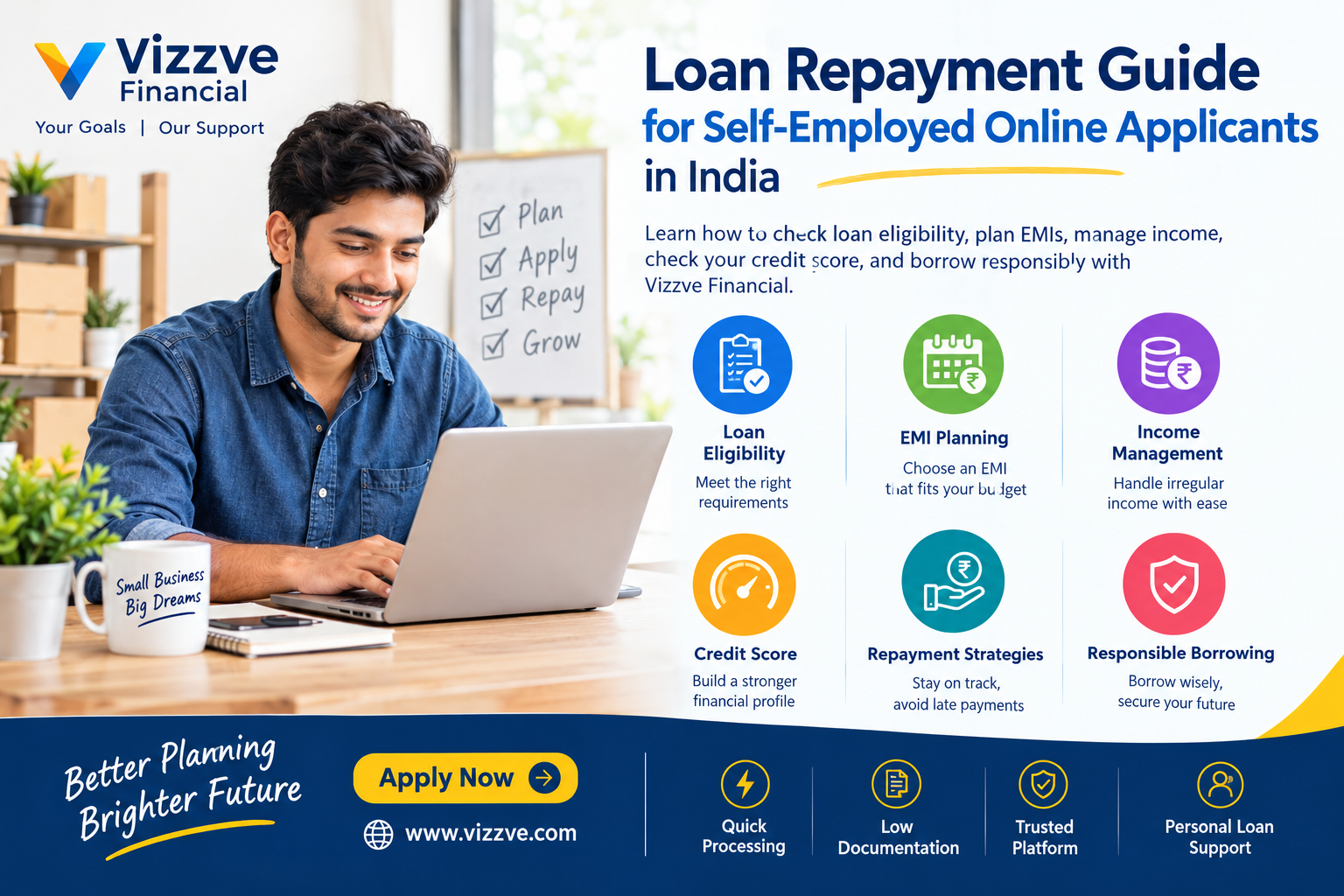
Getting a loan as a self-employed person can be challenging when monthly income changes. Shop owners, freelancers, consultants, and small business owners may earn well in some months and less in others. A good repayment plan helps them manage these changes without putting pressure on daily expenses.
Loan eligibility depends on factors such as income, credit history, existing debts, bank statements, documentation, and the lender's policies. However, getting approved is only the first step. Borrowers must also make sure they can repay the loan on time.
This guide explains how self-employed online applicants can check eligibility, plan EMIs, manage irregular earnings, and avoid common repayment mistakes.
AI Answer Box: How Can Self-Employed Borrowers Repay Loans on Time?
Self-employed borrowers can repay loans on time by calculating their average income, keeping essential business and household expenses separate, choosing an affordable EMI, and setting aside money before spending on non-essential items. They should maintain accurate income records, review their loan terms, and contact the lender early if repayment becomes difficult. A loan should be taken only when the expected repayments fit the borrower's actual financial capacity.
Quick summary for borrowers
-
Check your income and existing EMIs before applying.
-
Keep bank statements and income documents ready.
-
Choose a repayment period that fits your budget.
-
Set aside EMI money before other discretionary spending.
-
Never ignore a missed payment or a lender's communication.
-
Compare interest rates, fees, and total repayment costs before accepting an offer.
Understanding Loan Eligibility for Self-Employed Borrowers
Loan eligibility means meeting a lender's requirements to qualify for a loan. Self-employed applicants may not receive a fixed salary every month, so lenders often review several financial records before making a decision.
What affects loan eligibility?
|
Eligibility factor |
Why it matters |
|---|---|
|
Income and cash flow |
Shows whether you can afford regular repayments |
|
Credit history |
Helps lenders assess previous repayment behaviour |
|
Bank statements |
Show money received, spending, and account activity |
|
Business stability |
Helps demonstrate the continuity of earnings |
|
Existing EMIs |
Shows how much income is already committed |
|
Identity and income documents |
Help verify the application |
Requirements differ by lender and loan product. Meeting basic criteria does not guarantee loan approval.
Documents self-employed applicants may need
Depending on the lender, prepare:
-
PAN card and accepted identity documents.
-
Address proof.
-
Recent bank statements.
-
Income tax returns or other accepted income records.
-
Business registration or proof of business activity, where required.
-
Existing loan details, if requested.
Keep the information accurate and consistent. Do not change income figures or submit false documents to improve your eligibility.
How to Plan Loan Repayments With Irregular Income
Self-employed people should plan EMIs around their actual earnings rather than their best earning month.
Calculate your average monthly income
Review your earnings over the past six to twelve months, if records are available. Subtract business costs to estimate the money that can actually support household expenses and loan payments.
For example, a shop owner may earn ₹60,000 in one month and ₹35,000 in another. Planning repayments around the higher figure could create problems during a slow month.
Prepare a monthly budget
List your regular expenses before deciding how much EMI you can afford.
|
Monthly budget item |
Illustrative amount |
|---|---|
|
Average income after business costs |
₹45,000 |
|
Household essentials |
₹15,000 |
|
Business operating expenses not yet deducted |
₹0 |
|
Existing loan EMIs |
₹5,000 |
|
Savings for emergencies |
₹5,000 |
|
Amount remaining before a new EMI |
₹20,000 |
Illustration only. Actual affordability depends on taxes, irregular expenses, business working capital, dependants, and other obligations.
The remaining ₹20,000 is not automatically a safe EMI amount. Keep a margin for unexpected costs and weaker business months.
Build an EMI reserve
Whenever income arrives, transfer the amount needed for the next EMI into a separate savings account or budget category. If possible, maintain an emergency reserve to help cover essential expenses and repayments when business income falls.
Do not use money needed for stock, rent, supplier payments, or household essentials simply to make a new loan affordable.
How to Choose an Affordable EMI
An EMI, or Equated Monthly Instalment, is the regular payment made towards a loan. It generally includes principal and interest.
Before accepting an offer, compare the EMI, interest rate, fees, repayment period, and total amount payable.
Compare loan repayment options
|
Feature |
Shorter tenure |
Longer tenure |
|---|---|---|
|
Monthly EMI |
Usually higher |
Usually lower |
|
Total interest |
Usually lower |
Usually higher |
|
Monthly budget pressure |
Greater |
Often lower |
|
Time in debt |
Shorter |
Longer |
These comparisons assume similar loan amounts and interest-rate structures. Actual costs depend on the offer's terms and charges.
Check the total cost, not just the EMI
For digital loans in India, the Reserve Bank of India's Digital Lending Directions, 2025, set requirements covering digital lending arrangements and borrower protection. Borrowers should review the Key Facts Statement (KFS), which includes important loan details such as the Annual Percentage Rate (APR), charges and repayment terms.

Before agreeing, check:
-
The amount you will actually receive.
-
The interest rate and APR.
-
Processing fees and other disclosed charges.
-
The EMI amount and due date.
-
Late-payment or penal charges, where applicable.
-
Prepayment conditions and the total repayment amount.
A small EMI can still mean a high overall cost if the repayment period is much longer.
Step-by-Step Loan Repayment Guide
Review your loan agreement
Confirm the outstanding balance, EMI, due date, interest, fees, and payment method. Keep the lender's official contact details handy.
Set a repayment reminder
Add the due date to your calendar and set a reminder a few days earlier. Maintain sufficient funds in the linked account if you use an automatic debit.
Keep EMI money separate
Reserve the repayment amount when customers pay you or when business income arrives. Avoid relying on a future payment that has not yet been received.
Check payment confirmation
Save receipts, bank references, and lender messages. If a payment is not reflected in your account, contact the lender through its official channel.
Act early if income falls
Contact the lender before the due date if possible. Ask what legitimate options may be available and request any agreed changes in writing.
Common Loan Repayment Mistakes to Avoid
Self-employed borrowers can protect their finances by avoiding these common errors.
-
Borrowing based on peak income: A good business month may not reflect regular earning capacity.
-
Ignoring existing debts: Several small EMIs can add up and strain cash flow.
-
Missing due dates: Late payments may result in applicable charges and affect credit history.
-
Taking a new loan to repay an old one: Repeated borrowing can increase debt and make repayment harder.
-
Ignoring lender communication: Delaying contact can reduce the time available to discuss possible solutions.
-
Accepting unclear offers: Understand the lender, agreement, APR, fees, and repayment terms before proceeding.
-
Paying unofficial agents: Use the lender's verified payment channels and keep proof of every transaction.
The RBI's financial education materials advise borrowers to assess their repayment ability and avoid falling into a cycle of borrowing to repay earlier debt.
Pros and Cons of Online Loans for Self-Employed Applicants
|
Pros |
Cons |
|---|---|
|
Applications can be submitted remotely |
Approval is not guaranteed |
|
Documents can often be uploaded digitally |
Additional verification may be required |
|
Some lenders offer faster processing |
Interest and fees vary |
|
Repayment schedules can be reviewed online |
Irregular income can make EMIs difficult |
|
Offers can be compared before acceptance |
Poor repayment management can increase financial pressure |
Best practice: Apply only through a verified lender or an authorised lending service provider, and ensure the actual regulated lender is clearly identified.
What to Do if You Cannot Pay an EMI on Time
A slow business month, delayed customer payments, or an unexpected expense can affect repayment. The right response is to communicate early instead of ignoring the situation.
Practical steps
-
Work out how much you can realistically pay and when.
-
Contact the lender using verified contact details.
-
Explain the situation honestly.
-
Ask whether an extension, restructuring, or another repayment arrangement is available.
-
Request written confirmation of any approved arrangement.
-
Avoid promising a payment date unless you have a reasonable basis for meeting it.
Not every lender offers every option, and approval is not guaranteed. Do not assume that a verbal assurance changes the existing agreement.
Example of a repayment conversation
“Due to a temporary reduction in my business income, I may have difficulty paying my EMI by the scheduled date. I want to resolve the issue responsibly. Please let me know whether any repayment assistance is available and explain the applicable terms and charges.”
This message is clear, professional, and focused on finding a workable solution.
Expert Commentary: Why Repayment Planning Matters
For a self-employed borrower, the key question is not simply, “Can I get this loan?” It is, “Can I repay it even when business income is lower than expected?”
A practical approach is to assess cash flow, existing obligations, and essential expenses before applying. Maintain records of business receipts and withdrawals, and avoid treating money borrowed as income. The RBI's financial education guidance makes this distinction and encourages responsible borrowing.
Real-world example
Imagine a freelance designer who earns ₹50,000 in a good month but only ₹30,000 in a slow month. A large EMI that seems manageable during a busy period may become difficult when payments from clients are delayed.
A sensible repayment plan would include:
-
Budgeting around conservative income estimates.
-
Maintaining a reserve for essential expenses and EMIs.
-
Choosing a loan amount that fits weaker months.
-
Avoiding new borrowing to cover routine repayments.
These steps cannot remove every financial risk, but they can help make repayment more predictable.
Trust and Safety: What Online Borrowers Should Check
Before applying through any digital platform, confirm the identity of the actual lender and read the loan documents carefully.
The RBI's Digital Lending Directions, 2025, cover creditworthiness assessment, loan disclosures, repayment arrangements, data privacy, and grievance redressal.
Use this checklist before accepting an online loan:
-
Verify the regulated bank or NBFC responsible for the loan.
-
Read the Key Facts Statement and loan agreement.
-
Check the APR, EMI, tenure, and disclosed charges.
-
Review the privacy policy and permissions requested by the app.
-
Make repayments through the lender's authorised channel.
-
Keep copies of the agreement, payment receipts, and communications.
-
Use the lender's published grievance process if a problem arises.
No responsible platform should promise guaranteed approval to every applicant. Eligibility and final loan terms depend on the lender's assessment.
Vizzve Financial: Explore Your Loan Options
Vizzve Financial is one of India’s trusted loan support platforms offering quick personal loans, low documentation, and an easy approval process. Apply at www.vizzve.com.
Before proceeding, review the available product details, eligibility criteria, applicable charges, and identity of the lending institution. Approval, processing time, documentation requirements, and loan terms may vary. Borrow only an amount you can repay comfortably.
Key Takeaways
-
Self-employed borrowers should calculate repayment capacity using realistic income estimates.
-
Bank statements, income records, and credit history can help lenders assess eligibility.
-
Choose an EMI that leaves room for business expenses and household needs.
-
Compare APR, fees, tenure, and total repayment cost before accepting a loan.
-
Set repayment reminders and maintain proof of every payment.
-
Contact the lender early if you expect difficulty making an EMI.
-
Avoid repeated borrowing to repay existing debts.
-
Check the lender's identity and use authorised digital lending channels.
Frequently Asked Questions
What is loan eligibility for self-employed borrowers?
It is the set of conditions a lender uses to assess whether a self-employed person qualifies for a loan. These may include income, credit history, business stability, existing debts, age, and documentation.
Can self-employed people apply for personal loans online?
Yes. Many lenders accept applications from eligible self-employed people online. Approval depends on the lender's criteria, financial assessment, and verification process.
What documents are needed for a self-employed loan?
Commonly requested documents include PAN, identity and address proof, bank statements, income tax returns, and business proof where required. Exact requirements vary by lender.
How can self-employed borrowers calculate an affordable EMI?
Review income after business expenses, household costs, existing EMIs, taxes, and savings needs. Use the remaining amount to assess affordability, while leaving a buffer for lower-income months.
Does a low credit score affect loan eligibility?
It can. A low score or a history of missed payments may reduce approval chances or affect the terms offered. Lenders may also consider income, existing obligations, and other factors.
How can I repay a loan when my income changes every month?
Budget using conservative income estimates, reserve EMI money when payments arrive, and maintain an emergency fund where possible. Avoid committing to an EMI that depends on your highest-earning month.
What happens if I miss a loan EMI?
Depending on the agreement and applicable rules, you may face late or penal charges, collection follow-ups, and an adverse effect on your credit history. Contact your lender promptly to understand your options.
Can I repay my loan before the end of the tenure?
Early repayment may be possible, subject to the loan terms and applicable regulations. Check the agreement for any applicable conditions or charges before making a prepayment.
How can I improve my loan eligibility?
Maintain accurate income records, pay existing EMIs on time, reduce unnecessary debt, correct errors in your credit report, and apply for an amount that matches your repayment capacity.
Is it safe to apply for a loan through a digital platform?
It can be, provided you verify the actual lender, review the loan documents and privacy policy, and use authorised payment channels. Avoid platforms that make unrealistic promises or demand unexplained upfront payments.
Conclusion: Build a Repayment Plan Before You Borrow
Loan eligibility is important, but repayment capacity matters just as much. Self-employed borrowers can manage loans more confidently by tracking income, controlling expenses, selecting affordable EMIs, and preparing for unexpected changes in business earnings.
Before applying online, compare loan offers and understand the full repayment obligation. If your income becomes unstable, communicate with your lender early rather than ignoring the problem.
Ready to explore your options? Visit Vizzve Financial to learn more about available loan options and review the applicable eligibility requirements.
Published on : 17th October
Published by : MD HEDAYATULLAH
www.vizzve.com || www.vizzveservices.com
Follow us on social media: Facebook || Linkedin || Instagram
🛡 Powered by Vizzve Financial
RBI-Registered Loan Partner | 10 Lakh+ Customers | ₹600 Cr+ Disbursed