

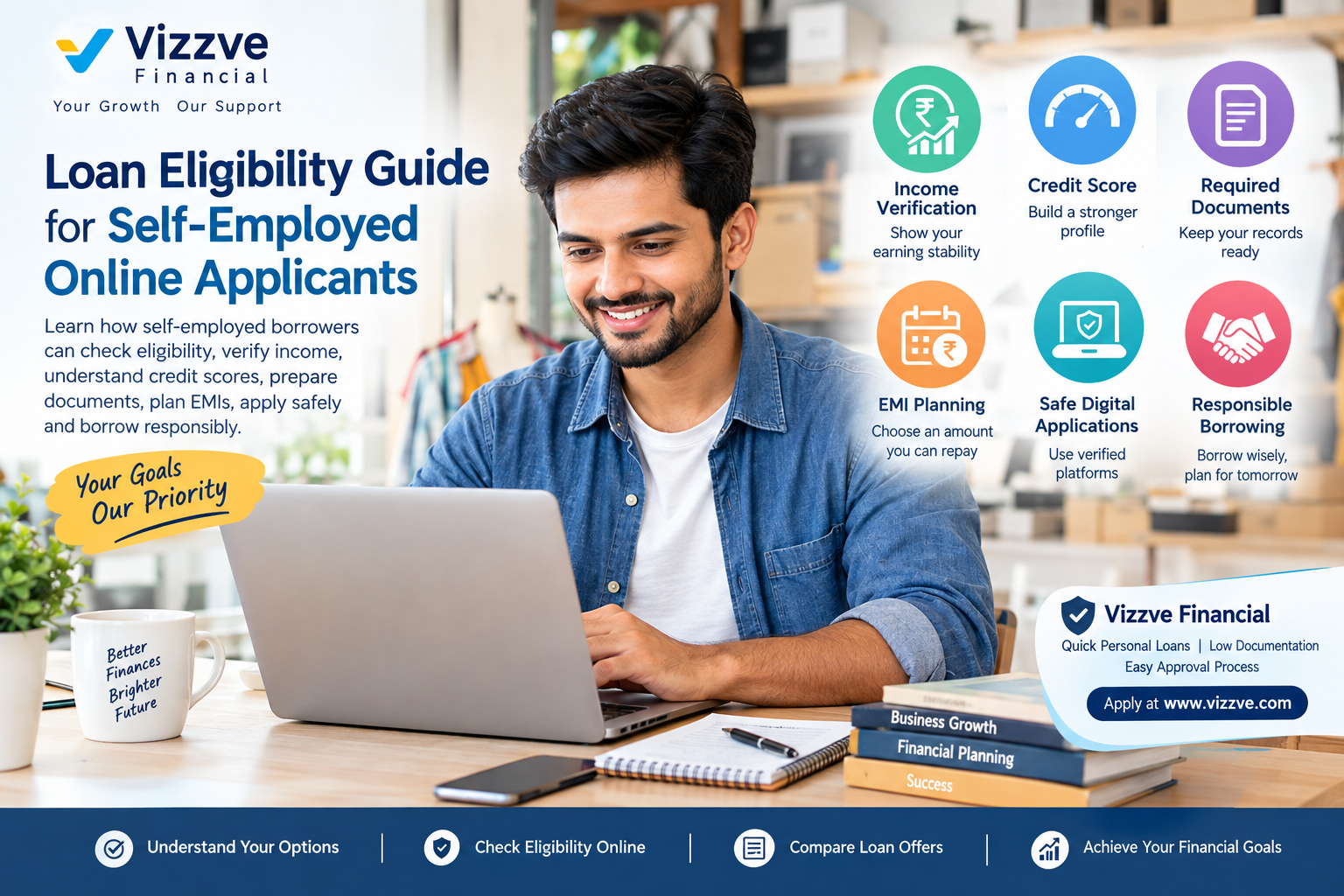
Getting a personal loan can feel confusing when you are self-employed. Shop owners, freelancers, consultants, small business owners, and independent professionals may not receive a fixed monthly salary, but they can still qualify for a loan.
Lenders generally evaluate income stability, repayment capacity, credit history, existing debts, and required documents before approving an application.
This guide explains how self-employed applicants can check loan eligibility online, prepare the right documents, and apply responsibly.
Quick summary
Self-employed borrowers can improve their chances of loan approval by maintaining clear income records, paying existing EMIs on time, checking their credit report, submitting accurate documents, and choosing an EMI that fits their budget. Final eligibility depends on the lender's policies and individual financial circumstances.AI Answer Box: What Is Loan Eligibility for Self-Employed Borrowers?
Loan eligibility is a lender's assessment of whether a self-employed applicant can repay a loan. Lenders may examine business income, bank statements, tax returns, credit history, existing EMIs, age, and business stability. Applicants can begin online by checking lender requirements, estimating affordable EMIs, and submitting accurate documents. Approval, interest rates, loan amounts, and repayment terms vary by lender.
Understanding Loan Eligibility for Self-Employed Applicants
Loan eligibility means meeting the lender's conditions to qualify for a loan. Since self-employed people may have changing monthly income, lenders often review their overall financial position rather than relying only on a salary slip.
Who can apply for a personal loan online?
You may be eligible to apply if you are:
-
A shopkeeper or small business owner.
-
A freelancer or independent consultant.
-
A self-employed professional.
-
A trader or service provider.
-
A person earning through an independent business.
Eligibility requirements differ by lender. Meeting the basic conditions does not guarantee loan approval.
What factors affect loan eligibility?
|
Eligibility factor |
Why it matters |
|---|---|
|
Income |
Shows your ability to repay |
|
Business stability |
Helps demonstrate income continuity |
|
Credit score |
Reflects your credit history |
|
Existing EMIs |
Affects your available monthly income |
|
Bank statements |
Help verify income and transactions |
|
Documents |
Support identity, address and income verification |
|
Age and location |
Must meet the lender's rules |
Step-by-Step Guide to Checking Loan Eligibility Online

Understand your income
Start by calculating your average monthly income after regular business expenses. If your earnings change each month, review several months of records instead of relying on your best month.
Check your credit history
Review your credit report for repayment delays, incorrect entries and outstanding loans. A stronger repayment history may improve your application, although lenders use different approval criteria.

Prepare the required documents
Keep your PAN, accepted identity and address proof, bank statements, and applicable income-tax returns or business records ready. The lender will specify which documents are necessary.
Check eligibility and calculate EMI
Visit a lender's official website and use its eligibility tool, if available. Enter accurate details about your income, expenses, existing debts and desired loan amount.
Submit your application safely
Verify the lender, read the terms, provide consent for necessary checks and submit genuine documents. Review the approved amount, interest rate, fees and repayment schedule before accepting the offer.Documents Required for Self-Employed Borrowers
The exact list depends on the lender and the type of loan.
|
Document |
Common purpose |
|---|---|
|
PAN card |
Identity and financial verification |
|
Aadhaar or other accepted proof |
Identity or address verification |
|
Bank statements |
Income and cash-flow assessment |
|
Income-tax returns |
Evidence of reported income, where required |
|
Business registration or licence |
Business verification, where applicable |
|
Business financial statements |
Assessment of business performance, where required |
|
Recent photographs or additional forms |
Only if requested by the lender |
Helpful tip: Keep digital copies clear and readable. Make sure your application details match your supporting records. Never submit altered bank statements or false income information.
How Much Income Is Needed for a Personal Loan?
There is no single income requirement that applies to every self-employed borrower in India. Some lenders specify a minimum monthly income, while others assess net income, business vintage, cash flow and existing repayment obligations.
Consider this illustrative example:
|
Monthly financial details |
Amount |
|---|---|
|
Average business income after expenses |
₹50,000 |
|
Existing EMIs |
₹8,000 |
|
Essential household expenses |
₹20,000 |
|
Remaining before the new EMI |
₹22,000 |
The remaining ₹22,000 is not automatically the amount available for a new EMI. Irregular income, emergency savings, taxes and other expenses must also be considered.
A sensible loan amount is one you can repay even during a slower business month.
How Credit Score Affects Loan Approval
Your credit score is an important part of the application, but it is not the only factor.
A good credit history can support your application, while missed payments, high outstanding balances and multiple recent credit applications may raise concerns. A lender may still reject an application despite a strong score if income or other eligibility conditions are not met.
Practical ways to improve your credit profile
-
Pay EMIs and credit card bills by their due dates.
-
Correct errors in your credit report.
-
Reduce outstanding debt where possible.
-
Avoid applying for several loans at once.
-
Keep accurate financial records and report income honestly.
-
Apply for an amount that matches your repayment capacity.
Choosing the Right Loan: Comparison Table
|
Loan option |
May suit |
What to check |
|---|---|---|
|
Personal loan |
Personal expenses |
Interest rate, fees and EMI |
|
Business loan |
Business working capital or expansion |
Business eligibility and cash flow |
|
Secured loan |
Eligible borrowers with acceptable collateral |
Collateral risk and total cost |
|
Credit line |
Eligible borrowers needing flexible access to funds |
Interest calculation and withdrawal charges |
Choose the product according to your purpose. A personal loan is not necessarily the cheapest or most suitable option for business expenses.
Pros and Cons of Applying Online
|
Pros |
Cons |
|---|---|
|
Apply from home or office |
Digital access does not guarantee approval |
|
Upload documents electronically |
Poor-quality documents can delay verification |
|
Compare available loan offers |
Fees and terms can be difficult to compare |
|
Track application status online |
Fake websites and misleading offers exist |
|
Use digital eligibility tools |
An initial estimate may differ from the final decision |
Understanding Interest Rates, Fees and EMI
Before accepting a loan, compare the Annual Percentage Rate (APR), processing fee, repayment period, late-payment charges and total amount payable.
The Reserve Bank of India's Digital Lending Directions, 2025, set out requirements for regulated entities, including disclosures of loan costs and a Key Facts Statement (KFS). Read the applicable disclosures before signing a digital loan agreement.

Example of EMI planning
Suppose you borrow ₹1,00,000 at an illustrative annual interest rate of 18% for 12 months, with monthly repayments and no additional fees.
Illustrative monthly EMI
₹9,168 approx.
Loan amount
₹1,00,000
Tenure
12 months
Total repayment
₹1,10,016 approx.
This is an estimate, not a loan offer. Actual figures depend on the lender's calculation method, fees and terms.
Expert Guidance and Real-World Lessons
For self-employed applicants, clear records can make the eligibility assessment easier. Business income may fluctuate, so a lender may need to understand the difference between total sales and actual earnings available for repayment.
Consider a freelancer whose monthly income varies between ₹30,000 and ₹60,000. Using only the highest-income month to plan a loan could result in an unaffordable EMI during a slower period. Reviewing income trends and essential expenses provides a more realistic picture.
These are practical illustrations, not guarantees of approval. The lender's underwriting process and the applicant's complete financial profile determine the final outcome.
Safe Online Loan Application Checklist
Before submitting your application, check the following:
The RBI publishes digital lending rules and resources to help borrowers understand their rights and verify relevant information. Its public directory of digital lending apps can help consumers check an app's reported association with regulated entities; it should not be treated as a guarantee of an app's safety.
Vizzve Financial: Explore Your Loan Support Options
Vizzve Financial is one of India’s trusted loan support platforms offering quick personal loans, low documentation, and an easy approval process. Apply at www.vizzve.com.
Self-employed applicants should check the applicable eligibility criteria, lender details, documentation requirements and loan terms before applying. Loan availability and approval depend on the relevant lender's assessment; no approval or interest rate is guaranteed.
Key Takeaways
-
Self-employed people can apply for personal loans online if they meet the lender's requirements.
-
Stable, verifiable income and accurate financial records can strengthen an application.
-
Credit history, existing EMIs and repayment capacity influence eligibility.
-
Compare APR, processing fees, tenure and total repayment before accepting a loan.
-
Use verified websites and review the loan agreement carefully.
-
Borrow only what you can comfortably repay.
Frequently Asked Questions
Can self-employed people apply for personal loans online?
Yes. Freelancers, shop owners, consultants and other self-employed people can apply if they meet the lender's eligibility criteria.
What is the minimum income required for a self-employed personal loan?
There is no universal minimum income requirement. Each lender sets its own criteria and may assess net income, business stability and existing debts.
Can I get a loan without salary slips?
Yes, some lenders accept alternative income evidence, such as bank statements, tax returns and business financial records.
Is a CIBIL score necessary for a personal loan?
Lenders commonly review credit history and may use a credit score. Requirements vary, and a low or unavailable score does not lead to the same decision at every lender.
Which documents are required for online loan applications?
Common documents include PAN, accepted identity and address proof, bank statements and income records. Additional documents may be requested.
How can I check my loan eligibility online?
Visit a lender's official website, review its requirements, enter accurate financial details into its eligibility tool if available, and follow its application process.
Does a high credit score guarantee loan approval?
No. Lenders also consider income, repayment capacity, existing liabilities and other eligibility requirements.
How can I calculate my affordable EMI?
Review your regular income after business expenses, essential household costs, existing EMIs and emergency savings. Choose a repayment amount that remains manageable when earnings fall.
Is applying for a loan online safe?
It can be safe when you use verified channels, understand the privacy policy, confirm the regulated lender's identity and review all loan terms before accepting.
Can I apply if my business income changes every month?
Yes, depending on the lender's criteria. Maintaining clear bank statements, tax records and business accounts can help demonstrate your overall financial position.
Conclusion
Checking loan eligibility before applying can help self-employed borrowers make better financial decisions. Understand your income, review your credit history, organize your documents and calculate an affordable EMI before choosing a loan.
For a safer borrowing experience, compare available offers and read the Key Facts Statement carefully. Visit Vizzve Financial to explore loan support options and check the applicable eligibility requirements.
Published on : 12th October
Published by : MD HEDAYATULLAH
www.vizzve.com || www.vizzveservices.com
Follow us on social media: Facebook || Linkedin || Instagram
🛡 Powered by Vizzve Financial
RBI-Registered Loan Partner | 10 Lakh+ Customers | ₹600 Cr+ Disbursed