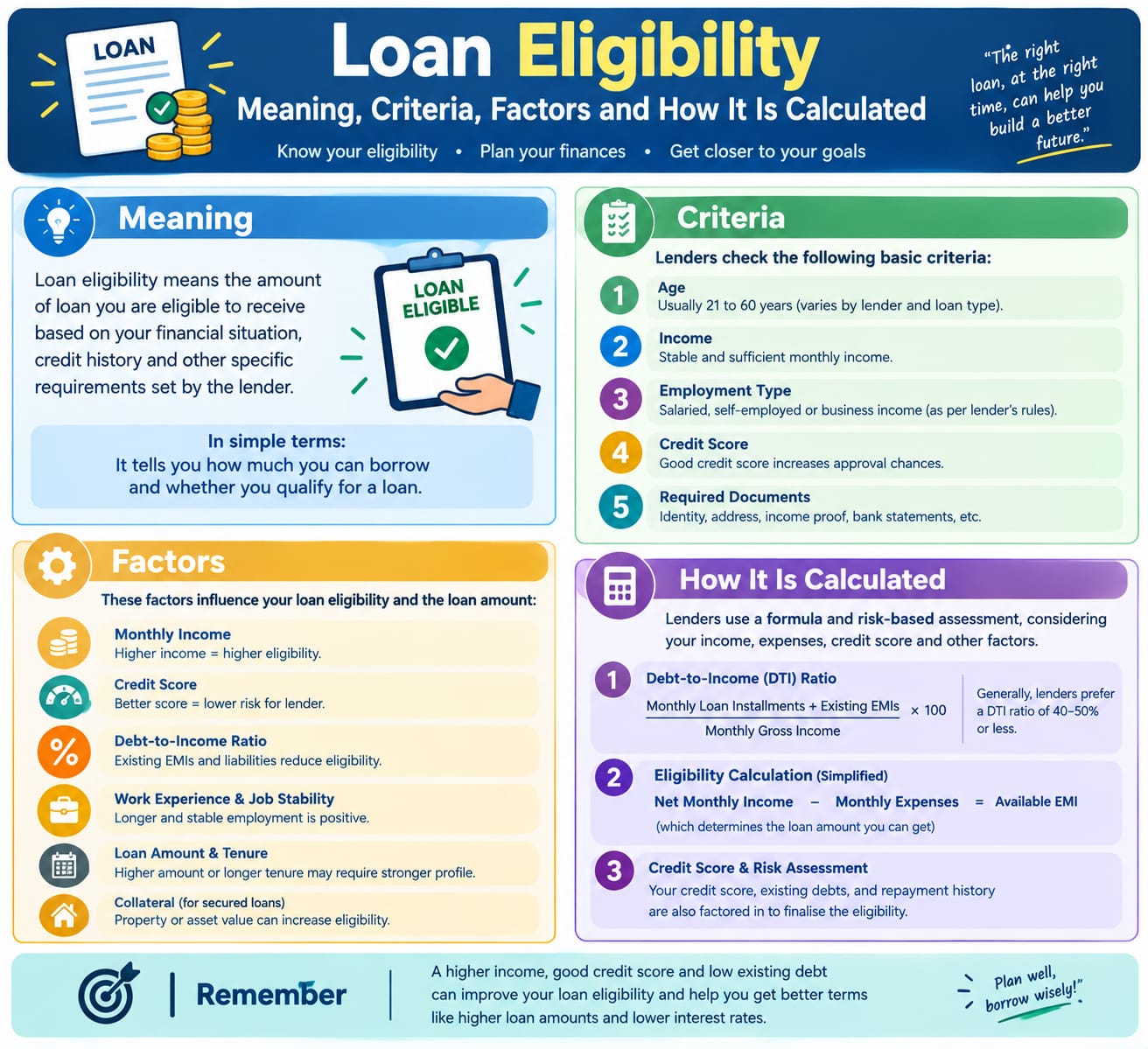
Loan Eligibility: Meaning, Criteria, Factors and How It Is Calculated
Vizzve Admin
Loan eligibility is an important factor to understand before applying for any type of loan. Banks and financial institutions assess several aspects of a borrower’s financial profile to determine whether they qualify for a loan and how much they may be able to borrow. Factors such as income, age, credit history, existing EMIs, employment stability, loan tenure and repayment capacity can influence the eligibility assessment.
Understanding how loan eligibility is calculated can help borrowers choose a suitable loan amount, plan their monthly repayments and prepare the necessary documents. In this guide, we explain the meaning of loan eligibility, key eligibility criteria, major factors that affect it and how lenders generally assess a borrower’s repayment capacity.
What Is Loan Eligibility?
Loan eligibility refers to the criteria a bank or financial institution uses to determine whether an applicant qualifies for a loan and the maximum loan amount they may be able to receive.
Lenders generally evaluate:
- Monthly income
- Age
- Employment or business stability
- Credit score and credit history
- Existing loans and EMIs
- Debt-to-income or fixed-obligation ratios
- Loan tenure
- Type and purpose of the loan
- Relationship with the lender
- Applicable lending policies
Eligibility requirements vary between lenders and loan products.
How Is Loan Eligibility Calculated?
There is no single formula applicable to every lender. For many personal and retail loans, lenders assess the applicant's repayment capacity after considering existing financial obligations.
A simplified illustration is:
Estimated EMI Capacity = Monthly Income − Existing Monthly Obligations − Other Considered Expenses
The lender may then use the applicant's eligible EMI capacity, applicable interest rate, and loan tenure to determine a possible loan amount.
For example, if a borrower earns ₹60,000 per month and already pays ₹15,000 toward existing EMIs, the lender will consider the remaining repayment capacity while assessing a new loan.
Note: This is only an illustration. Actual eligibility calculations differ by lender and loan type.
Key Loan Eligibility Criteria
1. Age
Lenders usually specify minimum and maximum age requirements. The maximum permissible age may also be considered at the end of the loan tenure.
2. Income
Income is an important factor because it indicates the borrower's ability to repay the loan. Lenders may consider:
- Salary income
- Business income
- Professional income
- Other eligible income sources
Income requirements can vary according to the loan type and lender.
3. Employment or Business Stability
For salaried applicants, lenders may consider employment history and job stability. Self-employed applicants may need to provide business and income-related documents.
4. Credit History
Credit history helps lenders assess previous borrowing and repayment behaviour. Factors such as repayment delays, defaults and outstanding credit obligations can affect a lender's assessment.
5. Existing Loans and EMIs
Existing financial commitments reduce the amount of income available for a new EMI. A borrower with substantial existing obligations may therefore qualify for a lower additional loan amount.
6. Loan Tenure
Loan tenure affects the EMI and overall repayment. A longer tenure can reduce the monthly EMI for a given principal, while increasing the total interest payable over the loan period.
7. Loan Type
Eligibility criteria differ depending on whether the applicant is seeking a:
- Personal loan
- Home loan
- Education loan
- Vehicle loan
- Business loan
- Gold loan
- Loan against property
Factors That Affect Loan Eligibility
| Factor |
How It Can Affect Eligibility |
| Monthly income |
Higher eligible income may support greater repayment capacity |
| Credit history |
Strong repayment history may support lender assessment |
| Existing EMIs |
Higher obligations can reduce available repayment capacity |
| Age |
Can affect permitted loan tenure |
| Employment stability |
May influence income stability assessment |
| Loan tenure |
Changes the EMI and repayment structure |
| Loan amount |
Larger borrowing creates higher repayment obligations |
| Loan type |
Each product has different eligibility requirements |
How to Improve Loan Eligibility
Borrowers can consider the following steps before applying:
Maintain a Good Credit History
Pay credit-card bills and existing EMIs on time. Avoid unnecessary defaults or repeated missed payments.
Reduce Existing Debt
Paying down high outstanding debt can improve monthly repayment capacity.
Maintain Stable Income
Consistent income and employment or business records can help demonstrate repayment capacity.
Choose an Appropriate Loan Amount
Applying for an amount that aligns with your income and existing obligations may make the application more manageable.
Consider the Loan Tenure Carefully
A suitable tenure can help keep the EMI within an affordable range, but borrowers should also consider the total interest payable.
Avoid Multiple Loan Applications
Submitting numerous credit applications within a short period may result in multiple lender credit enquiries. It is generally better to compare suitable options before applying.
Documents Commonly Required for Loan Eligibility
The exact requirements depend on the lender and loan type. Common documents may include:
- Identity proof
- Address proof
- PAN or other applicable tax identification
- Salary slips
- Bank statements
- Income-tax returns for eligible applicants
- Employment or business documents
- Existing loan statements
- Property-related documents for secured loans
Loan Eligibility vs Loan Amount
Loan eligibility and the approved loan amount are not always the same.
Eligibility is an assessment of how much a borrower may qualify for based on the lender's criteria. The final sanctioned amount can depend on additional factors, including verification, documentation, property value for secured loans, lender policies, and the borrower's overall financial profile.
Why Loan Eligibility Matters
Checking eligibility before applying can help borrowers:
- Estimate a realistic borrowing amount
- Understand their potential EMI
- Prepare documents in advance
- Compare suitable loan products
- Avoid applying for an unnecessarily high amount
- Plan their monthly budget
AI Answer Box: Loan Eligibility Explained
Loan eligibility is the assessment used by a bank or financial institution to determine whether a borrower qualifies for a loan and how much they may be able to borrow. It is generally influenced by income, age, credit history, existing EMIs, employment or business stability, loan tenure, and the type of loan. The exact eligibility calculation varies by lender.
Key Takeaways
- Loan eligibility indicates whether a borrower may qualify for a loan.
- Income and repayment capacity are major considerations.
- Credit history and existing EMIs can affect eligibility.
- Age can influence the available loan tenure.
- Different loan products have different eligibility requirements.
- Eligibility does not guarantee final loan approval.
- Borrowers should compare loan terms and assess affordability before applying.
FAQs
1. What is loan eligibility?
Loan eligibility is the set of conditions a lender uses to determine whether an applicant qualifies for a loan and the amount they may potentially borrow.
2. What factors affect loan eligibility?
Income, age, credit history, existing EMIs, employment stability, loan tenure and loan type are among the factors that can affect eligibility.
3. Does income affect loan eligibility?
Yes. Lenders generally consider income when assessing a borrower's repayment capacity.
4. Does credit score affect loan eligibility?
Credit history can influence a lender's assessment of an applicant's creditworthiness, although the exact criteria vary by lender.
5. Do existing EMIs reduce loan eligibility?
Existing EMIs represent financial obligations and can reduce the income available for repayment of a new loan.
6. Can self-employed people qualify for loans?
Yes. Self-employed applicants can qualify if they meet the lender's applicable eligibility and documentation requirements.
7. Does age affect loan eligibility?
Yes. Lenders may have minimum and maximum age requirements, and age can also influence the permitted loan tenure.
8. Does a longer loan tenure increase eligibility?
A longer tenure may reduce the EMI for a given loan amount, which can affect repayment-capacity calculations. However, lender policies differ.
9. Is loan eligibility the same as loan approval?
No. Eligibility is an initial assessment. Final approval may depend on document verification, underwriting and other lender-specific conditions.
10. How can I improve my loan eligibility?
Maintaining a strong repayment record, reducing existing debt, maintaining stable income and choosing an affordable loan amount can help strengthen your overall application.
11. Can I check loan eligibility before applying?
Many banks and financial institutions provide online eligibility calculators or application-based assessments.
12. Does loan tenure affect eligibility?
Yes. Tenure affects the EMI and therefore can influence how lenders assess repayment capacity.
13. Can I get a loan with a low credit score?
Possibly, depending on the lender, loan type, income, existing obligations and other factors. However, terms and eligibility may differ.
14. Why was my loan eligibility lower than expected?
Possible reasons include existing EMIs, income level, credit history, age, requested loan amount, loan tenure or lender-specific eligibility rules.
15. Is there one standard loan eligibility formula?
No. Banks and financial institutions use different criteria and assessment methods depending on the product and applicant profile.
Conclusion
Loan eligibility helps lenders assess a borrower’s ability to repay a proposed loan and determine the amount they may potentially qualify for. Income, credit history, existing financial obligations, age, employment or business stability and loan tenure are some of the important factors considered during this assessment.
Before applying, borrowers should understand the lender’s eligibility requirements, review their existing financial commitments and choose a loan amount that fits their repayment capacity. Since eligibility criteria and calculation methods vary between lenders and loan products, checking the specific terms of the chosen lender can help borrowers make a more informed borrowing decision.
Explore Vizzve Financial
Published on : 28th September
Published by : MONISHA
www.vizzve.com || www.vizzveservices.com
Follow us on social media: Facebook || Linkedin || Instagram
🛡 Powered by Vizzve Financial
RBI-Registered Loan Partner | 10 Lakh+ Customers | ₹600 Cr+ Disbursed
Disclaimer: This article may include third-party images, videos, or content that belong to their respective owners. Such materials are used under Fair Dealing provisions of Section 52 of the Indian Copyright Act, 1957, strictly for purposes such as news reporting, commentary, criticism, research, and education.
Vizzve and India Dhan do not claim ownership of any third-party content, and no copyright infringement is intended. All proprietary rights remain with the original owners.
Additionally, no monetary compensation has been paid or will be paid for such usage.
If you are a copyright holder and believe your work has been used without appropriate credit or authorization, please contact us at grievance@vizzve.com. We will review your concern and take prompt corrective action in good faith... Read more

