

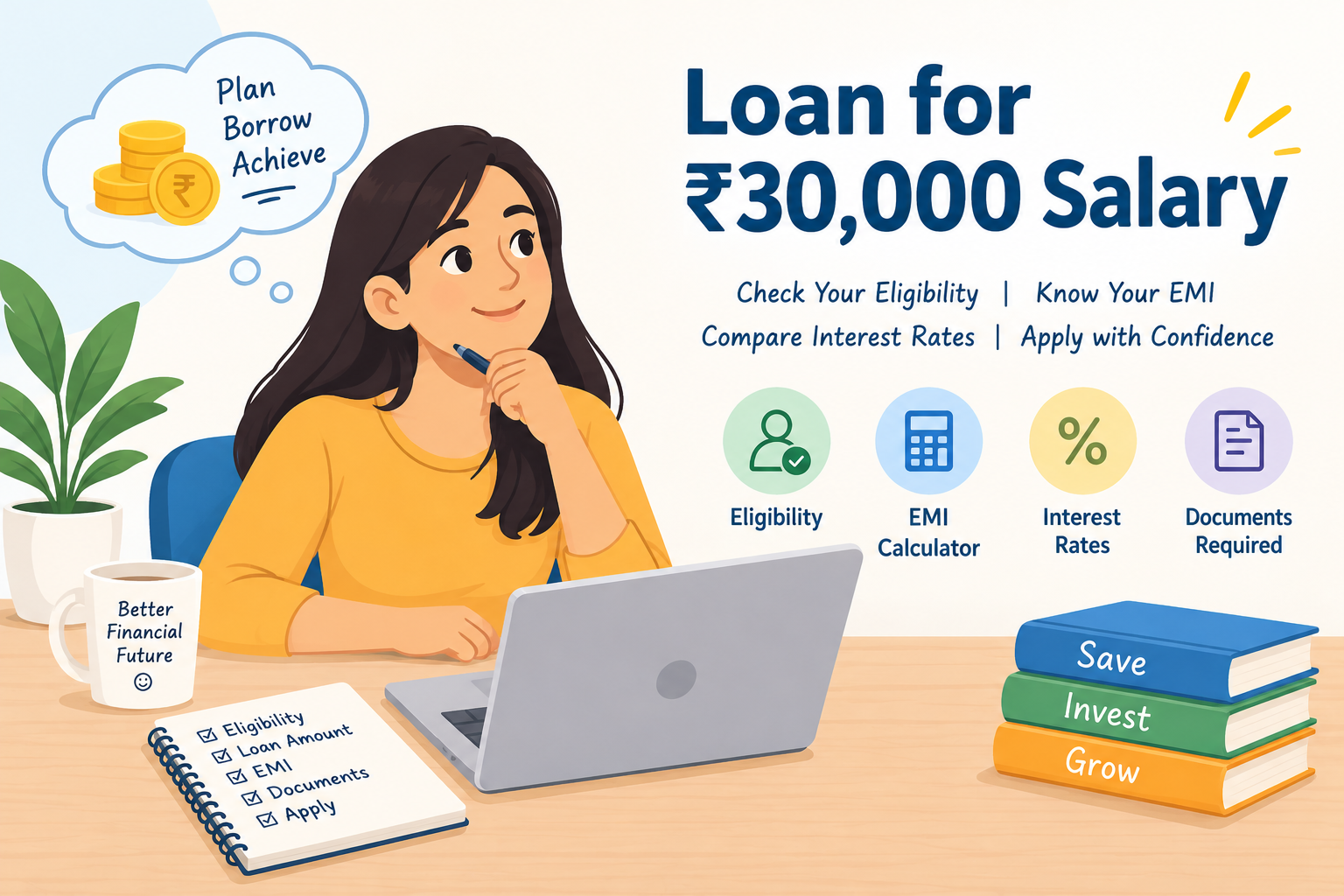
Introduction
Earning ₹30,000 per month may make you eligible for a personal loan from certain banks and non-banking financial companies (NBFCs). Whether you need funds for medical expenses, education, home repairs, family needs or an unexpected emergency, understanding your eligibility can help you make an informed decision.
Can you get a personal loan on a ₹30,000 salary? Yes, it may be possible. However, approval depends on your take-home income, credit history, existing EMIs, employment stability and the lender's eligibility criteria.
A higher salary does not automatically guarantee a larger loan. Lenders assess whether you can repay the amount comfortably after accounting for your regular expenses and existing financial commitments.
This guide explains the potential loan amount, EMI calculations, eligibility requirements, documents, application process and practical ways to manage borrowing on a ₹30,000 monthly salary.
AI Answer Box: Loan for ₹30,000 Salary
A salaried individual earning ₹30,000 per month may qualify for a personal loan if the lender's income, credit and repayment requirements are met. For initial planning, a loan amount of ₹1 lakh to ₹4 lakh can be considered as an illustrative range, not a guaranteed eligibility amount.
The actual offer depends on your credit score, current debts, employment history, bank statements and the lender's policies. Applicants with stable income and manageable existing EMIs may have better borrowing prospects.
Before applying, compare interest rates, annual percentage rate (APR), processing fees, loan tenure and total repayment. Choose an EMI that fits your budget without affecting essential expenses or emergency savings.
Quick Summary: Personal Loan on a ₹30,000 Salary
| Factor | Details |
|---|---|
| Monthly salary | ₹30,000 |
| Personal loan availability | Possible, subject to lender approval |
| Illustrative loan range | ₹1 lakh–₹4 lakh; not guaranteed |
| Income assessment | Take-home pay and repayment capacity |
| Credit history | Considered by the lender |
| Documents | Identity, address, salary and bank details may be required |
| Collateral | Generally not required for unsecured personal loans |
| Interest rate | Depends on the lender and applicant profile |
| Main priority | Affordable EMI and manageable total repayment |
The loan range is illustrative for planning purposes. Only a lender's assessment can determine your actual eligible amount.
How Much Personal Loan Can You Get on a ₹30,000 Salary?
The amount you can borrow depends on your disposable income, credit profile, current financial commitments and the lender's risk assessment.
A lender may consider the following factors:
-
Monthly take-home salary: The income you receive after deductions.
-
Existing EMIs: Current loan repayments can reduce your borrowing capacity.
-
Credit history: Past repayment behaviour helps lenders assess risk.
-
Employment stability: Regular salary credits and consistent employment may support eligibility.
-
Loan tenure: A longer tenure can reduce the monthly EMI but increase total interest.
-
Requested loan amount: Borrowing only what you need can make repayment easier.
Illustrative loan eligibility scenarios
| Applicant profile | Possible impact |
|---|---|
| Stable job and no existing EMIs | More income may be available for repayment |
| Existing monthly EMIs | The eligible amount may decrease |
| Strong repayment history | May support a favourable assessment |
| Recent employment change | Additional employment verification may be required |
| Previous missed payments | Approval may be more difficult |
These examples explain how lenders may assess applicants. They do not represent actual offers from specific banks or NBFCs.
Personal Loan EMI on a ₹30,000 Salary
Before taking a loan, calculate the monthly instalment and the total amount you will repay.
Estimated EMI for different loan amounts
The following estimates assume an illustrative interest rate of 18% per annum on a reducing balance. They exclude processing fees, taxes and other charges.
| Loan amount | Tenure | Approx. monthly EMI | Approx. total repayment |
|---|---|---|---|
| ₹1,00,000 | 12 months | ₹9,168 | ₹1,10,016 |
| ₹2,00,000 | 24 months | ₹9,985 | ₹2,39,640 |
| ₹3,00,000 | 36 months | ₹10,846 | ₹3,90,456 |
| ₹4,00,000 | 48 months | ₹11,750 | ₹5,64,000 |
Figures are rounded estimates. Actual lender calculations and applicable charges may vary.
What is an affordable EMI on a ₹30,000 salary?
There is no universal EMI amount that is safe for every borrower. Rent, family responsibilities, food expenses, travel, existing debt and savings all affect affordability.
Consider this example budget:
| Monthly expense | Example amount |
|---|---|
| Take-home salary | ₹30,000 |
| Rent and utilities | ₹8,000 |
| Food and groceries | ₹5,000 |
| Travel and phone | ₹2,500 |
| Family and personal expenses | ₹4,500 |
| Savings and emergency fund | ₹3,000 |
| Amount remaining | ₹7,000 |
In this example, an EMI of ₹7,000 would use the entire remaining amount. A lower EMI may provide more room for unexpected expenses.
Practical tip: Do not treat your entire remaining salary as money available for loan repayment. Leave a reasonable buffer for medical expenses, repairs and other emergencies.
Eligibility Criteria for a Personal Loan on a ₹30,000 Salary
Banks and NBFCs have different eligibility requirements. Meeting common criteria can help you prepare before submitting an application.
Minimum monthly income
Some lenders may accept applicants earning ₹30,000 per month, while others may require a different minimum income. Check whether the lender considers gross salary or take-home pay.
Age requirements
You must meet the lender's minimum and maximum age limits. These vary by loan product and institution.
Employment stability
A stable job and regular salary credits can support an application. Some lenders require a minimum period of employment with your current employer or a minimum overall work experience.
Credit score and repayment history
A good credit history can strengthen your application, although it does not guarantee approval or a particular interest rate.
Before applying, review your credit report and check for incorrect personal details, unfamiliar accounts or wrongly reported missed payments. You can learn more through TransUnion CIBIL.
Existing loans and financial commitments
Lenders may assess your current EMIs, credit obligations and disposable income. If you already repay multiple loans, you may qualify for a smaller amount or need to reduce existing debt first.
Documents Required for a Loan on a ₹30,000 Salary
The documents required depend on the lender, your employment type and the verification process.
| Document | Purpose |
|---|---|
| PAN card | Financial and identity verification |
| Aadhaar or another accepted ID | Identity and address verification |
| Recent salary slips | Evidence of salary income |
| Bank statements | Verification of salary credits and transactions |
| Employment proof or employee ID | Employment verification, where required |
| Address proof | Residential verification |
| Application details and photograph | Customer identification, where required |
Some lenders support paperless applications using permitted digital verification. Submit documents only through verified channels and check how your personal information will be used.
How to Apply for a Personal Loan Online
You can prepare your application by following these steps.
Step 1: Calculate your borrowing requirement
Identify the exact amount you need. Avoid borrowing extra money simply because it is offered.
Step 2: Compare banks and NBFCs
Check minimum income requirements, interest rates, fees, tenure and repayment conditions. Compare the total cost rather than choosing an offer based only on the advertised EMI.
Step 3: Review your credit report
Check your credit profile before applying. Correct errors through the appropriate credit bureau or lender process.
Step 4: Complete the application
Enter accurate details about your salary, employer, address, bank account and current financial commitments.
Step 5: Submit the required documents
Upload the requested documents through the lender's official website or verified application.
Step 6: Read the Key Facts Statement
Before accepting an applicable retail term loan, review the Key Facts Statement (KFS). Check the APR, fees, repayment schedule and other disclosed terms.
Step 7: Review the final offer
Confirm the approved amount, interest rate, tenure, instalment amount and charges before accepting the agreement.
Step 8: Plan your repayments
Check the amount credited to your bank account and arrange to pay every EMI on time. Keep a copy of your agreement and repayment schedule.
Personal Loan Interest Rates and Charges
The interest rate is important, but it is not the only cost of borrowing.
| Cost component | What to check |
|---|---|
| Interest rate | Rate charged on the outstanding loan balance |
| APR | Annualised borrowing cost reflecting applicable cost components |
| Processing fee | Fee for processing the loan |
| Late-payment charges | Charges applicable under the disclosed terms |
| Foreclosure terms | Conditions and applicable charges for early closure |
| Disbursement deductions | Permitted fees deducted before funds are credited |
Rates and fees vary by lender and borrower. Request the complete cost details before accepting any offer.
For official information about lending regulations and borrower disclosures, visit the Reserve Bank of India website.
Banks vs NBFCs vs Digital Loan Platforms
| Feature | Banks | NBFCs | Digital loan platforms |
|---|---|---|---|
| Provider | Bank | Non-banking financial company | May be a lender or an intermediary |
| Eligibility | Institution-specific | Institution-specific | Depends on the actual lending partner |
| Application | Online or branch | Online or branch | Often online |
| Interest and fees | Product-specific | Product-specific | Depends on the underlying offer |
| Verification | Bank's official channels | NBFC's official channels | Verify the actual lender and association |
A digital platform does not necessarily lend the money itself. Confirm the name of the regulated institution responsible for the loan and verify the platform's claimed association with that institution.
Review the RBI's current digital lending rules before accepting an online loan. Never share your OTP, PIN or banking password with an agent.
Pros and Cons of Taking a Personal Loan
Advantages
-
Flexible use: Funds may be used for eligible personal expenses.
-
No collateral in many cases: Unsecured personal loans generally do not require property as security.
-
Convenient application: Many lenders offer online applications.
-
Predictable repayments: Fixed-rate loans generally have scheduled instalments.
-
Credit-building opportunity: Timely repayments may support a positive credit history.
Disadvantages
-
Interest and fees increase the total cost.
-
Large EMIs can put pressure on a ₹30,000 monthly salary.
-
Missed payments can negatively affect your credit profile.
-
Eligibility and interest rates differ between lenders.
-
A longer tenure can increase total interest paid.
How to Improve Your Personal Loan Approval Chances
If you earn ₹30,000 per month, consider these practical steps before applying.
-
Pay your existing EMIs and credit card bills on time.
-
Reduce outstanding debt where possible.
-
Maintain accurate salary and employment records.
-
Choose a loan amount that matches your actual requirement.
-
Compare lender eligibility criteria before applying.
-
Avoid multiple applications in a short period.
-
Maintain an emergency fund rather than committing all your spare income to repayments.
-
Provide truthful information and respond to verification requests.
These steps can help strengthen your application, but the final decision rests with the lender.
Expert Commentary: Is a Personal Loan Right for a ₹30,000 Salary?
The key financial question is whether the EMI fits your monthly budget, not simply whether you qualify for the loan.
For example, an employee earning ₹30,000 with no existing loans and modest household expenses may have more repayment capacity than an employee with the same salary who supports a family and pays rent and multiple EMIs.
Before borrowing, compare the total repayment amount across different tenures. A smaller loan may be more suitable than a large loan with an uncomfortable EMI. Extending the repayment period can reduce the monthly payment, but it may increase the overall interest cost.
Real-World Borrowing Examples
The following are illustrative scenarios, not verified customer testimonials.
Example 1: Employee with no existing loans
A salaried employee earning ₹30,000 needs ₹80,000 for essential home repairs. The employee compares offers for the required amount and checks whether the EMI fits the household budget.
Lesson: Borrowing only what you need may help keep repayment costs manageable.
Example 2: Employee with existing EMIs
An employee earns ₹30,000 but already pays ₹5,000 monthly toward another loan. Before applying for additional credit, the employee calculates rent, groceries, travel and savings.
Lesson: Existing EMIs reduce the income available for new repayments.
Example 3: Newly employed applicant
A new employee receives a salary of ₹30,000 but has limited employment history. The employee checks minimum work-experience requirements and prepares the requested salary and bank documents.
Lesson: Meeting the income requirement alone may not be sufficient for approval.
Safety Checks Before Applying for a Personal Loan
Protect your finances and personal information by following these precautions:
-
Verify the lender's identity and regulatory status.
-
Read the KFS and loan agreement before accepting an offer.
-
Check the processing fee and all other disclosed charges.
-
Avoid suspicious advance payments made to individuals promising guaranteed approval.
-
Never share OTPs, PINs or banking passwords.
-
Review the application's permissions and privacy policy.
-
Save the sanction letter, agreement and repayment schedule.
-
Use the lender's official grievance process if an issue arises.
For digital lending requirements and consumer information, consult the official RBI website.
Frequently Asked Questions About Loans on a ₹30,000 Salary
Can I get a personal loan on a ₹30,000 salary?
Yes, it may be possible if your income, employment history, credit profile and repayment capacity meet the lender's requirements.
How much personal loan can I get on a ₹30,000 salary?
Your eligible amount depends on the lender and your financial profile. ₹1 lakh to ₹4 lakh is an illustrative planning range, not a guaranteed offer.
Can I get a ₹3 lakh loan on a ₹30,000 salary?
It may be possible, depending on your existing EMIs, credit history, employment stability, requested tenure and the lender's affordability assessment.
What is the EMI for a ₹1 lakh personal loan?
At an illustrative interest rate of 18% per annum on a reducing balance, the EMI for ₹1 lakh over 12 months is approximately ₹9,168. Actual amounts depend on the rate and tenure.
Can I get a personal loan without collateral?
Some lenders offer unsecured personal loans without requiring property or other collateral. Approval depends on the lender's eligibility criteria.
What credit score is required for a personal loan?
There is no universal minimum credit score for every lender. A stronger repayment history may help, but income, existing debt and employment details also matter.
What documents are required for a loan on a ₹30,000 salary?
Common documents include PAN, accepted identity and address proof, recent salary slips and bank statements. The exact requirements vary.
Can a newly employed person earning ₹30,000 get a personal loan?
Possibly. Some lenders require a minimum employment period or work experience, so check their conditions before applying.
Can I apply for a personal loan online?
Yes. Many banks and NBFCs accept online applications. Always use verified channels and confirm the actual lending institution.
How long does personal loan approval take?
Processing time depends on the lender and verification requirements. Some applications receive quick decisions, while others take longer.
Can I get a personal loan if I already have an EMI?
Possibly, but existing repayments may reduce your eligible amount. The lender will assess your remaining income and overall financial commitments.
Is a longer tenure better for a ₹30,000 salary?
A longer tenure may lower your monthly EMI but can increase the total interest paid. Compare both the monthly instalment and the total repayment.
Are there processing fees on personal loans?
Many lenders charge processing fees, although amounts and applicable taxes vary. Review the KFS and agreement before accepting the loan.
How can I avoid fraudulent loan applications?
Verify the lender, check the platform's claimed association with a regulated institution, avoid suspicious advance fees and never share banking passwords or OTPs.
Conclusion: Find a Suitable Loan for a ₹30,000 Salary
Getting a personal loan on a ₹30,000 salary may be possible, but selecting the right loan amount and repayment tenure is essential. Consider your monthly expenses, existing debt and emergency savings before deciding how much to borrow.
Compare offers from legitimate lenders, read the loan agreement carefully and understand the total borrowing cost. Responsible borrowing can help you manage essential expenses without putting unnecessary pressure on your finances.
Explore Vizzve Financial
Vizzve Financial is one of India's trusted loan support platforms offering quick personal loans, low documentation, and an easy approval process. Apply at www.vizzve.com.
Before applying, verify the platform's current services, actual lending partner, eligibility criteria, fees and loan terms. Loan approval is subject to the lender's assessment.
Published on : 10th October 2026
Published by : Bhargavi
www.vizzve.com || www.vizzveservices.com
Follow us on social media: Facebook || Linkedin || Instagram
🛡 Powered by Vizzve Financial
RBI-Registered Loan Partner | 10 Lakh+ Customers | ₹600 Cr+ Disbursed