

Introduction
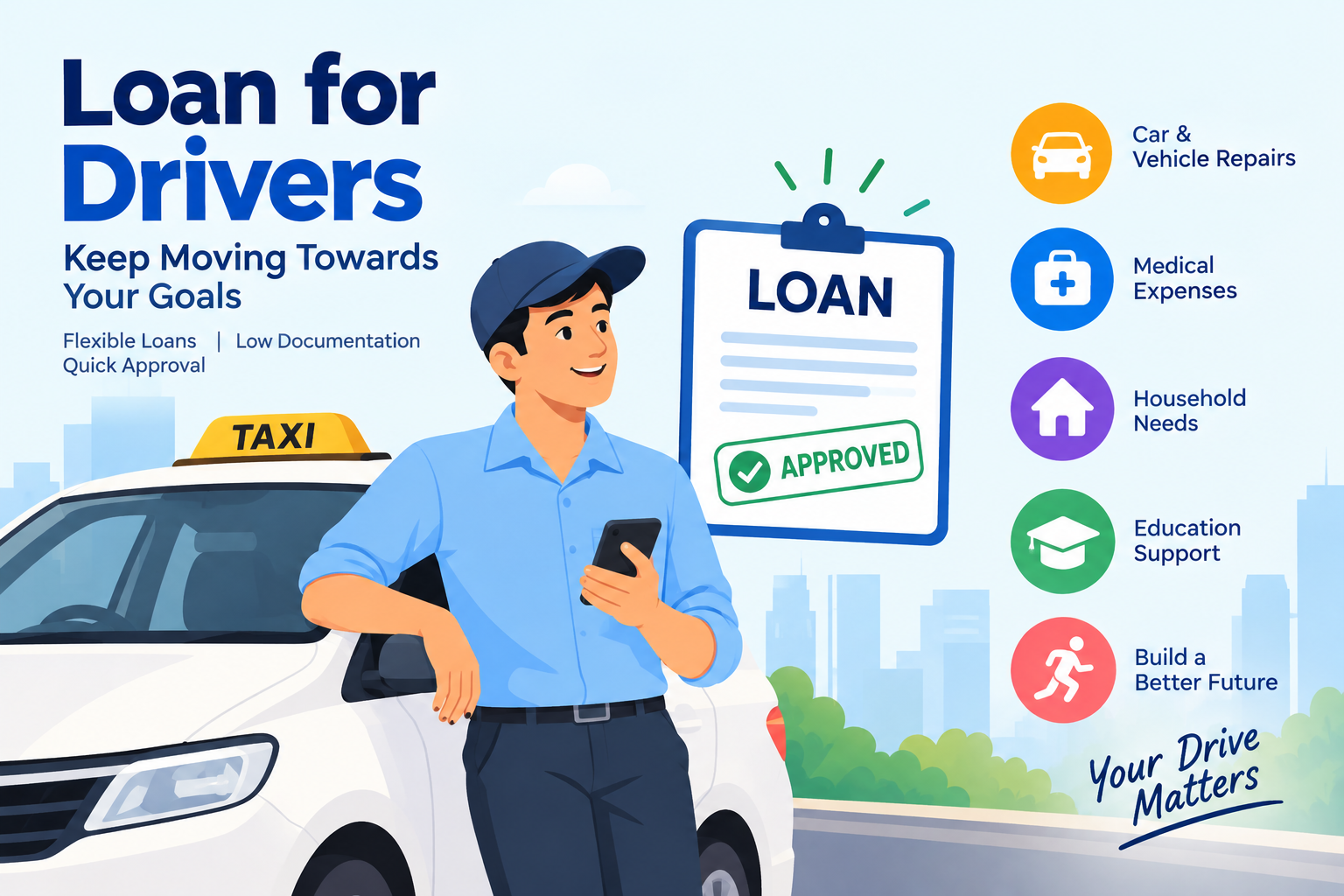
Drivers play an important role in India's transportation sector. Taxi drivers, cab drivers, auto drivers, truck drivers, private drivers, and commercial vehicle operators help people and goods reach their destinations every day.
However, drivers may face unexpected expenses, such as vehicle repairs, medical bills, household costs, insurance payments, or temporary income shortages. Managing these expenses can be difficult when earnings depend on trips, working hours, fuel prices, and customer demand.
A loan for drivers may help eligible applicants meet certain personal or vehicle-related expenses. Banks and Non-Banking Financial Companies (NBFCs) offer different loan products, but approval depends on their eligibility criteria, income assessment, credit history, and repayment capacity.
This guide explains the loan options available to drivers, eligibility requirements, documents, online application steps, interest costs, and practical tips for borrowing responsibly.
What Is a Loan for Drivers?
A loan for drivers is financing that may be available to individuals who earn income by driving taxis, cabs, auto-rickshaws, trucks, delivery vehicles, or private and commercial vehicles.
Drivers may work as salaried employees, self-employed individuals, vehicle owners, or platform-based gig workers. Their income documentation can differ depending on their employment arrangement.
For example, a salaried driver may have salary slips, while an independent taxi driver may use bank statements, trip earnings, payment records, or other acceptable income evidence.
Lenders evaluate each application individually. Working as a driver does not automatically guarantee approval or a specific loan amount.
Why Might Drivers Need a Personal Loan?
Drivers may consider a personal loan for various expenses, depending on the lender's terms.
-
Vehicle repairs: To cover unexpected repairs or maintenance.
-
Medical expenses: To manage urgent healthcare costs.
-
Household expenses: To pay essential bills during a temporary income gap.
-
Education expenses: To manage eligible education-related costs.
-
Family emergencies: To handle unexpected family requirements.
-
Personal expenses: To meet other permitted financial needs.
If the primary requirement is purchasing a vehicle for work, a dedicated vehicle loan may be more appropriate than a personal loan. Compare the total costs and conditions before deciding.
Types of Loans Available for Drivers
Personal Loan for Drivers
A personal loan may help eligible drivers pay for permitted personal expenses. Many personal loans are unsecured, meaning they do not require a specific asset as collateral. Lenders may still require proof of income and satisfactory creditworthiness.
Loan for Taxi and Cab Drivers
Taxi and cab drivers may explore personal loans if their income and credit profile meet the lender's requirements. Self-employed drivers may be asked to provide bank statements, trip earnings records, or other documents.
Commercial Vehicle Loan
Commercial vehicle financing may be suitable for drivers or eligible business owners who want to purchase a vehicle for commercial use. The vehicle may serve as security under the loan agreement.
Two-Wheeler or Auto Loan
Drivers who need a motorcycle, scooter, or auto-rickshaw for work can compare vehicle-specific financing products. Eligibility and ownership requirements vary by lender.
Small-Amount Personal Loan
Some lenders offer smaller personal loans to eligible applicants. Check the interest rate, fees, repayment period, and total repayment amount carefully before accepting an offer.
Important: Not every lender offers loans specifically for drivers. Always confirm that the product is available to your employment category and that you meet the lender's requirements.
Eligibility Criteria for a Loan for Drivers
The following factors may affect your eligibility:
-
Age: You must meet the lender's minimum and maximum age requirements.
-
Monthly income: Your earnings should support the proposed EMI and other financial commitments.
-
Employment status: The lender may distinguish between salaried, self-employed, and platform-based drivers.
-
Work experience: Some lenders require a minimum period of employment or business activity.
-
Credit history: Your repayment history and credit profile may affect approval.
-
Existing loans: Current EMIs and outstanding debt influence your repayment capacity.
-
KYC documents: Valid identity and address documents may be required.
-
Banking history: Bank statements can help establish income and financial activity.
Eligibility rules vary across lenders. A driver with irregular income may need to provide additional records to demonstrate the ability to repay.
Documents Required for a Driver Loan
The documents required depend on the loan type and lender.
| Document | Purpose |
|---|---|
| Aadhaar or other accepted identity proof | Identity verification |
| PAN card | Tax identification and applicable compliance checks |
| Address proof | Address verification |
| Bank statements | Review of income and transactions |
| Salary slips or employer letter | Evidence of salaried income, where applicable |
| Trip earnings or payment records | Evidence of self-employed or platform-based income |
| Driving licence | Verification of driving credentials, where relevant |
| Vehicle documents | May be required for vehicle-related financing |
| Additional application documents | As requested by the lender |
A driving licence alone does not establish loan eligibility. Lenders may also assess income, creditworthiness, and existing financial commitments.
Submit documents only through verified lender websites, official applications, or authorised representatives. Never share your OTP, UPI PIN, or banking password.
How to Apply for a Loan for Drivers Online
Drivers can follow these general steps to apply for a suitable loan.
Step 1: Calculate Your Average Monthly Income
Estimate your average earnings after subtracting fuel costs, vehicle maintenance, platform commissions, insurance, and other work-related expenses.
Step 2: Decide How Much You Need
Borrow only the amount required for your planned expense. Avoid taking a larger loan simply because the lender offers it.
Step 3: Compare Loan Options
Compare personal loans and relevant vehicle-financing products. Review the interest rate, Annual Percentage Rate (APR), processing fees, EMI, and repayment period.
Step 4: Prepare Your Documents
Keep your KYC documents, bank statements, and available salary or earnings records ready.
Step 5: Apply Through an Official Channel
Complete the application using the lender's official website or application. Provide accurate details about your occupation, income, and current obligations.
Step 6: Review the Loan Offer
Read the Key Facts Statement (KFS), where applicable, and the loan agreement. Confirm the approved amount, APR, EMI schedule, applicable charges, and repayment conditions.
Step 7: Complete Verification and Disbursement
The lender may verify your documents, income, credit profile, and other details. If approved, the funds are disbursed according to the agreed terms.
Approval and disbursement times vary by lender. Avoid relying on claims of guaranteed approval or instant funds without proper verification.
Interest Rates and Loan Costs for Drivers
There is no single interest rate for every driver. The rate offered may depend on the lender, loan product, income stability, credit history, loan amount, and repayment period.
Before accepting a loan, review:
-
Interest rate and whether it is fixed or variable, if applicable
-
Annual Percentage Rate (APR)
-
Processing fees and applicable taxes
-
Total repayment amount
-
Late-payment charges
-
Prepayment or foreclosure charges, where applicable
-
Other charges disclosed in the loan documents
Comparing the APR and total cost can help you understand the actual cost of borrowing instead of focusing only on the advertised interest rate.
Example: Understanding EMI for a Driver Loan
Suppose a driver borrows ₹50,000 for 12 months at an illustrative interest rate of 18% per annum on a reducing balance.
| Detail | Example |
|---|---|
| Loan amount | ₹50,000 |
| Repayment period | 12 months |
| Illustrative annual interest rate | 18% |
| Approximate monthly EMI | ₹4,584 |
| Approximate total repayment | ₹55,008 |
These figures are estimates and exclude processing fees and other charges. Actual EMI amounts depend on the lender's calculation method and final loan terms.
Before borrowing, check whether the EMI is affordable even during months with fewer trips, lower fares, or unexpected vehicle expenses.
Tips to Improve Loan Eligibility
Drivers can take several practical steps to strengthen their financial profile.
-
Maintain consistent bank records for income received.
-
Keep salary slips, trip earnings, or platform payment statements where available.
-
Pay existing loan EMIs and credit-card bills on time.
-
Reduce outstanding debt before applying, if possible.
-
Avoid submitting multiple loan applications in a short period.
-
Provide accurate income and employment information.
-
Check your credit report and correct any errors through the relevant process.
-
Choose a repayment period and EMI that fit your actual budget.
A strong credit profile may help, but it does not guarantee approval. Lenders apply their own eligibility and risk-assessment policies.
Personal Loan vs. Vehicle Loan for Drivers
| Feature | Personal Loan | Vehicle Loan |
|---|---|---|
| Main purpose | Permitted personal expenses | Vehicle purchase or specified vehicle-related purpose |
| Collateral | Often unsecured | Vehicle commonly serves as security |
| Use of funds | Subject to loan terms | Generally linked to the vehicle purchase |
| Income assessment | Usually required | Usually required |
| Key consideration | EMI and total borrowing cost | EMI, vehicle cost, and security conditions |
The more suitable option depends on your financial need. For a vehicle purchase, compare vehicle financing with personal loans rather than assuming one is always cheaper.
Common Mistakes Drivers Should Avoid
Borrowing More Than Necessary
A high EMI may become difficult to pay when earnings fall. Calculate your budget before deciding on the loan amount.
Ignoring Work-Related Expenses
Fuel, insurance, repairs, and maintenance reduce the amount available for household expenses and loan repayments.
Overlooking Fees
Processing fees and other charges can increase the total borrowing cost. Review the KFS and agreement before accepting.
Using Unverified Loan Apps
Avoid suspicious applications that demand unnecessary phone permissions, threaten borrowers, or request advance payments through personal accounts.
Missing EMI Payments
Missed payments may result in additional charges and negatively affect your credit history. Contact your lender early if repayment becomes difficult.
Accepting Offers Without Reading the Agreement
Check the lender's identity, repayment schedule, fees, grievance contact details, and applicable terms before signing.
Responsible Borrowing Tips for Drivers
Driving income may change from day to day or month to month. A loan that appears affordable during a busy period can become a burden when demand falls or a vehicle needs repairs.
Before applying, calculate your average take-home income after work expenses. Subtract rent, household costs, existing EMIs, and essential savings. Consider whether the proposed EMI remains manageable during a low-income month.
If your income is currently unstable, explore whether you can postpone the expense, use available savings, or choose a less expensive alternative.
Frequently Asked Questions (FAQs)
Can drivers get a personal loan in India?
Yes, some banks and NBFCs may consider drivers for personal loans. Approval depends on income evidence, credit history, existing obligations, and the lender's policies.
Can taxi drivers apply for personal loans?
Taxi drivers may apply with lenders that accept their employment or self-employment category. They may need bank statements, earnings records, and other requested documents.
Can Uber and Ola drivers get loans?
Drivers working through ride-hailing platforms may be eligible for loans from lenders that accept gig-worker or self-employed income. Platform affiliation alone does not guarantee approval.
Can self-employed drivers get a loan without salary slips?
Some lenders may accept bank statements, business records, trip earnings, or other evidence instead of salary slips. Requirements vary by lender.
What documents are needed for a driver loan?
Common documents include identity proof, PAN, address proof, bank statements, and income records. A driving licence or vehicle documents may also be required, depending on the loan type.
Can a driver get a loan with irregular income?
Possibly. Some lenders assess average income, banking history, credit profile, and repayment capacity. Irregular income may affect eligibility or the amount offered.
How much loan can a driver get?
The amount depends on verified income, existing debt, credit history, the lender's limits, and the selected product. There is no universal loan amount for all drivers.
Can drivers apply for a loan online?
Many lenders accept online applications through official websites or applications. Applicants should verify the lender and read the complete terms before accepting an offer.
Is collateral required for a personal loan for drivers?
Many personal loans are unsecured, but product conditions vary. Vehicle loans and other secured loans may require an asset as security.
Can a driver use a personal loan for vehicle repairs?
A personal loan may be used for permitted vehicle repair expenses, subject to the agreement. Compare it with any suitable vehicle-related financing option before deciding.
Can drivers with low credit scores get loans?
Some lenders may consider applicants with lower credit scores, while others may decline or offer different terms. Approval depends on the lender's policies and the complete financial profile.
How long does driver loan approval take?
Processing time varies by lender and depends on verification, document completeness, and other checks. Instant approval or disbursement is not guaranteed.
What happens if a driver misses an EMI?
Late-payment charges may apply, and the missed payment may affect the borrower's credit history. Contact the lender promptly if you expect difficulty making a payment.
How can drivers choose an affordable EMI?
Calculate average take-home income after fuel, repairs, household expenses, and existing EMIs. Compare total repayment and select an EMI that remains manageable during low-income periods.
Is a vehicle loan better than a personal loan for drivers?
A vehicle loan may be more appropriate when purchasing a vehicle, while a personal loan may suit permitted personal expenses. Compare the interest rate, fees, collateral conditions, and total cost for your specific need.
Published on : 14th October 2026
Published by : Bhargavi
www.vizzve.com || www.vizzveservices.com
Follow us on social media: Facebook || Linkedin || Instagram
🛡 Powered by Vizzve Financial
RBI-Registered Loan Partner | 10 Lakh+ Customers | ₹600 Cr+ Disbursed