

Introduction
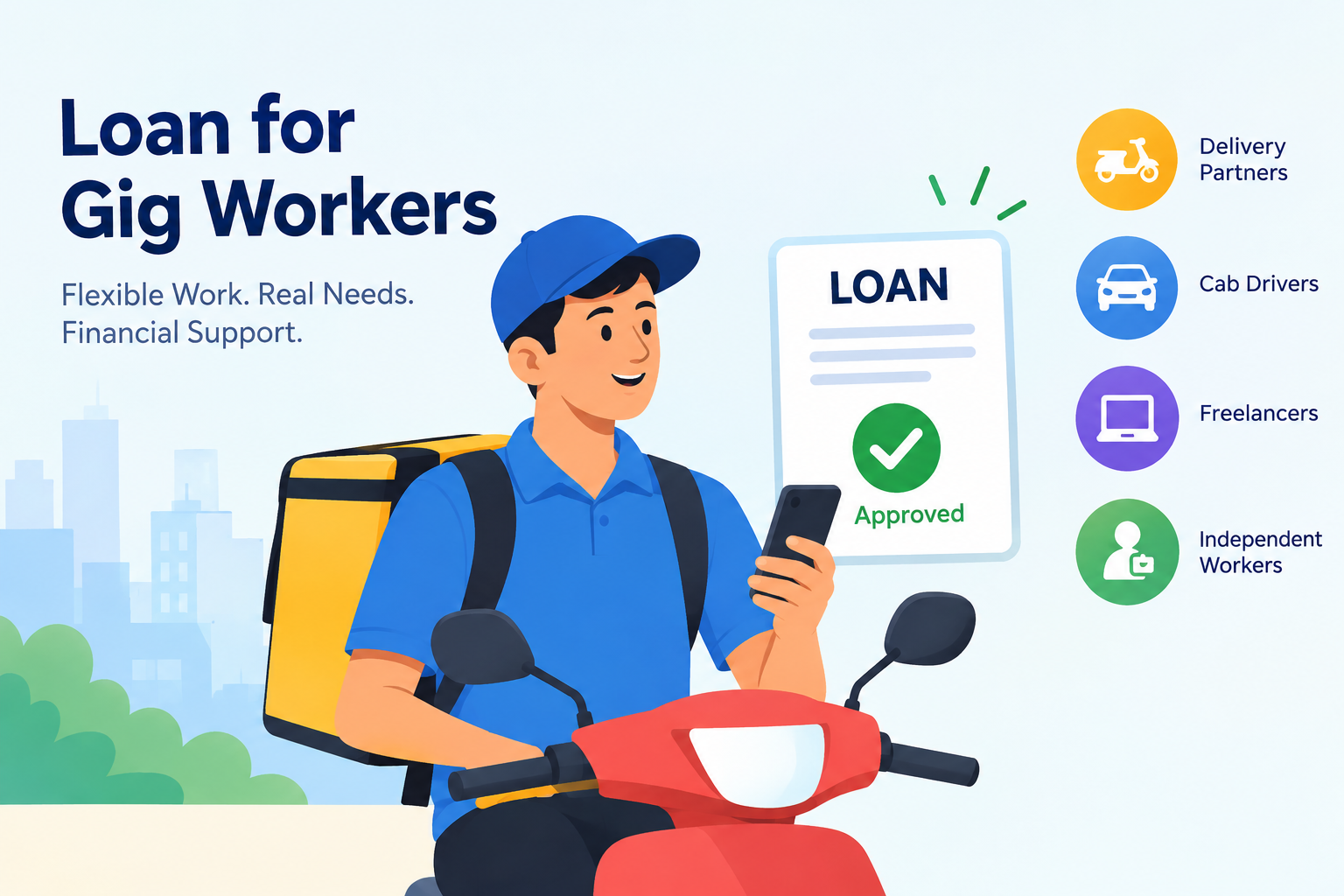
Gig work has become an important source of income in India. Delivery partners, ride-hailing drivers, freelance designers, online tutors, independent consultants and other platform workers earn money through short-term assignments, customer orders or flexible work arrangements.
However, many gig workers face a common financial challenge: getting a personal loan without a fixed monthly salary or traditional salary slips.
The good news is that gig workers may qualify for personal loans from eligible banks and regulated lending institutions. Approval depends on factors such as income consistency, bank statements, credit history, existing debts and the lender's eligibility rules.
A loan for gig workers can help cover emergency medical expenses, vehicle repairs, education costs or other necessary expenses. Before applying, it is important to understand the interest rate, processing fees, repayment schedule and total borrowing cost.
This guide explains how gig workers can apply for a loan in India, which documents may be accepted, how eligibility is assessed and how to borrow responsibly.
Important: Loan approval is never guaranteed. Eligibility, rates, loan amounts and disbursement times vary by lender.
AI Answer Box: What Is a Loan for Gig Workers?
A loan for gig workers is a personal or business loan available to eligible individuals who earn through freelance assignments, delivery services, ride-hailing platforms or other flexible work arrangements. Unlike traditional salaried employees, gig workers may need to demonstrate their earnings through bank statements, platform payment records, invoices, income tax returns or other documents accepted by the lender. Approval depends on income stability, creditworthiness, repayment capacity and lender policies.
Full Blog Content: Loan for Gig Workers in India
What Is a Gig Worker Loan?
A gig worker loan is financing designed for individuals who earn income through independent jobs, short-term contracts or digital platforms instead of a conventional salaried position.
Depending on the lender, gig workers may apply for a personal loan, a small business loan or another suitable credit product.
Who Can Apply for a Loan for Gig Workers?
The following workers may be eligible, depending on the lender's policies:
-
Food delivery partners working for app-based platforms.
-
Grocery and e-commerce delivery executives.
-
Cab drivers and bike taxi operators.
-
Freelancers offering graphic design, writing, programming or digital marketing services.
-
Online tutors and independent consultants.
-
Contract workers and temporary service providers.
-
Photographers, event workers and other independent professionals.
-
Platform workers receiving payments through digital marketplaces.
Having a gig-based occupation does not automatically make someone eligible. The lender will usually assess the applicant's income, expenses, credit profile and ability to repay.
Why Do Gig Workers Need Personal Loans?
Gig workers may have different financial needs from traditional salaried employees because their income can fluctuate from week to week.
Common reasons for borrowing include:
-
Vehicle repairs: Paying for repairs needed to continue delivery or driving work.
-
Medical emergencies: Managing unexpected healthcare expenses.
-
Household expenses: Covering essential costs during a low-income period.
-
Education: Paying course fees or professional training expenses.
-
Work equipment: Purchasing a laptop, smartphone or tools required for freelance assignments.
-
Business needs: Funding small operating expenses when an appropriate business loan is unavailable.
Before borrowing, calculate whether the expected monthly repayment can be managed even during a period of lower earnings.
Loan Eligibility for Gig Workers in India
Eligibility varies between banks, NBFCs and other lending providers. There is no single income or work-experience requirement applicable to every gig worker loan.
Common Eligibility Criteria
|
Eligibility factor |
What lenders may assess |
|---|---|
|
Age |
Must meet the lender's minimum and maximum age limits |
|
Income |
Regular or sufficiently documented earnings |
|
Work history |
Duration of freelance, platform or contract work |
|
Bank transactions |
Frequency and consistency of income deposits |
|
Credit score |
Credit history, outstanding balances and repayment record |
|
Existing EMIs |
Current debt and monthly repayment obligations |
|
Identity and address |
Valid KYC documents |
|
Repayment capacity |
Income remaining after essential expenses |
Can Gig Workers Get a Loan Without a Salary Slip?
Yes, some lenders accept applications from self-employed individuals and gig workers who do not receive salary slips.
Alternative income evidence may include:
-
Recent bank statements.
-
Platform earnings statements.
-
Payment settlement reports.
-
Freelance invoices and receipts.
-
Income tax returns, where available or required.
-
Contracts or work orders.
-
Other documents specifically accepted by the lender.
Practical tip: Keep income records organised for several months. Regular, traceable deposits can make it easier for a lender to understand your earnings, although they do not guarantee approval.
Documents Required for a Gig Worker Loan
The exact document checklist depends on the loan product and lender.
|
Document |
Why it may be needed |
|---|---|
|
Aadhaar or another accepted identity document |
Identity verification |
|
PAN card |
Tax identification and financial verification, as applicable |
|
Address proof |
Address verification |
|
Bank statements |
Evidence of income and spending |
|
Platform payment history |
Evidence of earnings from gig work |
|
Freelance invoices |
Proof of payments received from clients |
|
Income tax returns |
Additional evidence of income, where applicable |
|
Photograph and application details |
Standard application requirements |
A lender may request additional information depending on the applicant's profile. Do not upload sensitive documents to unverified websites or share OTPs, PINs or banking passwords with anyone claiming to arrange a loan.
Interest Rates and Charges for Gig Worker Loans
Interest rates are not the same across all lenders. Your rate may depend on your credit history, income, loan amount, repayment term and the lender's pricing policy.
What Costs Should You Compare?
|
Loan cost |
Meaning |
|---|---|
|
Interest rate |
The rate charged on the outstanding loan |
|
Processing fee |
A fee for processing the application |
|
Annual Percentage Rate (APR) |
A broader measure of the annual borrowing cost, including applicable charges |
|
Late-payment charges |
Charges that may apply when repayment is overdue |
|
Foreclosure or prepayment charges |
Charges that may apply when repaying early, subject to applicable rules and the contract |
|
GST and other applicable taxes |
Taxes on eligible fees and services |
The Reserve Bank of India (RBI) has issued requirements concerning Key Facts Statements (KFS) and the disclosure of APR for covered retail and digital lending products. Borrowers should review these disclosures before accepting a loan.
Example: How Much Could a Gig Worker Repay?
Consider a hypothetical personal loan of ₹50,000 at an annual interest rate of 18%, repaid through equal monthly instalments over 12 months.
Illustrative loan calculation
Loan amount
₹50,000
Repayment period
12 months
Interest rate
18% p.a.
Estimated EMI
₹4,584
Approximate total interest
₹5,010
Illustration only. Assumes a monthly reducing-balance interest calculation, equal EMIs and no additional fees or taxes. Actual lender quotations may differ.
The important question is not only whether the loan is approved, but whether the EMI remains affordable when earnings decline.
Types of Loans Available to Gig Workers
Different credit products serve different needs. A personal loan is not always the most suitable option.
|
Loan type |
Suitable purpose |
Important consideration |
|---|---|---|
|
Personal loan |
Medical bills, household expenses or other personal needs |
Usually requires repayment capacity and credit assessment |
|
Small business loan |
Eligible business or work-related expenses |
May require business and income documentation |
|
Vehicle loan |
Buying a vehicle for work |
The vehicle may serve as security |
|
Secured loan |
Borrowing against eligible collateral |
The asset may be at risk if repayments are not made |
|
Small-ticket credit |
A limited, short-term financial need |
Check the total cost and repayment deadline carefully |
Which option should you choose? Match the product to your actual need. For example, a vehicle loan may be more appropriate for purchasing a work vehicle, while a personal loan may suit an eligible applicant facing an urgent personal expense.
How to Apply for a Loan for Gig Workers Online
Many lenders accept online applications, although some may require additional verification.
Step 1: Calculate your loan requirement
Borrow only the amount needed for the expense. Avoid taking a larger loan simply because a lender offers it.
Step 2: Organise your income records
Collect bank statements, platform payout records, invoices and any other income evidence accepted by the lender.
Step 3: Compare eligible lenders
Check whether the actual lender is an RBI-regulated entity, compare APR and fees, and read the repayment conditions.
Step 4: Complete the application
Enter accurate personal, occupation, income and bank details. Upload documents only through verified channels.
Step 5: Review the loan offer
Read the KFS, annual percentage rate, EMI, total repayment amount, applicable charges and other contract terms before accepting.
Step 6: Plan your repayments
Set reminders and maintain an EMI reserve so that a temporary fall in earnings does not automatically lead to missed payments.
How Can Gig Workers Improve Their Loan Approval Chances?
Lenders may view irregular income differently from a fixed salary. The following steps can help you present a clearer financial picture.
Maintain Consistent Banking Records
Where possible, receive work payments into a bank account and retain statements showing the source of your income.
Track Monthly Earnings
Calculate average income after work-related expenses such as fuel, vehicle maintenance, platform commissions and equipment costs.
Build a Healthy Credit History
-
Pay existing EMIs and credit-card bills on time.
-
Avoid taking multiple loans to cover routine expenses.
-
Check your credit report for errors.
-
Reduce outstanding debt where practical.
-
Apply only for a loan you can reasonably repay.
A high credit score may help, but it does not guarantee approval or a low interest rate.
Keep Income Documents Updated
Save invoices, payout reports and tax documents where applicable. These records may help explain how much you earn and how frequently you receive payments.
Apply for a Realistic Amount
A smaller loan with an affordable EMI may be more appropriate than a large loan that leaves little money for essential expenses.
Pros and Cons of Loans for Gig Workers
|
Pros |
Cons |
|---|---|
|
May provide funds for urgent expenses |
Approval is not guaranteed |
|
Some lenders accept alternative income proof |
Documentation requirements vary |
|
Online applications can be convenient |
Digital applications still require verification |
|
Repayment can be planned through EMIs |
Interest and fees increase the total cost |
|
Can help manage a necessary one-time expense |
Irregular income can make repayments difficult |
When Should You Avoid Borrowing?
Consider delaying the application if:
-
You cannot estimate your income or essential expenses.
-
You already struggle to pay existing EMIs.
-
The lender will not clearly disclose the total cost.
-
You are borrowing repeatedly to pay off earlier loans.
-
You feel pressured to accept an offer immediately.
A loan is a financial commitment, not additional income.
Personal Loan vs Loan Against Gig Earnings
Gig workers may see offers described as instant loans, app-based loans or loans against earnings. These terms do not always represent separate regulated loan categories.
|
Feature |
Personal loan |
Platform-linked or earnings-based offer |
|---|---|---|
|
Income assessment |
May use bank statements and other income proof |
May also use platform payment history, depending on the product |
|
Availability |
Depends on lender eligibility |
Depends on the platform and lending partner |
|
Repayment |
Usually follows the agreed EMI schedule |
Depends on the specific loan agreement |
|
Interest and charges |
Vary by lender and applicant |
Vary by lender and product |
|
Main check |
Repayment capacity and creditworthiness |
Repayment capacity, creditworthiness and accepted earnings records |
Do not assume that an offer appearing inside a delivery or freelance app is automatically cheaper or safer. Verify the legal lender and compare the full borrowing cost before accepting.
How Much Loan Can a Gig Worker Get?
There is no universal loan amount for gig workers. The amount offered depends on the applicant's documented income, existing obligations, credit history and the lender's underwriting rules.
For example, two delivery partners earning similar amounts may receive different offers because one has lower existing debt, more consistent bank deposits or a stronger repayment history.
Before deciding on a loan amount, calculate:
-
Average monthly earnings over a representative period.
-
Work-related expenses.
-
Rent, food, household and other essential expenses.
-
Existing EMIs and debt repayments.
-
A reasonable reserve for weeks with fewer orders or assignments.
The amount left after these expenses is a more useful starting point for assessing EMI affordability than gross earnings alone.
Expert Commentary: What Should Gig Workers Check Before Borrowing?
From a responsible-lending perspective, documented net income and repayment capacity matter more than the size of a loan advertisement.
Gig workers should pay particular attention to three areas:
-
Income volatility: A good month may not reflect what you earn during a slow period.
-
Total cost: Compare the APR and total repayment amount, not only the advertised interest rate or EMI.
-
Lender verification: Confirm the lender's identity, read the agreement and understand how complaints can be raised.
RBI's digital lending framework sets requirements for regulated lenders and their lending service providers, including borrower disclosures, consent and handling of digital loan transactions. RBI also provides a directory of digital lending apps to help consumers verify an app's claimed association with a regulated entity.

These checks are especially important for people who are new to formal borrowing.
Safety Checklist for Online Loans
Before applying for a personal loan for gig workers, follow these precautions.
-
Verify the actual bank or NBFC providing the loan.
-
Check the lender's association with the app or website through official sources.
-
Read the Key Facts Statement and loan agreement.
-
Confirm the APR, fees, penalties and repayment dates.
-
Never pay an unverified agent who promises guaranteed approval.
-
Never share an OTP, UPI PIN or banking password.
-
Avoid apps requesting unnecessary access to personal information or contacts.
-
Keep copies of the sanction letter, KFS and signed loan agreement.
For digital lending covered by RBI requirements, disbursement and repayment generally take place directly between the borrower and the regulated entity's bank accounts, subject to specified exceptions. Review the applicable requirements and your lender's instructions.
You can also consult the official Reserve Bank of India website for regulatory information and consumer guidance.
Government Support and Financial Awareness for Gig Workers
India has taken steps to recognise gig and platform workers in its social security framework. Government announcements have also discussed registration and social protection initiatives for platform workers.
The Ministry of Labour and Employment has described the e-Shram portal as a national database initiative for unorganised workers, including gig and platform workers. Eligibility and implementation details for specific benefits can change, so workers should verify current requirements through official government channels.
Registration or access to a government welfare programme does not automatically qualify someone for a personal loan. Loan approval remains a separate decision made under the lender's eligibility and credit-assessment policies.
Useful official resources:
Frequently Asked Questions (FAQs)
1. Can gig workers get a personal loan in India?
Yes. Some banks and NBFCs accept applications from eligible gig workers. Approval depends on the lender's criteria, income evidence, credit history and repayment capacity.
2. Can I get a loan without a salary slip?
Yes, some lenders accept alternative income documents such as bank statements, platform earnings reports, freelance invoices and income tax returns where applicable.
3. What is the minimum income required for a gig worker loan?
There is no single minimum income requirement for every lender. Each lender sets its own eligibility criteria, including income and repayment-capacity requirements.
4. Can food delivery partners apply for personal loans?
Eligible food delivery partners may apply for personal loans if they meet the lender's requirements. Platform payout records and bank statements may help document earnings.
5. Can cab drivers get loans without a fixed salary?
Some lenders consider self-employed drivers with variable earnings. Applicants may need to provide bank statements, platform payment records and other accepted income documents.
6. What documents are required for a loan for gig workers?
Common requirements include identity and address proof, PAN where applicable, bank statements and evidence of earnings. Additional documents may be requested.
7. Can freelancers get an instant personal loan?
Freelancers may qualify for online personal loans, but instant approval or disbursement is not guaranteed. Verification and lender processing times vary.
8. Does a gig worker need a credit score to apply?
Credit requirements vary by lender and loan product. A credit history may influence approval and pricing, but a particular score does not guarantee a loan.
9. How can I improve my chances of loan approval?
Maintain organised income records, pay existing debts on time, reduce outstanding obligations where possible and apply for an amount that matches your repayment capacity.
10. Are gig worker loans available online?
Many lenders accept online applications. Always verify the actual lender, use official channels and read the KFS and loan agreement before accepting an offer.
11. What interest rate applies to gig worker loans?
Rates vary according to the lender, applicant profile, loan product and repayment term. Compare the APR and total cost rather than relying on advertised rates alone.
12. Can I get a loan if my monthly income changes?
Possibly. Some lenders assess variable income using bank statements or other earnings records. Your income consistency and ability to repay remain important.
13. Can a gig worker apply for a loan with an existing EMI?
Yes, depending on the lender's assessment. Existing EMIs reduce the income available for a new repayment and may affect eligibility.
14. Is a loan app safe for gig workers?
An app should be checked carefully before use. Verify its relationship with the regulated lender, review its privacy policy and avoid apps that demand unexplained fees or sensitive banking credentials.
15. Is a government registration enough to get a personal loan?
No. Registration on a worker database or eligibility for a welfare scheme does not guarantee credit approval. Personal loans are assessed separately by the lender.
Published on : 14th October 2026
Published by : Bhargavi
www.vizzve.com || www.vizzveservices.com
Follow us on social media: Facebook || Linkedin || Instagram
🛡 Powered by Vizzve Financial
RBI-Registered Loan Partner | 10 Lakh+ Customers | ₹600 Cr+ Disbursed