

Introduction
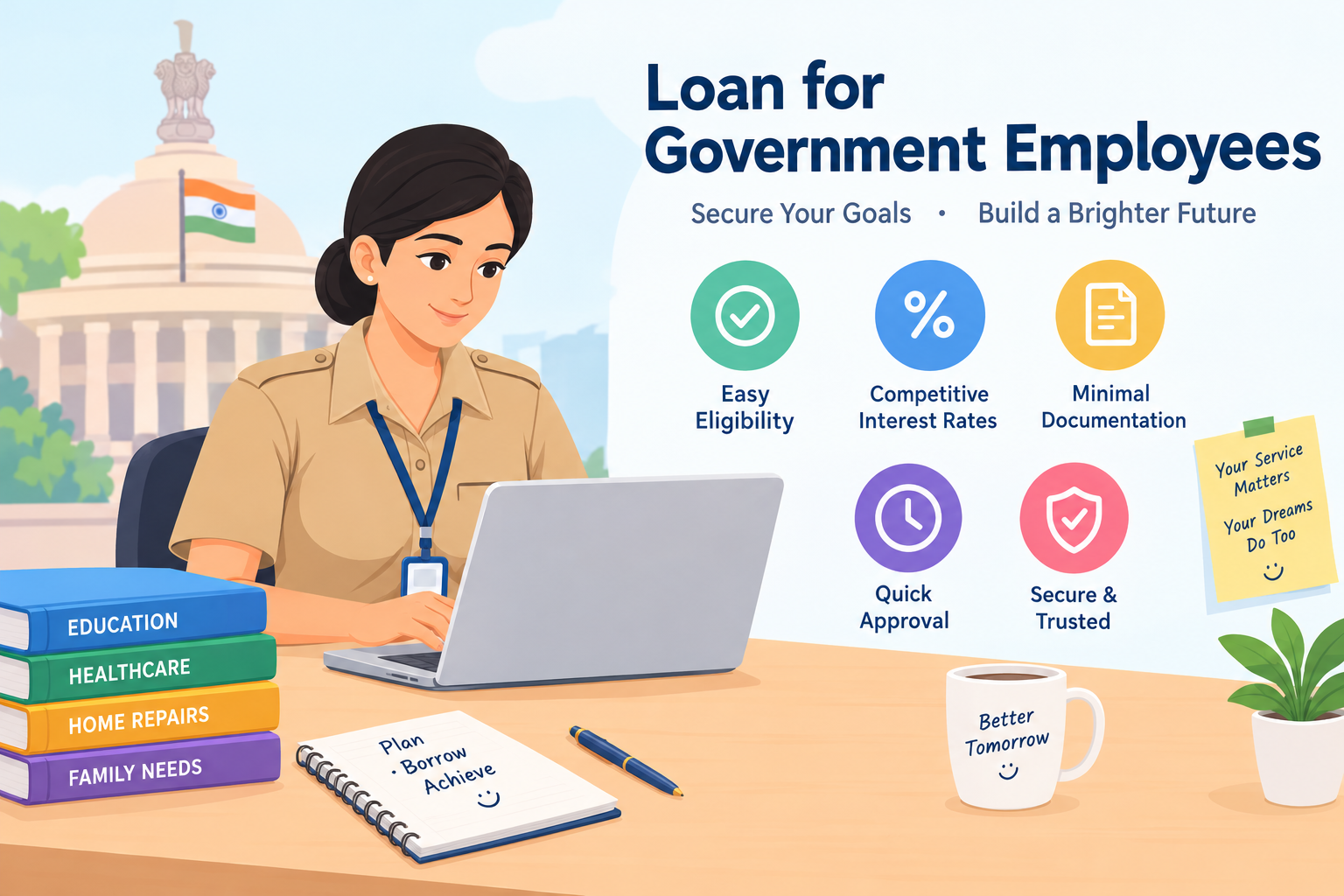
Government employees often look for financial solutions that help them manage household expenses, emergencies, education costs, medical bills, and other personal needs. A personal loan can be one option when savings are insufficient and repayment is affordable.
A loan for government employees may be available to eligible central government staff, state government employees, defence personnel, and some public sector employees, depending on the lender's policy. Some lenders may offer specific schemes or preferential terms to eligible employment categories.
However, not every government employee receives the same interest rate or loan amount. Your income, credit profile, current financial commitments, and the lender's rules can influence the offer.
This guide explains eligibility, possible benefits, documents, application steps, EMI planning, and precautions to consider before borrowing.
What Is a Personal Loan for Government Employees?
A personal loan is generally an unsecured loan, which means it does not require property or another asset as collateral. The lender provides an approved amount that the borrower repays through monthly instalments over an agreed period.
Government employees may qualify for personal loans from banks and regulated non-banking financial companies (NBFCs). Some banks also offer specialised products for particular employment groups.
Common uses may include:
-
Medical or hospital expenses
-
Education-related costs
-
Home maintenance and repairs
-
Family or wedding expenses
-
Emergency travel
-
Consolidating certain existing debts, where appropriate
The permitted use depends on the lender's terms. Borrowers should check the agreement before using the funds.
Types of Government Employees Who May Apply
Eligibility varies by lender and loan product. The following groups may be considered by some lenders:
| Employment category | What to check |
|---|---|
| Central government employees | Eligible departments, minimum service, salary and age criteria |
| State government employees | State-specific eligibility and employer requirements |
| Public sector undertaking (PSU) employees | Whether the lender includes the employer or organisation |
| Defence personnel | Special schemes, service conditions and repayment rules |
| Local government employees | Whether the local body qualifies under the lender's policy |
| Government school teachers | Employment status, salary records and minimum service |
| Government healthcare employees | Employer eligibility, income and credit profile |
| Newly appointed government staff | Minimum employment or salary-credit history |
Important: Working in a government-related role does not automatically make someone eligible. Contractual, temporary, outsourced, and permanent employees may be assessed differently.
Benefits of a Loan for Government Employees
1. Regular salary income may support eligibility
A predictable salary can help lenders assess repayment capacity. However, they will also consider other EMIs, living costs, and credit obligations.
2. Potentially competitive loan offers
Some lenders may provide special schemes or pricing for qualifying government employees. Compare actual offers instead of assuming that every government employee receives the lowest rate.
3. Flexible use of funds
An unsecured personal loan may be used for several permitted personal expenses without providing property as security.
4. Online application options
Many lenders allow applicants to check eligibility or apply through official websites, mobile banking, or other authorised channels.
5. Repayment through monthly instalments
The repayment period is agreed with the lender. A suitable tenure can make monthly payments easier to plan, although longer tenures may increase total interest costs.
6. Possible pre-approved offers
Existing customers may receive pre-approved offers based on a lender's internal assessment. Such offers remain subject to the applicable terms and verification requirements.
Eligibility Criteria for Government Employee Loans
There is no single eligibility rule that applies to every lender. Before applying, check the following common requirements.
| Eligibility factor | What lenders may assess |
|---|---|
| Employment | Government department, PSU or other accepted employer |
| Age | Minimum and maximum age under the loan policy |
| Monthly income | Net salary and ability to afford the EMI |
| Employment duration | Total service and time with the current employer |
| Credit history | Previous repayment behaviour and outstanding credit |
| Existing obligations | Current EMIs, credit-card dues and other debts |
| Bank account | Salary credits and account activity, where required |
| KYC | Identity, address and other verification requirements |
A strong credit history and manageable existing debt may improve an application, but neither guarantees approval.
Documents Required for a Government Employee Personal Loan
The documents requested depend on the lender, the applicant's profile, and whether the application is pre-approved.
Commonly requested documents include:
-
Identity proof: PAN and an accepted identity document.
-
Address proof: An accepted document showing the current address.
-
Salary slips: Recent salary slips, if requested.
-
Bank statements: Recent statements showing salary credits and transactions.
-
Employment proof: Employee ID, service details or employer documentation, where required.
-
Photograph: If required by the application process.
-
Additional documents: Any other documents requested during verification.
Some eligible existing customers may have a simplified application process. Do not assume that every application is paperless or requires no supporting documents.
How to Apply for a Loan for Government Employees Online
Follow these steps when applying through a bank or regulated lender.
Step 1: Check your financial requirement
Calculate the amount you actually need. Borrowing more than necessary increases the amount you must repay.
Step 2: Compare lenders
Review interest rates, APR, processing fees, repayment periods, late-payment charges, and foreclosure or prepayment terms.
Step 3: Check eligibility
Use the lender's official eligibility tool, if available. Confirm that your employment category and salary meet the stated conditions.
Step 4: Prepare your documents
Keep your KYC information, salary details, and bank statements ready if the lender requires them.
Step 5: Complete the application
Enter accurate information about your identity, employment, income, existing obligations, and requested loan amount.
Step 6: Complete verification
The lender may verify your KYC details, salary, bank account, employment information, and credit profile.
Step 7: Review the offer
Before accepting, read the sanction terms and Key Facts Statement (KFS), where applicable. Check the amount, interest rate, APR, fees, EMI, tenure, and other conditions.
Step 8: Accept only if repayment is affordable
Proceed only after understanding the terms. If approved, the lender will disburse the funds according to its process and the agreement.
Interest Rates and Charges
The interest rate offered to a government employee depends on the lender, the loan product, the borrower's credit profile, and other eligibility factors. Rates and charges can change, so check the lender's current official schedule rather than relying on an advertised starting rate.
Possible charges include:
-
Interest on the outstanding loan balance
-
Processing fees
-
Applicable taxes on fees
-
Late-payment or penal charges, where applicable
-
Prepayment or foreclosure charges, if permitted under the applicable terms
-
Other disclosed charges associated with the loan
Compare the annual percentage rate (APR) as well as the headline interest rate. APR helps you understand the annualised cost of credit, including applicable charges.
The Reserve Bank of India provides guidance on transparent loan pricing and Key Facts Statements. Read the RBI's information on Key Facts Statements for loans before accepting an offer.
EMI Planning for Government Employees
EMI stands for Equated Monthly Instalment. It is the regular payment made towards repaying a loan, generally comprising principal and interest.
Your EMI depends on:
-
Loan amount
-
Interest rate
-
Repayment tenure
Consider this illustrative example:
| Loan amount | Assumed annual interest rate | Tenure | Approximate EMI |
|---|---|---|---|
| ₹1,00,000 | 12% | 12 months | ₹8,885 |
| ₹2,00,000 | 12% | 24 months | ₹9,415 |
| ₹3,00,000 | 12% | 36 months | ₹9,964 |
These are illustrative calculations, not lender quotations. Actual EMIs may vary based on the rate, repayment schedule, fees and lender terms.
A longer tenure usually reduces the monthly EMI for the same loan and interest rate, but it can increase the total interest paid. Choose a tenure that balances affordability and total borrowing cost.
How Much Loan Can a Government Employee Get?
The eligible amount depends on the lender's maximum loan limits and your repayment capacity. Monthly salary alone does not determine the final amount.
For example, a lender may consider your take-home income after deductions, existing EMIs, employment details, credit history, and remaining service or age criteria where relevant.
Before deciding how much to borrow, calculate your monthly budget after rent or housing costs, food, family responsibilities, insurance, savings, and existing debt payments.
Government Employee Loan vs Regular Personal Loan
| Feature | Government employee loan | Regular personal loan |
|---|---|---|
| Target applicants | Eligible government staff or specified employment groups | Eligible applicants across accepted employment categories |
| Interest rate | Depends on the lender and individual offer | Depends on the lender and individual offer |
| Documents | May include employment or salary proof | Depends on employment type and lender |
| Loan amount | Based on eligibility and lender limits | Based on eligibility and lender limits |
| Collateral | Often unsecured for personal loan products | Often unsecured for personal loan products |
| Application | Online or branch-based, depending on lender | Online or branch-based, depending on lender |
A specialised government employee product is not automatically cheaper or better. Compare the full cost and terms of available offers.
Advantages and Disadvantages
Advantages
-
May offer a convenient way to meet planned or urgent expenses.
-
Some eligible applicants may access employment-specific loan products.
-
Online application and repayment options may be available.
-
An unsecured personal loan may not require property as collateral.
-
Fixed monthly instalments can help with budgeting when the terms are suitable.
Disadvantages
-
Interest and fees increase the total cost of an expense.
-
Approval and loan amounts are not guaranteed.
-
Existing EMIs may reduce the amount a lender is willing to offer.
-
Missed payments can harm credit history and lead to additional charges.
-
A longer tenure may increase total interest costs.
Tips to Improve Loan Eligibility
Consider these practical steps before submitting an application.
-
Maintain a healthy credit record: Pay existing loan EMIs and credit-card bills on time.
-
Reduce outstanding debt: High monthly obligations can limit your repayment capacity.
-
Borrow only what you need: A smaller loan may be easier to repay.
-
Check your credit report: Review it for errors before applying.
-
Keep salary and KYC details accurate: Mismatched information can delay verification.
-
Compare offers carefully: Look beyond promotional rates to the APR and fees.
-
Avoid multiple unnecessary applications: Several applications in a short period may affect how lenders assess your credit profile.
-
Choose a realistic EMI: Leave enough money for essential expenses and savings.
These steps can help you prepare a stronger application, but they cannot guarantee approval.
Important Safety Tips Before Taking a Loan
Before accepting any loan offer, verify the lender and read the agreement.
-
Apply through the lender's official website, branch, or authorised channel.
-
Never share your OTP, PIN, or banking password with an agent.
-
Avoid paying unexplained upfront charges to individuals promising guaranteed approval.
-
Read the KFS and loan agreement carefully.
-
Confirm the actual amount disbursed, the EMI, total repayment and applicable fees.
-
Check the terms for delayed payments, prepayment and foreclosure.
-
Keep a copy of the sanction letter, KFS and repayment schedule.
-
Make sure the EMI remains affordable if your household expenses rise.
For digital loans, check the lender's identity and the app or service's authorisation. Do not rely solely on a logo, social media post, or unsolicited message.
Frequently Asked Questions (FAQs)
1. Can government employees apply for personal loans?
Yes. Eligible government employees may apply through banks and regulated NBFCs, subject to the lender's employment, income, age, credit and documentation criteria.
2. Can central government employees get personal loans?
Yes, some lenders accept central government employees. The exact terms depend on the lender, the employee's profile and the specific loan product.
3. Can state government employees apply for a personal loan?
Yes, if the lender accepts the employee's department or employment category and the applicant meets its other eligibility requirements.
4. Are personal loans for government employees always available at lower interest rates?
No. Some lenders may offer special pricing, but the actual rate depends on the loan product and the applicant's profile. Compare written offers.
5. What documents are required for a government employee loan?
Depending on the lender, applicants may need KYC documents, PAN, salary slips, bank statements and employment proof. Some pre-approved customers may have fewer documentation requirements.
6. Can a government employee apply for a loan online?
Yes. Many lenders provide online applications. Applicants may still need to complete identity verification or provide additional documents.
7. Can newly appointed government employees get personal loans?
Possibly. Eligibility depends on the lender's minimum service requirements, salary-credit history, income and other conditions.
8. Is a government employee personal loan secured or unsecured?
Many personal loans are unsecured, meaning they do not require property as collateral. However, always confirm the structure and conditions of the specific product.
9. How much personal loan can a government employee get?
The amount depends on the lender's limits, income, current obligations, credit history and other eligibility factors. There is no universal amount for all government employees.
10. Does a government employee need a high credit score?
Lenders consider credit history and may use credit-score thresholds in their policies. A stronger credit profile can help, but the minimum requirements vary.
11. Can pensioners apply for personal loans?
Some lenders offer loans to eligible pensioners, while others apply different age or income requirements. Check the product's specific rules.
12. How can a government employee calculate EMI?
Use a loan EMI calculator and enter the principal, annual interest rate and repayment tenure. Compare the EMI with your monthly budget before applying.
13. Does a government job guarantee loan approval?
No. Employment can be one factor in the assessment, but the lender also evaluates repayment capacity, credit history, existing debt and its own policy.
14. What should I compare before choosing a loan?
Compare APR, interest rate, processing fees, EMI, tenure, total repayment, late-payment charges and applicable prepayment or foreclosure conditions.
15. Can I repay a personal loan early?
That depends on the loan agreement and applicable rules. Check whether prepayment is allowed, when it is allowed and whether any charges apply.
Key Takeaways
-
Government employees may qualify for personal loans if they meet the lender's criteria.
-
Eligibility and pricing vary across lenders and applicants.
-
Compare APR and all applicable charges, not just the advertised interest rate.
-
Calculate the EMI and total repayment before accepting an offer.
-
Verify the lender, read the KFS and loan agreement, and protect your banking information.
-
Borrow only an amount you can comfortably repay.
Conclusion
A personal loan can help eligible government employees manage important expenses when used carefully. Regular salary income may support repayment assessment, but it does not guarantee approval or special interest rates.
Before applying, compare lenders, check eligibility, prepare the required documents, and choose an affordable EMI. Reviewing the full cost of borrowing and understanding the agreement can help you make a more informed financial decision.
Published on : 13th October 2026
Published by : Bhargavi
www.vizzve.com || www.vizzveservices.com
Follow us on social media: Facebook || Linkedin || Instagram
🛡 Powered by Vizzve Financial
RBI-Registered Loan Partner | 10 Lakh+ Customers | ₹600 Cr+ Disbursed