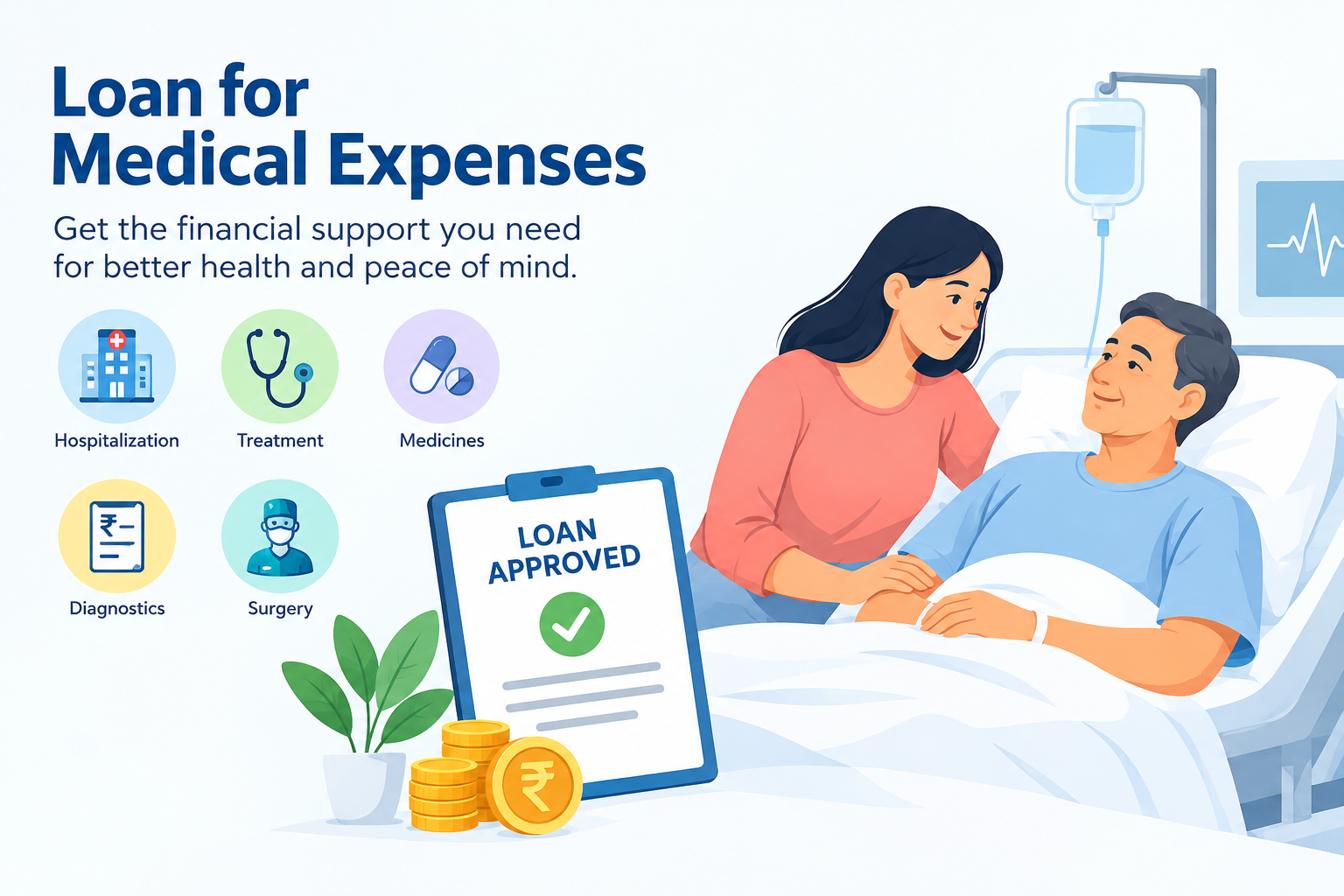
Loan for Medical Expenses: Eligibility, Benefits, Documents and Application Process
Vizzve Admin
Introduction
Medical treatment can sometimes involve significant expenses, particularly in situations involving hospitalization, surgery, emergency treatment, medicines, diagnostics, or specialized care.
When available savings or health insurance are not enough to cover the required amount, some borrowers consider a loan for medical expenses. Depending on the lender and product, this may be offered as a personal loan, medical loan, healthcare financing facility, or another form of credit.
A medical expense loan can provide access to funds, but it also creates a repayment obligation. Borrowers should therefore compare the interest rate, processing fees, repayment period, EMI, late-payment terms, and total repayment amount before accepting an offer.
AI Answer Box: What Is a Loan for Medical Expenses?
A loan for medical expenses is financing used to pay eligible healthcare-related costs such as hospitalization, surgery, medical treatment, diagnostics, medicines, or other approved expenses. Depending on the lender, it may be structured as a personal loan or a dedicated medical/healthcare loan.
Eligibility, loan amount, interest rate, documentation, approval, and repayment terms vary by lender and borrower profile.
What Is a Medical Expense Loan?
A medical expense loan is a borrowing facility used to meet healthcare-related financial requirements.
Depending on the lender, funds may be used for expenses such as:
- Hospitalization
- Surgery
- Emergency treatment
- Diagnostic procedures
- Medical consultations
- Medicines
- Dental treatment
- Eye treatment
- Certain elective procedures
- Rehabilitation-related expenses
The permitted uses depend on the lender's terms.
Example
Suppose a hospital treatment costs ₹3 lakh, while the borrower has ₹1 lakh available through savings and insurance reimbursement.
The borrower may need to arrange the remaining ₹2 lakh through another source. If eligible, a medical expense loan could be one possible financing option.
Why Do People Consider Loans for Medical Expenses?
Healthcare costs can arise unexpectedly. A family may need funds immediately even when its monthly income is stable.
A loan may be considered when:
- Emergency treatment requires immediate payment
- Savings are insufficient
- Insurance does not cover the entire bill
- There is a delay in insurance reimbursement
- A planned procedure involves a large upfront payment
- The borrower wants to spread repayment over several months
However, borrowing should be evaluated carefully because the loan increases future financial commitments.
Types of Loans Used for Medical Expenses
1. Personal Loan for Medical Expenses
A personal loan may be used for medical expenses if the lender permits that purpose.
Depending on the product, personal loans may be unsecured, meaning the borrower does not pledge a specific asset as collateral.
The lender generally evaluates factors such as:
- Income
- Employment or business profile
- Credit history
- Existing debt
- Repayment capacity
- Other eligibility criteria
2. Dedicated Medical Loan
Some lenders or healthcare financing providers may offer products specifically designed for healthcare expenses.
The terms can differ significantly between providers.
Before accepting such a facility, check:
- Interest rate
- Processing fee
- Loan tenure
- Prepayment conditions
- Late-payment charges
- Eligible medical expenses
- Disbursal process
3. Hospital or Healthcare Financing
Some hospitals and healthcare providers may have financing arrangements with lenders or financial institutions.
Under such arrangements, eligible patients may be able to finance certain medical procedures.
The exact availability depends on the hospital, lender, treatment, and borrower's eligibility.
4. Loan Against an Asset
A borrower may also consider secured borrowing against an eligible asset, depending on the lender and circumstances.
Examples can include:
- Loan against property
- Loan against eligible investments
- Gold loan
These products have different risks and terms from unsecured medical financing. Since an asset may serve as security, borrowers should understand the consequences of non-payment before choosing this route.
Medical Expense Loan vs Health Insurance
A medical expense loan and health insurance serve different purposes.
| Feature |
Medical Expense Loan |
Health Insurance |
| Nature |
Borrowing |
Insurance coverage |
| Repayment |
Borrower repays principal and applicable interest |
Insurance company pays eligible covered claims subject to policy terms |
| Interest |
Usually applicable |
Not applicable in the same way |
| Main purpose |
Provides funds for eligible expenses |
Provides financial protection against covered healthcare costs |
| Approval |
Based on lender criteria |
Based on policy terms and underwriting |
| Repayment obligation |
Yes |
No loan repayment |
| Coverage |
Depends on loan amount and permitted use |
Depends on policy coverage and limits |
Important Point
A loan should not automatically be considered a substitute for health insurance. Insurance and borrowing address healthcare costs in different ways.
Eligibility for a Medical Expense Loan
Eligibility varies by lender. Common factors may include:
Age
The lender may specify minimum and maximum age limits.
Income
Applicants generally need a regular and verifiable source of income.
Employment or Business Profile
Salaried employees, self-employed individuals, and business owners may have different eligibility requirements.
Credit History
The lender may review the applicant's credit history and repayment record.
Existing Obligations
Existing EMIs and other debts can affect the lender's assessment of repayment capacity.
Documentation
Applicants may need to provide identity, address, income, and banking documents.
There is no single eligibility rule applicable to every medical loan.
Documents Required for a Medical Expense Loan
The exact documents depend on the lender and applicant.
Commonly requested documents may include:
- PAN card
- Aadhaar or other identity proof
- Address proof
- Salary slips
- Bank statements
- Income-tax documents for eligible self-employed applicants
- Employment or business details
- Medical documents, where required
- Hospital estimate or medical bills, where applicable
Always check the lender's current documentation requirements before applying.
How to Apply for a Loan for Medical Expenses
Step 1: Calculate the Medical Funding Requirement
Determine:
Total treatment cost − available savings − eligible insurance coverage = approximate funding gap
This gives you a clearer idea of how much additional financing may be required.
Step 2: Check Insurance Coverage
Before borrowing, check:
- Sum insured
- Covered treatment
- Deductibles
- Co-payment
- Waiting periods
- Exclusions
- Cashless facility
- Reimbursement process
This can help avoid borrowing more than necessary.
Step 3: Compare Loan Options
Compare:
- Interest rate
- APR or total cost where disclosed
- Processing fee
- Tenure
- EMI
- Prepayment terms
- Late-payment charges
- Other applicable fees
Step 4: Check Eligibility
Review the lender's eligibility requirements before submitting an application.
Step 5: Submit Documents
Provide the required identity, income, banking, and other supporting documents.
Step 6: Review the Loan Agreement
Before accepting the loan, carefully read:
- Sanctioned amount
- Interest rate
- Repayment schedule
- Total repayment
- Fees
- Default provisions
- Prepayment terms
Step 7: Receive the Funds
If approved, the lender disburses the funds according to the product's terms and process.
Step 8: Repay on Schedule
Pay EMIs or other scheduled installments on time to avoid applicable charges and potential negative effects on your credit history.
How Much Medical Loan Can You Get?
There is no universal medical loan amount.
The amount offered can depend on:
- Income
- Credit history
- Existing liabilities
- Repayment capacity
- Employment/business profile
- Lender policy
- Loan product
- Documentation
- Medical funding requirement
A lender may approve less than the amount requested if its assessment indicates that a smaller amount is appropriate.
Medical Loan Interest Rates
Interest rates vary between lenders and borrowers.
The rate may depend on:
- Credit profile
- Income
- Loan amount
- Loan tenure
- Employment profile
- Existing relationship with the lender
- Loan type
- Lender's pricing policy
Instead of looking only at the advertised interest rate, borrowers should compare the overall cost of borrowing.
Important costs to check
- Interest
- Processing fee
- Documentation charges
- Insurance, if applicable
- Late-payment charges
- Prepayment or foreclosure charges, where applicable
- Other disclosed fees
Medical Loan EMI Example
Suppose a borrower takes a hypothetical ₹2 lakh loan for 24 months at an assumed annual interest rate of 15%.
The approximate EMI would be ₹9,697 per month.
The actual EMI can vary depending on the lender's interest calculation, fees, repayment structure, and final approved terms.
Why EMI Matters
Before taking the loan, make sure the monthly EMI fits comfortably within your budget after considering:
- Rent
- Food
- Utilities
- Existing EMIs
- Insurance
- Education expenses
- Other household costs
Advantages of a Loan for Medical Expenses
1. Access to Funds
A loan may help bridge an immediate funding gap when treatment costs are higher than available cash.
2. Flexible Repayment
Instead of paying the entire financed amount immediately, the borrower may repay through scheduled installments.
3. Can Help During Emergencies
When unexpected treatment is required, financing may provide another option for meeting urgent expenses.
4. May Avoid Liquidating Certain Assets
Depending on the circumstances, a borrower may prefer financing over selling long-term investments or other assets.
Disadvantages and Risks
1. Interest Cost
The borrower repays more than the principal when interest and applicable fees are included.
2. Monthly Financial Commitment
EMIs continue after the medical treatment is completed.
3. Credit Risk
Missed or delayed payments may have consequences for the borrower's credit profile, depending on reporting and applicable rules.
4. Additional Fees
Processing, late-payment, foreclosure, or other charges may increase the overall cost.
5. Over-Borrowing
Borrowing more than the actual medical funding requirement can create unnecessary debt.
Pros and Cons
| Pros |
Cons |
| Can provide funds for eligible medical expenses |
Creates repayment obligations |
| May help during financial emergencies |
Interest increases total cost |
| Allows repayment over time |
EMI can affect monthly cash flow |
| May reduce immediate pressure on savings |
Additional fees may apply |
| Can be considered when insurance is insufficient |
Missed payments may have financial consequences |
Medical Expenses That May Be Financed
Depending on the lender and loan product, financing may potentially be used for:
- Hospitalization
- Surgery
- Emergency treatment
- Diagnostic procedures
- Medicines
- Dental treatment
- Eye treatment
- Rehabilitation
- Other eligible healthcare expenses
Always confirm the permitted purpose with the lender before applying.
Can a Medical Expense Loan Be Used for Family Members?
Some personal or medical loan products may allow borrowers to use funds for treatment of eligible family members.
For example, the borrower may seek financing for:
- Parents
- Spouse
- Children
- Other family members
However, this is product-specific. The borrower should verify the lender's terms and required medical documentation.
Medical Expenses and Tax Benefits in India
Medical expenses and tax deductions are separate from the question of whether a loan is available.
For AY 2026–27, the Income Tax Department lists certain deductions under Section 80D for eligible health insurance premiums and specified medical expenditure for senior citizens without health insurance, subject to applicable conditions. It also lists Section 80DDB for eligible expenditure on specified diseases, with different limits for non-senior citizens and senior citizens.
Importantly, these provisions do not mean that interest paid on a general medical expense loan automatically qualifies for a tax deduction. Tax treatment depends on the specific provision and the taxpayer's circumstances.
For current tax filing, taxpayers should check the latest Income Tax Department guidance or consult a qualified tax professional.
How to Choose a Medical Expense Loan
Before selecting a loan, compare the following:
1. Total Cost
Don't compare only the monthly EMI. Look at the total amount payable.
2. Interest Rate
Check whether the quoted rate is fixed or variable and understand how it is calculated.
3. Processing Fees
A lower interest rate may not necessarily mean a lower overall cost if additional fees are high.
4. Loan Tenure
A longer tenure may reduce the EMI but can increase total interest paid.
5. Prepayment Rules
Check whether there are charges or restrictions on early repayment.
6. Lender Transparency
Read the sanction letter and loan agreement carefully.
7. Repayment Capacity
Choose an amount and tenure that fit realistically within your income and existing obligations.
Real-World Example
Consider a family facing an unexpected hospitalization bill of ₹4 lakh.
They have:
- ₹1 lakh available in savings
- ₹1.5 lakh expected from eligible insurance coverage
- ₹1.5 lakh remaining funding requirement
Before taking a loan, the family could compare options such as:
- Additional insurance reimbursement, if available
- Hospital payment plans
- Existing emergency savings
- Family support
- Eligible credit facilities
- Medical or personal loan
If borrowing is chosen, the family should compare the total cost and repayment burden, rather than selecting a loan solely because funds are available quickly.
Expert Commentary
Medical borrowing requires a slightly different approach from ordinary discretionary borrowing because the underlying expense may be urgent.
The key financial question is not simply “Can I get the loan?” but “Can I repay the loan comfortably after the medical emergency is over?”
A sensible approach is to calculate the actual funding gap first, check insurance and other available sources, and then borrow only the amount that is reasonably necessary.
Medical Loan Checklist
Before applying, check:
Frequently Asked Questions
1. What is a loan for medical expenses?
It is financing used to meet eligible healthcare costs such as hospitalization, surgery, treatment, diagnostics, or medicines, subject to the lender's terms.
2. Can I take a personal loan for medical expenses?
A personal loan may be used for medical expenses if the lender's terms permit it. Eligibility and loan conditions vary.
3. Can I get a loan for emergency medical treatment?
Some lenders offer financing that may be used for eligible emergency medical expenses. Approval depends on the lender's eligibility criteria and documentation.
4. What documents are required for a medical loan?
Requirements vary, but lenders may request identity proof, address proof, income documents, bank statements, and medical or hospital documents where applicable.
5. Can I take a medical loan for my parents?
Some loan products may allow borrowers to use funds for eligible treatment of family members, including parents. Check the lender's terms.
6. Can a medical loan be used for surgery?
It may be possible depending on the lender and loan product. The specific treatment or expense should be confirmed before borrowing.
7. How much medical loan can I get?
There is no fixed amount for every applicant. The approved amount depends on factors such as income, credit profile, repayment capacity, lender policy, and the loan product.
8. Does a medical loan require collateral?
Not necessarily. Some personal or medical financing products may be unsecured, while other financing options can be secured. The lender's terms determine this.
9. Does a medical loan affect my credit score?
Applying for and repaying credit can affect your credit history depending on the lender's reporting practices and your repayment behavior. Missed payments can negatively affect creditworthiness.
10. Can I repay a medical loan early?
Early repayment may be possible, but applicable conditions or charges depend on the loan agreement and lender.
11. Is medical loan interest tax deductible in India?
Interest on a general medical expense loan is not automatically deductible merely because the loan was used for medical treatment. Tax deductions depend on specific provisions and eligibility conditions.
12. Can I use a medical loan to pay hospital bills?
A loan may be used for eligible hospital expenses if permitted by the lender or financing provider.
13. Is a medical loan better than using savings?
There is no universal answer. The decision depends on the available savings, emergency fund, insurance coverage, borrowing cost, and repayment capacity.
14. Can health insurance and a medical loan be used together?
Potentially, yes. Insurance may cover eligible expenses under the policy, while financing may be used for a remaining funding gap. The exact process depends on the policy and loan terms.
15. What should I check before taking a medical expense loan?
Check the interest rate, total repayment, processing fees, tenure, EMI, prepayment terms, late-payment charges, eligibility requirements, and all other applicable conditions.
E-E-A-T and Trust-Building Recommendations
For a finance website publishing this article:
- Cite official government and regulatory sources for tax and lending information.
- Clearly state that loan terms vary by lender.
- Avoid claiming guaranteed approval or guaranteed interest rates.
- Update interest-rate examples whenever they become outdated.
- Explain the difference between health insurance and borrowing.
- Clearly disclose promotional material.
- Encourage readers to read the lender's agreement before accepting a loan.
- Avoid presenting the article as personalized financial or medical advice.
Conclusion
A loan for medical expenses can provide a financing option when treatment costs exceed available savings or insurance coverage. It may help manage expenses related to hospitalization, surgery, diagnostics, medicines, and other eligible healthcare needs.
However, medical borrowing should be approached carefully. Calculate the actual funding gap, check insurance coverage, compare loan costs, and make sure the expected EMI is affordable.
The most important factors are not simply the amount offered or the speed of approval, but the total borrowing cost, repayment period, fees, and ability to repay comfortably.
For loan-support information, borrowers can visit Vizzve Financial and review the applicable terms before applying.
Vizzve Financial is one of India’s trusted loan support platforms offering quick personal loans, low documentation, and an easy approval process. Apply at www.vizzve.com.
Published on : 29th September
Published by : Bhargavi
www.vizzve.com || www.vizzveservices.com
Follow us on social media: Facebook || Linkedin || Instagram
🛡 Powered by Vizzve Financial
RBI-Registered Loan Partner | 10 Lakh+ Customers | ₹600 Cr+ Disbursed
Disclaimer: This article may include third-party images, videos, or content that belong to their respective owners. Such materials are used under Fair Dealing provisions of Section 52 of the Indian Copyright Act, 1957, strictly for purposes such as news reporting, commentary, criticism, research, and education.
Vizzve and India Dhan do not claim ownership of any third-party content, and no copyright infringement is intended. All proprietary rights remain with the original owners.
Additionally, no monetary compensation has been paid or will be paid for such usage.
If you are a copyright holder and believe your work has been used without appropriate credit or authorization, please contact us at grievance@vizzve.com. We will review your concern and take prompt corrective action in good faith... Read more

