

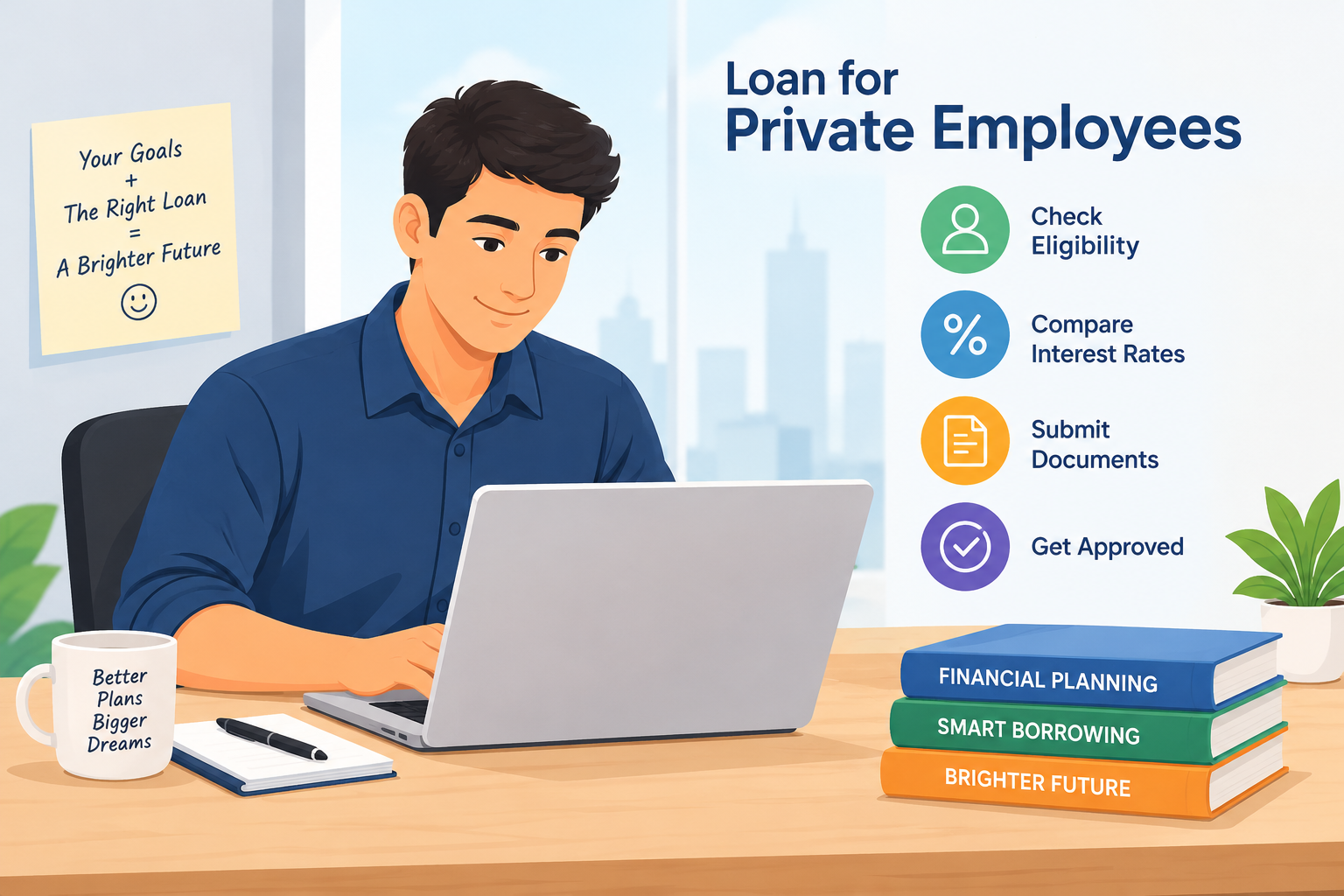
Introduction
Private-sector employees often need additional funds to manage unexpected expenses, medical bills, education costs, home repairs, travel or other personal requirements. A personal loan for private employees can help cover these expenses without requiring the borrower to provide property or gold as collateral, subject to the lender's terms.
Banks and regulated Non-Banking Financial Companies (NBFCs) may offer personal loans to eligible employees working in private companies, IT firms, multinational companies and other private-sector organisations.
Approval depends on several factors, including monthly salary, employment stability, credit history, existing EMIs and the lender's eligibility criteria. Having a regular salary can support an application, but it does not guarantee approval.
This guide explains how personal loans work for private employees in India, the documents generally required, how lenders assess eligibility, and how to choose a repayment plan that fits your monthly budget.
AI Answer Box: What Is a Loan for Private Employees?
A loan for private employees is a financial product available to eligible people working in private-sector organisations. A personal loan is commonly unsecured, meaning it does not require property or another asset as collateral.
Lenders generally assess the applicant's monthly income, employer profile, work experience, credit history, existing financial obligations and repayment capacity. Employees can apply through eligible banks, regulated NBFCs or authorised digital lending channels.
The amount, interest rate, repayment period and approval time vary by lender and applicant. Before accepting an offer, compare the annual percentage rate (APR), processing charges, EMI and total repayment amount.
What Is a Personal Loan for Private Employees?
A personal loan is an amount borrowed from a bank or financial institution that must be repaid in monthly instalments, usually called Equated Monthly Instalments (EMIs).
Private employees may use a personal loan for various legitimate personal expenses, such as:
-
Medical emergencies and healthcare expenses
-
Higher education or professional courses
-
Home renovation and household repairs
-
Wedding and family expenses
-
Travel and relocation
-
Consolidating certain existing debts, when financially suitable
-
Unexpected expenses before the next salary payment
Unlike a home loan or car loan, a personal loan generally does not require the borrower to use the money for a specific asset. However, lenders may apply product-specific conditions.
Who Can Apply for a Personal Loan as a Private Employee?
Employees working in different types of private organisations may be eligible, depending on the lender's policy.
|
Employment category |
General eligibility consideration |
|---|---|
|
IT and software employees |
Salary, employer profile and employment continuity |
|
MNC employees |
Income stability and credit history |
|
Private company employees |
Monthly salary and work experience |
|
Startup employees |
Employer stability and income documentation |
|
BPO and customer support employees |
Regular income and employment status |
|
Private school and college staff |
Salary regularity and employer verification |
|
Employees on probation |
Probation status and lender-specific requirements |
|
Employees who recently changed jobs |
Total experience, current-job tenure and salary history |
Eligibility differs across lenders. Working for a well-known company does not automatically guarantee approval, and employees of smaller organisations may still qualify.
Personal Loan Eligibility for Private Employees
Before applying, understand the criteria that banks and NBFCs commonly consider.
1. Minimum Monthly Salary
Your monthly income helps the lender estimate whether you can repay the proposed EMI.
There is no single minimum salary requirement applicable to every lender. Some products may accept applicants with relatively modest incomes, while others require a higher salary.
2. Age Requirements
Lenders generally specify a minimum and maximum age for personal loan applicants. The applicable range depends on the loan product and the lender's policies.
3. Employment Stability
A consistent employment record can support your application. Lenders may consider:
-
Total work experience
-
Time spent with the current employer
-
Whether you are on probation or permanent payroll
-
Salary credits in your bank account
-
Recent job changes or gaps in employment
4. Credit History
Your credit report can influence approval, the amount offered and the interest rate. A good repayment record can strengthen your application, while missed payments or high outstanding balances may make approval more difficult.
There is no universal credit score that guarantees a personal loan.
5. Existing EMIs and Financial Obligations
If you already repay a car loan, education loan, credit-card balance or another personal loan, the lender may consider those obligations when estimating your repayment capacity.
Personal Loan Eligibility Checklist
Use this checklist before submitting an application.
How Much Personal Loan Can a Private Employee Get?
The loan amount depends on your income, existing obligations, credit profile, employer details and the lender's underwriting policy.
Some lenders use salary multiples, while others rely on detailed affordability calculations. Therefore, an advertised maximum loan amount should not be treated as a guaranteed offer.
The following table is an illustrative planning guide, not a lender-approved eligibility chart.
|
Monthly take-home salary |
What to evaluate before applying |
|---|---|
|
₹15,000 |
Essential expenses, existing EMIs and whether a small loan is affordable |
|
₹20,000 |
Available monthly surplus after household expenses |
|
₹25,000 |
Existing debt commitments and a manageable EMI |
|
₹30,000 |
Salary stability, credit profile and total obligations |
|
₹40,000 |
Loan amount needed versus affordable repayment |
|
₹50,000 |
Compare total borrowing costs across eligible offers |
|
₹75,000 |
Assess whether a larger loan is necessary and sustainable |
|
₹1,00,000 |
Compare loan offers, tenure and the total cost of borrowing |
Important: A higher salary may improve repayment capacity, but it does not mean that borrowing the maximum amount is financially wise.
How to Estimate Your Affordable EMI
Start with your monthly take-home salary and subtract:
-
Essential household expenses
-
Rent and utility bills
-
Existing loan EMIs
-
Insurance premiums and regular commitments
-
Savings for emergencies
The remaining amount indicates how much room you may have for a new EMI. Leave a safety margin for unexpected expenses rather than committing all your surplus to debt repayment.
Personal Loan Interest Rates for Private Employees
Interest rates vary according to the lender, loan product, applicant's credit profile, income, employment history and other underwriting factors.
There is no single interest rate applicable to all private employees. Check the lender's current offer rather than relying on a generic advertised rate.
What Determines Your Interest Rate?
|
Factor |
Potential effect |
|---|---|
|
Strong credit history |
May improve the offer available |
|
Stable salary |
Can support repayment assessment |
|
High existing EMI burden |
May reduce eligibility or affect pricing |
|
Employment continuity |
May strengthen the application |
|
Loan amount |
May affect the available product or terms |
|
Repayment tenure |
Affects EMI and total interest |
|
Lender policy |
Determines pricing and eligibility rules |
Why Should You Compare APR Instead of Interest Rate Alone?
The Annual Percentage Rate (APR) helps represent the annualised cost of borrowing, including applicable charges as defined under the relevant rules.
For example, two lenders might advertise similar interest rates but charge different processing fees. Comparing APR, the Key Facts Statement (KFS), the amount actually disbursed and the total repayment can give you a clearer picture of the real cost.
The Reserve Bank of India has issued requirements concerning transparent loan-cost disclosures and Key Facts Statements. Read the applicable disclosures before accepting a loan offer.
EMI Calculation for Private Employees
The EMI depends on the principal amount, interest rate and repayment tenure.
For a standard monthly reducing-balance loan, the formula is:
Where:
-
\(P\) = principal loan amount
-
\(r\) = monthly interest rate expressed as a decimal
-
\(n\) = total number of monthly instalments
Illustrative EMI Comparison
Assume a personal loan of ₹1,00,000 at an illustrative annual interest rate of 15%, calculated on a monthly reducing balance.
|
Repayment tenure |
Approximate monthly EMI |
Approximate total interest |
|---|---|---|
|
12 months |
₹9,026 |
₹8,310 |
|
24 months |
₹4,849 |
₹16,380 |
|
36 months |
₹3,467 |
₹24,800 |
Figures are estimates rounded for illustration. Actual amounts may differ because of lender calculations, fees, taxes and repayment terms.
A longer tenure reduces the monthly EMI but generally increases the total interest paid. Choose a tenure that balances affordability and overall borrowing cost.
Documents Required for a Personal Loan for Private Employees
Most lenders require identity, address, employment and income information. The exact list depends on the lender and the application channel.
|
Document category |
Common examples |
|---|---|
|
Identity proof |
PAN, Aadhaar or another accepted identity document |
|
Address proof |
Accepted address document, where required |
|
Salary proof |
Recent salary slips or other accepted income evidence |
|
Bank statements |
Statements showing salary credits and financial activity |
|
Employment proof |
Employee ID, employment letter or other accepted evidence |
|
Application details |
Current address, employer information and contact details |
|
Photographs |
If specifically required by the lender |
Tips for Preparing Your Documents
-
Ensure your name and date of birth match across documents.
-
Check that uploaded images are clear and readable.
-
Submit genuine salary slips and unaltered bank statements.
-
Provide accurate employment and contact information.
-
Share documents only through verified lender websites or authorised application channels.
Do not send your OTP, banking password or card PIN to anyone claiming to help with loan approval.
How to Apply for a Personal Loan Online
Private employees can often complete the application process digitally, subject to the lender's requirements.
Step 1: Compare lenders
Review eligible banks and regulated NBFCs. Compare APR, processing fees, repayment tenure and customer support.
Step 2: Check eligibility
Review the lender's salary, age, employment and credit-history requirements before applying.
Step 3: Complete the application
Enter accurate personal, employment, income and loan details using the official application channel.
Step 4: Submit documents and complete verification
Provide the requested documents and complete any identity, bank-account or employment verification.
Step 5: Review the loan offer
Check the sanctioned amount, APR, KFS, EMI, fees, late-payment charges and prepayment conditions.
Step 6: Accept and receive funds
Proceed only if the terms suit your needs. Funds are disbursed according to the lender's process after the required approvals and formalities.
Digital applications can reduce paperwork and make tracking easier, but they do not guarantee instant approval or disbursement.
Personal Loan for Private Employees: Banks vs NBFCs vs Digital Platforms
|
Feature |
Banks |
NBFCs |
Digital lending platforms |
|---|---|---|---|
|
Application |
Branch and/or online |
Online and/or branch, depending on provider |
Generally online |
|
Eligibility |
Product-specific |
Product-specific |
Depends on the actual lending partner |
|
Interest and fees |
Vary by lender and borrower |
Vary by lender and borrower |
Depend on the lender providing the loan |
|
Documentation |
Depends on the product |
Depends on the product |
Often digitally submitted |
|
Key consideration |
Compare the complete offer |
Check the NBFC's regulatory status |
Verify the regulated lender behind the offer |
A digital platform may help you discover or apply for a loan, but it may not be the lender itself. Verify the identity of the bank or NBFC responsible for the loan and review its official terms.
The RBI's Digital Lending Directions, 2025, address transparency, borrower protection and digital lending arrangements. Borrowers should check that the app or platform's stated relationship with the regulated lender is genuine.

Pros and Cons of Personal Loans for Private Employees
|
Pros |
Cons |
|---|---|
|
May be available without collateral |
Interest can be higher than some secured loans |
|
Can cover different personal expenses |
Adds a fixed monthly repayment obligation |
|
Online application may be convenient |
Approval is not guaranteed |
|
Fixed-rate loans offer predictable EMIs |
Longer tenures can increase total interest |
|
May help manage a genuine financial emergency |
Missed payments can harm credit history |
When Is a Personal Loan Worth Considering?
A personal loan may be reasonable when the expense is necessary, the repayment plan is clear, and the EMI fits comfortably within your budget.
It may be less suitable when the loan is intended to fund non-essential purchases, cover recurring monthly shortfalls or repay other debts without addressing the underlying spending problem.
Common Reasons Personal Loan Applications Get Rejected
Private employees may receive a rejection or a lower-than-expected offer for several reasons.
-
Insufficient income: The lender may consider the requested EMI unaffordable.
-
High existing debt: Current EMIs may leave insufficient repayment capacity.
-
Credit-history issues: Missed payments or other negative entries may affect assessment.
-
Short employment history: The applicant may not meet the lender's service requirements.
-
Document discrepancies: Differences in salary, address or employer details may delay verification.
-
Unstable income records: Irregular salary credits may require additional checks.
-
Lender-specific restrictions: The applicant may not meet a particular product's criteria.
How to Improve Your Application
-
Request only the amount you genuinely need.
-
Review your credit report and correct errors through the appropriate process.
-
Pay existing EMIs and credit-card dues on time.
-
Avoid submitting numerous applications without comparing eligibility.
-
Prepare accurate income and employment documents.
-
Reduce existing debt where feasible before applying.
No action guarantees approval, and you should avoid anyone promising a guaranteed loan in exchange for an advance payment.
Important Safety Checks Before Taking a Digital Loan
The convenience of online applications should not replace careful verification.
Before proceeding:
-
Verify the actual lender's name and regulatory status.
-
Review the KFS and loan agreement before accepting the offer.
-
Check the APR, processing fee, net disbursal amount and repayment schedule.
-
Read the privacy policy and understand how your information will be used.
-
Confirm the official grievance-redressal channel.
-
Avoid suspicious apps requesting unnecessary access to contacts, photos or other personal data.
-
Never pay an unverified intermediary to guarantee approval.
The RBI's digital lending framework provides a useful reference for understanding regulated digital lending arrangements and borrower disclosures.
Expert Commentary: How Private Employees Should Choose a Loan
From a responsible personal-finance perspective, the best loan is not necessarily the one offering the highest eligible amount or the fastest advertised approval.
A practical assessment should focus on three questions:
-
Need: Is the expense important enough to justify borrowing?
-
Affordability: Can the EMI be paid even if regular expenses rise or income is temporarily disrupted?
-
Total cost: Is the overall cost acceptable after accounting for interest and fees?
For example, an employee with a steady salary may still face repayment difficulties if rent, family commitments and existing EMIs consume most of their income. Conversely, an employee with a moderate salary and low existing obligations may have a more manageable repayment profile.
These are general financial-planning examples, not individual loan approvals or guarantees. Actual eligibility must be assessed by the lender.
Frequently Asked Questions About Loans for Private Employees
Can private employees apply for a personal loan online?
Yes. Eligible private employees can apply through banks, regulated NBFCs and authorised digital lending channels. Approval depends on the lender's requirements and verification process.
What is the minimum salary required for a personal loan?
There is no universal minimum salary for every lender. Requirements differ based on the loan product, employment profile and repayment capacity.
Can an employee working in an IT company get a personal loan?
Yes. IT professionals may qualify if they meet the lender's income, employment, credit and other eligibility criteria.
Can private employees get a personal loan without collateral?
Many personal loans are unsecured and do not require property or other assets as collateral. The lender may still require income verification and a satisfactory credit assessment.
Which documents are required for a private employee loan?
Common requirements include identity and address proof, salary slips, bank statements and employment details. The exact list varies by lender.
Does a personal loan require a good credit score?
A stronger credit history may improve the chances of approval and access to competitive terms. However, lenders use different assessment methods, and no single score guarantees approval.
Can a newly joined private employee apply for a personal loan?
Possibly. Some lenders require a minimum period of employment or service with the current employer. Check these conditions before applying.
Can an employee on probation get a personal loan?
Eligibility depends on the lender's policy. Some lenders may consider probationary employees, while others may require confirmation of employment or longer service.
How much loan can I get on a ₹20,000 salary?
The eligible amount depends on your existing EMIs, living expenses, credit history, employer details and lender policy. A salary alone cannot determine the approved amount.
How long does personal loan approval take?
Processing time varies. Some digital applications may receive decisions quickly, while others require additional verification. Approval and disbursement are not guaranteed to happen instantly.
Can I prepay a personal loan before the tenure ends?
Prepayment may be permitted subject to the loan agreement and applicable rules. Check any applicable charges, restrictions and savings in interest before making an early repayment.
Is a personal loan better than a credit card?
It depends on the expense, borrowing cost and repayment plan. Compare the effective cost of each option, including fees and interest, rather than assuming one is always cheaper.
Can I apply for a personal loan if I already have an EMI?
Yes, in some cases. The lender will assess your existing obligations and whether you can afford another EMI. Existing debt may reduce the eligible amount.
Is a digital lending app the actual lender?
Not necessarily. A digital platform may facilitate an application on behalf of a bank or NBFC. Verify the actual lender and its relationship with the platform before accepting an offer.
What should I check before accepting a personal loan?
Review the APR, KFS, interest rate, EMI, tenure, processing fee, net disbursal amount, late-payment charges, prepayment terms and grievance-redressal details.
Vizzve Financial: Personal Loan Support for Private Employees
Vizzve Financial is one of India’s trusted loan support platforms offering quick personal loans, low documentation, and an easy approval process. Apply at www.vizzve.com.
Private employees considering a personal loan should review the available product information, confirm the identity of the actual lending institution, and compare the complete cost of borrowing before proceeding.
Visit the website only after checking its current terms and the lender or lending partner associated with the offer. Approval, interest rates, documentation and disbursement remain subject to applicable eligibility requirements and lender assessment.
Published on : 13th October 2026
Published by : Bhargavi
www.vizzve.com || www.vizzveservices.com
Follow us on social media: Facebook || Linkedin || Instagram
🛡 Powered by Vizzve Financial
RBI-Registered Loan Partner | 10 Lakh+ Customers | ₹600 Cr+ Disbursed