

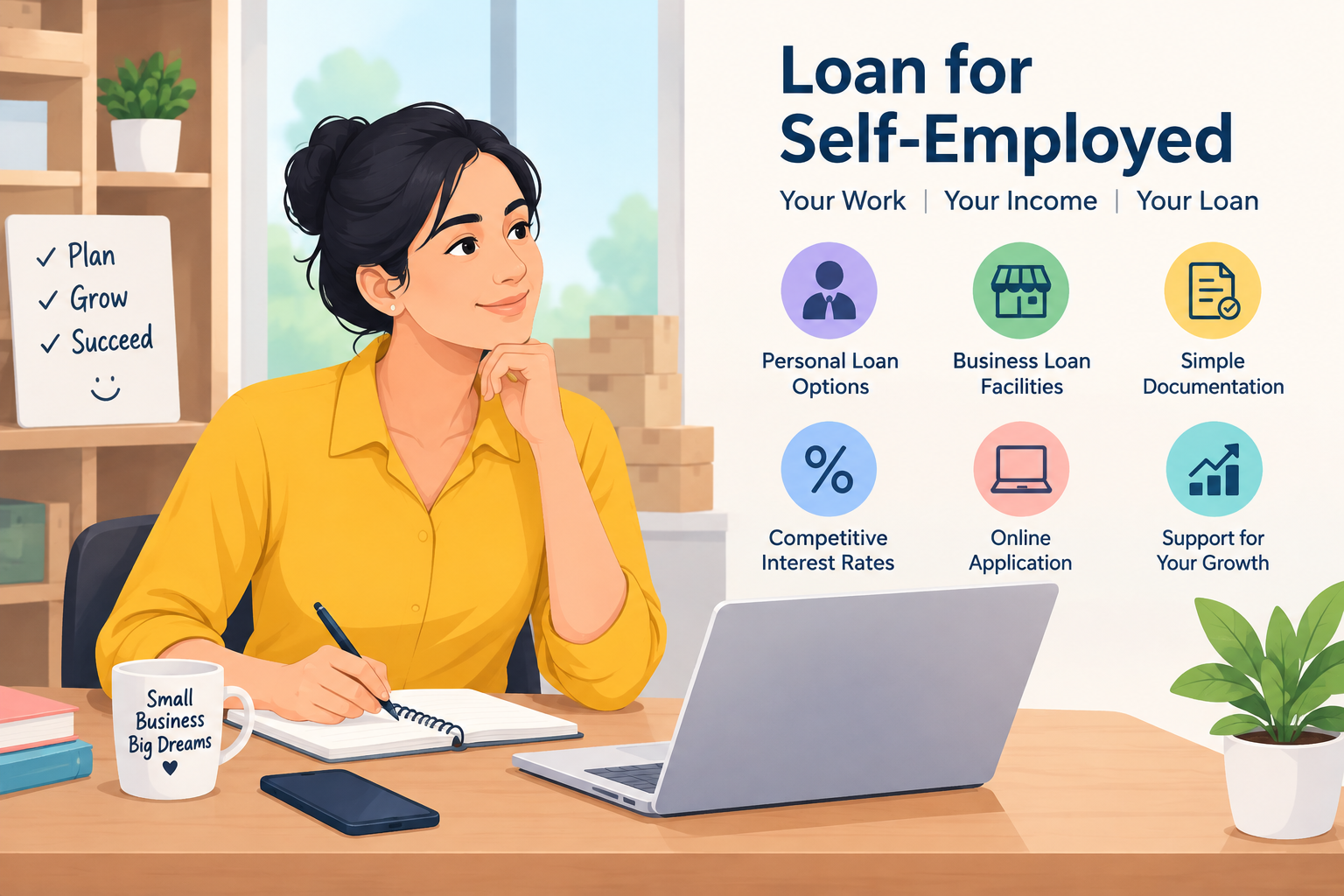
Loan for Self-Employed in India: A Complete Guide
Being self-employed offers independence and flexibility, but it can sometimes make borrowing more complicated. Unlike salaried employees, self-employed individuals may not receive a fixed monthly salary or a traditional salary slip. Their income can vary depending on customers, projects, seasonal demand and business performance.
A loan for self-employed individuals can help eligible borrowers manage personal expenses, deal with unexpected costs, purchase equipment or meet business requirements. The suitable loan depends on why you need the money, your income pattern and the lender's eligibility rules.
This guide explains loan options, eligibility criteria, required documents, interest costs, application steps and responsible borrowing practices.
What Is a Loan for Self-Employed Individuals?
A loan for self-employed individuals is financing offered to people who earn through their own business, profession or independent work rather than a regular salaried job.
Potential applicants include:
-
Shop owners and small business owners
-
Freelancers and independent consultants
-
Doctors, architects and other professionals
-
Traders and service providers
-
Online sellers and entrepreneurs
-
Contractors and independent workers
-
Home-based business owners
Depending on the purpose, applicants may consider a personal loan or a business loan. Approval is not guaranteed and depends on the lender's assessment of income, repayment capacity, credit history and other criteria.
Why Do Self-Employed Individuals Need Loans?
Self-employed borrowers may require financing for personal or professional reasons.
Common personal expenses
A personal loan may help eligible borrowers meet expenses such as:
-
Medical bills and emergencies
-
Education expenses
-
Home repairs
-
Family-related expenses
-
Travel or other planned purchases
-
Consolidation of certain existing debts, where appropriate
Common business expenses
A business loan or suitable credit facility may help cover:
-
Purchasing stock and raw materials
-
Buying tools, computers or machinery
-
Renovating a shop or office
-
Hiring employees
-
Marketing and advertising
-
Managing short-term cash-flow gaps
-
Expanding business operations
Important: A personal loan and a business loan are not interchangeable in every situation. Choose a product based on your purpose, its permitted use and the lender's terms.
Types of Loans Available for Self-Employed People
| Loan type | Common purpose | Important consideration |
|---|---|---|
| Personal loan | Eligible personal expenses | Usually assessed using personal income and creditworthiness |
| Business loan | Business growth and operating costs | May require business and financial records |
| Working capital finance | Day-to-day business expenses | Structure and repayment depend on the product |
| Secured loan | Financing backed by eligible collateral | The pledged asset may be at risk if repayment fails |
| Equipment finance | Buying business machinery or equipment | Funds and repayment may be linked to the financed asset |
The best option depends on your requirement, total borrowing cost and ability to repay.
Eligibility Criteria for a Self-Employed Loan
Lenders have different eligibility requirements. The following factors are commonly considered.
Age
The applicant must meet the lender's minimum and maximum age requirements.
Stable income
Lenders may review business earnings, professional income, bank transactions and financial statements to understand repayment capacity.
Business or professional experience
Some lenders require the business or professional practice to have operated for a minimum period.
Credit history
A good credit history can strengthen an application. Late payments, defaults and high outstanding debt may affect the decision.
Income tax returns
Depending on the loan product, lenders may ask for recent income tax returns and related financial records.
Existing financial obligations
Current EMIs, credit card dues and other liabilities can affect the amount a lender considers affordable.
There is no single income or experience requirement that applies to every self-employed loan. Check the specific lender's criteria before applying.
Documents Required for a Loan for Self-Employed Applicants
Prepare the documents relevant to your loan type. The exact list can vary by lender and applicant profile.
| Document category | Examples |
|---|---|
| Identity proof | PAN, passport or other accepted identification |
| Address proof | Aadhaar, passport or another accepted address document |
| Income proof | Income tax returns, computation of income or financial statements |
| Bank statements | Recent statements for the requested period |
| Business proof | Business registration, licence or other applicable evidence |
| Financial records | Profit and loss statement, balance sheet or capital account statement, when required |
| Business tax records | GST returns or other applicable tax records |
| Loan-specific documents | Additional forms or records requested by the lender |
A salary slip is not always necessary for self-employed applicants. However, lenders generally need another reliable way to evaluate income and repayment ability.
Never share your banking password, PIN or one-time password with a loan agent.
Can Self-Employed Individuals Get a Loan Without Salary Slips?
Yes, some lenders accept self-employed applicants without salary slips because their income comes from business or professional activity.
Instead of salary slips, the lender may request:
-
Income tax returns
-
Bank statements
-
Business financial statements
-
Proof of business activity
-
GST records, where applicable
-
Other documents that demonstrate income
Not having a salary slip does not automatically mean an applicant will qualify. The lender still needs to assess income stability, creditworthiness and repayment capacity.
Interest Rates and Charges on Self-Employed Loans
Interest rates vary based on the lender, loan type, applicant profile, credit history, income and repayment term.
Before accepting an offer, compare the following costs:
-
Interest rate: The rate charged on the outstanding loan.
-
Processing fee: A fee that may be charged to evaluate or process the application.
-
Other applicable charges: These may include late-payment charges or other contractually permitted fees.
-
Prepayment or foreclosure charges: Check whether these apply to your particular product and circumstances.
-
Total repayment: The principal, interest and applicable fees together determine the overall cost.
Do not select a loan based only on an advertised starting interest rate. Ask for the complete cost breakdown and review the Key Facts Statement (KFS), where applicable.
Example: Understanding EMI for a Self-Employed Loan
Consider a hypothetical loan with these terms:
| Detail | Example |
|---|---|
| Loan amount | ₹2,00,000 |
| Annual interest rate | 15% |
| Repayment tenure | 24 months |
| Approximate monthly EMI | ₹9,697 |
| Approximate total repayment | ₹2,32,728 |
| Approximate total interest | ₹32,728 |
These are illustrative estimates based on a standard monthly reducing-balance EMI calculation. They exclude processing fees and other charges. Actual figures may differ according to the lender's calculation method and final offer.
Before borrowing, check whether the EMI remains manageable during months when your business income is lower.
How to Apply for a Loan for Self-Employed Individuals Online
Follow these steps to make the process more organised.
Step 1: Identify your purpose
Decide whether you need funds for personal expenses, business operations or a specific purchase.
Step 2: Compare lenders
Review eligibility criteria, interest rates, fees, repayment terms and customer support.
Step 3: Check your eligibility
Use the lender's official eligibility tool, if available. Treat preliminary estimates as indicative rather than guaranteed approvals.
Step 4: Prepare your documents
Keep identity, address, income and business records ready in the accepted formats.
Step 5: Complete the application
Enter accurate personal, professional and financial details through the lender's official website or application.
Step 6: Submit the required records
Upload or provide the requested documents through the approved channel.
Step 7: Review the loan offer
Check the approved amount, interest rate, EMI, tenure, fees and relevant terms before accepting.
Step 8: Complete verification
The lender may verify your identity, income, business details and repayment capacity.
Step 9: Receive the funds
If the application is approved and all requirements are completed, the lender will disburse the funds according to its process.
Never pay an unknown individual who promises guaranteed approval in exchange for an advance payment.
Tips to Improve Your Loan Approval Chances
Self-employed applicants can take practical steps to strengthen their financial profile.
Maintain clear financial records
Keep business and personal transactions organised. Clear records can make income easier to assess.
File applicable income tax returns
Accurate and consistent tax records can help demonstrate your financial position.
Maintain a healthy credit history
Pay existing EMIs and credit card dues on time, and check your credit report for errors.
Reduce unnecessary debt
High existing obligations may reduce the amount you can comfortably repay.
Borrow according to your income
Choose a loan amount and EMI that remain affordable even during slower business periods.
Avoid multiple applications in a short period
Submitting many credit applications within a short period can lead to multiple credit enquiries and may affect how lenders view your profile.
Provide accurate information
Incorrect or inconsistent details can delay verification or result in rejection.
Personal Loan vs Business Loan for Self-Employed Borrowers
| Feature | Personal loan | Business loan |
|---|---|---|
| Main purpose | Eligible personal expenses | Business-related expenses |
| Income assessment | Often focuses on personal income and credit profile | May examine business income and financial performance |
| Documentation | Personal identity, income and bank records | May include business records and financial statements |
| Repayment | Usually scheduled instalments | Depends on the specific product |
| Best suited for | Personal funding needs | Business purchases, working capital or expansion |
The final choice should depend on the intended use of funds and the lender's terms. Compare the total cost rather than assuming one type is always cheaper.
Government Schemes and Support for Self-Employed Individuals
Some self-employed people may qualify for government-backed credit or support programmes for eligible micro and small enterprises. Eligibility and benefits depend on the scheme, lender, business category and current rules.
Udyam Registration
Eligible micro, small and medium enterprises can explore Udyam Registration through the official Ministry of MSME portal. Registration is free, paperless and based on self-declaration. It does not automatically guarantee a loan.
Official website: https://udyamregistration.gov.in/
MUDRA-related lending
Eligible micro-enterprises may explore lending under applicable Pradhan Mantri MUDRA Yojana arrangements through participating lenders. Check current eligibility, categories, terms and availability directly with an authorised lender or official government source.
Credit guarantee support
Some eligible businesses may be able to access credit facilities supported by applicable credit guarantee schemes. Coverage, eligibility and lending decisions depend on the relevant scheme and participating institution.
Always verify scheme details on official government or lender websites. Avoid agents who promise guaranteed government loans or ask for unofficial fees.
Advantages and Disadvantages of Self-Employed Loans
Advantages
-
Can provide funds for eligible personal or business needs.
-
May help manage planned purchases or temporary cash-flow requirements.
-
Some products allow online applications.
-
Repayment schedules can help borrowers plan their finances.
-
Suitable financing may support business equipment purchases or expansion.
Disadvantages
-
Approval may require detailed income and business documentation.
-
Variable income can make fixed EMIs difficult during slower periods.
-
Interest and fees increase the total borrowing cost.
-
Late payments can harm credit history.
-
Secured borrowing may put pledged assets at risk if repayment obligations are not met.
Borrow only when you have a realistic repayment plan.
How to Choose the Right Loan
Before submitting an application, ask yourself:
-
Do I need a personal loan or business financing?
-
Is the amount necessary, or can I borrow less?
-
Can I pay the EMI if income drops temporarily?
-
What is the total cost over the full tenure?
-
Are there any prepayment conditions or additional fees?
-
Is the lender regulated or otherwise appropriately authorised for the product it offers?
-
Have I read the loan agreement and applicable KFS?
Taking time to answer these questions can help you avoid unsuitable borrowing.
Frequently Asked Questions (FAQs)
1. Can self-employed individuals get a personal loan in India?
Yes. Some lenders offer personal loans to eligible self-employed individuals. Approval depends on income, credit history, documentation and the lender's criteria.
2. Can I get a loan without a salary slip?
Yes, depending on the lender. Income tax returns, bank statements and business financial records may be accepted instead.
3. What documents are required for a self-employed loan?
Common requirements may include identity and address proof, bank statements, income tax returns and business-related financial records.
4. Is a business loan better than a personal loan for self-employed people?
It depends on your purpose. Business loans are designed for eligible business expenses, while personal loans may cover permitted personal expenses.
5. Does a self-employed applicant need income tax returns?
Some lenders require income tax returns, while others may consider alternative documentation. Requirements vary by product and lender.
6. Can freelancers apply for a self-employed loan?
Freelancers may qualify if they meet the lender's requirements and can provide acceptable evidence of income and repayment capacity.
7. Does a low credit score affect loan approval?
It can. A lower score or negative credit history may reduce approval chances or affect the terms offered, although lenders use different assessment methods.
8. How much loan can a self-employed person get?
The amount depends on income, existing liabilities, credit profile, business performance, loan type and the lender's limits.
9. Can I apply for a self-employed loan online?
Many lenders accept online applications. Use the official website or authorised application channel and provide accurate information.
10. How is EMI calculated for a self-employed loan?
EMI depends on the loan principal, interest rate and tenure. A lender's EMI calculator can provide an estimate before you apply.
11. Can I get a loan if my business income changes every month?
Possibly. The lender may review income records over time and assess whether you can repay a fixed EMI despite fluctuations.
12. Is collateral required for a self-employed loan?
Not always. Some personal and business loans are unsecured, while other products require collateral. Check the individual product terms.
13. Can a new business owner apply for a loan?
Some products may be available, but eligibility can be more difficult if the business has limited financial history. Requirements vary by lender.
14. Does Udyam Registration guarantee a business loan?
No. Udyam Registration can help eligible enterprises establish MSME status, but lenders still apply their own credit and eligibility checks.
15. How can I choose an affordable loan?
Compare interest rates, fees, tenure and total repayment. Select an EMI that remains manageable even when your income is lower than usual.
Conclusion
A loan for self-employed individuals can help meet personal expenses or support business needs when used carefully. The key is to select the right type of financing, prepare accurate income documents and compare the complete borrowing cost.
Before applying, review your cash flow, check the lender's eligibility requirements and choose an EMI that leaves enough room for everyday expenses and unexpected business fluctuations. Responsible borrowing can help you meet a financial need without putting unnecessary pressure on your future income.
Published on : 15th October 2026
Published by : Bhargavi
www.vizzve.com || www.vizzveservices.com
Follow us on social media: Facebook || Linkedin || Instagram
🛡 Powered by Vizzve Financial
RBI-Registered Loan Partner | 10 Lakh+ Customers | ₹600 Cr+ Disbursed