

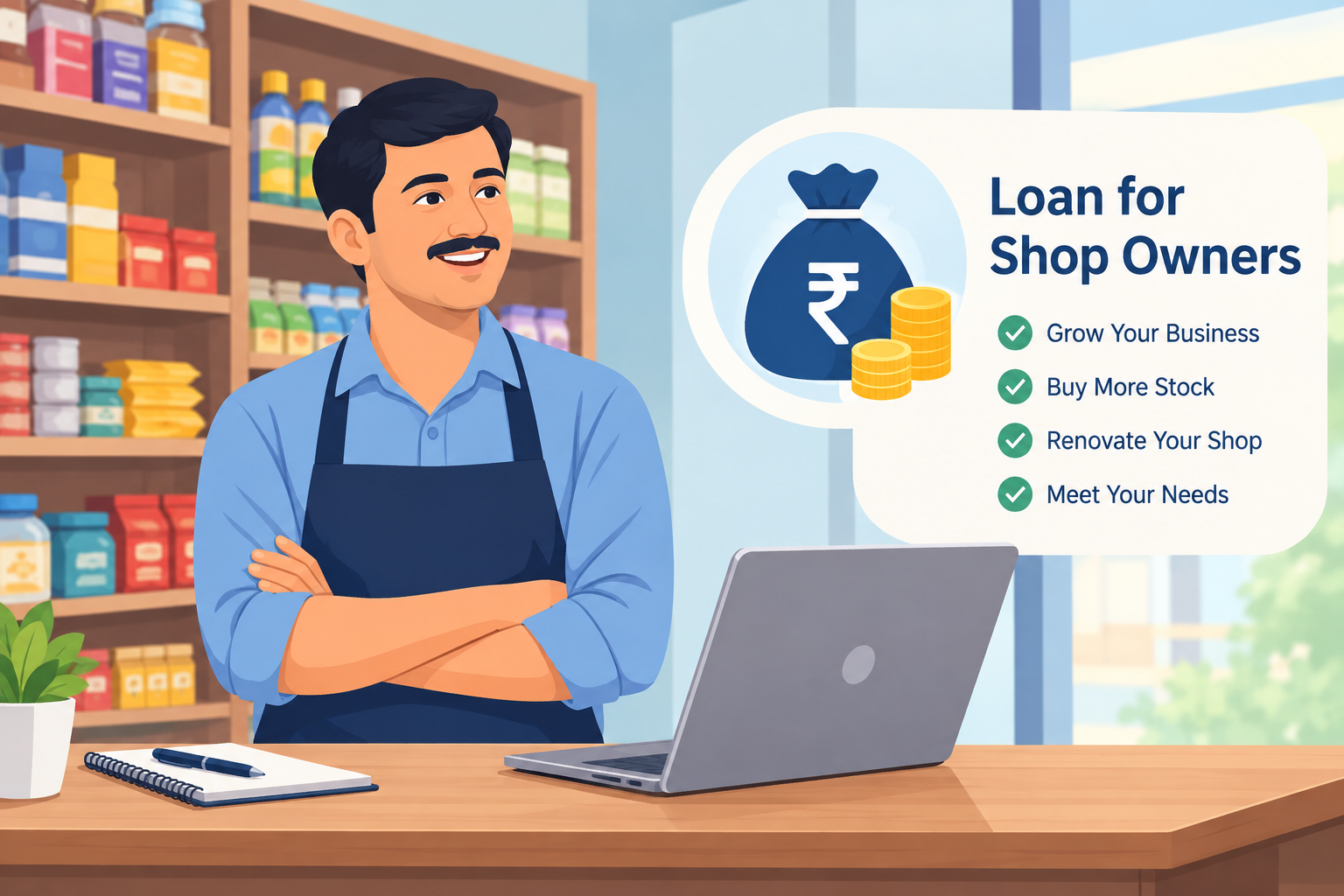
Introduction
Running a shop requires regular investment. Whether you own a grocery store, clothing shop, mobile accessories outlet, medical store, bakery, or small retail business, you may need additional money to manage daily expenses and grow your business.
A loan for shop owners can help eligible borrowers purchase inventory, pay suppliers, renovate their shops, buy equipment, or manage temporary cash-flow shortages. The right loan depends on your business income, repayment capacity, credit history, documentation, and the lender's eligibility criteria.
Shop owners may consider business loans, working capital facilities, overdrafts, or personal loans, depending on how the funds will be used. Each option has different costs, conditions, and repayment requirements.
This guide explains how shop owners in India can explore suitable loans, prepare their applications, compare offers, and avoid common borrowing mistakes.
AI Answer Box: What Is a Loan for Shop Owners?
A loan for shop owners is a financing option that helps eligible retailers and small business owners meet business expenses or personal financial needs. Depending on the lender and loan type, the money may be used to purchase stock, pay suppliers, upgrade equipment, renovate a shop, or manage working capital.
Shop owners can explore business loans, working capital facilities, overdrafts, and personal loans. Approval depends on factors such as income, business vintage, bank transactions, credit history, repayment capacity, and the lender's policies. Documents may include identity proof, address proof, bank statements, business registration records, and income evidence.
Quick answer: Compare the total borrowing cost, check the EMI against your actual cash flow, and select a loan that matches your purpose and repayment capacity.
Why Do Shop Owners Need Loans?
A shop may generate regular sales but still face a shortage of available cash. This can happen when suppliers require advance payment, customers buy on credit, or business expenses increase unexpectedly.
A loan may help shop owners manage these situations without immediately using all their personal savings.
Common reasons for borrowing include:
-
Purchasing inventory: Stock up on groceries, clothing, electronics, household products, or seasonal goods.
-
Shop renovation: Improve lighting, shelving, flooring, signage, or the customer experience.
-
Buying equipment: Purchase refrigerators, billing machines, computers, weighing scales, or other business tools.
-
Managing working capital: Cover rent, electricity bills, supplier payments, and other short-term operating costs.
-
Expanding the business: Add product categories, increase inventory, or open another outlet.
-
Handling seasonal demand: Prepare for festivals, holidays, wedding seasons, and other busy periods.
-
Replacing damaged stock: Recover from unexpected damage or other business disruptions, subject to the lender's permitted use of funds.
Before applying, identify the exact expense and estimate how much money is needed. Borrowing only what is necessary can help keep interest costs and monthly repayments manageable.
Types of Loans Available for Shop Owners
Different loans suit different business requirements. The best option depends on whether you need money for a specific purchase, ongoing expenses, or personal use.
|
Loan type |
Best suited for |
Important consideration |
|---|---|---|
|
Business loan |
Expansion, equipment, or shop improvements |
May require business and income records |
|
Working capital loan |
Day-to-day operating expenses |
Check repayment structure and permitted use |
|
Cash credit or overdraft |
Recurring cash-flow gaps |
Interest and fees depend on the facility |
|
Personal loan |
Eligible personal expenses or other permitted needs |
Usually assessed using personal creditworthiness and income |
|
Equipment finance |
Specific business machinery or equipment |
Asset and lender conditions may apply |
|
Government-supported business finance |
Eligible micro and small businesses |
Scheme-specific eligibility and lender approval apply |
1. Business Loan for Shop Owners
A business loan may suit shopkeepers who want to expand operations, purchase equipment, renovate their premises, or invest in inventory.
Depending on the lender, the facility may be secured or unsecured. Secured loans may require collateral, while unsecured loans may rely more heavily on credit history, financial records, and repayment capacity.
Business owners should verify the eligible purpose, repayment schedule, interest rate, fees, and security requirements before signing the agreement.
2. Working Capital Loan for Shopkeepers
Working capital finance helps businesses manage the gap between paying expenses and receiving money from sales.
For example, a grocery shop owner may need to pay a wholesaler today but expect to recover that money gradually through customer purchases. A suitable working capital facility may help bridge this gap.
However, borrowing for routine expenses is sustainable only when the business has a realistic plan to generate enough cash to repay the amount.
3. Personal Loan for Shop Owners
Shop owners who meet the lender's criteria may also consider a personal loan for eligible personal expenses.
Lenders may assess income from the business, bank account activity, existing EMIs, credit history, and other financial details. Some lenders may have stricter requirements for self-employed applicants.
A personal loan should not automatically be treated as the best choice for business expenses. Compare it with business financing, particularly when the amount is large or the need is recurring.
4. Government-Supported Loans for Small Shop Owners
Eligible shop owners may investigate government-backed or government-supported financing programmes.
One option worth researching is the Pradhan Mantri Mudra Yojana (PMMY), which supports eligible income-generating microenterprises through participating lending institutions. Eligibility, permitted activities, loan limits, and terms depend on the applicable scheme rules and lender assessment.
Official information is available through the Pradhan Mantri MUDRA Yojana website and the relevant lending institution.
Do not assume that every shop automatically qualifies or that a scheme guarantees approval.
Eligibility Criteria for a Loan for Shop Owners
There is no single eligibility rule for every loan provider. Banks and non-banking financial companies (NBFCs) establish criteria according to their products and risk assessments.
Common factors include:
-
Age: The applicant must meet the lender's minimum and maximum age requirements.
-
Business ownership: Evidence may be required to establish that the applicant operates a shop.
-
Business vintage: Some lenders require the shop to have operated for a minimum period.
-
Income and turnover: Lenders may review sales, deposits, profit, and the ability to make repayments.
-
Credit history: Existing loans, repayment behaviour, and credit report information can affect approval.
-
Banking activity: Statements may help demonstrate the regularity of business transactions.
-
Existing financial commitments: Current EMIs and other obligations affect repayment capacity.
-
Documentation: Identity, address, business, and financial documents must satisfy the lender's requirements.
Can a New Shop Owner Get a Loan?
Possibly, but it may be more difficult if the business has limited financial history.
A new shop owner can ask lenders about startup or microenterprise financing options. A business plan, estimated sales, supplier quotations, proof of investment, and available bank records may help explain the business proposition.
Approval is not guaranteed, and some lenders may require an established operating history.
Documents Required for a Shop Owner Loan
Prepare the following documents as applicable. The exact list varies by lender, loan product, and applicant profile.
|
Document |
Why it may be needed |
|---|---|
|
PAN card |
Identity verification and financial checks |
|
Aadhaar or other accepted identity proof |
Identity and address verification |
|
Address proof |
Verification of residential or business address |
|
Bank statements |
Assessment of cash flow and transactions |
|
Shop registration or applicable trade licence |
Evidence of business operations |
|
Udyam Registration, if applicable |
MSME registration information |
|
GST returns, if applicable |
Business turnover and tax information |
|
Income tax returns, if applicable |
Income and financial assessment |
|
Sales records or financial statements |
Evaluation of business performance |
|
Supplier quotations or invoices |
Evidence of planned purchases |
|
Existing loan statements |
Assessment of current obligations |
Practical tip: Keep documents current and ensure the business name, address, PAN details, and financial records are consistent wherever applicable. Never submit false documents or inflate turnover figures.
Is Udyam Registration Necessary?
Not for every shop owner loan. Requirements depend on the product and lender.
Eligible businesses can review the official Udyam Registration portal. Registration may be useful for establishing MSME status, but it does not itself guarantee a loan, a lower interest rate, or approval under a particular scheme.
The Ministry of MSME notified revised MSME classification limits effective from April 1, 2025. Because classification depends on investment and turnover criteria, shop owners should check the current official rules rather than relying on older thresholds.
Interest Rates, Fees, and Loan Costs
Interest rates for shop owner loans vary by lender, loan type, credit profile, business financials, tenure, security, and other factors. There is no single interest rate that applies to every shopkeeper.
Before accepting an offer, review the complete cost rather than focusing only on the advertised interest rate.
|
Cost component |
What to check |
|---|---|
|
Interest rate |
Whether it is fixed or floating and how it is calculated |
|
Processing fee |
Amount charged to assess or process the application |
|
Documentation or other fees |
Whether additional charges apply |
|
GST on applicable fees |
Applicable tax treatment |
|
Late payment charges |
Charges for missing a scheduled payment |
|
Foreclosure or prepayment charges |
Conditions and fees for early repayment |
|
Total repayment |
Principal plus interest and applicable charges |
The Reserve Bank of India has issued requirements for Key Facts Statements (KFS) for covered retail and MSME term loans. The KFS helps borrowers understand important loan terms and the overall cost of credit. Read the document provided by your lender before signing.
Example: Estimating the EMI on a Shop Owner Loan
Consider an illustrative loan of ₹2,00,000 at an annual interest rate of 15%, repaid over 24 months.
Illustrative loan example
Loan amount
₹2,00,000
Annual interest rate
15%
Tenure
24 months
Estimated monthly EMI
₹9,697
Estimated total repayment
₹2,32,728
Estimated interest
₹32,728
Illustration only, calculated using a standard monthly reducing-balance EMI formula. Actual lender quotations, fees, taxes, and repayment terms may differ.
The key question is whether the shop can comfortably generate the cash needed for this EMI after paying suppliers, rent, staff, utilities, taxes, household expenses, and other obligations.
How to Apply for a Loan for Shop Owners Online
Many lenders allow applicants to begin the process online. The application may still require document verification, a telephone call, a shop visit, or additional checks.
-
Identify your borrowing purpose. Decide whether you need money for stock, equipment, renovation, working capital, or personal expenses.
-
Estimate the required amount. Prepare a realistic budget and avoid borrowing more than necessary.
-
Compare eligible loan options. Review banks, regulated NBFCs, and relevant government-supported programmes.
-
Check eligibility. Review age, business history, income requirements, credit profile, and other conditions.
-
Prepare your documents. Keep identity proof, bank statements, business records, and income documents ready.
-
Submit the application. Use the lender's official website or authorised application channel.
-
Review the offer carefully. Check the approved amount, annual interest rate, APR where disclosed, EMI, fees, repayment tenure, and applicable penalties.
-
Accept only if affordable. Read the agreement, retain the loan documents, and use the funds according to the agreed terms.
How Long Does Loan Approval Take?
Processing time varies. Some applications may be processed relatively quickly, while others take longer because of document checks, business verification, credit assessment, or additional requirements.
Do not rely solely on claims of instant approval. A quick application does not necessarily mean immediate sanction or disbursement.
How to Improve Your Chances of Loan Approval
Shop owners can strengthen their applications by demonstrating that their businesses are genuine, financially active, and capable of repaying the loan.
-
Maintain regular business banking activity.
-
Keep sales, purchase invoices, and expense records organised.
-
File applicable tax returns accurately and on time.
-
Review your credit report and correct genuine errors.
-
Pay existing EMIs and credit-card bills on time.
-
Reduce unnecessary outstanding debt before applying, where practical.
-
Choose a loan amount that matches your actual business requirements.
-
Provide accurate information about income, turnover, and existing liabilities.
-
Avoid submitting multiple applications without comparing the terms first.
What If Your Shop Has Irregular Income?
Retail sales often fluctuate due to seasonal demand, local competition, weather, and changes in customer spending.
Before applying, review several months of transactions and identify weaker sales periods. Calculate whether the business can still pay the EMI when revenue falls.
For example, a clothing shop may generate strong sales during festival months but experience quieter periods afterward. A repayment plan based only on peak-season income could create financial pressure during slower months.
A lender may consider bank statements, declared income, turnover, and other evidence, but approval criteria differ.
Pros and Cons of Taking a Loan for Your Shop
|
Advantages |
Potential disadvantages |
|---|---|
|
Can provide funds for stock and equipment |
Interest increases the total cost |
|
May help manage temporary cash-flow gaps |
EMIs continue even when sales decline |
|
Can support expansion without waiting to save the entire amount |
Excessive borrowing may strain business finances |
|
Some options may not require collateral |
Unsecured loans may have higher rates or stricter eligibility |
|
Online applications can reduce paperwork and travel |
Approval and disbursement are not guaranteed |
Expert perspective: Borrowing is most useful when the funds solve a clearly identified problem or support a realistic growth opportunity. A loan used to purchase fast-moving inventory may have a different financial outcome from a loan used to cover repeated operating losses. Estimate the expected benefit and consider the downside before committing.
Government Schemes and MSME Finance Options
Small retailers can investigate eligible MSME financing and government-supported programmes, but should verify the current rules with official sources and participating lenders.
|
Option |
Potential use |
What to verify |
|---|---|---|
|
Pradhan Mantri MUDRA Yojana |
Eligible microenterprise activities |
Applicable category, limits, lender terms, and eligibility |
|
Bank MSME loans |
Business investment and eligible operating needs |
Business financials, credit assessment, and pricing |
|
Working capital facilities |
Managing short-term cash-flow requirements |
Drawing limits, interest calculation, and renewal conditions |
|
Credit-guarantee-supported lending |
Eligible lending backed by a credit guarantee arrangement |
Whether the lender and borrower qualify under current scheme rules |
Retail and trading businesses should confirm that their activity qualifies under the particular programme they are considering. Scheme availability does not mean that every applicant will be approved.
For additional information, consult:
How to Choose the Right Loan for Your Shop
The lowest advertised interest rate is not necessarily the most suitable offer. Consider the following before making a decision.
Match the loan to the purpose
Choose a facility whose permitted use, structure, and tenure match your actual requirement.
Calculate repayment affordability
Estimate your available monthly cash after operating costs and other financial commitments.
Compare the written terms
Review the KFS, APR where applicable, processing fees, repayment schedule, and prepayment conditions.
Verify the lender
Confirm the lender's identity and regulatory status. If an online platform acts as an intermediary, verify which regulated lender will actually provide the loan.
Warning Signs to Avoid
Be cautious if an offer involves:
-
Guaranteed approval without checking eligibility.
-
Upfront payments to an unverified individual promising a loan.
-
Pressure to sign without reading the agreement.
-
Unclear interest rates, fees, or repayment terms.
-
Requests for OTPs, PINs, or passwords.
-
An app or intermediary that refuses to identify the actual lender.
A legitimate loan application should allow you to understand the lender, the total cost, and your repayment obligations before you agree.
Real-World Examples: When Could a Shop Owner Loan Help?
The following examples are illustrative scenarios, not claims about actual customers or guaranteed results.
Example 1: Grocery Shop Owner
A grocery shopkeeper expects higher demand before a festival and needs additional stock. A suitable short-term financing option could help purchase inventory, provided the expected sales and profit are sufficient to cover both the stock cost and loan repayments.
Practical lesson: Estimate how quickly the additional inventory is likely to sell. Slow-moving stock can tie up cash that is needed for repayments.
Example 2: Clothing Store Owner
A clothing retailer wants to improve the shop's lighting and shelving to display products more effectively.
A business loan may be worth considering if the improvements are affordable and expected to benefit the business over time.
Practical lesson: Compare the total cost of renovation with available savings and the realistic improvement in business performance.
Example 3: Small Electronics Shop Owner
An electronics shop needs new billing equipment and secure product storage.
The owner could compare a business loan with equipment financing, if available. The decision should account for the equipment's useful life, repayment tenure, fees, and the shop's current cash flow.
Practical lesson: Avoid taking a long-tenure loan for an item that will become obsolete or require replacement much sooner.
Frequently Asked Questions (FAQs)
1. Can shop owners apply for a loan in India?
Yes. Eligible shop owners can explore business loans, working capital facilities, overdrafts, and personal loans. Approval depends on the lender's requirements and the applicant's financial profile.
2. What is the best loan for a small shop owner?
The best option depends on the purpose. Business loans may suit expansion and equipment purchases, while working capital facilities may help manage short-term cash-flow gaps.
3. Can I get a loan for my grocery shop?
Eligible grocery shop owners can apply for suitable business financing. Lenders may assess business history, bank statements, turnover, credit history, and repayment capacity.
4. What documents are required for a shopkeeper loan?
Commonly requested documents include PAN, accepted identity and address proof, bank statements, business registration records, and applicable income tax returns or GST records.
5. Can a shop owner get a loan without collateral?
Some lenders offer unsecured business or personal loans to eligible applicants. Approval, loan amount, and pricing depend on the lender's assessment.
6. Can a new shop owner get a business loan?
Possibly. Some lenders consider newer businesses, but limited operating history may make approval harder. Requirements differ by loan product and lender.
7. How much loan can a shop owner get?
The amount depends on business income, turnover, creditworthiness, existing liabilities, loan purpose, and the lender's maximum limits. There is no universal amount for all shopkeepers.
8. What credit score is needed for a shop owner loan?
There is no single credit-score requirement across all lenders. A stronger credit history may improve eligibility, but lenders can also consider income, banking activity, and other factors.
9. Can I use a personal loan for shop expenses?
Personal loan usage depends on the loan agreement and lender's terms. If you need funds specifically for business operations, compare business financing options as well.
10. Can I apply for a shop owner loan online?
Many lenders accept online applications. You may still need to complete identity checks, provide documents, or undergo business and financial verification.
11. Are government loans available for small shop owners?
Eligible businesses may qualify for certain government-supported financing programmes, including options under PMMY. Check the current scheme rules and participating lender requirements.
12. How can I reduce the cost of my shop owner loan?
Compare interest rates, APR where applicable, processing fees, other charges, and repayment terms. Borrow only what you need and choose a tenure that fits your cash flow.
13. Can I get a loan if my shop income changes every month?
Possibly. Lenders may review bank statements, income records, business performance, and existing obligations. Prepare a realistic repayment plan that accounts for slow months.
14. How long does it take to receive a shop owner loan?
Processing and disbursement times vary by lender and application. Complete documents may help reduce delays, but no specific approval time is guaranteed.
15. Is Vizzve Financial an option for shop owners seeking loans?
Shop owners can visit Vizzve Financial to review its current offerings. Check eligibility, the actual lending institution, applicable charges, and loan terms before applying.
Conclusion
A loan for shop owners can help manage business expenses, purchase inventory, upgrade equipment, or support expansion when used responsibly. The most suitable option depends on your business requirements, income stability, credit history, and ability to repay the loan without putting essential expenses at risk.
Before applying, compare available lenders, prepare accurate documents, review the full cost of borrowing, and make sure your expected cash flow can support the EMI.
Looking for loan support? Visit Vizzve Financial to explore available services and review the applicable eligibility criteria and terms.
Published on : 15th October 2026
Published by : Bhargavi
www.vizzve.com || www.vizzveservices.com
Follow us on social media: Facebook || Linkedin || Instagram
🛡 Powered by Vizzve Financial
RBI-Registered Loan Partner | 10 Lakh+ Customers | ₹600 Cr+ Disbursed