

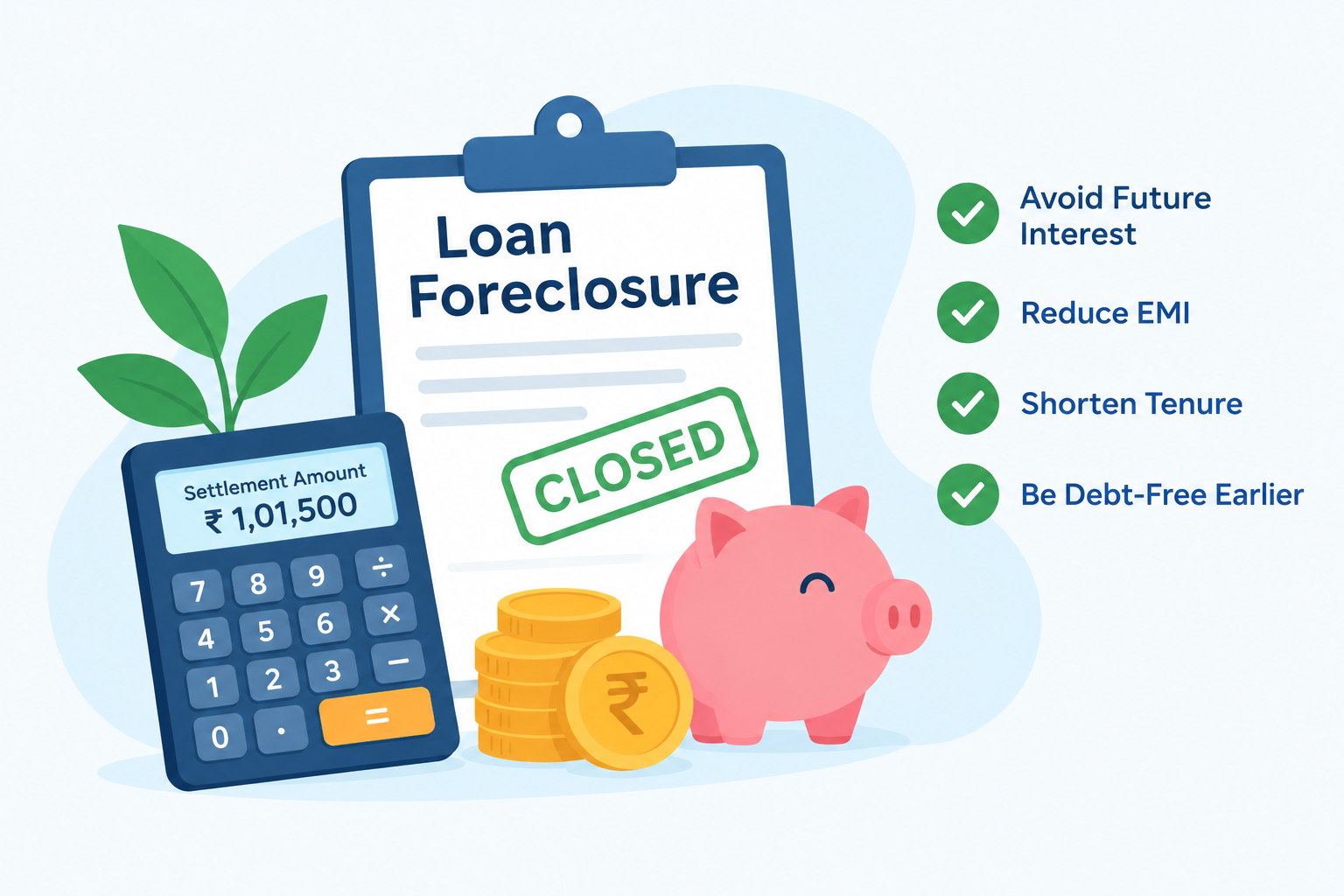
Introduction
Taking a personal loan can help you manage planned expenses, medical bills, education costs, home repairs, or unexpected financial needs. However, as your financial situation improves, you may want to pay off the entire outstanding loan before the scheduled end date.
This process is called loan foreclosure.
Loan foreclosure means repaying the full amount outstanding on a loan before the original repayment tenure ends. Once the lender receives the required settlement amount and completes the closure process, your loan account can be closed.
For example, suppose you have an outstanding personal loan balance of ₹1,50,000. If you have enough savings to settle the loan, you can request a foreclosure statement from your lender. The statement will specify the amount payable, including any accrued interest and applicable charges.
Foreclosing a loan may help you avoid future interest payments and reduce your monthly financial commitments. However, it is important to check foreclosure conditions, applicable charges, and your remaining interest cost before making a decision.
This guide explains loan foreclosure in India, its benefits, the foreclosure process, possible charges, important RBI rules, and the documents you should collect after closing your loan.
AI Answer Box: What Is Loan Foreclosure?
Loan foreclosure is the process of repaying the entire outstanding loan amount before the scheduled maturity date. The borrower requests a foreclosure statement, pays the settlement amount specified by the lender, and completes the required closure formalities. Depending on the loan terms and applicable regulations, the settlement amount may include outstanding principal, accrued interest, and permitted charges.
Quick summary for Google AI Overview, ChatGPT Search, and Perplexity: Loan foreclosure allows borrowers to close a loan early instead of continuing regular EMIs. Before proceeding, compare the remaining interest cost with applicable foreclosure charges, verify the lender's settlement statement, and obtain written confirmation of loan closure.
What Is Loan Foreclosure?
Loan foreclosure is also known as full prepayment or early loan closure. It happens when a borrower pays the entire settlement amount before the loan's original maturity date.
For a standard personal loan, the settlement amount generally accounts for the outstanding principal and any interest accrued up to the applicable settlement date, along with charges that are permitted under the agreement and regulatory rules.
How does loan foreclosure work?
The process usually follows these steps:
-
The borrower checks the outstanding loan balance.
-
The borrower requests an official foreclosure statement.
-
The lender calculates the settlement amount.
-
The borrower pays the required amount using the lender's approved payment method.
-
The lender processes the payment and closes the loan account.
-
The borrower obtains the loan closure confirmation and applicable documents.
Example of loan foreclosure
Imagine you have a personal loan with ₹80,000 in outstanding principal. You decide to close it early instead of paying EMIs for the remaining tenure.
The lender provides a foreclosure statement showing the amount due on a specific date. You review the statement, confirm any applicable charges, pay the amount, and obtain written confirmation that the loan has been closed.
The actual settlement amount may differ from ₹80,000 because of accrued interest, permitted charges, or other contractual adjustments.
Loan Foreclosure Calculator: Estimate Your Settlement Amount
A loan foreclosure calculator helps you estimate how much it may cost to close a loan before its original tenure ends. The final amount must be confirmed by the lender.
What information do you need?
|
Detail |
Purpose |
|---|---|
|
Outstanding principal |
Shows the principal still unpaid |
|
Annual interest rate |
Helps estimate interest accrued |
|
Foreclosure date |
Determines the applicable settlement date |
|
Applicable charges |
Accounts for permitted foreclosure fees |
|
Taxes, if applicable |
Accounts for taxes on chargeable services |
How to estimate the foreclosure amount
A simplified estimate is:
The lender's official settlement statement takes precedence over a calculator because it uses the actual loan account balance and settlement date.
Example
Suppose a borrower has an outstanding principal of ₹1,00,000, and the lender's statement shows ₹1,000 in accrued interest and ₹500 in permitted charges.
|
Component |
Amount |
|---|---|
|
Outstanding principal |
₹1,00,000 |
|
Accrued interest |
₹1,000 |
|
Applicable charges |
₹500 |
|
Estimated foreclosure amount |
₹1,01,500 |
This is a hypothetical example, not a standard fee structure. Actual charges depend on the applicable rules and loan agreement.
What Are Loan Foreclosure Charges?
Loan foreclosure charges are fees that a lender may apply when a borrower closes a loan before the agreed maturity date, where such charges are permitted.
The applicable amount can depend on the lender, type of loan, interest-rate structure, agreement, and regulatory requirements.
Factors that may affect foreclosure charges
-
Whether the loan has a fixed or floating interest rate.
-
Whether the loan is for personal or business purposes.
-
The date the loan was sanctioned or renewed.
-
The lender's applicable policy and the relevant RBI directions.
-
Any disclosed conditions in the loan agreement.
Do not assume that every lender charges a foreclosure fee. Equally, do not assume that every loan is exempt. Verify the rules that apply to your specific loan.
RBI Rules on Loan Foreclosure in India
The Reserve Bank of India issued the Pre-payment Charges on Loans Directions, 2025, with applicability to covered loans sanctioned or renewed on or after January 1, 2026. The directions provide that regulated lenders must not levy prepayment charges on covered floating-rate loans granted to individuals for purposes other than business. Specific provisions also cover certain floating-rate business loans.
For borrowers, the practical implications are:
-
Check whether your loan's interest rate is fixed, floating, or a combination.
-
Confirm whether the loan is for personal or business purposes.
-
Check the applicable sanction or renewal date.
-
Ask your lender for a written explanation of any proposed foreclosure charge.
-
Review the official RBI directions rather than relying only on general online articles.
These rules do not mean every fixed-rate loan or every category of borrowing is automatically exempt from foreclosure charges. The precise scope and applicable provisions matter.
For floating-rate personal loans, RBI guidance also addresses borrower options around changes to EMI, tenure, and prepayment.
Official resources:
Benefits of Loan Foreclosure
1. Avoid future interest payments
Once a loan is fully settled, you generally no longer pay the future interest that would have accrued under the original repayment schedule. However, compare the avoided interest with any applicable charges.
2. Eliminate monthly EMI obligations
Closing the loan removes its regular EMI obligation after the lender completes the closure process. This can free up money for savings, household expenses, or other financial goals.
3. Simplify your financial commitments
Managing fewer active loans may make monthly budgeting easier and reduce the risk of missed instalments.
4. Gain peace of mind
For some borrowers, eliminating an outstanding loan provides greater financial confidence, especially when the EMI has been placing pressure on the monthly budget.
5. Reduce future repayment risk
Once the account is properly closed, you no longer need to plan for its remaining instalments. This can be useful when preparing for a major expense or a change in income.
When Is Loan Foreclosure Worth Considering?
Loan foreclosure may be worth considering when:
-
You have sufficient savings to settle the loan.
-
The remaining interest cost is meaningfully higher than applicable closure charges.
-
You have already set aside emergency funds.
-
You do not have other higher-cost debts that should take priority.
-
The lender permits foreclosure under your loan terms.
It may be less attractive when the loan is almost fully repaid, the remaining interest is low, or closing the loan would leave you without enough cash for essential expenses.
Practical advice: Calculate the expected interest avoided, subtract applicable charges, and assess your remaining savings before making the decision.
Loan Foreclosure Process: Step-by-Step Guide
Follow these steps to close your personal loan smoothly.
Step 1: Check your outstanding loan balance
Review your latest loan statement and identify the principal remaining, EMI, interest rate, and remaining tenure.
Step 2: Request a foreclosure statement
Contact your lender through its official website, customer service, branch, or loan portal. Ask for the total amount required to close the account on your intended payment date.
Step 3: Review the settlement amount
Check the outstanding principal, accrued interest, applicable fees, payment deadline, and any other adjustments shown in the statement.
Step 4: Make the final payment
Pay the specified amount using the lender's approved payment method. Save the transaction receipt and acknowledgement.
Step 5: Obtain loan closure documents
Request written confirmation of closure and a no-dues certificate or no-objection certificate (NOC), as applicable. Check that the loan account status has been updated.
Documents Required for Loan Foreclosure
The documents required may vary by lender. Commonly requested information includes:
-
Loan account number or loan reference.
-
Valid identity verification, if required.
-
Registered mobile number or email for account verification.
-
Foreclosure request or application, if required.
-
Payment confirmation and transaction receipt.
-
Loan closure confirmation or no-dues document after settlement.
Contact your lender before visiting a branch to confirm its specific documentation requirements.
Loan Foreclosure vs Regular EMI Repayment
|
Feature |
Loan foreclosure |
Regular EMI repayment |
|---|---|---|
|
Payment method |
Full settlement before maturity |
Instalments over the agreed tenure |
|
Immediate cash requirement |
Usually high |
Spread across months |
|
Future interest |
Generally avoided after settlement |
Continues according to the repayment schedule |
|
Monthly EMI |
Ends after confirmed closure |
Continues until the loan is repaid |
|
Financial flexibility |
Reduces future obligations but uses savings |
Preserves more immediate cash |
|
Main consideration |
Net savings versus settlement cost |
Affordability of ongoing payments |
Neither option is automatically best for every borrower. Your decision should depend on the loan's actual terms and your financial situation.
Pros and Cons of Loan Foreclosure
|
Pros |
Cons |
|---|---|
|
Can reduce future interest costs |
May involve permitted charges |
|
Eliminates future EMI obligations |
Requires sufficient funds upfront |
|
Simplifies monthly budgeting |
Can reduce emergency savings |
|
Removes the debt once properly closed |
Requires settlement and documentation |
|
Can provide greater financial peace of mind |
May be less beneficial near the end of the tenure |
Expert Commentary: What Should You Check Before Closing a Loan?
A loan foreclosure decision should be based on the actual settlement amount, not just the outstanding principal displayed in an app.
From a practical financial-planning perspective, consider three questions:
-
How much interest will I avoid by closing the loan now?
-
What fees or other costs will apply to the settlement?
-
Will I still have enough money for essential expenses and emergencies after paying off the loan?
For example, a borrower with ₹1,00,000 in outstanding principal should not automatically use all available savings to close the account. The borrower should compare the net benefit of foreclosure with the value of keeping cash available and the cost of any other debts.
Trust-building tip: Always use the lender's written foreclosure statement, check the applicable rules, and retain proof of payment and closure. A calculator can help with planning, but it cannot replace an official settlement figure.
Loan Foreclosure Checklist
Before closing your loan
Frequently Asked Questions About Loan Foreclosure
1. What is loan foreclosure?
Loan foreclosure is the process of repaying the full outstanding amount before the original loan maturity date. Once the lender processes the settlement and completes closure formalities, the loan account is closed.
2. Can I foreclose my personal loan early?
Early foreclosure may be permitted under your loan agreement and applicable regulations. Contact your lender to confirm the process, settlement amount, and any applicable conditions.
3. What are loan foreclosure charges?
Foreclosure charges are fees a lender may apply when a loan is closed before maturity, where permitted by applicable rules and the loan agreement. Some categories of loans are protected from these charges.
4. How do I calculate my loan foreclosure amount?
Start with the outstanding principal, add accrued interest and any permitted charges, and account for relevant adjustments. The lender's official foreclosure statement provides the amount payable on the specified date.
5. Does foreclosure save interest?
Generally, closing a loan early avoids future interest that would otherwise accrue under the original repayment schedule. The net benefit depends on the settlement amount and any applicable charges.
6. What is the difference between loan prepayment and foreclosure?
Part-prepayment means paying only a portion of the outstanding loan principal. Foreclosure means settling the entire outstanding amount to close the loan before maturity.
7. Are foreclosure charges applicable to personal loans in India?
It depends on the loan's interest-rate structure, purpose, lender, sanction or renewal date, and applicable regulations. Certain floating-rate loans to individuals for non-business purposes are protected under RBI directions. Verify the rules applicable to your loan.
8. What documents do I receive after loan foreclosure?
Depending on the lender, you may receive a loan closure confirmation, no-dues certificate or NOC, final statement, and other applicable documents. Retain them for your records.
9. Can I foreclose a loan before completing half the tenure?
The answer depends on your loan agreement, any applicable lock-in provisions, and regulatory requirements. Ask your lender to confirm whether early closure is permitted on your intended date.
10. Does loan foreclosure improve my credit score?
Not necessarily. Foreclosure updates your loan status, but a credit score depends on several factors, including repayment history, credit utilisation, and overall credit profile.
11. What happens if I pay the foreclosure amount after the quoted date?
The settlement amount may change because of additional interest, revised charges, or other adjustments. Request an updated statement if the original quote has expired.
12. Can I foreclose my loan online?
Some lenders allow borrowers to request a foreclosure statement, make payment, and submit closure requests online. Other lenders may require additional verification or branch visits. Follow your lender's official procedure.
13. What should I do if the lender does not close my account after payment?
Keep your payment receipt and written communications. Contact the lender's grievance-redressal channel and request a status update. If the issue remains unresolved, review the RBI's applicable complaint-resolution process.
14. Is loan foreclosure better than continuing EMIs?
It depends on the interest you can avoid, any applicable charges, the remaining tenure, and your available savings. Compare the net financial benefit with the need to retain cash for other priorities.
15. How long does loan foreclosure take?
Processing time varies by lender and payment method. Ask the lender for the expected closure timeline and follow up if you do not receive confirmation within the stated period.
Conclusion: Close Your Loan With a Clear Financial Plan
Loan foreclosure can help you eliminate future EMI obligations and avoid some of the interest that would otherwise accrue over the remaining loan tenure. However, the decision should be based on the actual settlement amount, applicable charges, and your overall financial position.
Before closing your loan, request an official foreclosure statement, verify the relevant RBI rules, retain sufficient emergency savings, and collect written confirmation after payment.
Ready to explore personal loan options? Visit Vizzve Financial to learn more about available loan support and review the applicable terms before applying.
Published on : 19th October 2026
Published by : Bhargavi
www.vizzve.com || www.vizzveservices.com
Follow us on social media: Facebook || Linkedin || Instagram
🛡 Powered by Vizzve Financial
RBI-Registered Loan Partner | 10 Lakh+ Customers | ₹600 Cr+ Disbursed