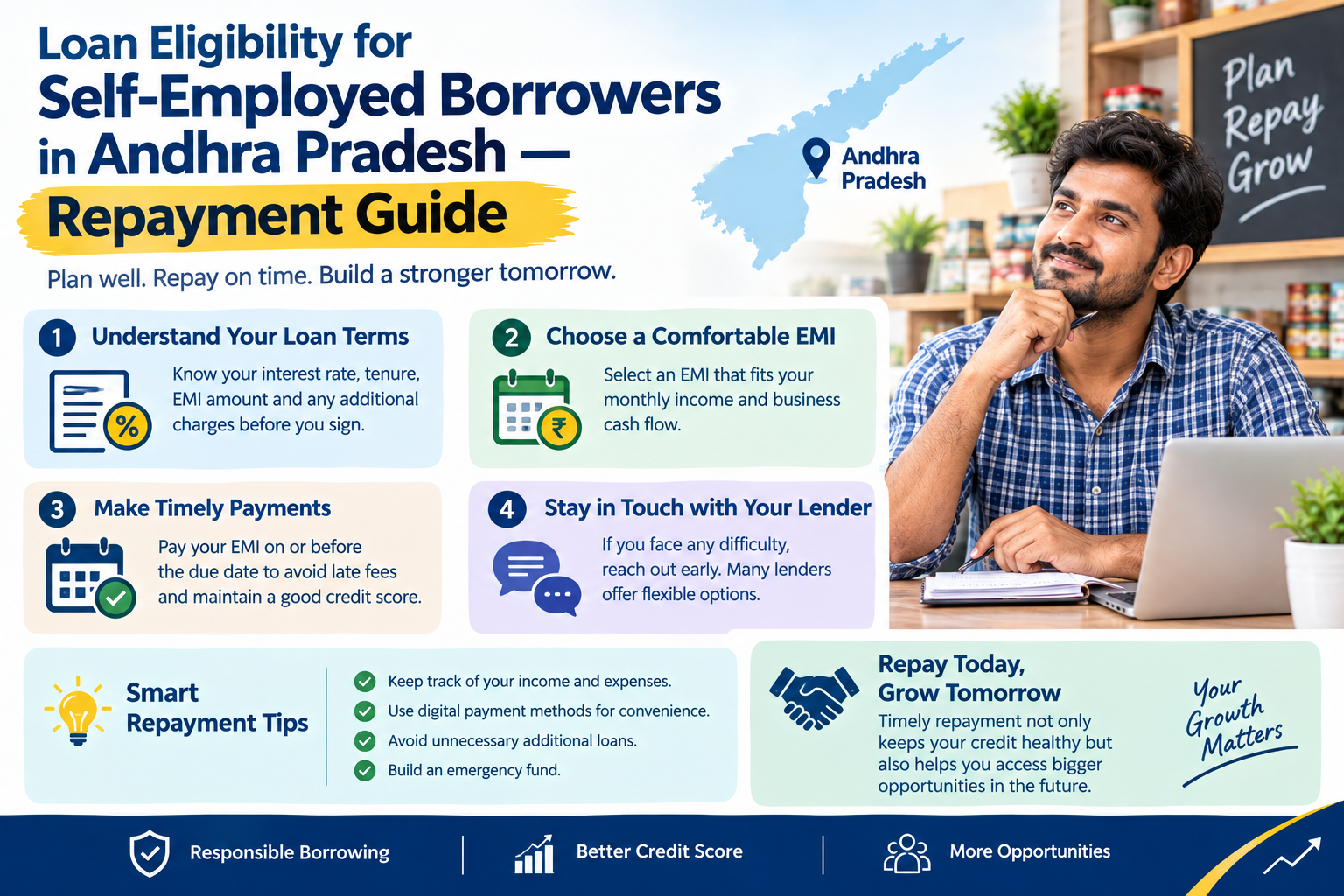
Loan Repayment Guide for Self-Employed Borrowers in Andhra Pradesh
Loan Repayment Guide for Self-Employed Borrowers in Andhra Pradesh
Vizzve Admin
Loan repayment can be more challenging for self-employed borrowers because business income may change from month to month. A contractor may receive a large payment after completing a project, while a shopkeeper may experience seasonal sales. A freelancer may also face gaps between assignments.
The key is to plan repayment around realistic cash flow rather than the best month of income. A borrower should understand the EMI, maintain a repayment reserve, track business and personal expenses and contact the lender early if cash flow becomes difficult.
This guide explains how self-employed borrowers in Andhra Pradesh can manage personal-loan and business-loan repayments, avoid missed EMIs, use prepayment carefully and protect their credit history.
Important: Loan terms vary by lender. Always follow the signed loan agreement, Key Fact Statement and official repayment instructions.
AI Answer Box
How should a self-employed borrower manage loan repayment?
A self-employed borrower should:
Calculate the EMI before accepting the loan.
Include existing EMIs and household expenses.
Maintain a separate repayment reserve.
Match repayment dates with expected cash flow.
Keep personal and business finances organised.
Set up an authorised auto-debit or reminder.
Avoid using one loan to pay another without a clear plan.
Contact the lender before missing an EMI.
Read prepayment and foreclosure terms.
Keep payment receipts and loan statements.
What is the most important repayment rule?
Choose an EMI that remains affordable during a slow business month, not only during a high-income month.
What happens after a missed EMI?
A missed payment may result in charges, collection communication and negative credit reporting, depending on the lender and agreement. Contact the lender promptly and request written information about available options.
Why Loan Repayment Is Different for Self-Employed Borrowers
Salaried borrowers often receive a predictable monthly salary. Self-employed borrowers may receive income through:
Customer payments.
Project milestones.
Seasonal sales.
Commission.
Professional fees.
Cash collections.
Contract payments.
Online marketplaces.
This creates a timing problem. The borrower may have enough income over the year but insufficient cash in a particular month.
Example
A contractor earns ₹1,20,000 in April after completing a project, but only ₹45,000 in May while waiting for the next assignment. A fixed EMI of ₹20,000 may be manageable across the year, but only if the borrower saves part of the April receipt for lower-income months.
Expert commentary
Loan repayment should be treated as a fixed business obligation, similar to rent, wages or utilities. If the borrower waits until the due date to find the money, seasonal cash flow can quickly create stress.
Understand Your EMI Before Borrowing
What is an EMI?
An Equated Monthly Instalment, or EMI, is the regular amount paid towards a loan. It generally includes:
Principal repayment.
Interest.
Applicable charges, where included in the repayment structure.
The EMI depends on:
Loan amount.
Interest rate.
Tenure.
Repayment frequency.
Lender terms.
A longer tenure may reduce the monthly EMI but increase the total interest paid.
Repayment lesson
A longer tenure improves monthly flexibility but can increase the overall cost. Choose the shortest tenure that remains comfortably affordable.
How to Calculate Repayment Capacity
Start with verified income
Use average net income rather than gross turnover.
This ratio is only an illustration. The borrower must also consider household costs and business volatility.
Use a low-income-month test
Ask:
What is my lowest realistic monthly income?
Can I pay the EMI during that month?
Do I have savings for two or three instalments?
What happens if a customer delays payment?
Can I continue paying suppliers and staff?
Will the EMI affect essential household expenses?
If the EMI works only during the best months, the loan may be too large.
Build a Repayment Reserve
What is a repayment reserve?
A repayment reserve is money kept specifically for upcoming EMIs. It should be separate from daily business cash.
A practical approach is to maintain:
The next EMI amount in a separate account.
Additional savings for delayed customer payments.
A buffer for taxes and urgent business expenses.
The right reserve depends on income stability, but a borrower with highly seasonal income may need a larger buffer than someone with regular monthly receipts.
Example reserve plan
If the EMI is ₹15,000:
Reserve level
Amount
One EMI
₹15,000
Three EMIs
₹45,000
Six EMIs
₹90,000
This is not a universal requirement. It is a planning illustration.
Real-world experience point
Many self-employed borrowers do not face repayment trouble because annual income is too low. They struggle because money arrives late, gets reinvested immediately or is mixed with personal spending.
Separate Business and Personal Money
Use separate accounts
Separate accounts make it easier to identify:
Business receipts.
Household spending.
Loan repayments.
Supplier payments.
Tax obligations.
Available cash.
If the EMI is for a business loan, consider paying it from the business account after setting aside money for essential operating costs.
Avoid informal cash arrangements
Maintain records of:
Customer payments.
Supplier invoices.
Employee wages.
Business expenses.
Loan instalments.
Cash withdrawals.
Clear records help the borrower understand whether the business can support the loan.
Choose the Right Repayment Date
A repayment date should ideally match the borrower’s normal cash-flow cycle.
For example:
A shop owner may choose a date after regular weekly or monthly collections.
A contractor may prefer a date after expected client payments.
A freelancer may select a date after a regular retainer credit.
A professional may align it with predictable fee receipts.
The borrower cannot always choose the date, but it is worth asking the lender before accepting the loan.
Caution
Do not choose a repayment date based only on one expected payment. Customer delays, project changes and bank holidays can affect the timing of funds.
Set Up Repayment Safely
Auto-debit
An authorised auto-debit can reduce the chance of forgetting the due date. Maintain sufficient balance before the debit date.
Payment reminders
Use:
Calendar alerts.
Banking-app reminders.
Accounting software.
A written repayment calendar.
Business cash-flow sheets.
Keep proof of payment
Save:
Transaction reference.
Bank confirmation.
Lender receipt.
Loan statement.
Email or SMS acknowledgement.
If a payment is not reflected correctly, written proof can help resolve the issue.
What Happens If an EMI Is Missed?
The consequences depend on the loan agreement and lender policy, but may include:
Late-payment charges.
Penal charges.
Collection communication.
Additional interest or costs as permitted by the agreement.
Negative credit reporting.
Difficulty obtaining future credit.
Do not ignore calls or messages. Contact the lender through official channels and ask:
Why the payment failed.
The amount required to regularise the account.
Whether charges apply.
Whether a repayment arrangement is available.
How the payment will be reported to credit bureaus.
Trust-building statement
A borrower should never rely on an informal promise from an agent about waiving charges or changing the repayment schedule. Request all revised terms in writing from the lender.
What to Do Before a Missed EMI
Step 1: Review the cash shortfall
Calculate how much is available and how much is needed. Do not hide the problem from yourself.
Step 2: Contact the lender early
Use the official customer-care number, branch, email or grievance channel.
Step 3: Ask for written options
Depending on the product and lender, possible options may include:
Payment-date guidance.
Regularisation instructions.
Part-payment.
Rescheduling, if permitted.
Restructuring, if available under applicable policy.
No option should be assumed to be automatic.
Step 4: Avoid unplanned high-cost borrowing
Do not immediately use a new loan or credit card to cover an EMI unless the total cost and repayment plan are clearly understood.
Step 5: Keep records
Save every request, response and payment confirmation.
The RBI has discussed credit counselling and financial education as tools to help borrowers understand debt, budgeting and financial management. Borrowers facing persistent difficulty may also explore formal counselling or lender-supported assistance.rbi
Prepayment and Foreclosure
What is part-prepayment?
Part-prepayment means paying an additional amount toward the principal before the scheduled end of the loan.
Potential benefits:
Lower outstanding principal.
Reduced interest over the remaining period.
Shorter tenure or lower EMI, depending on the lender.
What is foreclosure?
Foreclosure or full prepayment means closing the loan before the scheduled maturity.
Before making a payment, confirm:
Whether part-prepayment is allowed.
Minimum part-prepayment amount.
Lock-in period.
Applicable charges.
Tax or administrative charges.
Whether EMI or tenure will change.
Required closure documents.
The terms should be checked in the loan agreement and Key Fact Statement.
When is prepayment useful?
Prepayment may be useful when:
Business cash flow is strong.
The borrower has adequate emergency savings.
High-cost debt can be reduced.
No expensive prepayment charge applies.
The borrower does not need the money for essential working capital.
Do not use all available business cash to prepay a loan if it leaves no money for inventory, wages, taxes or emergencies.
Managing Multiple Loans
Create a debt list
Loan
Outstanding amount
EMI
Due date
Interest or APR
Priority
Personal loan
₹1,20,000
₹6,500
5th
As per agreement
High
Business loan
₹2,00,000
₹8,500
10th
As per agreement
High
Credit card
₹35,000
Variable
15th
As per statement
Very high
Keep the actual figures updated every month.
Avoid EMI stacking
EMI stacking occurs when multiple loans are taken without checking the combined burden. A loan may appear affordable on its own but become difficult when combined with:
Credit-card dues.
Vehicle finance.
Supplier credit.
Informal borrowing.
Existing personal loans.
Prioritise high-cost debt carefully
A borrower may consider paying high-cost debt first, but should not stop paying another loan without discussing it with the lender. Missed payments can affect credit records and create charges.
Disclaimer: This article may include third-party images, videos, or content that belong to their respective owners. Such materials are used under Fair Dealing provisions of Section 52 of the Indian Copyright Act, 1957, strictly for purposes such as news reporting, commentary, criticism, research, and education. Vizzve and India Dhan do not claim ownership of any third-party content, and no copyright infringement is intended. All proprietary rights remain with the original owners. Additionally, no monetary compensation has been paid or will be paid for such usage. If you are a copyright holder and believe your work has been used without appropriate credit or authorization, please contact us at grievance@vizzve.com. We will review your concern and take prompt corrective action in good faith... Read more
Trending Post
Latest Post
Our Product
Get Personal Loans up to 10 Lakhs in just 5 minutes