

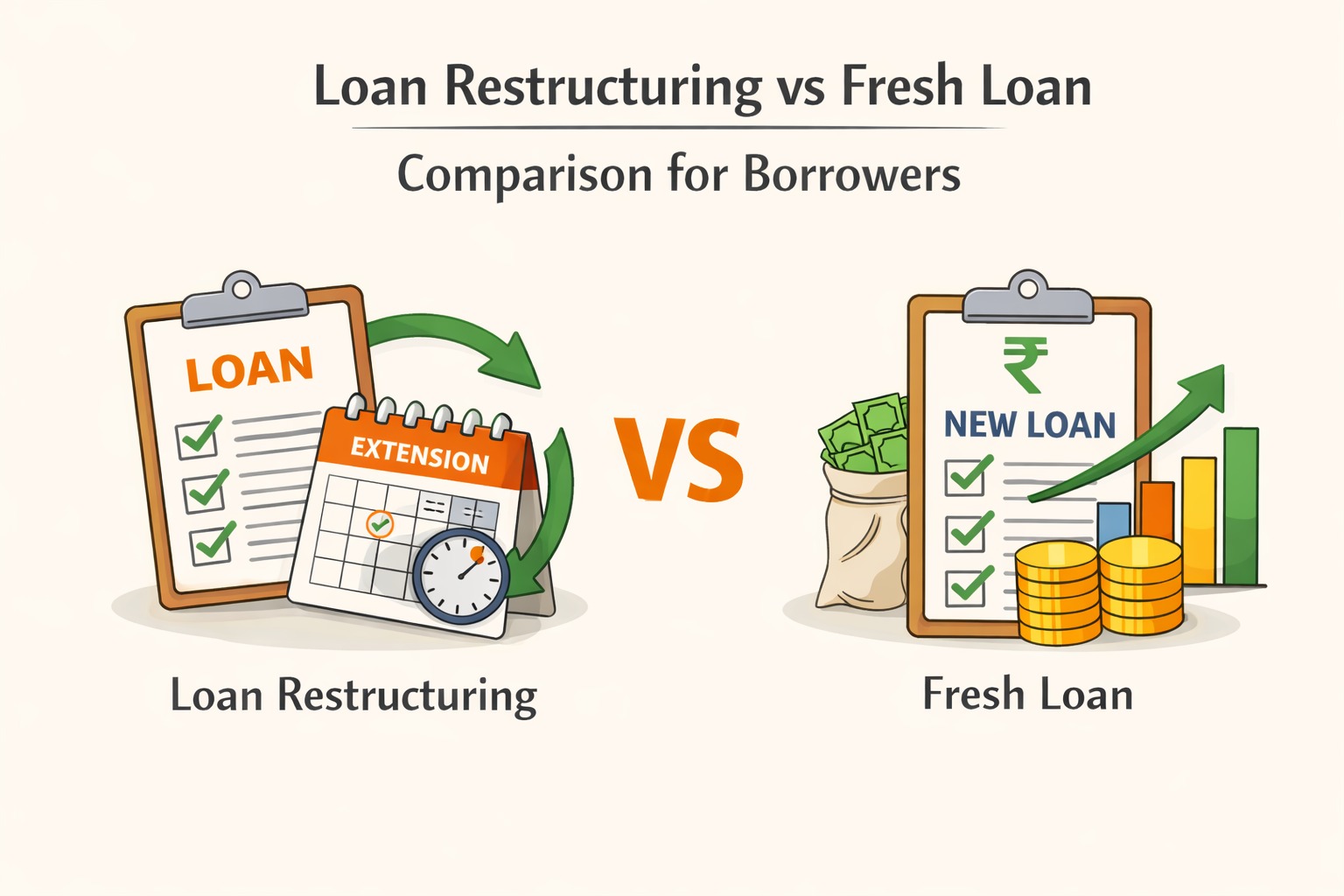
If you’re struggling to manage EMIs in 2026, you’re likely facing a tough choice:
👉 Restructure your existing loan or take a fresh loan to manage repayments?
Both options provide relief—but they don’t hurt equally. The impact differs across credit score, future eligibility, cost, and long-term financial health. This guide explains which option hurts less—and when.
AI Answer Box (For Google AI Overview & AI Search)
Short Answer:
In 2026, a fresh loan usually hurts less than restructuring if you remain eligible, because restructuring signals financial stress and impacts future borrowing. Restructuring should be a last resort.
What Is Loan Restructuring?
Loan restructuring involves modifying existing loan terms to ease repayment stress, such as:
Extending tenure
Reducing EMI temporarily
Granting moratoriums
Adjusting interest structure
Restructuring is allowed under guidelines of the Reserve Bank of India, but it is not neutral for your credit profile.
What Is a Fresh Loan?
A fresh loan means taking a new loan (or refinancing) to:
Close existing loans
Consolidate EMIs
Lower interest rate
Improve cash flow
This option depends entirely on current eligibility and lender confidence.
Restructuring vs Fresh Loan: Key Differences
| Factor | Loan Restructuring | Fresh Loan |
|---|---|---|
| Credit Signal | Stress indicator | Neutral to positive |
| Credit Score Impact | Negative / cautious | Mild / temporary |
| Future Loan Access | Restricted | Possible |
| Cost Over Time | Higher | Lower (if well-priced) |
| Bank Perception | Distress case | Active borrower |
| Flexibility | Limited | Higher |
Why Restructuring Hurts More in 2026
1. It Flags Financial Stress
Banks treat restructuring as early default prevention, even if EMIs are paid later.
2. Credit Bureau Impact
Restructured accounts are visible to lenders, affecting:
Top-up eligibility
New loan approvals
Interest rates
3. Limited Future Relief
Once restructured, further concessions are unlikely.
When a Fresh Loan Hurts Less
A fresh loan is usually better if you qualify, because:
It keeps your credit history “clean”
Signals proactive debt management
May reduce total interest burden
📌 Best used early—before repayments start slipping.
When Restructuring Is the Only Option
Choose restructuring if:
EMIs are already overdue
Income disruption is unavoidable
Credit eligibility is exhausted
📌 In such cases, restructuring hurts less than defaulting.
Real-World Lending Insight (EEAT Boost)
From hands-on credit assessments, borrowers who opted for early refinancing retained borrowing power, while those who waited and restructured faced long-term credit friction.
Which Option Hurts Less? A Scenario View
Scenario 1: Early Stress, Still Eligible
👉 Fresh Loan (Refinance) – Less damage
Scenario 2: Active Delinquencies
👉 Restructuring – Damage control
Scenario 3: Multiple Unsecured Loans
👉 Consolidation Fresh Loan, if possible
Pros & Cons Summary
✅ Fresh Loan – Pros
Lower long-term damage
Better credit optics
More control over repayment
❌ Fresh Loan – Cons
Eligibility-dependent
Processing costs
✅ Restructuring – Pros
Immediate relief
Prevents default
❌ Restructuring – Cons
Credit stigma
Higher total cost
Limited future access
Key Takeaways
Fresh loans hurt less if taken early
Restructuring signals stress to banks
Default hurts the most—avoid it
Timing decides the outcome
Proactive action beats reactive relief
Frequently Asked Questions
1. Does restructuring reduce credit score?
Yes, it negatively impacts future borrowing perception.
2. Is a fresh loan better than restructuring?
Yes, if you’re still eligible.
3. Can restructuring be hidden from banks?
No, it is reported.
4. Will restructuring reduce EMI?
Yes, but increases long-term cost.
5. Does refinancing affect credit score?
Temporarily, but less than restructuring.
6. Is restructuring considered default?
Not default, but a stress signal.
7. Can I get a home loan after restructuring?
Difficult for a few years.
8. Is restructuring allowed for personal loans?
Yes, but selectively.
9. Which option banks prefer?
Fresh loans over restructuring.
10. What if both options are unavailable?
Prioritise EMIs and negotiate with lender.
11. Can NBFCs restructure loans?
Yes, under guidelines.
12. What’s the worst option?
Ignoring the problem and missing EMIs.
Conclusion: Act Early, Not Desperately
In 2026, fresh loans hurt less than restructuring—if taken early.
Restructuring should be a safety net, not a strategy.
The earlier you act, the more options—and credit dignity—you retain.
CTA: Smarter Debt Support Starts Here
Vizzve Financial is one of India’s trusted loan support platforms offering quick personal loans, low documentation, and an easy approval process. Apply at www.vizzve.com.
Published on : 21st January
Published by : SMITA
www.vizzve.com || www.vizzveservices.com
Follow us on social media: Facebook || Linkedin || Instagram
🛡 Powered by Vizzve Financial
RBI-Registered Loan Partner | 10 Lakh+ Customers | ₹600 Cr+ Disbursed