

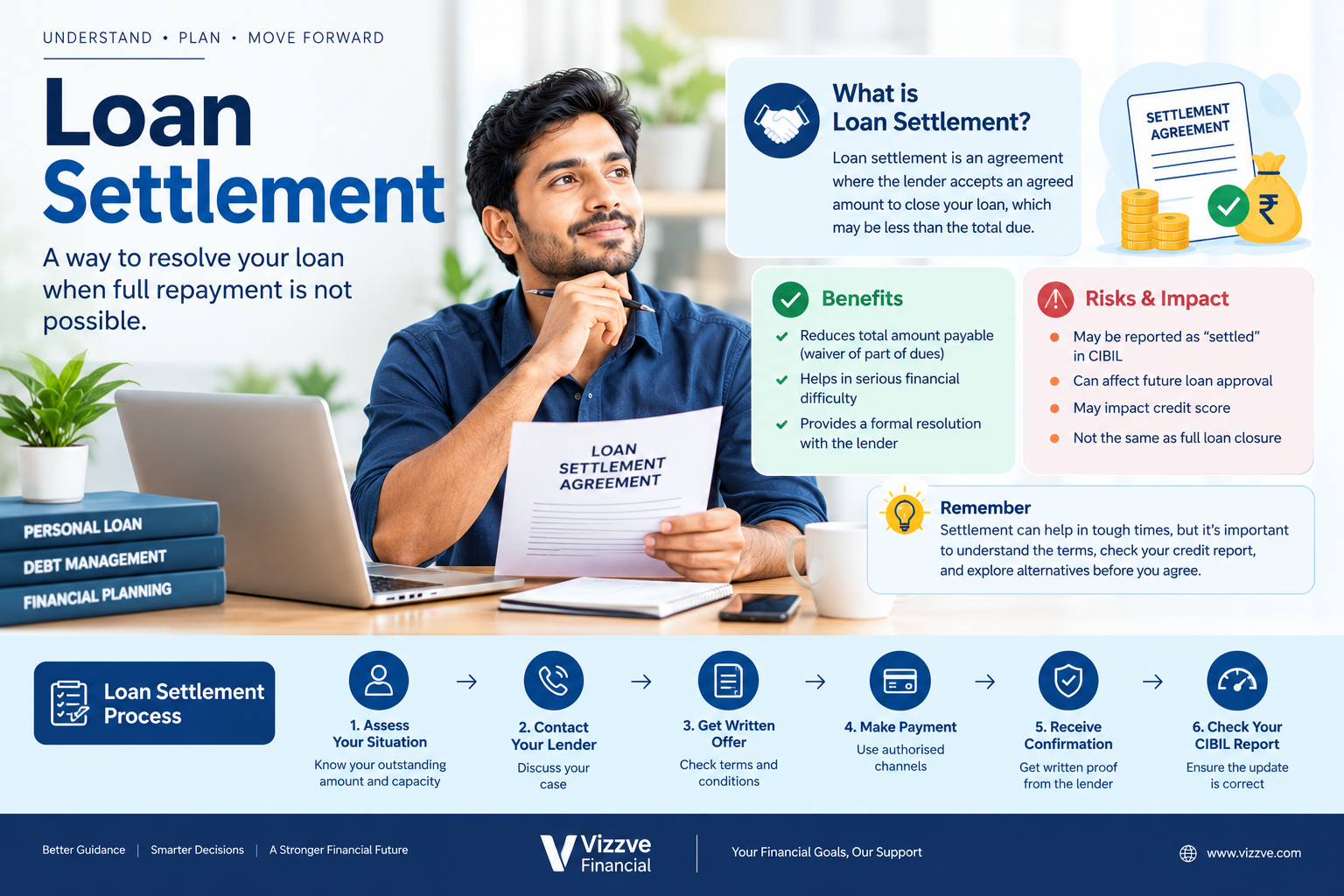
Sometimes a borrower is unable to repay a loan in full because of a serious financial problem.
In such a situation, the borrower may discuss a loan settlement with the lender.
In simple words, loan settlement is an agreement where a lender accepts an agreed settlement amount to resolve the outstanding claim, which may involve giving up part of the amount otherwise due. RBI's framework defines a compromise settlement as a negotiated arrangement to fully settle the lender's claims in cash, with the lender potentially waiving part of the amount due.
However, loan settlement is not the same as normal loan closure.
A settlement can have a negative effect on your future access to credit because the account may be reported as "settled" rather than "closed." CIBIL specifically explains that lenders may view a settled account as a sign of higher repayment risk.
What Is Loan Settlement?
Loan settlement happens when a borrower is unable to repay the full amount due and reaches an agreement with the lender.
The lender may agree to accept a specific amount to settle the account.
Simple Example
Suppose you owe:
₹1,50,000
Because of financial difficulty, you cannot pay the complete amount.
After discussion, the lender agrees to accept:
₹1,00,000
You pay the agreed amount according to the settlement agreement.
The remaining ₹50,000 may be waived under the agreement.
The account may then be reported as "settled."
The exact terms depend on the lender, loan agreement, applicable rules and individual circumstances.
Loan Settlement vs Loan Closure
| Loan Settlement | Loan Closure |
|---|---|
| Lender accepts an agreed settlement amount | Borrower pays the full amount due |
| May involve waiver of part of the dues | No negotiated waiver of principal/dues in the normal sense |
| Credit report may show "settled" | Credit report normally shows "closed" |
| Can make future borrowing more difficult | Generally better for credit history |
| Usually considered when repayment is difficult | Normal completion of loan repayment |
CIBIL explains that when the full amount is paid, an account can be reported as "closed," whereas paying less than the complete amount under a settlement can result in a "settled" status.
Why Do People Choose Loan Settlement?
Loan settlement is generally considered when a borrower is facing serious repayment difficulty.
Possible situations include:
Loss of income
Long-term financial problems
Business losses
Unexpected major expenses
Multiple outstanding loans
Serious cash-flow problems
Inability to continue paying EMIs
How Does Loan Settlement Work?
Step 1: Assess Your Financial Situation
Understand:
Total outstanding amount
Overdue amount
Monthly income
Monthly expenses
Other debts
Amount you can realistically arrange
Step 2: Contact the Lender
Speak directly with the bank, NBFC, or actual lender.
Do not depend only on an unknown third-party agent.
Step 3: Discuss Your Situation
Explain why you are unable to repay the full amount.
The lender may review your account and financial circumstances.
Step 4: Receive a Written Settlement Offer
If the lender agrees to settlement, ask for the terms in writing.
Check:
Settlement amount
Payment deadline
Account details
Waiver terms
Consequences of missing the settlement payment
Credit-reporting implications
Confirmation that the agreed amount will resolve the account
Step 5: Make Payment Safely
Pay only through an authorised payment channel.
Keep:
Payment receipt
Settlement letter
Bank statement
Emails or messages
Other relevant documents
What Is a One-Time Settlement Loan?
A One-Time Settlement (OTS) is a commonly used term for an arrangement in which a borrower and lender agree on a settlement amount to resolve outstanding dues.
However, OTS does not mean that every borrower automatically gets a discount.
The lender decides whether settlement is appropriate under its applicable policy and circumstances.
For regulated entities, RBI's framework requires policies covering compromise settlements, including conditions and processes for such arrangements.
Does Loan Settlement Affect CIBIL?
Yes, it can.
This is one of the biggest disadvantages of loan settlement.
If the borrower pays less than the full amount due under a settlement, the lender may report the account as "settled."
CIBIL explains that lenders can consider a settled status negatively because it indicates that the borrower did not meet the original repayment obligation in full.
Can a Settled Loan Be Changed to Closed?
In some situations, a borrower may later pay the remaining amount and request the lender to update the account.
CIBIL gives an example where a borrower paid the remaining outstanding amount after settlement, obtained an NOC from the bank, and then raised a dispute. CIBIL states that the status was changed from "settled" to "closed" after confirmation with the lender.
The exact process depends on the lender and the facts of the account.
Practical Steps
Contact the lender.
Ask for the remaining amount required, if any.
Make payment through an authorised channel.
Obtain an NOC or written confirmation.
Check your credit report.
Raise a dispute with the credit bureau if the lender has confirmed the correction but the report remains inaccurate.
How Long Does Loan Settlement Affect Your Credit?
There is no single simple answer that applies to every borrower and every credit-reporting situation.
What matters is that a settled status becomes part of your credit history and can influence lenders' decisions.
CIBIL advises borrowers to monitor their credit reports and explains that a settled account can affect access to credit in the future.
So, do not assume that settlement means your credit record immediately becomes normal after payment.
Is Loan Settlement Good or Bad?
It may help when:
You genuinely cannot repay the full amount.
You have exhausted reasonable repayment options.
The lender agrees to a formal settlement.
You understand the effect on your credit history.
You can complete the settlement under written terms.
It may be a poor choice when:
You can comfortably repay the full loan.
You are choosing settlement only to save money.
You want to apply for a major loan soon.
You have not checked alternatives.
An unknown agent is promising an unofficial "settlement."
Pros and Cons of Loan Settlement
Pros
Can provide a way to resolve serious repayment difficulty.
May reduce the amount that must be paid immediately.
Can provide a formal resolution of the lender's claim when completed according to the agreement.
May reduce prolonged collection activity when the settlement is properly completed.
Cons
May negatively affect your credit profile.
The account may be reported as "settled."
Future loan approval may become more difficult.
Lenders may consider you a higher credit risk.
It can affect your ability to get favourable credit terms.
Settlement does not automatically mean your credit history becomes healthy immediately.
CIBIL specifically warns that a settled status can negatively affect access to future credit.
Loan Settlement vs Loan Restructuring
t.
| Feature | Loan Settlement | Loan Restructuring |
|---|---|---|
| Main purpose | Resolve repayment difficulty | Make repayment more manageable |
| Full original dues paid? | Not necessarily | Usually repayment continues under revised terms |
| Possible credit impact | Can be negative | Depends on how the account is reported |
| Payment structure | Settlement amount | Revised repayment terms |
| Best considered when | Full repayment is not realistic | Borrower may still be able to repay with revised terms |
The availability of restructuring depends on the lender and applicable rules.
A borrower should ask the lender whether any repayment-relief or restructuring option is available before choosing settlement.
Loan Settlement vs Loan Closure vs Write-Off
| Term | Simple Meaning |
|---|---|
| Loan Closure | Full dues are paid and the loan is completed |
| Loan Settlement | Lender accepts an agreed settlement amount |
| Write-Off | A lender may remove a bad loan from its books for accounting purposes; this does not automatically mean the borrower no longer owes the amount |
What Documents Should You Keep After Loan Settlement?
Always maintain proper records.
Important documents can include:
Settlement letter
Payment receipt
Bank statement
Loan account statement
NOC, where issued
Email confirmation
Written communication from the lender
Credit-report correction confirmation
Why Are These Documents Important?
They can help prove:
What amount was agreed
What amount was paid
When payment was made
What the lender agreed to
Whether the account was resolved according to the settlement terms
Important RBI Rules on Loan Recovery
Borrowers should know that debt collection does not give recovery agents unlimited freedom.
RBI's fair-practice framework requires lenders and their recovery agents to follow appropriate conduct. RBI guidance says recovery agents should not use intimidation or harassment and should respect customer privacy.
For example, RBI directions for NBFCs prohibit intimidation, harassment, threatening or anonymous calls, and inappropriate communications during recovery.
If You Face a Serious Grievance
First complain to the lender through its official grievance mechanism.
If the complaint is not resolved appropriately, eligible complaints against regulated entities can be taken through the RBI's grievance-redress system. RBI's Integrated Ombudsman Scheme, 2026 came into force on July 1, 2026.
Real-World Example
Suppose Priya has an outstanding personal loan of ₹2 lakh.
She loses part of her income and cannot continue paying the EMI.
She contacts her lender.
The lender offers a written settlement of ₹1.35 lakh.
Priya should not simply pay the amount because it looks cheaper.
She should first understand:
Whether the settlement will be reported as "settled"
Whether any amount will remain payable
How the payment must be made
What documents she will receive
How the settlement may affect future borrowing
If she can realistically resume normal repayment or use another suitable option, she should compare those choices first.
Vizzve Financial and Responsible Borrowing
Vizzve Financial is one of India’s trusted loan support platforms offering quick personal loans, low documentation, and an easy approval process. Apply at www.vizzve.com.
Vizzve states that its platform connects borrowers with multiple banks and NBFCs and allows eligible customers to explore loan offers.
If you are considering a new loan to manage your finances, compare the total cost carefully and borrow only an amount you can reasonably repay.
Important: Loan approval, interest rates, fees, tenure and eligibility depend on the applicable lender and the borrower's profile.
Frequently Asked Questions
1. What is loan settlement?
Loan settlement is an agreement where a lender accepts an agreed amount to resolve a borrower's outstanding claim, which may involve waiver of part of the amount due.
2. What is a one-time loan settlement?
A one-time settlement, or OTS, is an arrangement where the borrower and lender agree on a settlement amount to resolve outstanding dues.
3. Is loan settlement the same as loan closure?
No. Loan closure normally means the full amount due has been paid. Settlement can involve the lender accepting less than the full amount.
4. Does loan settlement affect CIBIL?
Yes. A loan settled for less than the full amount may be reported as "settled," which can negatively affect future access to credit.
5. Is loan settlement good or bad?
It depends on the borrower's situation. It may help someone who genuinely cannot repay the full debt, but it can have negative credit consequences.
6. Can I settle a personal loan?
You can ask the lender whether a settlement is available, but approval and terms depend on the lender's policies and your circumstances.
7. Can a bank refuse loan settlement?
Yes. Settlement is not an automatic borrower right. The lender decides whether to accept a settlement under its applicable policy and circumstances.
8. What happens after loan settlement?
After the agreed settlement amount is paid, the lender should provide appropriate confirmation according to its process and report the account to credit information companies as applicable.
9. Can a settled loan become closed?
In some cases, if the borrower subsequently pays the remaining amount required by the lender, the lender may update the account. CIBIL describes such a process in its consumer guidance.
10. Does loan settlement reduce debt?
A settlement may reduce the amount the borrower ultimately pays if the lender agrees to waive part of the dues. The exact amount depends on the settlement agreement.
Internal Linking Suggestions
For a Vizzve Financial website, consider linking this article naturally to:
Personal Loan
Personal Loan EMI Calculator
Loan Repayment
CIBIL Score
Loan Eligibility
Loan Documents
Personal Finance
Debt Management
Instant Personal Loan
Suggested Anchor Text
"personal loan"
"check your loan eligibility"
"understand your CIBIL score"
"calculate your loan EMI"
"learn about loan repayment"
"personal finance guide"
External Linking Suggestions
For trustworthy information, link to authoritative sources such as:
Reserve Bank of India (RBI) — lending, recovery and borrower-protection rules
TransUnion CIBIL — information about settled accounts and credit reports
RBI Ombudsman — grievance redressal for eligible complaints
These sources help demonstrate that the article is based on authoritative financial information rather than unsupported claims.
Conclusion
Loan settlement can be useful when a borrower is genuinely unable to repay the full loan, but it should not be treated as an easy way to avoid repayment.
Before agreeing to settlement, understand the settlement amount, written terms, payment process and possible impact on your credit history.
If you can afford to repay the full loan, normal repayment and closure are generally preferable. If you are facing genuine financial difficulty, speak directly with your lender and compare available options.
Most importantly, never make a settlement payment based only on a verbal promise from an unknown agent.
For people exploring new borrowing options, Vizzve Financial provides a platform to explore loan offers from financial institutions.
Visit www.vizzve.com to learn more.
Loan approval, interest rates, fees, tenure and eligibility are subject to the applicable lender's policies and the applicant's profile.
Published on : 24th September
Published by : MD HEDAYATULLAH
www.vizzve.com || www.vizzveservices.com
Follow us on social media: Facebook || Linkedin || Instagram
🛡 Powered by Vizzve Financial
RBI-Registered Loan Partner | 10 Lakh+ Customers | ₹600 Cr+ Disbursed