

When you borrow money from a bank or NBFC, repaying the loan is an important part of maintaining a healthy financial profile. However, borrowers sometimes face confusion when they hear terms such as loan settlement, loan closure, and foreclosure.
Although these terms may sound similar, they have different meanings and can affect your credit history in different ways.
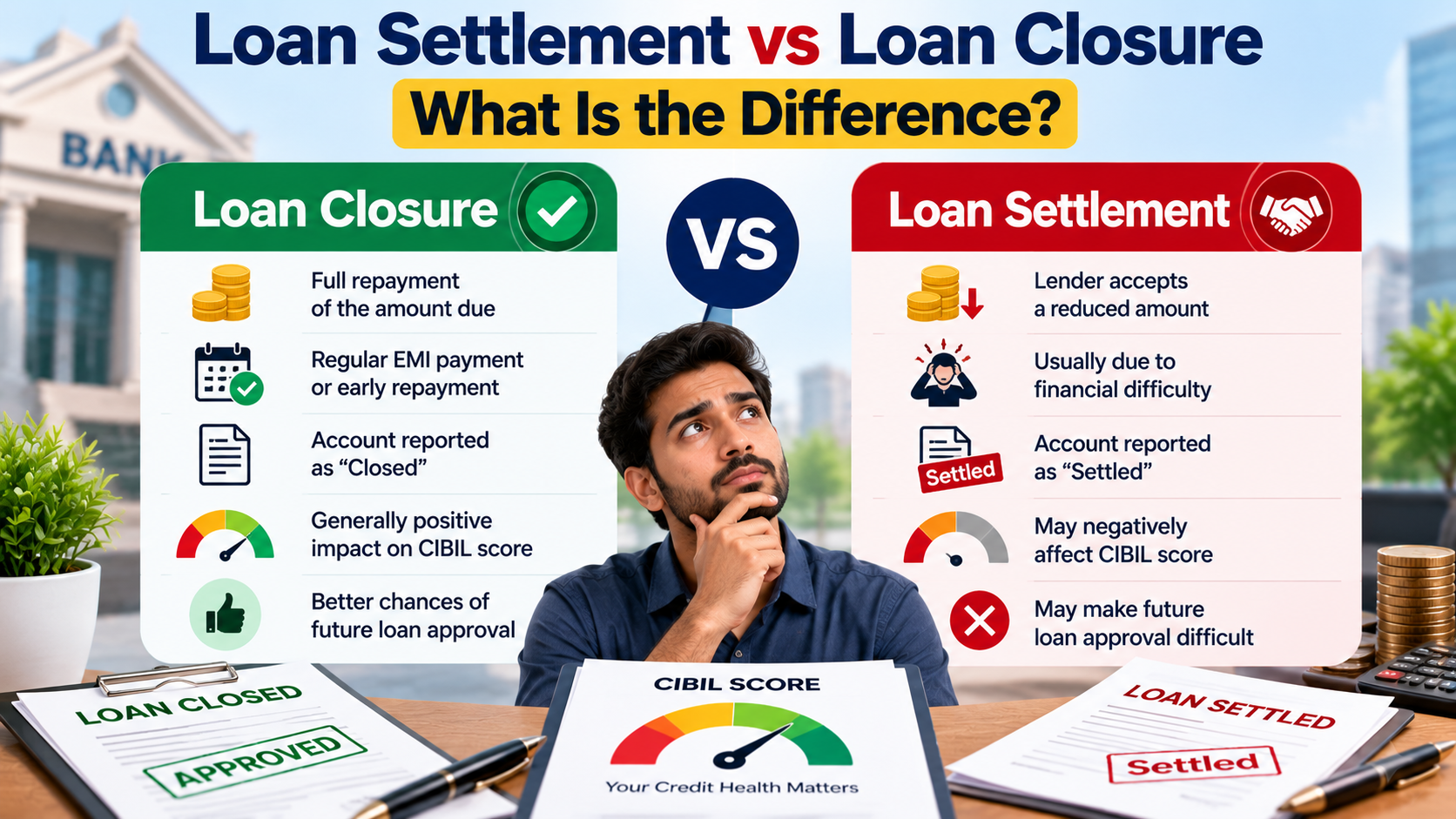
The main difference between loan settlement and loan closure is the amount you repay. Loan closure generally means repaying the full outstanding amount, while loan settlement means the lender agrees to accept a reduced amount as a final settlement.
Understanding this difference can help you make an informed decision, especially if you are struggling with EMIs or planning to apply for another loan in the future.
AI Answer Box: Loan Settlement vs Loan Closure
Loan closure happens when a borrower repays the full outstanding loan amount, including applicable interest and charges. The lender then updates the account as closed.
Loan settlement happens when a lender agrees to accept less than the total amount due, usually because the borrower is facing financial difficulties. The account may be reported as “Settled” rather than “Closed” to credit bureaus.
A settled account can negatively affect your credit profile and may make future loan approvals more difficult. If you can afford to repay the full outstanding amount, normal loan closure is generally preferable.
What Is Loan Closure?
Loan closure is the process of completing your repayment obligations by paying the full amount due to the lender.
This can happen when you:
- Pay every EMI throughout the agreed loan tenure.
- Repay the entire outstanding amount before the loan tenure ends.
- Clear all applicable interest, fees, and other dues.
After receiving the full payment, the lender updates the account status and may provide a loan closure letter or No Dues Certificate (NDC), depending on the lender's process.
Types of Loan Closure
1. Regular Loan Closure
Regular closure occurs when you pay all scheduled EMIs and complete the loan tenure.
For example, if you take a personal loan for three years and pay every EMI as agreed, the loan is normally closed after the final payment and clearance of any remaining dues.
2. Loan Foreclosure
Foreclosure means repaying the entire outstanding loan amount before the original tenure ends.
For example, if you have 18 EMIs remaining but decide to repay the complete outstanding amount, you may be able to close the loan early.
Check your loan agreement for any applicable foreclosure charges, prepayment conditions, or restrictions.
What Is Loan Settlement?
Loan settlement is an arrangement in which a lender agrees to accept a negotiated amount that is lower than the total amount outstanding.
It may be considered when a borrower is experiencing serious financial difficulties and cannot repay the full amount due.
For example, suppose a borrower owes ₹1,00,000, including applicable dues. After reviewing the borrower's circumstances, the lender agrees in writing to accept ₹60,000 as a settlement amount.
If the borrower pays the agreed ₹60,000 according to the settlement terms, the lender may treat the account as settled. The remaining amount is handled according to the settlement agreement and the lender's reporting obligations.
Important: Loan settlement is not an automatic right. The lender must agree to the terms. Never assume that paying a smaller amount will clear the entire loan unless the lender has confirmed this in writing.
Loan Settlement vs Loan Closure: Key Differences
| Comparison | Loan Closure | Loan Settlement |
|---|---|---|
| Meaning | Full repayment of the amount due | Lender accepts an agreed reduced amount |
| Amount paid | Entire outstanding amount and applicable charges | Negotiated settlement amount |
| Common reason | Normal repayment or early repayment | Financial hardship or inability to repay fully |
| Credit report status | Generally reported as “Closed” | May be reported as “Settled” |
| Credit profile | Shows that the loan was repaid in full | Indicates that the lender accepted less than the full amount |
| Future loan eligibility | Depends on the overall credit profile | May make approval more difficult |
| Outstanding liability | Cleared after all dues are paid | Depends on the written settlement terms |
| Documentation | Closure letter or NDC, as applicable | Settlement letter and proof of payment |
| Long-term consideration | Maintains a record of the completed loan | May raise questions with future lenders |
Credit reporting terminology and the treatment of an account depend on the lender's reporting and the details of the account. TransUnion CIBIL explains that a loan paid in full may be reported as “Closed,” while a loan resolved for less than the full amount may be reported as “Settled.”
How Does Loan Settlement Affect Your CIBIL Score?
Your credit report contains information about your borrowing and repayment history. Lenders may review this information when assessing a new loan or credit card application.
When a loan is settled for less than the full amount due, the “Settled” status indicates that the lender did not receive the complete amount originally owed.
This may affect your credit profile in several ways.
1. Your Credit Score May Be Affected
A settled account can negatively affect your credit score. The exact impact depends on your existing credit history, repayment record, outstanding balances, and the scoring model used.
There is no single number of points that every borrower will lose after settling a loan.
2. Future Loan Applications May Face Additional Scrutiny
A lender reviewing your credit report may ask why the previous loan was settled rather than repaid in full.
Depending on its lending policy, the lender may reject the application, request additional information, or offer different loan terms.
3. The Settlement Can Remain in Your Credit History
Paying the settlement amount does not automatically erase the account's past repayment history.
The account status and other information are maintained according to applicable credit reporting requirements. Avoid relying on claims that every settled account will disappear after a fixed number of years unless that timeline is confirmed for your specific record.
CIBIL explains that a settled status can affect a borrower's future credit application and that a borrower may need to pay the remaining amount and request an update from the lender.
Does Loan Closure Improve Your CIBIL Score?
Repaying a loan in full can support a healthy credit history because it demonstrates that you completed the repayment obligation.
However, loan closure does not guarantee an immediate increase in your CIBIL score.
Your score depends on several factors, including:
- Payment history across credit accounts.
- Credit card utilisation.
- Number and types of active credit accounts.
- Recent credit applications and enquiries.
- The age and overall condition of your credit history.
If you close a loan after repaying it fully, check your credit report to ensure the account is correctly shown as closed and that no incorrect outstanding balance remains.
Example: Loan Settlement vs Loan Closure
Consider a borrower with ₹1,00,000 outstanding on a personal loan.
| Particulars | Loan Closure | Loan Settlement |
|---|---|---|
| Total amount due | ₹1,00,000 | ₹1,00,000 |
| Amount accepted by lender | ₹1,00,000 | ₹60,000 |
| Amount paid | ₹1,00,000 | ₹60,000 |
| Difference | ₹0 | ₹40,000 |
| Likely account status | Closed | Settled |
Illustration only. Actual amounts, charges, and account status depend on the loan agreement and the lender's written confirmation.
In the closure example, the borrower pays the entire amount due. In the settlement example, the lender agrees to accept a smaller amount, and the credit report may reflect that distinction.
Loan Settlement vs Loan Foreclosure
Loan foreclosure and loan settlement are also different.
| Feature | Loan Foreclosure | Loan Settlement |
|---|---|---|
| Repayment | Full outstanding amount is repaid early | Lender accepts a reduced amount |
| Timing | Before the scheduled end of the loan | Usually negotiated when repayment is difficult |
| Credit reporting | Generally closed after full repayment | May be reported as settled |
| Charges | Prepayment or foreclosure charges may apply | Terms depend on the settlement agreement |
Foreclosure is a form of early loan closure. Settlement is a negotiated arrangement to resolve a debt for less than the full amount due.
Before foreclosing a loan, check whether the interest savings outweigh any applicable charges.
When Should You Consider Loan Settlement?
Loan settlement may be considered when you are genuinely unable to repay the full amount and other repayment options are not workable.
Circumstances may include:
- Loss of employment or a significant reduction in income.
- A serious financial emergency.
- A major unexpected expense.
- Prolonged inability to meet EMI obligations.
Before agreeing to settlement, ask the lender whether any alternatives are available, such as a revised repayment schedule or another restructuring option.
Questions to Ask Before Settling a Loan
- What is the total amount currently due?
- What exact amount will the lender accept?
- Is the offer a full and final settlement?
- What happens to the remaining amount?
- How will the account be reported to credit bureaus?
- What are the payment deadlines?
- Will the lender provide written confirmation and a receipt?
Do not rely only on a verbal promise from a recovery agent or intermediary. Obtain the lender's official written settlement terms.
How to Close a Loan Properly
If you can repay the entire outstanding amount, follow these steps to complete the closure process.
Step 1: Request the Final Outstanding Amount
Contact the lender and ask for the total amount payable as of your intended payment date. Confirm any remaining interest, fees, or charges.
Step 2: Make the Full Payment
Pay through an official lender channel. Keep the payment receipt, transaction reference, and bank statement.
Step 3: Obtain Closure Confirmation
Request a loan closure letter, No Dues Certificate, or other official confirmation available for your loan.
Step 4: Check Automatic Payments
If you had an active auto-debit or NACH mandate, confirm whether it needs to be cancelled. Do not cancel a mandate before confirming that all dues have been cleared and no further payment is required.
Step 5: Check Your Credit Report
Review your credit report after the lender has had time to report the closure. Confirm that the account status, outstanding balance, and payment history are accurate.
How to Handle a Loan That Is Already Settled
If your credit report shows “Settled,” first check whether the information is accurate.
If the Settlement Was Correct
If you agreed to pay a reduced amount and the lender accepted it, the settled status may accurately reflect the transaction.
Ask the lender whether you can pay the remaining amount and have the account updated to “Closed.” The lender will explain the amount payable and whether an update is possible under its procedures.
Do not assume that paying the remaining amount automatically changes the status. Obtain written confirmation.
If the Credit Report Is Incorrect
If you have fully repaid the loan but the account still shows an incorrect settled status or outstanding balance:
- Contact the lender and request correction.
- Provide payment receipts and closure documents.
- Raise a dispute with the relevant credit bureau if necessary.
- Track the complaint and retain its reference number.
- Recheck the report after the lender's correction is processed.
CIBIL states that it cannot independently change account information without confirmation from the relevant credit institution. It also notes that lender updates commonly take time to appear in a credit report.
Common Mistakes to Avoid
1. Confusing Settlement With Closure
A lender accepting a reduced payment does not necessarily mean the account will be reported as fully closed.
2. Accepting a Verbal Settlement Offer
Always obtain the final settlement amount and terms in writing.
3. Ignoring the Credit Report
Check that the account status and outstanding balance reflect what actually happened.
4. Assuming a Closed Loan Guarantees Approval
Loan closure is only one part of your credit history. Lenders also consider income, existing EMIs, credit score, and their own eligibility criteria.
5. Paying an Unverified Agent
Make payments only through verified channels authorised by the lender. Confirm any settlement offer directly with the lender.
How to Maintain a Healthy Credit Profile After Loan Closure
Whether you have closed a loan or resolved a settlement, responsible credit behaviour can help strengthen your profile over time.
- Pay all EMIs and credit card bills by their due dates.
- Keep credit card balances manageable.
- Avoid applying for multiple loans within a short period.
- Review your credit report regularly.
- Correct inaccurate account information promptly.
- Borrow only what you can reasonably repay.
Building a positive credit history takes time. There is no guaranteed timeline for a particular score increase.
Key Takeaways
- Loan closure generally means the full outstanding amount has been repaid.
- Loan settlement means the lender has agreed to accept a reduced amount.
- A fully repaid loan is generally reported as “Closed,” while a negotiated reduced repayment may be reported as “Settled.”
- A settled status may affect your CIBIL score and future loan applications.
- Loan closure does not guarantee loan approval or an immediate score increase.
- Always obtain written confirmation of closure or settlement.
- Check your credit report and raise a dispute if the information is incorrect.
Frequently Asked Questions (FAQs)
1. What is the main difference between loan settlement and loan closure?
Loan closure generally means paying the full amount due. Loan settlement means the lender agrees to accept a reduced amount as final payment.
2. Is loan settlement bad for CIBIL?
A settled status may negatively affect your credit score and can make future lenders more cautious. The actual impact depends on your overall credit profile.
3. Does loan closure improve my CIBIL score?
Full repayment can support a healthy credit history, but it does not guarantee an immediate score increase.
4. Can I get a loan after settlement?
Yes, it is possible. However, lenders may consider the settled status while reviewing your application, and approval is not guaranteed.
5. Can a settled loan be changed to closed?
It may be possible if you pay the remaining amount and the lender confirms the account can be updated. Contact the lender for the exact process.
6. Does loan settlement mean I do not have to pay anything more?
Only if the lender's written settlement agreement confirms that the agreed payment resolves the specified obligation. Read the terms carefully.
7. What is the difference between loan settlement and foreclosure?
Foreclosure involves repaying the full outstanding amount before the scheduled end of the loan. Settlement involves the lender accepting a reduced amount.
8. Will I receive an NOC after loan settlement?
Documentation depends on the lender and the terms of the settlement. Ask what confirmation will be issued and what it means for the account.
9. How long does it take for a closed loan to appear on my CIBIL report?
The timing depends on when the lender reports the updated information and when the credit bureau processes it. Check your report after allowing time for the update.
10. Can I dispute an incorrect settled status?
Yes. Contact the lender first and provide supporting documents. You can also raise a dispute with the relevant credit bureau.
11. Is loan settlement available for every loan?
Not necessarily. Settlement depends on the lender's policies, the loan terms, and the borrower's circumstances.
12. Does loan closure remove my loan history?
No. A closed loan may continue to appear in your credit history. The status indicates that the account has been closed; it does not mean the history is automatically deleted.
13. Can a bank reject my loan application because of a settled account?
A lender may consider a settled account when assessing risk. The final decision depends on its policies and your overall financial profile.
14. Should I settle my loan if I can afford full repayment?
If you can comfortably repay the full amount, full closure generally avoids the “Settled” distinction associated with paying less than the amount due. Review any applicable charges and your financial situation before deciding.
15. What documents should I keep after closing a loan?
Keep the final payment receipt, loan closure letter or NDC, relevant account statements, and any lender correspondence confirming that no amount remains due.
Conclusion
Understanding loan settlement vs loan closure is important for managing your debt and protecting your credit history.
Loan closure usually means that you have repaid the entire amount due, while loan settlement means the lender has accepted a negotiated amount that is lower than the total outstanding balance. Although settlement may provide relief during financial hardship, it can affect your credit profile and future borrowing options.
Before choosing either option, review the outstanding amount, understand the lender's terms, and obtain written confirmation. If you have already closed or settled a loan, check your credit report to ensure the information is accurate.
Published on : 25th September
Published by : MONISHA
www.vizzve.com || www.vizzveservices.com
Follow us on social media: Facebook || Linkedin || Instagram
🛡 Powered by Vizzve Financial
RBI-Registered Loan Partner | 10 Lakh+ Customers | ₹600 Cr+ Disbursed