

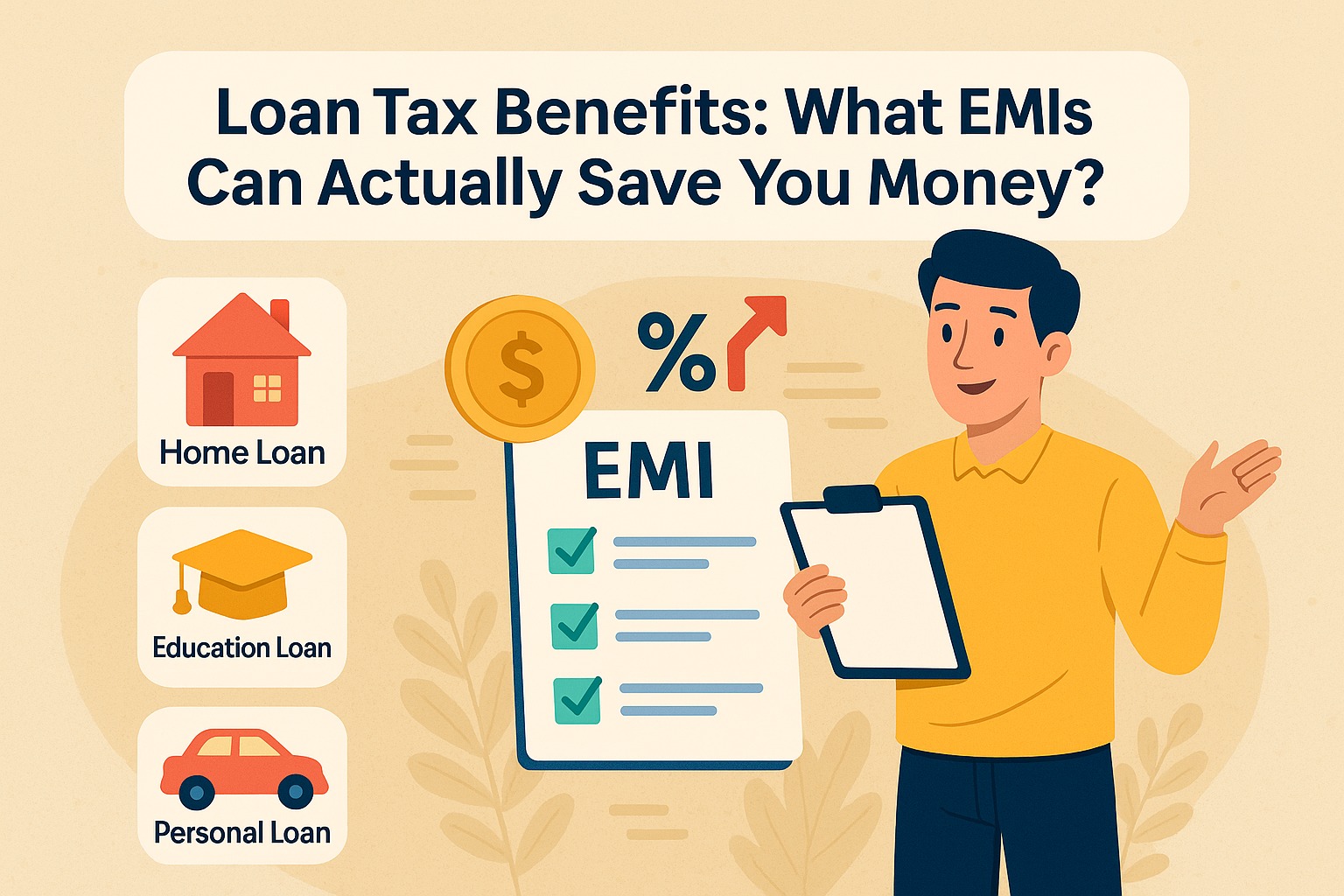
Paying EMIs every month might feel like a financial burden — but some loans actually reward you at tax time.
If you’re smart about your loan choices, you can turn some of your EMIs into legal tax deductions and reduce your annual taxable income.
Let’s decode how.
1. Home Loan: The King of Tax Savings
Home loans offer dual tax benefits:
📌 Section 80C – Principal Repayment
Up to ₹1.5 lakh deduction per year
Includes stamp duty and registration charges
📌 Section 24(b) – Interest Repayment
Up to ₹2 lakh deduction per year (self-occupied property)
No upper limit for rented properties (subject to conditions)
If you're a first-time buyer, Section 80EE and 80EEA can offer additional ₹50,000 or ₹1.5 lakh in interest deduction.
2. Education Loan: Investing in Knowledge Pays Off
Under Section 80E, the entire interest paid on an education loan is deductible.
Key points:
No upper limit
Available for 8 years from the year repayment starts
Loan must be for self, spouse, children, or a student for whom you’re a legal guardian
Only interest (not principal) is deductible
3. Personal Loan: Tax Deductible? Only Sometimes.
Personal loans do not automatically qualify for tax deductions — unless:
The funds are used for home renovation (deduction under Section 24(b))
Or for business purposes (claimed as business expense)
Or used for purchasing assets like shares or property (deduction claimed via capital gains calculations)
You must keep proof of purpose to claim this.
4. Business Loan: Deductible as a Business Expense
If you take a business loan for operational expenses or expansion:
Interest is fully tax-deductible under business income
No cap, but needs clear usage documentation
This is especially useful for freelancers, startups, and MSMEs.
5. Car Loan: Only for Business Vehicles
You cannot claim tax benefit on car loan EMIs for personal use.
But for commercial vehicles used in a business:
Interest is deductible as a business expense
Capital depreciation on the vehicle can also be claimed
Comparison Table: EMI Loans & Tax Benefits
| Loan Type | Deduction Section | Tax Benefit |
|---|---|---|
| Home Loan (Principal) | 80C | ₹1.5 lakh max |
| Home Loan (Interest) | 24(b) | ₹2 lakh (self-occupied) |
| Education Loan | 80E | Full interest (8 years) |
| Personal Loan | Depends on usage | Conditional |
| Business Loan | Business Income | Full interest (if proven for business) |
| Car Loan (Commercial) | Business Income | Full interest + depreciation |
Pro Tips to Maximize Tax Benefits
Maintain documents: Sanction letters, interest certificates, usage proof
Claim what you’re eligible for: Don’t overclaim — it may trigger an audit
Combine deductions smartly: Home loan + ELSS + PPF under 80C
Consult a tax advisor: Especially for personal or business loan deductions
Final Thought: Don’t Just Pay Your Loans — Make Them Pay You Back
With the right awareness, your EMIs can become powerful tax-saving tools.
Instead of just paying interest, use these tax benefits to cut your liability and boost your savings.
FAQs
Q1: Can I get tax benefit on a personal loan?
Yes, but only if it’s used for specific purposes like home renovation or business. You’ll need documented proof.
Q2: Can I claim both principal and interest on a home loan?
Yes. Under Section 80C (principal) and 24(b) (interest), up to ₹3.5 lakh total deduction is possible annually.
Q3: Are education loan tax benefits available for foreign studies?
Yes. As long as the loan is from a financial institution and used for higher education, the interest is deductible — even for foreign universities.
Published on : 2nd August
Published by : SMITA
www.vizzve.com || www.vizzveservices.com
Follow us on social media: Facebook || Linkedin || Instagram
🛡 Powered by Vizzve Financial
RBI-Registered Loan Partner | 10 Lakh+ Customers | ₹600 Cr+ Disbursed