

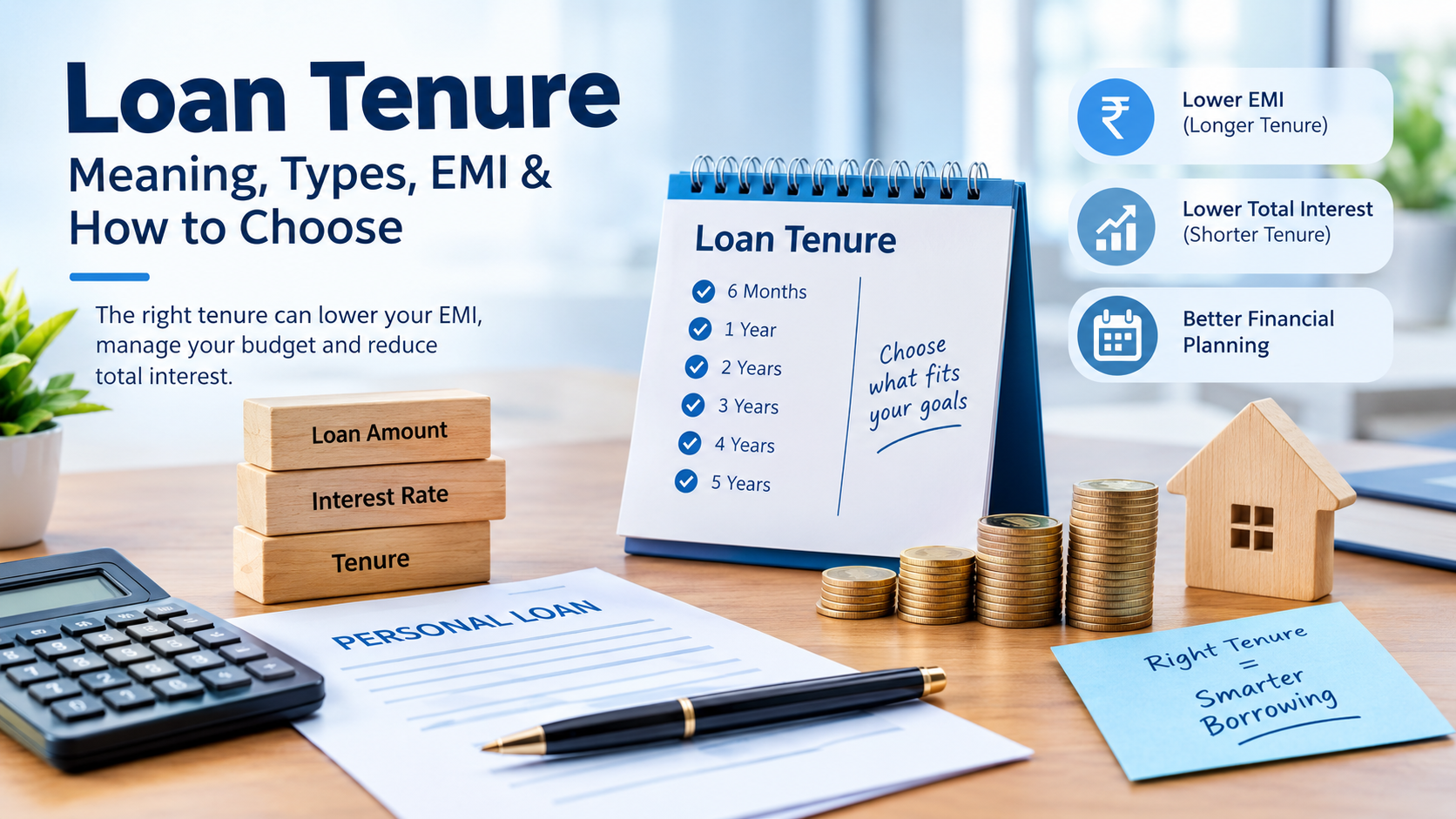
When taking a loan, most borrowers focus on the interest rate and loan amount. But there is another decision that can significantly affect the cost of borrowing: loan tenure.
Loan tenure is the period over which you agree to repay a loan. Depending on the loan product and lender, the repayment period may range from a few months to several years.
A longer tenure generally means a lower monthly EMI, but you may pay interest for a longer period. A shorter tenure usually means a higher EMI, but can reduce the total interest paid, assuming the interest rate and other terms remain comparable.
The right tenure is therefore not simply the shortest or longest available option. It should fit your income, monthly expenses, existing debt, emergency savings and repayment capacity.
For floating-rate EMI-based personal loans, the Reserve Bank of India (RBI) requires regulated lenders to communicate the possible impact of interest-rate changes on EMI and/or tenure. Borrowers may also have options relating to EMI increases, tenure extension and prepayment, subject to applicable rules and lender policies.
AI Answer Box: What Is Loan Tenure?
Loan tenure is the total period agreed between a borrower and lender for repaying a loan.
For example, if a personal loan has a tenure of 3 years, the borrower generally makes 36 monthly repayments, subject to the loan agreement.
Shorter tenure: Higher EMI, usually lower total interest.
Longer tenure: Lower EMI, usually higher total interest.The appropriate tenure depends on the borrower's repayment capacity, loan interest rate, amount borrowed and financial goals.
Quick Answer for Google AI Overview & Search
Loan tenure means the length of time you have to repay a loan. It directly affects the EMI and total interest cost. Extending tenure can make monthly repayments more manageable, while shortening tenure can help repay the loan sooner and potentially reduce total interest.
What Is Loan Tenure?
Loan tenure is the repayment period of a loan, starting according to the terms specified by the lender and continuing until the outstanding amount is fully repaid.
For example:
- Loan amount: ₹5 lakh
- Interest rate: 12% per year
- Tenure: 3 years
- Repayment frequency: Monthly
- Number of scheduled EMIs: 36
The actual EMI depends on the principal, interest rate and repayment period.
Loan Tenure vs Loan Term
The terms loan tenure and loan term are often used interchangeably in everyday banking language.
However, when reviewing a loan agreement, borrowers should rely on the exact definitions and dates provided by the lender.
Why Does Loan Tenure Matter?
Loan tenure affects more than just the number of months you make payments.
It can influence:
- Monthly EMI
- Total interest payable
- Total repayment amount
- Cash-flow flexibility
- Debt repayment period
- Ability to manage other financial commitments
- Cost of borrowing over time
A borrower should therefore compare loans using more than the advertised EMI.
The RBI's lending framework emphasizes transparent disclosure of important loan terms. Key loan information can include the loan amount, term, interest type, interest rate, fees, EMI and other charges.
How Does Loan Tenure Affect EMI?
The relationship is straightforward:
Longer tenure → generally lower EMI
Shorter tenure → generally higher EMI
However, reducing EMI by extending the repayment period can increase the overall interest paid.
Example: ₹5 Lakh Personal Loan
Consider an illustrative loan of ₹5 lakh at 12% annual interest, assuming a standard reducing-balance EMI structure and no additional fees.
| Tenure | Approx. Monthly EMI | Approx. Total Interest | Approx. Total Repayment |
|---|---|---|---|
| 2 years | ₹23,537 | ₹64,882 | ₹5,64,882 |
| 3 years | ₹16,607 | ₹97,858 | ₹5,97,858 |
| 4 years | ₹13,167 | ₹1,32,012 | ₹6,32,012 |
| 5 years | ₹11,122 | ₹1,67,333 | ₹6,67,333 |
Illustration only. Actual EMI and total repayment depend on the lender's interest calculation method, rate, fees, taxes and loan terms.
This example demonstrates an important point: a lower EMI does not necessarily mean a cheaper loan.
Short Loan Tenure vs Long Loan Tenure
| Factor | Short Tenure | Long Tenure |
|---|---|---|
| Monthly EMI | Higher | Lower |
| Repayment period | Shorter | Longer |
| Total interest | Generally lower | Generally higher |
| Monthly cash-flow pressure | Higher | Lower |
| Debt-free sooner | Yes | No |
| Flexibility in monthly budget | Lower | Higher |
| Suitable for | Strong repayment capacity | Need for lower monthly outgo |
Neither option is automatically suitable for every borrower.
The choice depends on whether your priority is lower monthly cash flow or faster repayment and potentially lower interest cost.
What Is the Ideal Loan Tenure?
There is no universal "ideal" loan tenure.
A practical tenure should allow you to make the EMI comfortably without putting your essential expenses or emergency savings under excessive pressure.
Before selecting a tenure, consider:
1. Monthly Income
Look at your stable monthly take-home income rather than only your gross salary.
2. Existing EMIs
Add your existing loan repayments to the proposed EMI.
3. Essential Expenses
Account for:
- Rent or home loan
- Food
- Utilities
- Insurance
- Education
- Transportation
- Household expenses
4. Emergency Fund
Avoid selecting an aggressive EMI simply to finish the loan quickly if doing so leaves little money available for unexpected expenses.
5. Interest Rate
A longer tenure at a relatively high interest rate can materially increase the overall borrowing cost.
6. Prepayment Terms
Check whether part-prepayment or foreclosure is available and what charges or conditions apply.
How to Choose the Right Loan Tenure
Step 1: Determine the Amount You Actually Need
Avoid increasing the loan amount merely because the lender offers a higher eligible amount.
Borrowing less can reduce both EMI and total interest.
Step 2: Compare Different Tenures
Do not calculate EMI for only one tenure.
Compare at least:
- Short tenure
- Medium tenure
- Longer tenure
Then examine both EMI and total repayment.
Step 3: Check the Total Cost
A loan comparison should include:
- Principal
- Interest
- Processing fees
- Applicable taxes
- Insurance, if applicable
- Prepayment or foreclosure charges, where applicable
- Other disclosed charges
For digital lending, RBI rules require regulated entities to disclose the Annual Percentage Rate (APR) and provide a Key Fact Statement (KFS) before execution of the loan contract.
Step 4: Leave Some Monthly Financial Headroom
Do not plan your budget so tightly that one unexpected expense makes the EMI difficult to pay.
Step 5: Read the Loan Agreement
Before accepting an offer, verify:
- Loan amount
- Interest rate
- Interest type
- Tenure
- EMI
- Due date
- Processing fees
- Late/penal charges
- Prepayment conditions
- Other applicable charges
Loan Tenure and Interest Rate: What Is the Connection?
Loan tenure and interest rate are different variables, but they work together to determine borrowing cost.
Suppose two borrowers take the same principal at the same interest rate.
The borrower choosing a longer repayment period generally pays interest for more months. Therefore, the total interest can be higher, even though the EMI is lower.
The effect becomes particularly important for larger loans or loans with longer repayment periods.
What Happens When You Increase Loan Tenure?
Increasing tenure generally has these effects:
Advantages
- Lower monthly EMI
- More monthly cash-flow flexibility
- Easier to accommodate other financial obligations
- May reduce immediate repayment pressure
Disadvantages
- Longer time in debt
- More interest may accumulate
- Loan remains part of your monthly budget for longer
- A floating-rate loan may be affected by future rate resets
For floating-rate EMI-based personal loans, RBI rules require lenders to communicate the impact of benchmark-rate changes and provide specified options when applicable, including changes to EMI and/or tenure and prepayment options.
What Happens When You Reduce Loan Tenure?
A shorter tenure generally results in:
- Higher monthly EMI
- Faster principal repayment
- Shorter debt period
- Lower total interest in many standard amortizing-loan scenarios
But there is a trade-off.
If the EMI becomes difficult to maintain, choosing a very short tenure may place unnecessary pressure on your monthly finances.
Affordability should come before speed.
Fixed vs Floating Interest Rate and Loan Tenure
The impact of tenure can also depend on whether your loan carries a fixed or floating interest rate.
Fixed-Rate Loan
With a fixed rate, the agreed interest rate remains fixed according to the terms of the loan.
The EMI structure can therefore be easier to plan.
Floating-Rate Loan
A floating rate can change based on the applicable benchmark and loan terms.
If the interest rate increases, the lender may adjust the EMI, tenure or both, subject to the applicable framework and agreement.
RBI's framework for EMI-based floating-rate personal loans specifically addresses communication around such changes and provides borrowers with certain options at rate resets.
Can a Loan Tenure Increase After the Loan Starts?
Yes, in certain circumstances.
For example, an increase in the applicable interest rate on an eligible floating-rate EMI-based personal loan can result in an increase in EMI, an extension of tenure, or a combination of both.
RBI states that lenders should communicate the impact of rate changes and provide borrowers with applicable choices, including increasing EMI, extending tenure or combining the two.
This is why borrowers should not look only at the original EMI. They should also understand how the loan behaves if the interest rate changes.
Can You Reduce Your Loan Tenure?
Depending on the loan agreement and lender policies, you may be able to reduce the effective repayment period through:
Increasing EMI
If your income increases, you may choose a higher EMI, where permitted.
Part-Prepayment
You can use surplus funds to reduce outstanding principal if the lender permits part-prepayment.
Full Prepayment
You may be able to close the outstanding loan early, subject to applicable terms and charges.
RBI's framework for EMI-based floating-rate personal loans provides for prepayment options, subject to applicable instructions.
Always check the applicable lender charges and conditions before making a prepayment decision.
Loan Tenure Planning: A Real-World Example
Consider a salaried borrower who wants a ₹5 lakh personal loan.
The borrower has two choices:
Option A: 2-year tenure
Option B: 5-year tenure
At the illustrative 12% rate used above:
- The 2-year option has an EMI of roughly ₹23,537.
- The 5-year option has an EMI of roughly ₹11,122.
The 5-year option creates significantly more monthly cash-flow room.
However, the illustrative total interest rises from about ₹64,882 to ₹1.67 lakh.
This is the central tenure decision:
Can you comfortably afford the higher EMI in exchange for potentially paying less total interest?
If yes, a shorter tenure may be worth considering.
If no, a longer tenure may provide greater monthly flexibility.
The final decision should be based on your actual financial circumstances and the lender's exact offer.
Pros and Cons of Short Loan Tenure
Pros
- Higher principal repayment speed
- Usually lower total interest
- Faster debt repayment
- Loan obligation ends sooner
Cons
- Higher EMI
- Less monthly cash-flow flexibility
- Greater risk of budget pressure
- May leave less money for savings or emergencies
Pros and Cons of Long Loan Tenure
Pros
- Lower monthly EMI
- Easier monthly budgeting
- Greater cash-flow flexibility
- Can be useful when income has other significant commitments
Cons
- Longer repayment period
- Generally higher total interest
- Debt remains for longer
- Floating-rate changes can potentially affect EMI or tenure
Loan Tenure Comparison at a Glance
| Question | Short Tenure | Long Tenure |
|---|---|---|
| Want lower EMI? | No | Yes |
| Want to repay sooner? | Yes | No |
| Want to reduce total interest? | Generally | Generally no |
| Need greater monthly flexibility? | Less | More |
| Comfortable with higher EMI? | Required | Less important |
| Financial priority | Faster repayment | Cash-flow management |
Common Mistakes When Choosing Loan Tenure
Choosing Only by EMI
A low EMI can look attractive, but it may hide a significantly longer repayment period.
Always check total repayment.
Choosing the Longest Available Tenure Automatically
Maximum tenure is not automatically the most affordable option in the long run.
Ignoring Interest-Rate Changes
For floating-rate loans, understand how a rate reset can affect your EMI and tenure.
Ignoring Fees
Processing fees and other charges can increase the effective cost of borrowing.
Overstretching Your Budget
A very high EMI can make a loan difficult to manage if your income or expenses change.
Not Checking the KFS
For applicable regulated digital loans, the Key Fact Statement is an important document for understanding the loan's key costs and terms.
How to Compare Two Loan Offers
Use this simple checklist.
| Comparison Point | Offer A | Offer B |
|---|---|---|
| Loan amount | ₹_____ | ₹_____ |
| Interest rate | _____% | _____% |
| Interest type | Fixed/Floating | Fixed/Floating |
| Tenure | _____ months | _____ months |
| EMI | ₹_____ | ₹_____ |
| Processing fee | ₹_____ | ₹_____ |
| Other charges | ₹_____ | ₹_____ |
| Total repayment | ₹_____ | ₹_____ |
| Prepayment terms | _____ | _____ |
| APR, where applicable | _____ | _____ |
The lowest EMI should not automatically be treated as the lowest-cost loan.
Expert Commentary: What Should Borrowers Focus On?
From a responsible lending perspective, tenure should be considered together with affordability and total cost, rather than in isolation.
The RBI framework itself emphasizes repayment capacity for floating-rate EMI-based personal loans and requires regulated entities to consider sufficient headroom for possible EMI or tenure changes when benchmark rates rise.
A useful practical rule is:
Choose the shortest tenure that you can comfortably afford while retaining reasonable financial flexibility.
This is not a universal financial rule or a guarantee of the lowest overall cost. Your actual loan rate, fees, income stability, existing debt and prepayment terms all matter.
Key Takeaways
- Loan tenure is the period over which a loan is scheduled to be repaid.
- A shorter tenure generally means a higher EMI.
- A longer tenure generally means a lower EMI.
- Longer repayment periods can result in higher total interest.
- Do not compare loans using EMI alone.
- Compare interest rate, APR where applicable, fees, tenure and total repayment.
- Check the Key Fact Statement and loan agreement before accepting an offer.
- Floating-rate personal loans can experience changes in EMI and/or tenure when applicable interest rates reset.
- Keep sufficient monthly financial headroom.
- Prepayment may help reduce the outstanding principal or repayment period, subject to the loan's terms and applicable regulations.
Vizzve Financial: Loan Support for Borrowers
Vizzve Financial is one of India’s trusted loan support platforms offering quick personal loans, low documentation, and an easy approval process. Apply at www.vizzve.com.
Before applying, borrowers should review the lender's eligibility requirements, interest rate, applicable fees, repayment tenure, APR where applicable, KFS and other loan terms.
Frequently Asked Questions About Loan Tenure
1. What is loan tenure?
Loan tenure is the period agreed for repaying a loan. It determines how long the borrower is scheduled to make repayments.
2. How does loan tenure affect EMI?
Generally, a longer tenure reduces the monthly EMI, while a shorter tenure increases the EMI, assuming the loan amount and interest rate remain the same.
3. Does a longer loan tenure increase interest?
Generally, yes. With a standard amortizing loan, extending the repayment period usually means interest is charged over a longer period, increasing total interest paid.
4. Is a shorter loan tenure better?
A shorter tenure can reduce total interest and help you become debt-free sooner, but it also creates a higher monthly EMI. Whether it is appropriate depends on your repayment capacity.
5. Is a longer loan tenure cheaper?
Not necessarily. A longer tenure can reduce the monthly EMI but may increase the total interest paid over the life of the loan.
6. How do I choose the right loan tenure?
Compare different tenure options and check the EMI, total interest, total repayment, fees and your monthly budget. Choose a repayment period that you can comfortably manage.
7. Can loan tenure change after approval?
It can change in certain situations depending on the loan type, agreement and applicable regulations. For eligible floating-rate EMI-based personal loans, changes in benchmark rates can affect EMI and/or tenure.
8. Can I reduce my loan tenure after taking the loan?
Depending on the lender's terms, you may be able to reduce the effective repayment period through a higher EMI or partial/full prepayment.
9. What happens if interest rates rise during the loan tenure?
For applicable floating-rate loans, a rate increase can affect the EMI, tenure or both. RBI requires regulated lenders to communicate relevant changes and provide specified options in eligible EMI-based floating-rate personal loans.
10. Does loan tenure affect loan eligibility?
It can affect affordability calculations because the tenure changes the EMI. However, eligibility criteria are determined by the lender and can also consider income, credit history, existing obligations and other factors.
11. Should I select the maximum loan tenure?
Not automatically. A longer tenure may provide a lower EMI, but it can increase the total interest cost. Compare multiple options before deciding.
12. Can I prepay a personal loan before the tenure ends?
Prepayment may be available depending on the loan agreement and applicable rules. Check the lender's prepayment or foreclosure terms and any applicable charges before proceeding.
13. What is the difference between loan tenure and EMI?
Loan tenure is how long you repay the loan. EMI is the periodic amount you pay toward the loan, generally comprising principal and interest.
14. Why should I check the Key Fact Statement?
The KFS provides important information about applicable loan costs and terms. For regulated digital lending, RBI requires disclosure of APR and a KFS before execution of the loan contract.
15. Where can I apply for a personal loan?
Borrowers can explore loan options through banks, NBFCs and eligible lending platforms. Always verify the actual regulated lender, loan terms, APR where applicable, fees and KFS before accepting a loan.
Conclusion
Loan tenure is one of the most important decisions when taking a loan because it directly influences your monthly EMI, repayment period and overall borrowing cost.
A shorter tenure can help you repay faster and may reduce total interest, but the higher EMI needs to fit comfortably within your budget. A longer tenure can reduce monthly financial pressure, but it may increase the total interest paid.
The best approach is to compare several tenure options rather than choosing solely on the basis of the lowest EMI.
Before signing a loan agreement, check the loan amount, interest rate, tenure, EMI, APR where applicable, fees, prepayment conditions and Key Fact Statement.
For loan assistance, Vizzve Financial is one of India’s trusted loan support platforms offering quick personal loans, low documentation, and an easy approval process. Apply at www.vizzve.com.
Published on : 23rdseptember
Published by : Sumanth Arumulla
www.vizzve.com || www.vizzveservices.com
Follow us on social media: Facebook || Linkedin || Instagram
🛡 Powered by Vizzve Financial
RBI-Registered Loan Partner | 10 Lakh+ Customers | ₹600 Cr+ Disbursed
#LoanTenure #PersonalLoan #LoanEMI #LoanInterest #LoanRepayment #PersonalFinance #FinancialPlanning #LoanTips #EMICalculator #LoanCalculator #BorrowingTips #CreditManagement #FinanceTips #MoneyManagement #PersonalLoanGuide #SmartBorrowing #VizzveFinancial #Vizzve #FinancialLiteracy #LoanPlanning