

Introduction
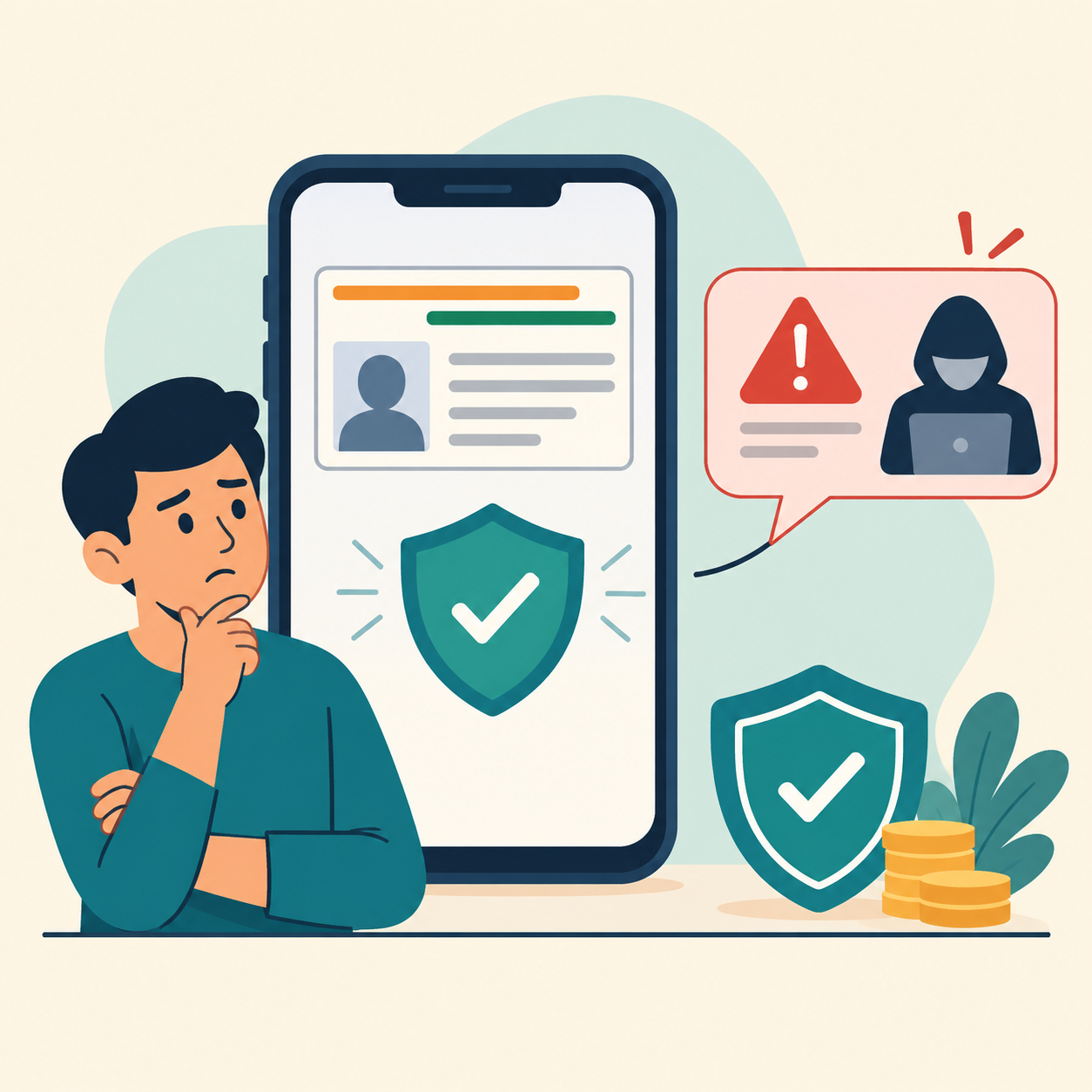
Aadhaar has made identity verification easier for many financial services in India. Today, several banks and regulated lending institutions allow customers to use Aadhaar-based verification when applying for personal loans and other credit facilities.
However, the convenience of Aadhaar-based KYC also creates certain risks when borrowers do not understand how digital lending works.
Many people believe that having an Aadhaar card automatically qualifies them for a personal loan. Others share their Aadhaar number, OTP, personal information or identity documents with unknown loan agents without checking whether the lender is genuine.
These mistakes can result in financial losses, identity misuse, privacy problems and unnecessary debt.
Aadhaar is primarily an identity document used for verification. It does not guarantee loan approval, low interest rates or instant disbursement. Lenders may also evaluate income, employment, repayment capacity, credit history and other eligibility requirements.
This guide explains the common mistakes, risks and safer decisions associated with loans using Aadhaar. It also covers practical precautions, fraud warning signs and borrower protection measures.
3. AI Answer Box: What Are the Common Mistakes and Risks of Loan Using Aadhaar?
A loan using Aadhaar is a borrowing facility where Aadhaar details may be used for identity verification and KYC. The most common mistakes include trusting unknown loan apps, sharing OTPs, ignoring interest rates, overlooking processing fees and accepting loan agreements without reading them.
The major risks include Aadhaar data misuse, identity fraud, hidden charges, excessive borrowing, privacy violations and harassment by fraudulent recovery agents.
Safer decisions include:
-
Apply only through verified banks or RBI-regulated lenders.
-
Check the actual lending institution before submitting documents.
-
Never share Aadhaar OTPs with agents or callers.
-
Use masked Aadhaar wherever accepted.
-
Read the Key Facts Statement (KFS) before accepting the loan.
-
Compare the Annual Percentage Rate (APR), EMI and total repayment.
-
Avoid applications demanding unnecessary mobile permissions.
-
Borrow only an amount you can comfortably repay.
Important: Aadhaar can help verify identity, but it cannot independently guarantee loan eligibility or approval.
4. Understanding the Common Mistakes When Taking a Loan Using Aadhaar
Aadhaar-based loan applications can simplify identity verification, but borrowers should understand the complete borrowing process before applying.
The following mistakes are particularly important to avoid.
4.1 Assuming Aadhaar Guarantees Loan Approval
One of the biggest misconceptions is that anyone with a valid Aadhaar card can automatically receive a personal loan.
Aadhaar helps lenders verify identity. However, loan approval depends on several additional factors.
Why is this a mistake?
-
Aadhaar does not prove that an applicant has sufficient income.
-
It does not guarantee a good credit score.
-
It does not establish repayment capacity.
-
It does not automatically satisfy every lender's eligibility requirements.
Safer decision: Check the lender's eligibility criteria before applying. Review your income, employment status, existing EMIs and credit history.
4.2 Applying Through Unknown Loan Apps
Many borrowers search online for instant loans and download the first application they find.
Some fraudulent applications imitate genuine financial companies and use attractive advertisements such as:
-
Instant loan without verification.
-
Guaranteed approval using Aadhaar.
-
No income proof required.
-
Loans for everyone.
-
Money within five minutes.
These promises can encourage borrowers to submit personal information without proper verification.
Risks include:
-
Identity information being misused.
-
Unauthorised access to personal data.
-
Fake processing-fee demands.
-
Fraudulent loan agreements.
-
Harassment through fake recovery calls.
Safer decision: Verify the actual bank or NBFC providing the loan. Check whether the lender identifies the app or lending service provider on its official website.
The RBI's Digital Lending Directions, 2025, establish requirements for regulated lenders and their digital lending partners.
4.3 Sharing Aadhaar OTP With Unknown People
An OTP is an important security measure used during identity verification and other online transactions.
Some fraudulent agents may call applicants and request Aadhaar OTPs, claiming that the code is required to release the loan.
This is a dangerous practice.
Common warning signs:
-
Someone requests an OTP over a phone call.
-
An agent asks you to share a screen.
-
A caller requests multiple verification codes.
-
Someone asks you to approve an authentication request that you did not initiate.
Safer decision:
-
Never disclose OTPs to loan agents or callers.
-
Read the authentication message before approving it.
-
Do not approve unexpected Aadhaar authentication requests.
-
Use only the official lender's secure verification process.
Remember that an OTP should be entered only by you through a legitimate process that you initiated.
4.4 Ignoring Interest Rates and Hidden Charges
Some borrowers focus only on the loan amount and EMI while ignoring the total borrowing cost.
A loan advertised as an easy or low-interest loan may include additional charges.
Examples include:
-
Processing fees.
-
Applicable GST on taxable services.
-
Late-payment charges.
-
Penal charges.
-
Foreclosure or prepayment charges, where applicable.
-
Other disclosed service-related costs.
Example:
Suppose a borrower applies for a personal loan of ₹50,000.
|
Particulars |
Illustrative amount |
|---|---|
|
Approved loan |
₹50,000 |
|
Processing fee |
₹1,000 |
|
GST on processing fee at 18% |
₹180 |
|
Amount received |
₹48,820 |
The borrower may still have to repay the full contractual principal of ₹50,000, along with applicable interest.
This example assumes the processing fee and GST are deducted upfront. Actual terms vary by lender.
Safer decision: Compare the Annual Percentage Rate (APR), net disbursal amount, total repayment and all applicable charges before accepting the offer.
4.5 Not Reading the Loan Agreement
Accepting a digital loan agreement without reading it can create problems later.
Borrowers sometimes click the acceptance button simply because they want the money quickly.
However, the agreement contains important financial and legal information.
Before accepting, review:
-
Approved loan amount.
-
Interest rate.
-
Repayment period.
-
EMI amount.
-
Processing fee.
-
Late-payment charges.
-
Prepayment conditions.
-
Default-related terms.
-
Data privacy policy.
-
Grievance contact details.
Safer decision: Download the loan agreement, sanction letter and Key Facts Statement (KFS). Keep copies for future reference.
4.6 Sharing Full Aadhaar Details Everywhere
Some borrowers send Aadhaar photographs through WhatsApp, email or social media without checking who receives them.
Unnecessary sharing increases the risk of identity information being exposed.
Safer decision:
-
Use masked Aadhaar where the lender accepts it.
-
Share documents only through verified channels.
-
Avoid uploading Aadhaar to unknown websites.
-
Do not post Aadhaar images publicly.
-
Check whether the document-sharing process is secure.
UIDAI provides a masked Aadhaar facility that displays only the last four digits of the Aadhaar number.
4.7 Applying for Multiple Loans at the Same Time
Some applicants submit applications to several loan providers because they believe that more applications will improve their chances of approval.
However, multiple formal credit applications may result in multiple credit enquiries, depending on how lenders process them.
Frequent applications can also indicate greater credit-seeking activity to lenders.
Safer decision:
-
Compare loan offers first.
-
Shortlist suitable lenders.
-
Check eligibility before submitting a formal application.
-
Avoid unnecessary applications.
-
Review your credit report periodically.
4.8 Borrowing More Than You Actually Need
An applicant may qualify for a higher loan amount than originally required.
Accepting the entire approved amount can increase the EMI and total interest burden.
For example, someone who needs ₹30,000 for an urgent expense may accept ₹80,000 simply because the lender offers it.
This creates unnecessary debt.
Safer decision: Borrow only the amount required for the intended purpose and choose a repayment period that fits your monthly budget.
4.9 Ignoring Mobile App Permissions
Some digital loan applications may request access to mobile phone features and information.
Not every requested permission is necessary for loan processing.
Be especially cautious about requests for:
-
Contacts.
-
Call logs.
-
Personal photographs.
-
Media files.
-
Unrelated device information.
The RBI's 2025 Digital Lending Directions require regulated entities to ensure that data collection is need-based and based on explicit borrower consent, subject to the applicable requirements.
Safer decision: Review app permissions and privacy policies before installation. Do not grant unnecessary access merely to complete an application.
4.10 Ignoring Repayment Dates
Some borrowers focus entirely on receiving the loan and forget to plan for repayment.
Missing an EMI can result in additional charges and may negatively affect credit history when reported by the lender.
Safer decision:
-
Maintain sufficient bank balance before the EMI date.
-
Set repayment reminders.
-
Track outstanding loan amounts.
-
Contact the lender early if repayment difficulties arise.
5. Major Risks Associated With Loans Using Aadhaar
Understanding potential risks helps borrowers make better financial decisions.
5.1 Aadhaar Identity Misuse
Aadhaar details may become exposed when borrowers share documents with unknown agents or upload them to suspicious websites.
Fraudsters may attempt to misuse exposed personal information for impersonation or other fraudulent activities.
How to reduce this risk:
-
Use masked Aadhaar where accepted.
-
Avoid sharing Aadhaar copies unnecessarily.
-
Protect registered mobile numbers.
-
Never share authentication OTPs.
-
Check unexpected financial messages and transactions.
5.2 Fake Loan Approval Scams
Fraudsters sometimes send messages claiming that a personal loan has been approved.
They may demand advance payments for:
-
File opening.
-
Loan insurance.
-
Verification.
-
Approval confirmation.
-
Security deposits.
A request for payment to a personal UPI ID or unrelated bank account should be treated as a serious warning sign.
Safer decision: Verify every charge directly with the actual lender. Check the KFS and official payment instructions before making any payment.
5.3 Hidden Financial Costs
A loan may appear affordable because the advertised EMI is small.
However, the total borrowing cost can become expensive due to interest, fees and repayment-related charges.
For this reason, borrowers should compare APR instead of considering only the advertised interest rate.
5.4 Data Privacy and Personal Information Exposure
Digital loan applications may collect information during the application and servicing process.
Poor data protection practices can expose sensitive information.
Potential consequences include:
-
Unwanted marketing calls.
-
Unauthorised sharing of information.
-
Identity-related fraud.
-
Financial scams.
-
Privacy violations.
Read the lender's privacy policy and understand how your information is collected, stored, used and shared.
5.5 Harassment by Fake Recovery Agents
Some fraudulent operators threaten borrowers or misuse personal information to demand payments.
Warning signs include:
-
Threatening messages.
-
Abusive phone calls.
-
Threats to contact family members.
-
Demands for payment to personal accounts.
-
False legal notices.
-
Requests for additional OTPs.
Legitimate recovery activity must follow applicable rules. RBI's digital lending framework also requires relevant regulated lenders to disclose authorised recovery-agent information to borrowers before the agent contacts them in the specified circumstances.
Safer decision: Verify the recovery agent through the lender's official customer support. Preserve messages, call records and payment receipts.
5.6 Aadhaar-Related KYC Errors
Differences between Aadhaar information and the details submitted in a loan application may delay verification.
Common examples include:
-
Incorrect name spelling.
-
Outdated address.
-
Unlinked or inaccessible mobile number.
-
Incorrect date of birth.
-
Poor-quality document uploads.
Safer decision: Check your details before submitting an application. Correct errors through authorised UIDAI channels rather than relying on unknown agents.
5.7 Debt Traps From Repeated Borrowing
Taking a new loan to repay an existing loan can create a cycle of borrowing.
This may increase financial pressure and make it difficult to manage monthly expenses.
Safer decision: Prepare a repayment plan before borrowing. Consider whether existing income can support the additional EMI without affecting essential expenses.
6. Common Mistakes vs Safer Decisions
The following table provides a quick comparison of unsafe borrowing practices and better alternatives.
|
Common mistake |
Safer decision |
|---|---|
|
Trusting every loan advertisement |
Verify the lender |
|
Sharing Aadhaar OTP |
Keep OTP private |
|
Sending documents to unknown agents |
Use official channels |
|
Ignoring interest rates |
Compare APR |
|
Accepting loans without reading agreements |
Read the KFS |
|
Downloading unknown apps |
Check the official lender website |
|
Granting unnecessary permissions |
Review app permissions |
|
Borrowing the maximum amount |
Borrow only what is needed |
|
Ignoring repayment dates |
Set EMI reminders |
|
Paying advance fees to strangers |
Verify charges with the lender |
|
Ignoring suspicious messages |
Report suspected fraud |
|
Applying to many lenders |
Shortlist before applying |
7. How to Identify a Fake Aadhaar Loan App
Fake loan applications can look professional and may use the names or logos of genuine financial companies.
However, a professional-looking interface does not prove that an application is legitimate.
7.1 Warning Signs of a Fake Loan App
Look for the following signs:
-
Guaranteed loan approval without proper assessment.
-
Unusually high processing fees before approval.
-
No identifiable bank or NBFC.
-
No clear customer support information.
-
Requests for unnecessary contact or gallery access.
-
Threatening messages before repayment is due.
-
No proper loan agreement.
-
Unclear interest rates and repayment conditions.
-
Requests to transfer money to personal accounts.
7.2 How to Verify a Loan App
Follow these steps before submitting your Aadhaar details.
Step 1: Identify the actual lender
Find out whether the loan is being provided by a bank or NBFC.
Step 2: Visit the lender's official website
Check whether the lender lists the application or lending service provider as an authorised partner.
Step 3: Verify regulatory details
Check the lender's regulatory status through the appropriate official RBI resources.
Remember that RBI does not approve every individual loan app simply because it appears in an app store.
Step 4: Read the privacy policy
Understand what personal information the application collects and why.
Step 5: Check loan documents
Review the KFS, interest rate, repayment schedule and applicable fees.
Step 6: Verify customer support
Make sure the lender provides genuine customer-care and grievance-redressal details.
8. Safer Decisions Before Applying for a Loan Using Aadhaar
Making a few checks before applying can reduce financial and privacy risks.
8.1 Check Whether You Really Need the Loan
Start by understanding the reason for borrowing.
Ask yourself:
-
Is the expense necessary?
-
Can I use existing savings?
-
Can I manage the expense through monthly budgeting?
-
Will the loan affect my essential expenses?
-
Can I repay the EMI comfortably?
If borrowing is necessary, select an amount that matches your actual requirement.
8.2 Verify the Lender's Identity
A genuine loan application should clearly identify the regulated lender responsible for providing the loan.
Check:
-
Legal name of the bank or NBFC.
-
Official website.
-
Customer support information.
-
Loan product details.
-
Lending service provider relationship, where applicable.
-
Grievance-redressal mechanism.
8.3 Protect Your Aadhaar Information
Aadhaar security should be a priority during digital loan applications.
Practical precautions include:
-
Download masked Aadhaar from UIDAI where accepted.
-
Avoid sharing unnecessary copies.
-
Never reveal OTPs.
-
Avoid public Wi-Fi when uploading sensitive documents.
-
Do not save Aadhaar photographs in publicly accessible folders.
-
Check the recipient before sending documents.
-
Use UIDAI's available security services where appropriate.
8.4 Understand the Key Facts Statement
The Key Facts Statement is an important document that helps borrowers understand the actual cost and conditions of a loan.
Under RBI's KFS framework, applicable new retail and MSME term loans must have standardised key information, including APR details and repayment schedules.
For applicable loans, the KFS is intended to be supplied before the borrower enters into the loan contract.
Check these details carefully:
|
KFS information |
What to verify |
|---|---|
|
Loan amount |
Approved principal |
|
Interest rate |
Applicable rate |
|
APR |
Overall annualised borrowing cost |
|
Processing fee |
Deduction or payment required |
|
EMI |
Monthly repayment amount |
|
Tenure |
Total repayment period |
|
Penal charges |
Charges for specified defaults |
|
Repayment schedule |
EMI dates and outstanding balance |
|
Lender details |
Actual bank or NBFC |
8.5 Choose an Affordable EMI
An EMI should fit comfortably into your monthly budget.
For example, if your monthly take-home income is ₹30,000, accepting a loan with an EMI of ₹12,000 may leave insufficient money for essential expenses, especially if you already have other EMIs.
Before borrowing, calculate:
-
Monthly income.
-
Existing loan repayments.
-
Rent and household expenses.
-
Essential savings.
-
Proposed new EMI.
Do not depend entirely on the lender's maximum eligible loan amount.
9. Aadhaar Loan Safety Checklist Before Submitting Your Application
Use this checklist to review your application.
Pre-loan safety checklist
If you cannot confidently verify the lender or understand the loan terms, do not proceed until your doubts are resolved.
10. What Should You Do If Your Aadhaar Details Are Misused?
If you suspect that your Aadhaar information has been misused during a loan application, take action quickly.
Step-by-Step Safety Measures
Step 1: Contact UIDAI
Visit the official UIDAI website and use its available Aadhaar security and support services.
Step 2: Check Aadhaar authentication history
Where available, review authentication records to identify unexpected activity.
Step 3: Secure Aadhaar authentication
Consider locking Aadhaar or biometric authentication through UIDAI services if you suspect misuse and the restrictions are suitable for your needs.
Step 4: Contact your bank
Inform your bank immediately if you notice unauthorised transactions or suspicious financial activity.
Step 5: Report financial cyber fraud
Use India's National Cyber Crime Reporting Portal or call the cybercrime helpline.
-
Cybercrime reporting: National Cyber Crime Reporting Portal
-
Cyber financial fraud helpline: 1930
-
Aadhaar services: UIDAI Official Website
Step 6: Preserve evidence
Keep screenshots, transaction IDs, SMS messages, emails, loan application details and payment receipts.
Step 7: Raise a lender complaint
Contact the actual bank or NBFC and request an investigation if a fraudulent loan appears in your name.
If the complaint against an RBI-regulated lender is not satisfactorily resolved within 30 days, or the response is unsatisfactory, you may be eligible to approach the RBI Complaint Management System under the applicable Ombudsman framework.
11. RBI Digital Lending Guidelines: What Borrowers Should Know
The Reserve Bank of India introduced the Digital Lending Directions, 2025, on May 8, 2025.
These directions consolidate and update regulatory requirements relating to digital lending by regulated entities.
They cover several areas important to borrowers.
|
Area |
Important borrower protection |
|---|---|
|
Creditworthiness |
Lenders assess the borrower's economic profile |
|
Loan disclosures |
Important loan information must be disclosed |
|
KFS |
Borrowers receive key loan information |
|
Data collection |
Collection must follow applicable consent and necessity requirements |
|
Loan disbursement |
Generally, funds are disbursed directly to the borrower's bank account, subject to specified exceptions |
|
Cooling-off period |
Digital loans must provide an eligible exit option of at least one day |
|
Grievance redressal |
Borrowers must have access to complaint mechanisms |
Source: RBI Digital Lending Directions, 2025.
11.1 Cooling-Off Period
An important borrower protection is the cooling-off period.
Under the RBI Digital Lending Directions, 2025, borrowers must receive an explicit option to exit a digital loan during an initial period determined by the regulated lender, which cannot be less than one day.
During this period, the borrower can exit by paying the principal and proportionate APR without a penalty. A reasonable one-time processing fee may be retained if it was disclosed upfront in the KFS.
11.2 Loan Disbursement and Repayment
For digital loans, the general RBI requirement is that disbursement should be made directly into the borrower's bank account, subject to specified exceptions.
Borrowers should be cautious if an unknown agent asks them to receive or transfer loan funds through an unrelated personal account.
11.3 Data Privacy
Regulated lenders must follow applicable requirements relating to the collection, usage, storage and sharing of borrower information.
Borrowers should still read privacy policies and avoid granting unnecessary permissions.
12. Comparison: Safe vs Unsafe Aadhaar Loan Practices
|
Factor |
Safer practice |
Unsafe practice |
|---|---|---|
|
Lender |
Verified bank/NBFC |
Unknown operator |
|
Identity verification |
Official KYC process |
Unverified agent |
|
Aadhaar |
Masked Aadhaar where accepted |
Unnecessary full Aadhaar sharing |
|
OTP |
Enter privately |
Share with callers |
|
Fees |
Disclosed charges |
Advance payment to strangers |
|
Interest |
Compare APR |
Trust advertisements |
|
Documents |
Read KFS |
Accept without reading |
|
Permissions |
Need-based access |
Grant all permissions |
|
Disbursement |
Verified lender account process |
Personal third-party account |
|
Repayment |
Official repayment channel |
Unverified UPI account |
13. Pros and Cons of Aadhaar-Based Loan Applications
Aadhaar-based verification can simplify certain parts of the application process. However, it is important to understand both the advantages and limitations.
Advantages
-
Convenient identity verification: Aadhaar can support digital KYC where permitted.
-
Reduced paperwork: Some lenders may accept digital verification instead of requiring extensive physical documentation.
-
Faster processing: Online verification can reduce administrative delays.
-
Remote application: Applicants may complete eligible processes without visiting a branch.
-
Easy document availability: Aadhaar details can be accessed when required through authorised channels.
Disadvantages
-
Privacy concerns: Careless document sharing can expose personal information.
-
Fraud risk: Fake applications may misuse Aadhaar-related information.
-
No guaranteed approval: Other eligibility requirements still apply.
-
Additional documentation: Lenders may require income proof, bank statements and other records.
-
Potential financial burden: Interest and charges can make borrowing expensive.
-
Digital dependency: Technical or authentication issues may delay the application.
Overall Comparison
|
Feature |
Advantage |
Limitation |
|---|---|---|
|
KYC |
Convenient verification |
Requires secure handling |
|
Application |
Online process |
Internet and device dependency |
|
Documentation |
Potentially reduced paperwork |
Other documents may be required |
|
Processing |
Can be faster |
Approval is not guaranteed |
|
Security |
Authorised authentication |
Risk of social engineering |
|
Borrowing |
Access to credit |
Interest and repayment obligations |
14. Expert Commentary: Why Borrowers Should Focus on Safety Instead of Speed
A quick loan is not necessarily an affordable loan.
Many borrowers make financial decisions under pressure because they need money for medical expenses, education, household requirements or unexpected emergencies.
However, speed should never become the only factor when choosing a lender.
A responsible borrowing decision involves three important checks:
1. Identity and lender verification
Confirm who is actually providing the loan and whether the lending institution is regulated.
2. Complete cost understanding
Compare APR, processing fees, repayment tenure and total interest rather than selecting an offer based only on the EMI.
3. Repayment capacity
Make sure the proposed EMI does not interfere with essential monthly expenses.
Practical experience point: Consider a borrower who needs ₹40,000 urgently. They receive two loan offers. One promises immediate approval but does not clearly disclose charges. The other provides a KFS, transparent repayment details and verified lender information. Even if the second option takes slightly longer, it allows the borrower to make a more informed decision.
The most important lesson is that responsible borrowing is about understanding the financial commitment, not simply receiving money quickly.
15. Real-World Situations: Mistakes Borrowers Should Avoid
Understanding common situations can help people recognise risks before they become financial problems.
Situation 1: A borrower receives an instant loan approval message
A person receives an SMS claiming that a ₹1 lakh loan has been approved using Aadhaar.
The sender requests ₹2,000 as an advance processing fee.
Correct decision: Do not transfer money to an unknown account. Contact the actual lender using its official contact details.
Situation 2: An agent requests an Aadhaar OTP
A loan agent claims that an OTP is required to complete verification and release funds.
Correct decision: Never disclose the OTP. Complete authentication yourself through the lender's verified process.
Situation 3: A borrower accepts a loan without checking APR
A person selects a loan because the monthly EMI appears affordable but later discovers additional costs.
Correct decision: Review the KFS and calculate the total repayment before accepting the loan.
Situation 4: A borrower installs an unknown loan application
An application requests access to contacts, photographs and call logs before showing loan offers.
Correct decision: Avoid granting unnecessary permissions. Verify the lender and review the privacy policy.
Situation 5: A borrower cannot repay an EMI
An unexpected expense makes it difficult to pay the monthly instalment.
Correct decision: Contact the lender early, discuss available repayment options and avoid taking another expensive loan without assessing the consequences.
16. Frequently Asked Questions (FAQs)
1. What are the common mistakes when applying for a loan using Aadhaar?
The common mistakes include sharing OTPs, trusting unknown loan applications, ignoring interest rates, overlooking hidden charges, not reading loan agreements and borrowing more than necessary.
2. Can someone misuse my Aadhaar details to take a loan?
Exposed identity information may be misused in fraudulent activities. However, Aadhaar details alone do not automatically establish a valid loan or guarantee successful authentication. Protect your Aadhaar information and report suspicious activity immediately.
3. Is it safe to share Aadhaar details with loan apps?
It is safer to share Aadhaar details only with verified lenders through authorised channels. Check the lender's identity, privacy policy and document requirements before submitting information.
4. Can I get a loan using Aadhaar without sharing an OTP?
It depends on the lender's permitted KYC process. Some verification methods may require OTP-based authentication, while others may use different authorised processes. Never share an OTP with another person.
5. Does Aadhaar guarantee instant personal loan approval?
No. Aadhaar supports identity verification, but lenders also assess income, employment, credit history, repayment capacity and their own eligibility conditions.
6. How can I identify a fake Aadhaar loan app?
Look for warning signs such as guaranteed approval, unclear lender details, unnecessary permissions, advance payment demands, missing loan agreements and suspicious recovery practices.
7. What should I check before accepting an Aadhaar-based loan?
Check the actual lender, interest rate, APR, processing fee, EMI, repayment tenure, total repayment, KFS, loan agreement and privacy policy.
8. What is masked Aadhaar, and why should I use it?
Masked Aadhaar is an Aadhaar document in which the first eight digits are hidden and only the last four digits are visible. It can help reduce unnecessary exposure of your Aadhaar number where the lender accepts it.
9. Can an Aadhaar-based loan have hidden charges?
A loan may involve processing fees, applicable taxes and other contractual charges. Review the KFS and loan agreement to understand the complete cost before accepting the offer.
10. What should I do if someone misuses my Aadhaar for a loan?
Contact the relevant lender, report suspected fraud, preserve evidence, secure your Aadhaar authentication options and check your financial records. For cyber financial fraud, contact 1930 or use the National Cyber Crime Reporting Portal.
11. Can I apply for multiple loans using the same Aadhaar?
You may apply to different lenders if you meet their eligibility conditions. However, multiple applications may create additional credit enquiries and increase your overall debt burden. Apply selectively.
12. Are digital loans regulated by the RBI?
Digital lending by entities covered under RBI regulations is subject to applicable RBI directions. The RBI Digital Lending Directions, 2025, address disclosures, borrower protection, data practices and grievance redressal.
13. What happens if I miss an EMI on an Aadhaar-based loan?
Missing an EMI may lead to applicable late-payment or penal charges and can affect your credit history if reported by the lender. Contact the lender promptly to discuss available solutions.
14. Can I cancel a digital loan after accepting it?
Eligible digital loans must provide an initial cooling-off period of at least one day under the RBI Digital Lending Directions, 2025. During this period, borrowers can exit by paying the principal and proportionate APR without a penalty, subject to any permitted and upfront-disclosed one-time processing fee.
15. How can I make an Aadhaar-based loan application safer?
Apply through a verified lender, use secure KYC channels, protect OTPs, use masked Aadhaar where accepted, read the KFS, compare APR and borrow only what you can repay.
Conclusion
Loans using Aadhaar have made identity verification more convenient for people seeking digital financial services. However, convenience should not replace careful financial decision-making.
The biggest mistakes borrowers make are trusting unknown loan applications, sharing OTPs, overlooking interest rates, ignoring hidden charges and accepting loan agreements without understanding the conditions.
These mistakes can create financial difficulties and expose personal information to misuse.
A safer approach is to verify the lender, protect Aadhaar details, understand the KFS, compare APR and calculate repayment capacity before applying.
Remember that a responsible loan decision is not simply about getting money quickly. It is about choosing a legitimate lender, understanding the borrowing cost and maintaining financial stability throughout the repayment period.
Before applying for a loan using Aadhaar, stay informed, verify every detail and borrow responsibly.
Published on : 25th November
Published by : Bhargavi
www.vizzve.com || www.vizzveservices.com
Follow us on social media: Facebook || Linkedin || Instagram
🛡 Powered by Vizzve Financial
RBI-Registered Loan Partner | 10 Lakh+ Customers | ₹600 Cr+ Disbursed