

Introduction
Aadhaar is widely used for identity verification in India's digital financial services. Depending on the lender and applicable rules, it may help borrowers complete KYC while applying for a loan online or through a branch.
But borrowers may come across several loan options, each with different eligibility conditions, interest rates, repayment periods and risks.
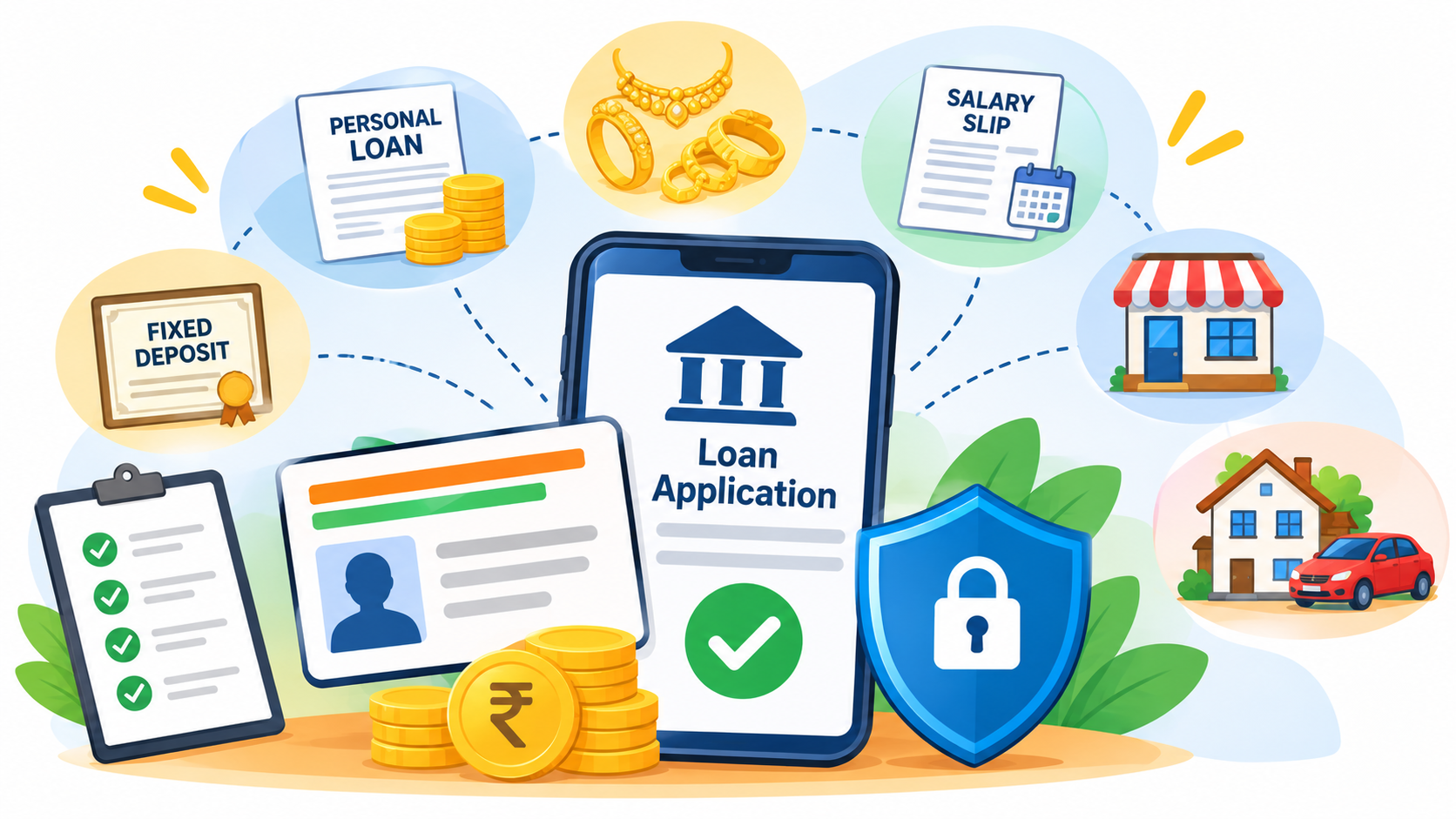
For example, a personal loan may not require collateral, while a gold loan requires the borrower to pledge eligible gold. A salary-based loan may depend on regular employment income, whereas a secured loan depends on the value of an asset.
The right option depends on how much money is needed, how quickly it is required, whether collateral is available and whether the monthly repayment is affordable.
3. AI Answer Box: What Are the Loan Options Using Aadhaar?
Aadhaar can be used as an accepted identity-verification document or method for different loan applications, subject to the lender's KYC process. Borrowers may explore personal loans, salary-based loans, gold loans, secured loans and certain credit facilities. These options differ in collateral requirements, interest rates, eligibility, loan amounts and repayment conditions. Aadhaar helps with KYC but does not guarantee loan approval.
4. Different Loan Options Using Aadhaar
Aadhaar may be accepted for KYC across several types of lending products. The loan itself is determined by the lender's product, not by the Aadhaar card.
Here are common options borrowers can explore.
4.1 Personal Loan
A personal loan is generally an unsecured loan that can be used for eligible personal expenses, such as medical bills, education costs, home repairs or emergencies.
Key features:
-
Usually does not require collateral.
-
Approval depends on income and creditworthiness.
-
Can be applied for online or through a branch.
-
Repayment is generally through monthly EMIs.
Suitable for: Salaried or self-employed applicants who need funds for personal expenses and meet the lender's eligibility conditions.
4.2 Gold Loan
A gold loan is a secured loan in which the borrower pledges eligible gold jewellery or other accepted gold collateral with a lender.
Key features:
-
Gold is pledged as security.
-
Loan amount depends on the accepted gold's value and applicable loan-to-value rules.
-
The lender holds the gold until the loan is repaid according to the agreement.
-
Default may result in the lender enforcing its rights over the pledged gold.
Suitable for: People who own eligible gold and need funds without relying only on salary-based eligibility.
4.3 Salary-Based Loan
A salary-based loan is generally offered to eligible employees based on their regular salary and financial profile.
Key features:
-
Regular monthly income may support eligibility.
-
Salary slips and bank statements may be requested.
-
Existing EMIs can affect the approved amount.
-
Some products are offered through employer or bank relationships.
Suitable for: Employees with regular income who can comfortably manage monthly repayments.
4.4 Loan Against Fixed Deposit
A loan against a fixed deposit (FD) allows an eligible depositor to borrow against an existing deposit.
Key features:
-
The FD acts as security.
-
The available loan or overdraft limit depends on the bank's policy and deposit value.
-
Interest is charged on the amount borrowed under the applicable arrangement.
-
The FD may be subject to a lien or restriction until the outstanding amount is cleared.
Suitable for: People who have an FD and need funds without immediately breaking it.
4.5 Business or MSME Loan
A business or MSME loan helps eligible entrepreneurs meet business-related expenses, such as purchasing equipment, maintaining inventory or managing working capital.
Key features:
-
Designed for business requirements.
-
Business activity and cash flow may be assessed.
-
Financial records and bank statements may be requested.
-
Some products may be secured, while others may be unsecured.
Suitable for: Eligible small-business owners, traders and entrepreneurs who need funds for business purposes.
4.6 Home or Vehicle Loan
Home loans and vehicle loans are purpose-specific financing options. The property or vehicle generally serves as security, subject to the loan agreement.
Key features:
-
Funds are intended for purchasing a home or vehicle.
-
Loan amounts and tenures depend on the lender and product.
-
Down payment or margin money may be required.
-
The financed asset may be subject to lender security rights.
Suitable for: Borrowers planning a home or vehicle purchase who meet the lender's financial and other conditions.
5. Comparison of Different Loan Options
The following table highlights the main differences.
|
Loan option |
Collateral required? |
Main eligibility factor |
Common purpose |
|---|---|---|---|
|
Personal loan |
Usually no |
Income and credit profile |
Personal expenses |
|
Gold loan |
Yes, eligible gold |
Gold value and lender rules |
Short-term funding |
|
Salary-based loan |
Depends on product |
Regular salary |
Personal needs |
|
Loan against FD |
Yes, FD |
Deposit value and bank policy |
Liquidity needs |
|
Business/MSME loan |
Depends on product |
Business profile and repayment ability |
Business expenses |
|
Home loan |
Generally yes, property |
Income and property assessment |
Home purchase |
|
Vehicle loan |
Generally yes, vehicle |
Income and vehicle assessment |
Vehicle purchase |
Important: Aadhaar may be used for KYC in these products where accepted. It does not remove collateral requirements or other eligibility conditions.
6. Secured Loan vs Unsecured Loan: What Is the Difference?
One of the most important differences between loan options is whether collateral is required.
|
Feature |
Secured loan |
Unsecured loan |
|---|---|---|
|
Collateral |
Required |
Usually not required |
|
Examples |
Gold loan, FD loan, home loan |
Personal loan |
|
Approval assessment |
Income and security value |
Income and creditworthiness |
|
Interest rate |
Depends on lender and security |
Depends on lender and borrower profile |
|
Risk |
Asset may be at risk if repayment defaults |
Legal recovery and credit consequences may apply |
|
Ownership |
Security interest may apply to the asset |
No collateral is pledged |
A secured loan is not automatically cheaper or better. Borrowers should compare the full cost, repayment conditions and risks before choosing.
7. Which Loan Option Is Suitable for Different Needs?
The right choice depends on the reason for borrowing and the resources available.
|
Financial requirement |
Options worth comparing |
|---|---|
|
Medical or personal emergency |
Personal loan or eligible gold loan |
|
Regular employee's financial need |
Salary-based loan or personal loan |
|
Funds without breaking an FD |
Loan against FD |
|
Business expansion |
Business or MSME loan |
|
Buying a house |
Home loan |
|
Buying a vehicle |
Vehicle loan |
|
Short-term need with eligible gold |
Gold loan |
These are general comparisons, not approval recommendations. Always check the actual terms and eligibility requirements.
8. Differences in Eligibility Requirements
Each loan product has a different assessment process.
Personal Loan Eligibility
Lenders may consider:
-
Age.
-
Monthly income.
-
Employment or business stability.
-
Credit history.
-
Existing EMI commitments.
Gold Loan Eligibility
Lenders may examine:
-
Purity and weight of eligible gold.
-
Applicable valuation method.
-
Loan-to-value requirements.
-
KYC and other lender conditions.
Salary-Based Loan Eligibility
Lenders may consider:
-
Monthly take-home salary.
-
Employment status.
-
Salary account activity.
-
Existing financial commitments.
-
Employer-related eligibility conditions, where applicable.
Loan Against FD Eligibility
The bank may consider:
-
Deposit amount.
-
Deposit type and maturity.
-
Existing lien or restrictions.
-
Applicable loan or overdraft limit.
Business Loan Eligibility
Lenders may examine:
-
Business activity.
-
Revenue and cash flow.
-
Business vintage.
-
Bank statements.
-
Existing business liabilities.
-
Financial records and other applicable requirements.
9. How Aadhaar Is Used Across These Loan Options
Aadhaar may support the KYC process in different ways, depending on the lender and the legally permitted verification method.
A simplified process looks like this:
Choose a suitable loan product
Personal, gold, FD, salary, business or other loan
Complete accepted KYC
Aadhaar or another permitted verification method
Submit financial information
Income, bank details and other required documents
Lender assesses the application
Creditworthiness, collateral and loan conditions
Review offer and accept agreement
Check KFS, APR, EMI and repayment terms
Aadhaar verification is only one part of the process. The lender makes the final decision after completing the applicable checks.
10. Costs and Charges Across Loan Options
Different loan products can have different costs.
|
Cost factor |
Personal loan |
Gold loan |
Loan against FD |
Home/vehicle loan |
|---|---|---|---|---|
|
Interest |
Applicable |
Applicable |
Applicable |
Applicable |
|
Processing fee |
May apply |
May apply |
Depends on bank |
May apply |
|
Valuation charges |
Usually not applicable |
May apply |
Usually not applicable |
Property/asset-related charges may apply |
|
Collateral-related risk |
Usually none |
Pledged gold at risk |
FD may be restricted |
Financed asset at risk |
|
Other charges |
Depends on agreement |
Depends on agreement |
Depends on agreement |
Depends on agreement |
Always check the Key Facts Statement (KFS), Annual Percentage Rate (APR), applicable fees and total repayment amount. The RBI's Digital Lending Directions, 2025 require regulated entities to assess creditworthiness and provide important loan disclosures for covered digital lending activities.
11. Advantages and Limitations of Different Loan Options
Advantages
-
Personal loans: No collateral is generally required.
-
Gold loans: Eligible gold can be used as security to access funds.
-
Salary-based loans: Regular salary may help establish repayment capacity.
-
FD loans: Borrowers may access funds without immediately closing their fixed deposit.
-
Business loans: Can support eligible business activities and working capital.
-
Home and vehicle loans: Provide financing for high-value purchases.
Limitations
-
Personal loans may have higher interest costs than some secured options.
-
Gold loans put pledged gold at risk if the borrower defaults.
-
Salary-based loans depend on employment and income conditions.
-
FD loans may restrict access to the pledged deposit.
-
Business loans may require detailed financial records.
-
Home and vehicle loans involve long-term repayment commitments and asset-related risks.
12. How to Choose the Right Loan Using Aadhaar
Before selecting a loan, consider the following factors.
12.1 Identify Your Financial Requirement
Decide why you need the money. A medical emergency, business expansion and home purchase may require different loan products.
12.2 Compare Interest Rates and APR
Do not compare only the advertised interest rate. Check the APR and all applicable charges.
12.3 Check Your Repayment Capacity
Calculate your monthly income, existing EMIs and household expenses before deciding how much to borrow.
12.4 Understand Collateral Requirements
If you choose a secured loan, understand what happens to the pledged asset if you cannot repay.
12.5 Review the Loan Tenure
A longer tenure may reduce the monthly EMI but can increase the total interest paid.
12.6 Verify the Lender
Apply through a genuine bank or RBI-regulated NBFC. If a loan app or platform is involved, identify the actual regulated lender.
12.7 Read the Loan Agreement
Review the KFS, APR, EMI, late-payment charges, prepayment conditions and grievance-redressal details before accepting.
13. Important Safety Checks Before Applying
Follow these precautions when applying for any loan using Aadhaar:
-
Use the lender's official website or authorised application.
-
Never share Aadhaar OTPs with agents or unknown callers.
-
Read the consent details before completing digital KYC.
-
Avoid applications requesting unnecessary access to contacts and call logs.
-
Do not pay suspicious advance fees to personal accounts.
-
Check the lender's privacy policy.
-
Save the loan agreement and payment receipts.
-
Verify the repayment account and official customer-support details.
The RBI's digital lending rules include requirements covering borrower disclosures, data protection, lender accountability and grievance redressal.
Useful official resources:
-
UIDAI Official Website – Aadhaar services and information.
-
Reserve Bank of India – Banking and lending regulations.
-
RBI Digital Lending Directions, 2025 – Digital lending requirements.
14. Common Mistakes to Avoid
|
Mistake |
Better approach |
|---|---|
|
Thinking Aadhaar guarantees a loan |
Check the lender's eligibility criteria |
|
Choosing only by advertised interest rate |
Compare APR and total repayment |
|
Ignoring collateral risks |
Understand the consequences of default |
|
Borrowing more than necessary |
Calculate your actual requirement |
|
Not checking the lender |
Verify the bank or NBFC |
|
Accepting without reading the KFS |
Review all important costs |
|
Sharing OTPs with others |
Complete verification securely |
15. Frequently Asked Questions
1. What are the different loan options using Aadhaar?
Borrowers may explore personal loans, gold loans, salary-based loans, loans against fixed deposits, business loans, home loans and vehicle loans, depending on lender requirements.
2. Can I get a personal loan using only Aadhaar?
Usually, no. Aadhaar may support identity verification, but lenders can also request PAN, income details, bank statements and other information.
3. What is the difference between an Aadhaar loan and a personal loan?
An Aadhaar loan is a commonly used term for a loan application involving Aadhaar-based KYC. A personal loan is an actual loan product. Aadhaar does not create a separate loan category.
4. Which loan option does not require collateral?
Personal loans are generally unsecured and do not require collateral, although approval depends on the lender's eligibility assessment.
5. Can I get a gold loan using Aadhaar?
Aadhaar may be accepted for KYC when applying for a gold loan. The borrower must also provide eligible gold as security and meet the lender's conditions.
6. Is a gold loan better than a personal loan?
It depends on the borrower's needs, interest rate, repayment capacity and willingness to pledge gold. A gold loan involves collateral risk, while a personal loan generally does not.
7. Can salaried employees apply for an Aadhaar-based loan?
Yes, if they meet the lender's requirements. Salary slips, bank statements and employment details may be requested.
8. Can self-employed people apply for loans using Aadhaar?
Yes. They may apply for eligible personal or business loans and provide financial records or income information as required.
9. Can I get a loan against a fixed deposit using Aadhaar?
Aadhaar may be accepted for KYC, subject to the bank's process. The fixed deposit must meet the bank's requirements for use as security.
10. Does Aadhaar improve loan approval chances?
Aadhaar can support identity verification, but it does not automatically improve creditworthiness or guarantee approval.
11. Which loan is suitable for business owners?
Eligible business owners can compare business or MSME loans, personal loans and secured financing based on their purpose, financial records and repayment ability.
12. What is the difference between secured and unsecured loans?
A secured loan requires an asset as collateral, while an unsecured loan generally does not. Both require repayment, and default can have financial and legal consequences.
13. Are online Aadhaar-based loans safe?
They can be safe when offered through genuine regulated lenders and authorised platforms. Always verify the actual lender and review the privacy and loan terms.
14. Can I compare different loan offers before applying?
Yes. Compare the loan amount, APR, monthly EMI, total repayment, fees, tenure and collateral conditions before making a decision.
15. What should I check before accepting an Aadhaar-based loan?
Verify the lender, review the KFS, understand the interest rate and charges, check the repayment schedule and read the loan agreement.
Conclusion
Loan options using Aadhaar are not limited to one particular type of borrowing. Depending on eligibility and financial requirements, applicants may explore personal loans, gold loans, salary-based loans, FD loans, business loans and other financing products.
The main differences involve collateral, interest rates, eligibility, repayment periods and financial risks. Aadhaar may simplify KYC, but it does not guarantee approval.
Before choosing a loan, compare available options, understand the total cost and select a repayment plan that fits your budget.
Published on : 24th November
Published by : Bhargavi
www.vizzve.com || www.vizzveservices.com
Follow us on social media: Facebook || Linkedin || Instagram
🛡 Powered by Vizzve Financial
RBI-Registered Loan Partner | 10 Lakh+ Customers | ₹600 Cr+ Disbursed