

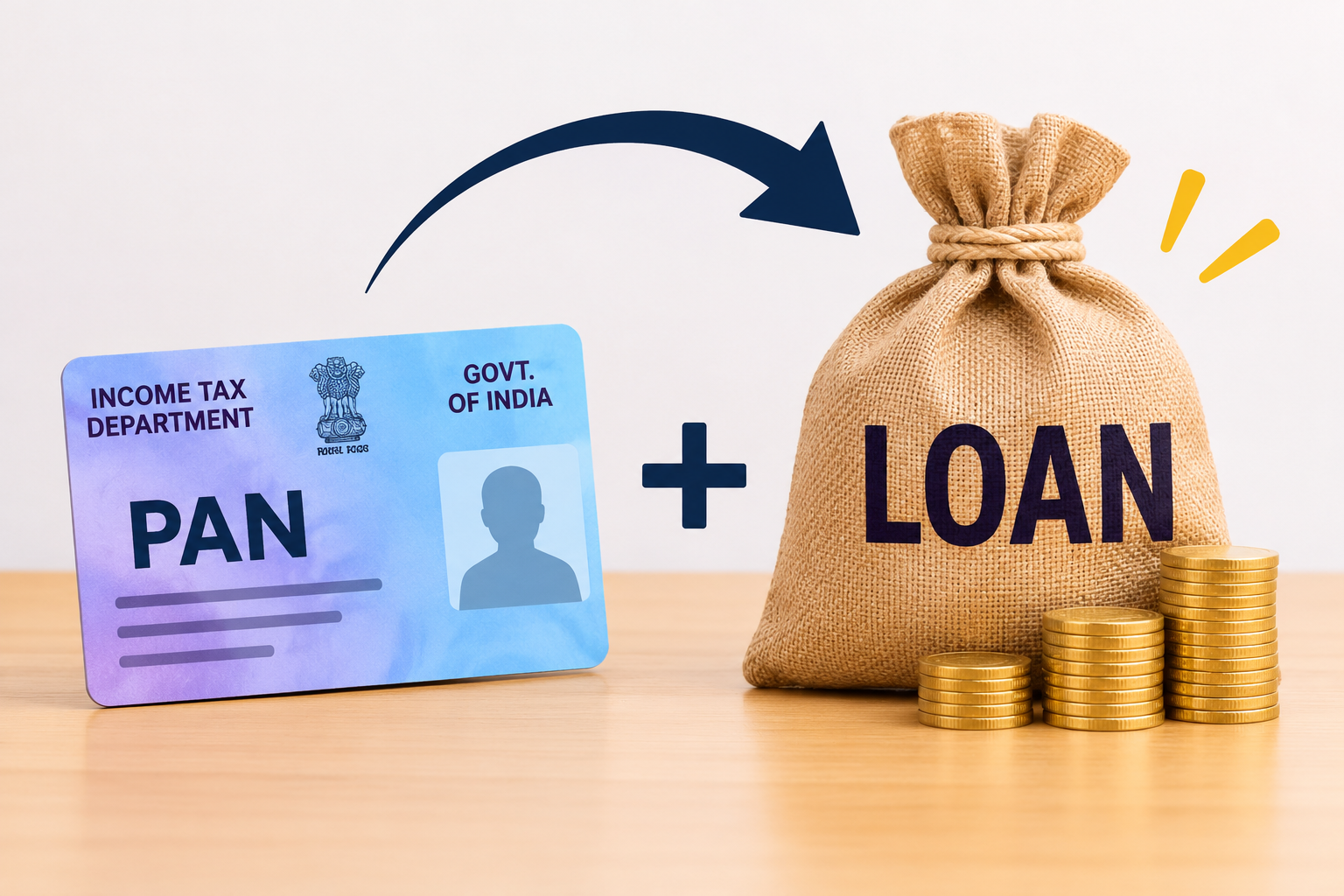
Introduction
A PAN card is one of the important documents used when applying for a personal loan in India. Banks and Non-Banking Financial Companies (NBFCs) commonly request PAN details to verify an applicant's identity, check financial information and assess loan eligibility.
Today, many financial institutions provide online personal loan applications. Applicants can submit their PAN details, complete digital verification and upload supporting documents without visiting a branch.
However, an important point must be understood: A PAN card alone does not guarantee loan approval. It is generally used as an identity and financial verification document. Lenders also consider income, employment, repayment capacity, existing debts and credit history.
Whether you are a salaried employee, self-employed professional or freelancer, understanding the PAN-based loan application process can help you make informed borrowing decisions.
This guide explains how loans using PAN cards work, eligibility requirements, documents, costs, benefits, limitations and precautions.
3. AI Answer Box: What Is a Loan Using PAN Card?
A loan using a PAN card is a personal loan application in which the applicant provides their Permanent Account Number (PAN) as part of the identity verification and financial assessment process.
Banks and NBFCs use PAN details, along with other information, to verify applicants and assess their creditworthiness.
A PAN card is generally required for financial verification, but it is not sufficient by itself to obtain a loan. Applicants may also need income proof, bank statements, address proof and other documents.
Quick facts:
-
PAN helps identify the loan applicant.
-
PAN details may be used for credit bureau checks.
-
Loan approval depends on eligibility and repayment capacity.
-
Interest rates and charges vary between lenders.
-
PAN-based loan applications can be completed online or offline.
-
Applicants should verify the actual lending institution before applying.
4. What Does Loan Using PAN Card Mean?
A loan using PAN card refers to a loan application where the borrower uses their PAN details as one of the required documents for verification.
PAN stands for Permanent Account Number. It is a ten-character alphanumeric identification number issued by the Income Tax Department of India.
Financial institutions use PAN information to:
-
Verify the applicant's identity.
-
Match financial and tax-related information where applicable.
-
Retrieve credit information through authorised credit bureaus.
-
Reduce identity-related fraud.
-
Support loan application processing.
-
Maintain financial records.
Is a PAN Card Enough to Get a Personal Loan?
No. A PAN card is not enough to guarantee a personal loan.
Most lenders assess several factors before approving an application.
|
Requirement |
Why lenders need it |
|---|---|
|
PAN card |
Identity and financial verification |
|
Aadhaar or other KYC documents |
Identity/address verification, as applicable |
|
Bank statements |
Income and transaction assessment |
|
Salary slips |
Employment and salary verification |
|
Credit history |
Previous borrowing and repayment behaviour |
|
Address proof |
Applicant's residential details |
|
Employment details |
Stability and repayment assessment |
The exact requirements depend on the lender and loan product.
5. How Does a Loan Using PAN Card Work?
The process generally involves submitting PAN details, completing KYC, providing financial information and undergoing a lender's credit assessment.
Step 1: Select a Lending Institution
Choose a bank or RBI-regulated NBFC that offers personal loans.
Before applying, check:
-
Lender's registration and credibility.
-
Interest rate and annual percentage rate (APR).
-
Processing charges.
-
Repayment period.
-
Customer support and grievance process.
Step 2: Enter PAN Details
Provide your PAN number in the lender's official application form.
The lender may use it to verify your identity and retrieve relevant credit information, subject to applicable consent and legal requirements.
Always check that the website or app is genuine before entering personal information.
Step 3: Complete KYC Verification
The lender may request additional identity and address verification.
Depending on the process, this may include Aadhaar-based verification, an officially valid document, digital KYC or another permitted method.
Step 4: Submit Income Information
Lenders assess whether you can repay the requested amount.
They may ask for:
-
Monthly income.
-
Employment type.
-
Salary details.
-
Bank statements.
-
Existing EMI commitments.
-
Business income details, where applicable.
Step 5: Creditworthiness Assessment
The lender evaluates your credit profile, repayment history, outstanding loans and other eligibility factors.
A good credit history can improve your chances, but approval is never guaranteed.
Step 6: Review the Loan Offer
If eligible, you may receive a loan offer.
Before accepting it, carefully examine the interest rate, APR, EMI, processing fee, applicable taxes and total repayment amount.
Step 7: Loan Agreement and Disbursement
After accepting the terms and completing the required formalities, the lender processes the loan agreement and disburses the approved amount.
For regulated digital loans, RBI directions require loan disbursal and repayment to follow prescribed fund-flow arrangements between the borrower and regulated lender.
6. Eligibility Criteria for a Loan Using PAN Card
Eligibility requirements vary between banks and NBFCs. However, most lenders evaluate the following factors.
|
Eligibility factor |
General consideration |
|---|---|
|
Age |
Must meet the lender's minimum and maximum age limits |
|
PAN card |
Valid PAN details |
|
Income |
Stable and sufficient income |
|
Employment |
Salaried or self-employed status |
|
Credit history |
Previous repayment behaviour |
|
Bank account |
Active account for verification and repayment |
|
Existing EMIs |
Current debt obligations |
|
Residential status |
Must satisfy the lender's requirements |
Who Can Apply for a Loan Using PAN?
1. Salaried Employees
People working in private companies, government departments or established organisations may apply if they satisfy the lender's income and employment requirements.
2. Self-Employed Individuals
Business owners, shopkeepers and independent professionals can apply by providing suitable income and business-related documents.
3. Freelancers
Freelancers may qualify if they can demonstrate regular earnings through bank statements, invoices, tax records or other accepted documents.
4. New Employees
People who have recently started working may apply, but some lenders require a minimum employment period or salary history.
Does a Good Credit Score Help?
Yes. A strong credit profile may improve loan eligibility and help applicants access more favourable loan terms.
Many lenders consider a CIBIL score of 750 or above favourable, but this is not a universal approval requirement.
Other factors include:
-
Timely repayment of previous loans.
-
Credit card utilisation.
-
Number of existing loans.
-
Recent loan applications.
-
Monthly income and financial stability.
A good credit score does not guarantee approval, and a lower score does not automatically mean every lender will reject an application.
7. Documents Required for a Loan Using PAN Card
Although PAN is an important document, lenders usually request additional documents.
Commonly Required Documents
|
Document |
Purpose |
|---|---|
|
PAN card |
Identity and financial verification |
|
Aadhaar card or other accepted KYC document |
Identity/address verification |
|
Recent bank statements |
Financial assessment |
|
Salary slips |
Income verification |
|
Employment details |
Employment verification |
|
Passport-size photograph |
If requested |
|
Address proof |
Residential verification |
|
ITR or financial statements |
Self-employed income verification |
Documents for Salaried Applicants
Salaried employees may need:
-
PAN card.
-
Accepted KYC documents.
-
Recent salary slips.
-
Bank statements, commonly covering the last three to six months if requested.
-
Employment details.
-
Additional documents requested by the lender.
Documents for Self-Employed Applicants
Business owners and independent professionals may need:
-
PAN card.
-
KYC documents.
-
Income Tax Returns (ITR), where applicable.
-
Business bank statements.
-
Business registration or proof of business activity, where requested.
-
Financial statements or income records.
Why Are Additional Documents Necessary?
A PAN card establishes an important identity reference, but it does not independently demonstrate repayment capacity.
For example, two applicants may have valid PAN cards, but one may have stable monthly income and a good repayment history, while the other may have irregular income and several outstanding loans.
Lenders use these additional documents to understand the difference.
8. Loan Amount, Interest Rates and Repayment Period
The loan amount and interest rate depend on the applicant's financial profile and the lender's policies.
There is no fixed loan amount or universal interest rate applicable to everyone applying with a PAN card.
Factors That Influence Loan Amount
-
Monthly income.
-
Credit score and repayment history.
-
Existing financial obligations.
-
Employment stability.
-
Business income, if self-employed.
-
Lender's risk assessment.
-
Loan repayment capacity.
What Determines the Interest Rate?
Interest rates may differ based on:
-
Credit profile.
-
Monthly income.
-
Employment category.
-
Loan amount.
-
Repayment tenure.
-
Lender's pricing policy.
Example of Personal Loan EMI
Suppose an applicant borrows ₹1,00,000 at an illustrative annual interest rate of 12% for 12 months.
Illustrative loan calculation
Loan amount
₹1,00,000
Annual interest
12%
Tenure
12 months
Estimated EMI
₹8,885
|
Particulars |
Approximate amount |
|---|---|
|
Principal |
₹1,00,000 |
|
Total interest |
₹6,620 |
|
Total repayment |
₹1,06,620 |
Why Should You Check the APR?
The Annual Percentage Rate represents the annualised cost of borrowing, including interest and applicable charges as prescribed in the relevant disclosure framework.
Comparing APRs can help borrowers understand the actual cost of different loan offers instead of looking only at advertised interest rates.
RBI's Key Facts Statement framework requires lenders to disclose important loan information, including APR and applicable charges.
9. Types of Loans Available Using PAN Details
PAN can be requested across different categories of borrowing. However, the eligibility and documentation depend on the specific loan.
|
Loan type |
Purpose |
Common additional requirements |
|---|---|---|
|
Personal loan |
Medical, travel or personal expenses |
Income and repayment proof |
|
Business loan |
Business expansion |
Business and financial records |
|
Education loan |
Higher education |
Admission and course details |
|
Home loan |
Buying or constructing a house |
Property and income documents |
|
Vehicle loan |
Purchasing a vehicle |
Vehicle and income details |
|
Loan against property |
Raising funds against property |
Property ownership and valuation |
Personal Loan Using PAN
A personal loan is generally unsecured, meaning the borrower does not usually need to pledge property or other collateral.
It can be used for eligible personal expenses, depending on the lender's terms.
Business Loan Using PAN
Small business owners may submit PAN details as part of their loan application. Lenders may also examine turnover, business performance and cash flow.
Education Loan Using PAN
Students or co-applicants may need to provide PAN details depending on the lender's KYC and application requirements.
Admission letters, fee structures and co-applicant financial documents may also be required.
Home Loan Using PAN
PAN details are commonly requested for identity and financial checks. Applicants must also provide property-related and income-related documents.
Important: PAN is not a substitute for property documents, collateral or other security requirements where a particular loan product requires them.
10. Benefits of Applying for a Loan Using PAN Card
Using PAN details in a loan application can offer several practical benefits.
1. Convenient Identity Verification
PAN provides a standardised financial identity reference that lenders can use during application processing.
2. Easier Online Application
Many lenders allow applicants to submit PAN details through official websites or mobile applications.
3. Credit Profile Assessment
PAN can help lenders identify the applicant's credit information when conducting authorised credit bureau checks.
4. Less Paperwork in Some Cases
Digital verification may reduce the need for repeated physical documentation.
However, the lender can still request additional documents.
5. Access to Multiple Loan Products
PAN may be used during applications for personal loans, business loans, home loans and other eligible credit products.
6. Application Tracking
Digital lending platforms may allow applicants to track application progress and receive updates online.
11. Limitations of Getting a Loan Using PAN Card
Despite its benefits, applying with PAN details has certain limitations.
-
PAN alone cannot guarantee loan approval.
-
Additional KYC documents may be necessary.
-
Applicants with poor credit histories may face rejection or less favourable terms.
-
Lenders may reject applications if income is insufficient.
-
Interest rates and processing charges may increase the total borrowing cost.
-
Fake loan apps may misuse PAN and other personal information.
-
Multiple loan applications within a short period may affect credit assessments.
Pros and Cons
|
Pros |
Cons |
|---|---|
|
Convenient identity verification |
PAN alone is insufficient |
|
Supports online applications |
Additional documents may be required |
|
Helps with credit assessment |
Approval depends on lender policies |
|
Can simplify digital processing |
Fraudulent platforms pose risks |
|
Useful across loan categories |
Interest and fees can be significant |
12. How to Apply for a Loan Using PAN Card Online
Applying online can be convenient when using an authorised lender.
Step-by-Step Application Process
Step 1: Visit the Official Website
Visit the official website of your selected bank, NBFC or authorised lending platform.
Step 2: Select the Loan Product
Choose a personal loan or another suitable loan product.
Step 3: Enter Personal Information
Provide the information requested, such as:
-
Full name.
-
Mobile number.
-
Date of birth.
-
PAN number.
-
Residential details.
Step 4: Enter Employment and Income Details
Select your employment category and provide accurate income information.
Step 5: Complete Verification
Follow the lender's KYC instructions and submit the required supporting documents.
Step 6: Check the Loan Offer
Review the offered loan amount, interest rate, EMI, tenure, APR and charges.
Step 7: Read the Loan Agreement
Understand the repayment schedule, late-payment charges, foreclosure terms and other conditions before accepting.
Step 8: Complete the Application
Give consent and complete the required digital signing or other formalities.
Step 9: Receive the Loan Amount
If approved, the lender will process disbursement according to the agreed terms.
Important Application Tips
-
Enter PAN details accurately.
-
Use your own mobile number and bank account.
-
Provide genuine income information.
-
Avoid submitting multiple applications unnecessarily.
-
Never share OTPs or UPI PINs with anyone.
-
Download and save the loan agreement and KFS.
13. Interest Rates and Charges You Should Check
The total cost of a loan is not limited to the advertised interest rate.
Borrowers should review all applicable charges before accepting an offer.
|
Charge |
Meaning |
|---|---|
|
Interest |
Cost of borrowing the principal |
|
Processing fee |
Charge for processing the application |
|
GST |
Applicable tax on taxable fees and services |
|
Late-payment charges |
Charges for delayed payments, as per terms |
|
Foreclosure charges |
Charges, if legally and contractually applicable |
|
Prepayment charges |
Charges for early repayment, where applicable |
|
Bounce charges |
Charges associated with failed repayment instructions, where applicable |
How to Reduce Loan Costs
-
Compare multiple eligible lenders.
-
Choose a suitable repayment tenure.
-
Borrow only the amount required.
-
Compare APR instead of interest rate alone.
-
Check processing fees and other charges.
-
Make EMI payments on time.
-
Understand prepayment and foreclosure conditions.
Expert commentary: A lower monthly EMI does not necessarily mean a cheaper loan. A longer tenure may reduce the monthly payment while increasing the total interest paid. Always compare the complete repayment amount before accepting a loan.
14. Important Safety Checks Before Applying for a PAN Card Loan
Online lending is convenient, but sharing financial information without proper verification can expose borrowers to fraud.
1. Verify the Actual Lender
Check whether the loan is offered by a bank or RBI-regulated NBFC. If an online platform acts as a Lending Service Provider (LSP), identify the regulated lender responsible for the loan.
2. Avoid Guaranteed Loan Approval Claims
Be cautious of advertisements promising:
-
Loans without any verification.
-
Guaranteed approval with only PAN.
-
Loans regardless of income.
-
Instant money without a loan agreement.
-
Loans without repayment checks.
Legitimate lenders generally assess an applicant's creditworthiness.
3. Do Not Pay Advance Fees to Unknown Agents
Avoid transferring money to personal accounts or unknown UPI IDs to obtain loan approval.
Check whether any processing fee is officially disclosed by the lender.
4. Check App Permissions
A loan application should not demand unnecessary access to your personal information.
Be especially careful with requests for:
-
Contact lists.
-
Call logs.
-
Personal photographs.
-
Unrelated files.
-
Unnecessary device information.
RBI's Digital Lending Directions, 2025, contain requirements concerning customer consent, data collection, privacy and the use of digital lending applications.
5. Read the Key Facts Statement
Before accepting a loan, examine the KFS and confirm:
-
Loan amount.
-
Interest rate.
-
APR.
-
EMI.
-
Repayment tenure.
-
Processing charges.
-
Applicable penalties.
-
Grievance redressal contact details.
6. Understand the Cooling-Off Period
Under RBI's Digital Lending Directions, 2025, eligible digital loans must provide a cooling-off period of at least one day, during which the borrower can exit by paying the principal and proportionate APR without a penalty. A reasonable one-time processing fee may be retained if disclosed upfront in the KFS.
Check the specific terms applicable to your lender and loan.
7. Know Where to Complain
If a regulated lender does not resolve your complaint satisfactorily, or does not respond within 30 days, you may be able to approach the RBI Complaint Management System, subject to the applicable scheme requirements.
15. PAN Card Loan vs Other Identity-Based Loan Applications
Many borrowers assume that using PAN or Aadhaar automatically makes them eligible for an instant loan. In reality, these documents serve different verification purposes.
|
Feature |
Loan using PAN |
Loan using Aadhaar |
|---|---|---|
|
Main purpose |
Financial identity and verification |
Identity/address verification, where applicable |
|
Credit assessment |
May support credit bureau checks |
Depends on lender's separate assessment |
|
Income verification |
Additional documents may be needed |
Additional documents may be needed |
|
Loan approval |
Depends on overall eligibility |
Depends on overall eligibility |
|
Collateral |
Depends on loan type |
Depends on loan type |
|
Online application |
Available with participating lenders |
Available with participating lenders |
Important: Neither PAN nor Aadhaar independently guarantees loan approval. Both can be part of the KYC and verification process, depending on applicable rules and lender requirements.
16. Common Mistakes to Avoid When Applying for a PAN Card Loan
Some applicants make avoidable mistakes that can delay applications or increase financial risks.
Mistake 1: Assuming PAN Guarantees Approval
A PAN card is not a loan approval document. Lenders consider income, credit history and repayment capacity.
Mistake 2: Ignoring the Total Loan Cost
Focusing only on the interest rate can result in overlooking processing fees, taxes and other charges.
Mistake 3: Providing Incorrect Information
Incorrect employment, income or PAN details can cause verification problems.
Mistake 4: Applying Through Unverified Apps
Unregulated or fraudulent applications may misuse personal and financial information.
Mistake 5: Borrowing More Than Necessary
A larger loan increases repayment obligations and can create financial pressure.
Mistake 6: Ignoring Existing EMIs
Existing loan commitments reduce the amount of income available for additional repayments.
Mistake 7: Not Reading the Loan Agreement
Always underst
and the repayment terms and penalties before accepting the loan.
17. Real-World Examples: How PAN-Based Loan Applications Work
The following examples are illustrative and explain how lenders may assess different applicants.
Example 1: Salaried Employee
Rahul works in a private company and receives a regular monthly salary.
He wants a personal loan to cover an unexpected home repair expense.
He submits:
-
PAN details.
-
KYC documents.
-
Salary slips.
-
Bank statements.
-
Employment information.
The lender reviews his income, existing EMIs and repayment history before deciding whether to approve the application.
Practical lesson: Regular income and a good repayment record can strengthen a loan application.
Example 2: Self-Employed Business Owner
Priya runs a small retail business and needs funds to purchase additional inventory.
She provides her PAN, bank statements, business income details and other documents requested by the lender.
The lender evaluates her business cash flow and financial stability.
Practical lesson: Business owners should maintain clear financial records to demonstrate repayment capacity.
Example 3: Freelancer
Arun works independently and receives payments from multiple clients.
He wants a personal loan but does not receive traditional monthly salary slips.
He provides bank statements, invoices and available income records.
The lender considers the documents accepted under its eligibility policy.
Practical lesson: Freelancers should maintain organised records of their earnings and financial transactions.
18. How to Improve Your Chances of Getting a Loan Using PAN
A valid PAN is an important starting point, but a stronger financial profile can make an application more attractive to lenders.
Consider the following practices:
-
Maintain a good credit history: Pay existing EMIs and credit card bills on time.
-
Reduce outstanding debt: Avoid taking additional loans when existing obligations are high.
-
Maintain stable income: Keep proper records of salary or business earnings.
-
Check your credit report: Correct inaccurate information before applying.
-
Avoid unnecessary applications: Multiple credit enquiries within a short period may affect your credit profile.
-
Choose a realistic loan amount: Request an amount that fits your repayment capacity.
-
Maintain accurate KYC information: Ensure your identity and contact details are consistent.
-
Compare lenders: Choose a loan with affordable repayment terms rather than accepting the first offer.
Frequently Asked Questions (FAQs)
1. Can I get a loan using only my PAN card?
Generally, no. PAN is an important verification document, but lenders usually require additional KYC information, income details and supporting documents before approving a loan.
2. How can I apply for a loan using a PAN card online?
Visit a verified bank, NBFC or authorised lending platform, enter your PAN details, complete KYC, submit income information and review the loan offer before accepting it.
3. Is PAN card mandatory for a personal loan?
Many lenders require PAN details for personal loan applications and financial verification. Specific requirements depend on applicable regulations and the lender's policies.
4. Can I get an instant loan using PAN?
Some lenders provide digital applications and quick decisions. However, processing time and approval depend on document verification, credit assessment and lender policies.
5. What is the minimum credit score required for a PAN card loan?
There is no universal minimum credit score for every lender. Many consider 750 or above favourable, but income, repayment history and other factors also influence approval.
6. Can unemployed individuals get a loan using PAN?
It may be difficult to obtain an unsecured personal loan without a regular or demonstrable income source. However, eligibility depends on the lender and available financial support or alternative income.
7. Can self-employed people apply for loans using PAN?
Yes. Self-employed individuals may apply by providing PAN, KYC documents, bank statements, ITRs and other accepted business income records.
8. Can students get a personal loan using PAN?
Students may face difficulties qualifying for personal loans without independent income. Education loans or applications involving an eligible co-applicant may be more suitable.
9. Does PAN verification affect my credit score?
Providing PAN details alone does not automatically reduce your credit score. However, a lender's hard credit enquiry, where applicable, may be recorded and can affect your score.
10. What documents are required apart from PAN?
Common additional documents include Aadhaar or other accepted KYC documents, bank statements, salary slips, address proof and income records.
11. Can I get a loan using PAN without collateral?
Yes. Many personal loans are unsecured and do not require collateral. However, approval depends on the lender's eligibility and credit assessment.
12. Are PAN-based online loans safe?
They can be safe when obtained through legitimate banks, regulated NBFCs and authorised lending platforms. Verify the lender, read the loan agreement and avoid suspicious applications.
13. Can I apply for a loan if I have an existing loan?
Yes, in some cases. The lender will consider your existing EMIs, income, credit profile and overall repayment capacity.
14. Does a PAN card guarantee a higher loan amount?
No. Loan amounts depend on income, creditworthiness, existing obligations and lender policies. PAN is primarily used for identification and financial verification.
15. How can I check whether a PAN-based loan offer is genuine?
Verify the regulated lender's identity, check the platform's relationship with the lender, review the KFS and loan agreement, and avoid paying unofficial advance fees.
Published on : 26th November
Published by : Bhargavi
www.vizzve.com || www.vizzveservices.com
Follow us on social media: Facebook || Linkedin || Instagram
🛡 Powered by Vizzve Financial
RBI-Registered Loan Partner | 10 Lakh+ Customers | ₹600 Cr+ Disbursed