

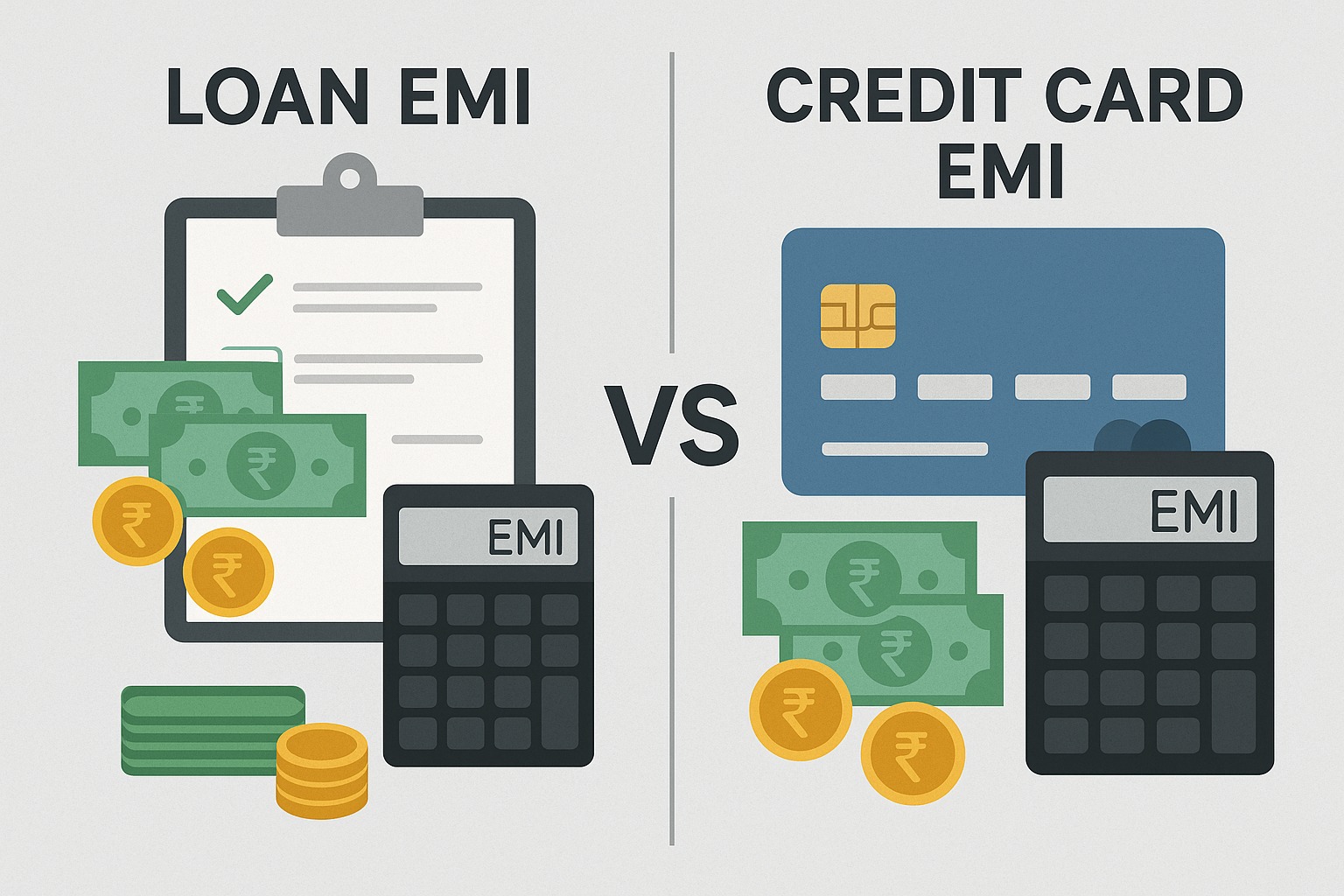
When you need quick money — whether for a phone, medical expense, travel, or home repairs — you usually have two choices:
Take a personal loan, or
Convert expenses into a credit card EMI
Both offer flexibility, both are easy to avail — but one of them almost always costs you more.
Let’s break it down so you choose wisely.
⭐ 1. Interest Rates: The Biggest Difference
Personal Loan Interest Rate:
Usually 10% – 18% per annum
Credit Card EMI Interest Rate:
Usually 14% – 24% per annum
(And sometimes even higher)
➡️ Credit card EMIs are usually more expensive.
Why?
Because card EMIs include processing fees + higher interest + GST on interest/fees.
⭐ 2. Processing Fees
Personal Loans:
₹999 – ₹2,999 (varies by lender)
Credit Card EMIs:
1% – 2% of the transaction amount
Sometimes ₹199 – ₹499 as fixed charge
This makes high-value purchases expensive when converted to card EMI.
⭐ 3. Loan Amount Flexibility
Credit Card EMI:
Depends on your credit limit.
You can’t convert beyond your available limit.
Personal Loan:
You can borrow ₹50,000 to ₹20 lakh, based on income.
If you need a bigger amount → Personal loan is the only practical choice.
⭐ 4. Tenure Options
Credit Card EMI:
3, 6, 9, 12 or 24 months
Shorter tenures = high EMI burden
Personal Loan:
Up to 60 months (5 years)
Longer tenures make EMI manageable.
➡️ For higher repayment flexibility, personal loans win.
⭐ 5. Impact on Credit Score
Credit Card EMI:
Increases utilisation
Limits drop
High utilisation can reduce your score
Short tenures → strict repayment timeline
Personal Loan:
Adds a healthy “credit mix”
Maintains credit card limit
Helpful for building long-term credit history
➡️ If you’re building credit, personal loans help more.
⭐ 6. Hidden Charges to Watch Out For
Credit Card EMIs include:
Processing fee
GST on interest
GST on fees
Pre-closure charges
Possible interest recalculation if EMI is cancelled
Personal Loans include:
Processing fee
Pre-closure fee (after 6–12 months)
EMI bounce charges
Credit card EMIs often have more layers of hidden cost.
⭐ 7. When Credit Card EMI Is Cheaper
There is one exception:
No-Cost EMI Offers
If the brand or merchant subsidises interest, you pay:
✔ Zero interest
✔ Zero processing fee
✔ Only the product price
In such cases → Credit Card EMI becomes the cheapest option.
But be careful:
Some “no-cost” deals inflate the product price quietly.
⭐ 8. When Personal Loan Is the Better Choice
A personal loan is smarter when:
✔ The amount is large
✔ You need lower EMIs
✔ You want longer tenure
✔ You want to keep credit card usage low
✔ You want predictable repayment
In most real-life scenarios, a personal loan offers better overall affordability.
Final Verdict: What Actually Costs You More?
In general:
Credit Card EMI = More Expensive
because of higher interest + higher fees + GST + reduced card limit.
Personal Loan = More Affordable for Most Borrowers
because of lower interest + longer tenure + better credit impact.
The only exception is a true no-cost EMI.
FAQs
Q1. Is credit card EMI bad for my credit score?
Not directly, but high utilisation can reduce your score.
Q2. Which is cheaper — personal loan or card EMI?
Personal loans are usually cheaper unless the card EMI is no-cost.
Q3. Can I pre-close a credit card EMI?
Yes, but banks often charge a penalty.
Q4. Should I convert every big purchase into EMI?
No — only those you can comfortably repay.
Q5. Does taking many EMIs hurt my credit?
Only if you miss payments or use too much of your credit limit.
Published on : 13th November
Published by : SMITA
www.vizzve.com || www.vizzveservices.com
Follow us on social media: Facebook || Linkedin || Instagram
🛡 Powered by Vizzve Financial
RBI-Registered Loan Partner | 10 Lakh+ Customers | ₹600 Cr+ Disbursed