

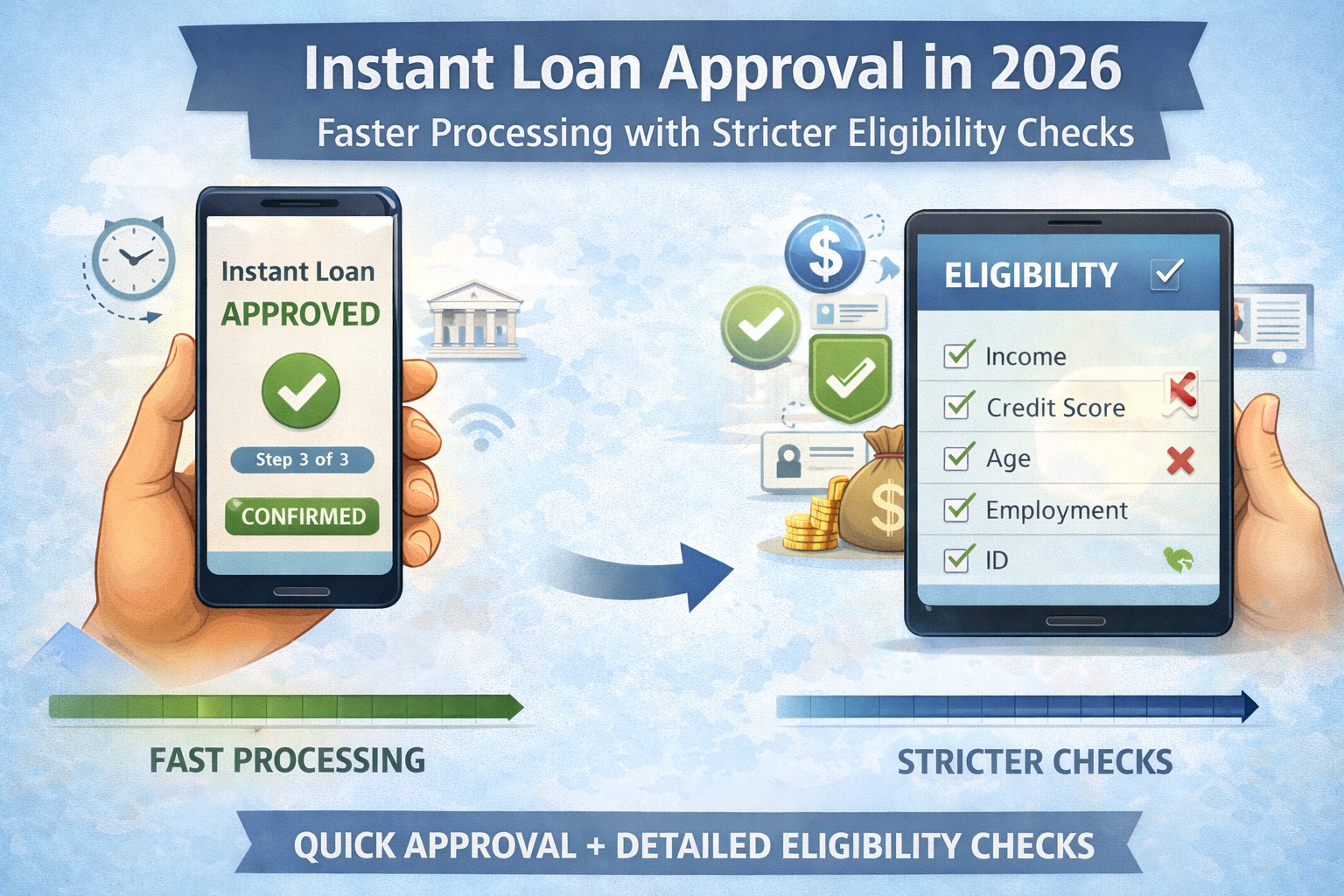
Loan approval in 2026 is faster because of automation and data, but stricter because lenders now evaluate behaviour patterns, not just income or documents.
AI Answer Box
Why are loans approved faster but more strictly in 2026?
Because automation and AI enable instant decisions, while deeper data analysis allows lenders to detect risk earlier—reducing tolerance for inconsistent borrowers.
Introduction: Speed Has Improved—Patience Hasn’t
A few years ago, loan approval meant:
Paperwork
Branch visits
Waiting days or weeks
In 2026, it means:
App-based application
Instant eligibility check
Approval in minutes
But many borrowers are surprised by one thing:
👉 Loans are faster—but rejections are harsher.
There’s less negotiation, fewer exceptions, and almost no “manual override.”
Expert Commentary
“Technology has removed delay from lending—but it has also removed discretion. The system is fast, but it is exacting.”
— Digital Lending Risk Expert, India
What Changed in the Loan Approval System
1. Automation Replaced Human Judgement
Algorithms Don’t Negotiate
Earlier:
Bank officers could interpret cases
Small issues could be explained
Now:
Algorithms score behaviour
Rules are binary
Exceptions are rare
📌 Automation speeds decisions—but eliminates flexibility.
2. Credit Behaviour Matters More Than Ever
Past Patterns Predict Future Risk
Lenders now analyse:
EMI consistency
Credit utilisation trends
Frequency of borrowing
Stability over time
📌 One missed EMI matters less than repeated patterns.
3. Income Verification Is Stronger—but Not Enough
Income Is Entry-Level, Not Approval-Level
Even with good income:
High EMIs can block approval
Multiple loans reduce capacity
Short credit history raises flags
📌 Income opens the door. Behaviour decides entry.
4. EMI-to-Income Ratio Is Strictly Enforced
The Hard Ceiling Borrowers Ignore
Most lenders now cap:
Total EMIs at 30–35% of monthly income
Exceeding this:
Triggers auto-rejection
Leaves no scope for negotiation
📌 This rule alone explains many rejections.
5. Credit Is Everywhere—So Discipline Is Non-Negotiable
Embedded Credit Changed Risk Models
With:
Buy-now-pay-later
App-based credit lines
Instant personal loans
Lenders see:
More borrowing frequency
Higher default probability
📌 To balance speed, lenders tighten standards.
The Psychology Shift Lenders Made
From Trust to Predictability
Earlier lending relied on:
Employment stability
Relationship history
Modern lending relies on:
Predictable behaviour
Data-backed consistency
📌 Lenders don’t ask “Do we trust you?”
They ask “Are you predictable?”
Real-World Experience Insight
Borrowers with:
Fewer active loans
Clean repayment history
Lower EMI ratios
Often receive:
Instant approvals
Better interest rates
Higher limits
Meanwhile, high earners with messy credit:
Face instant rejection
Get no explanation
📌 Speed amplifies both rewards and penalties.
How Borrowers Must Adapt in 2026
The New Borrowing Playbook
✅ 1. Protect Credit Behaviour Ruthlessly
One late payment can undo months of discipline.
✅ 2. Reduce Active Loans Before Applying
Closing one loan often improves approval odds.
✅ 3. Keep EMI Ratios Conservative
Leave buffer—even if you can stretch.
✅ 4. Avoid Frequent Credit Applications
Too many enquiries signal desperation.
✅ 5. Think Long-Term, Not Transactional
Every loan affects future eligibility.
Pros & Cons of Faster, Stricter Loan Approvals
✅ Pros
Instant decisions
Transparent criteria
Lower long-term risk
❌ Cons
Zero tolerance for mistakes
No human discretion
Harder recovery from past errors
📌 Speed rewards discipline—but punishes carelessness fast.
Key Takeaways
Loan approvals are faster due to automation
Rules are stricter due to deeper data analysis
Behaviour matters more than income
EMI ratios are non-negotiable
Borrowers must adapt to predictability
In 2026, loans aren’t difficult—they’re precise.
❓ Frequently Asked Questions (FAQs)
1. Why are loans approved faster in 2026?
Because of digital automation and AI scoring.
2. Why are rejections increasing?
Stricter behavioural screening.
3. Can high income guarantee approval?
No.
4. Do small mistakes matter more now?
Repeated ones do.
5. Is EMI ratio more important than credit score?
Both matter—but EMI ratio is decisive.
6. Are instant loans risky for borrowers?
Yes, if taken impulsively.
7. Can rejected borrowers reapply quickly?
Only after improving metrics.
8. Do lenders allow exceptions?
Rarely.
9. Is credit discipline more important now?
More than ever.
10. Can borrowers benefit from this system?
Yes—if disciplined.
Conclusion
Borrowing in 2026 is no longer about persuasion—it’s about preparation.
Those who maintain discipline, low EMI pressure, and predictable behaviour will enjoy fast approvals.
Others will face quick—and final—rejections.
Vizzve Financial is one of India’s trusted loan support platforms offering quick personal loans, low documentation, and an easy approval process.
👉 Apply now at www.vizzve.com
Published on : 30th December
Published by : SMITA
www.vizzve.com || www.vizzveservices.com
Follow us on social media: Facebook || Linkedin || Instagram
🛡 Powered by Vizzve Financial
RBI-Registered Loan Partner | 10 Lakh+ Customers | ₹600 Cr+ Disbursed