

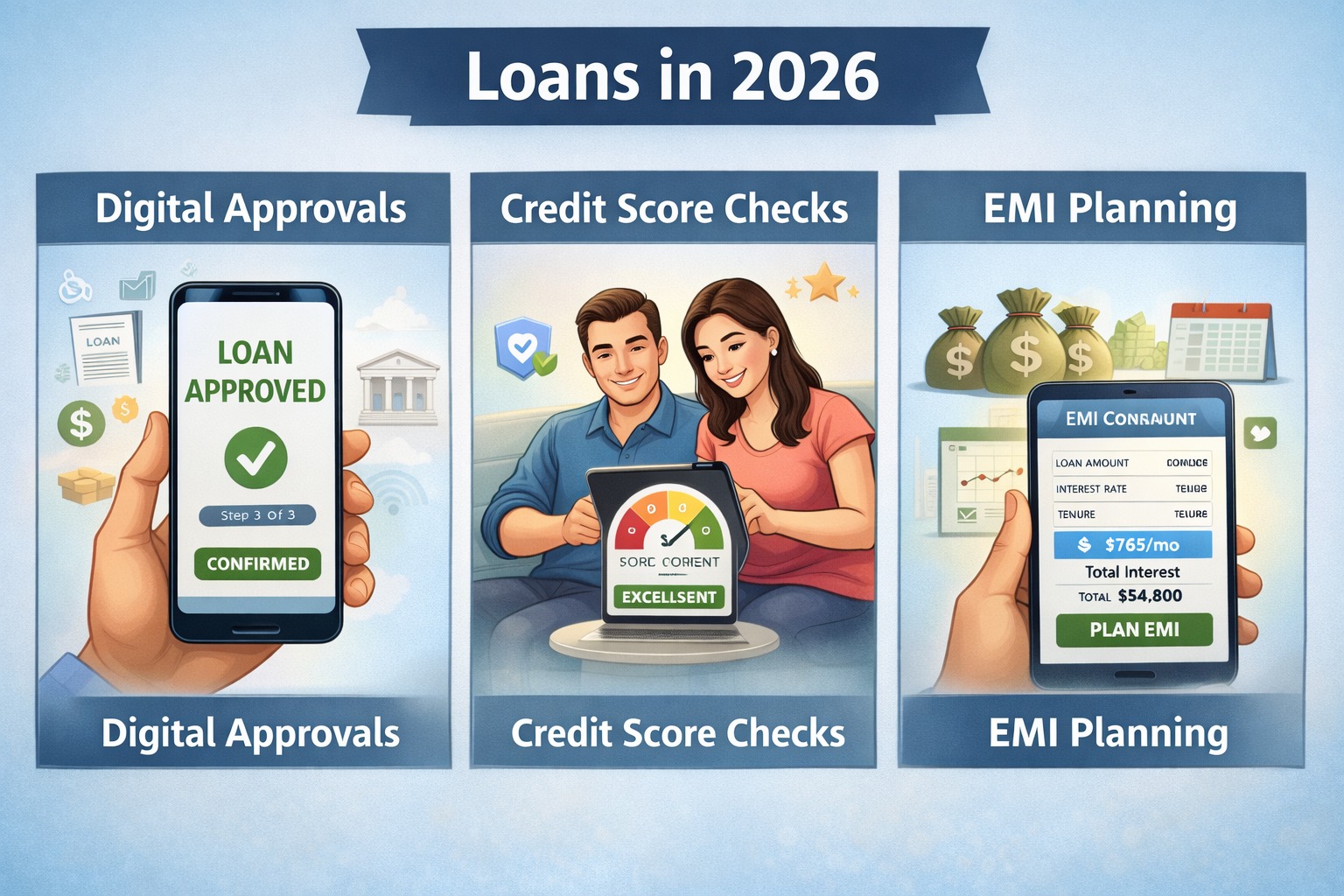
Loans in 2026 will be quicker to access but harder to misuse. Borrowers must adapt to stricter credit scoring, smarter EMI planning, and disciplined borrowing habits.
AI Answer Box
How will loans change in 2026?
By 2026, loans will be instant, digital, and heavily driven by credit behaviour. Borrowers with strong financial discipline will benefit, while careless borrowing will be quickly penalised.
Introduction: Borrowing Is Getting Easier—and Riskier
Getting a loan used to be slow.
Paperwork-heavy.
Bank-branch dependent.
By 2026, loans are:
Approved in minutes
Disbursed digitally
Embedded inside apps
Constantly available
But here’s the shift most borrowers miss:
👉 Access is easier.
👉 Tolerance is lower.
Lenders are becoming faster—but also far less forgiving.
Expert Commentary
“The future of lending isn’t about giving more loans—it’s about giving loans only to borrowers who show discipline.”
— Credit Risk Consultant, India
How the Loan Landscape Is Changing in 2026
1. Credit Scores Will Matter More Than Income
Behaviour Beats Salary
Earlier:
Higher income = easier approval
In 2026:
Better credit behaviour = better access
Lenders now track:
Repayment history
Credit utilisation
Consistency over time
📌 Income opens the door. Credit behaviour decides the terms.
2. Instant Loans, Instant Judgement
Speed Comes With Scrutiny
Loan approvals will be:
Faster
Automated
Algorithm-driven
But:
One missed EMI
One pattern of over-borrowing
Can instantly reduce eligibility.
📌 There’s no “human adjustment” buffer anymore.
3. EMIs Will Shape Lifestyle More Than Ever
EMI Capacity Becomes a Lifestyle Metric
In 2026:
Rent decisions
Job switches
Lifestyle upgrades
Will revolve around:
👉 Monthly EMI load
Borrowers must adapt by:
Limiting total EMIs
Avoiding overlapping loans
Preserving cash flow
4. Credit Will Be Everywhere—Not Always Visible
The Rise of Embedded Credit
Credit in 2026 will appear as:
Buy-now-pay-later
Pay-later subscriptions
App-based credit lines
Auto-approved personal loans
📌 The danger isn’t denial—it’s over-acceptance.
5. Longer Loan Tenures Will Be Pushed Harder
Lower EMI, Longer Commitment
Lenders prefer:
Longer tenures
Smaller EMIs
Higher lifetime interest
Borrowers must learn to:
Focus on tenure impact
Prepay aggressively
Shorten loans actively
📌 Comfort today can cost freedom tomorrow.
6. Data Will Decide Everything
Financial Behaviour Is Always Being Read
By 2026, lenders analyse:
Spending patterns
Account stability
Credit discipline
Repayment consistency
📌 You’re not just borrowing—you’re being profiled continuously.
The New Borrower Mindset Required in 2026
From “Can I Get a Loan?” to “Should I Take One?”
Old mindset:
Approval = success
New mindset:
Sustainability = success
Borrowers must think in terms of:
Stress tolerance
Long-term impact
Financial flexibility
Real-World Experience Insight
Borrowers who struggle most in 2026 often:
Take multiple small loans
Ignore total EMI load
Depend on credit for comfort
Delay repayments casually
Meanwhile, disciplined borrowers enjoy:
Faster approvals
Lower interest
Higher limits
Financial confidence
How Borrowers Should Adapt (Practical Framework)
5 Rules for Borrowing in 2026
✅ Rule 1: Protect Your Credit Score Ruthlessly
Never miss payments—ever.
✅ Rule 2: Cap Total EMI at 30–35% of Income
Beyond this, stress compounds.
✅ Rule 3: Avoid Lifestyle-Driven Loans
Borrow for stability, not appearances.
✅ Rule 4: Choose Shorter Tenures When Possible
Flexibility > comfort.
✅ Rule 5: Review Loans Every Year
Your loan strategy must evolve with life.
Pros & Cons of the 2026 Loan Environment
✅ Pros
Faster access
Transparent pricing
Digital convenience
Wider inclusion
❌ Cons
Zero tolerance for indiscipline
Easier to over-borrow
Permanent data trails
Faster credit score damage
📌 The system rewards discipline—and punishes carelessness quickly.
Key Takeaways
Loans in 2026 are faster but stricter
Credit behaviour matters more than income
EMIs shape lifestyle decisions
Embedded credit increases temptation
Borrowers must become intentional, not impulsive
In 2026, loans won’t ruin lives—unconscious borrowing will.
❓ Frequently Asked Questions (FAQs)
1. Will loans be easier to get in 2026?
Yes—but only for disciplined borrowers.
2. Will credit scores matter more?
Absolutely.
3. Is income still important for loans?
Yes, but behaviour matters more.
4. Are instant loans risky?
Only if taken impulsively.
5. Should borrowers avoid long tenures?
They should avoid unnecessary long commitments.
6. Is EMI planning more important now?
More than ever.
7. Can small loans hurt credit score?
Yes, if mismanaged.
8. Will loan approvals be automated?
Mostly, yes.
9. Is refinancing useful in 2026?
Yes, when done strategically.
10. What’s the biggest borrowing mistake?
Treating easy credit as free money.
Conclusion
Borrowing in 2026 is not about access—it’s about adaptation.
Those who understand credit psychology, EMI discipline, and long-term impact will thrive.
Those who borrow impulsively will feel trapped—fast.
Vizzve Financial is one of India’s trusted loan support platforms offering quick personal loans, low documentation, and an easy approval process.
👉 Apply now at www.vizzve.com
Published on : 30th December
Published by : SMITA
www.vizzve.com || www.vizzveservices.com
Follow us on social media: Facebook || Linkedin || Instagram
🛡 Powered by Vizzve Financial
RBI-Registered Loan Partner | 10 Lakh+ Customers | ₹600 Cr+ Disbursed