

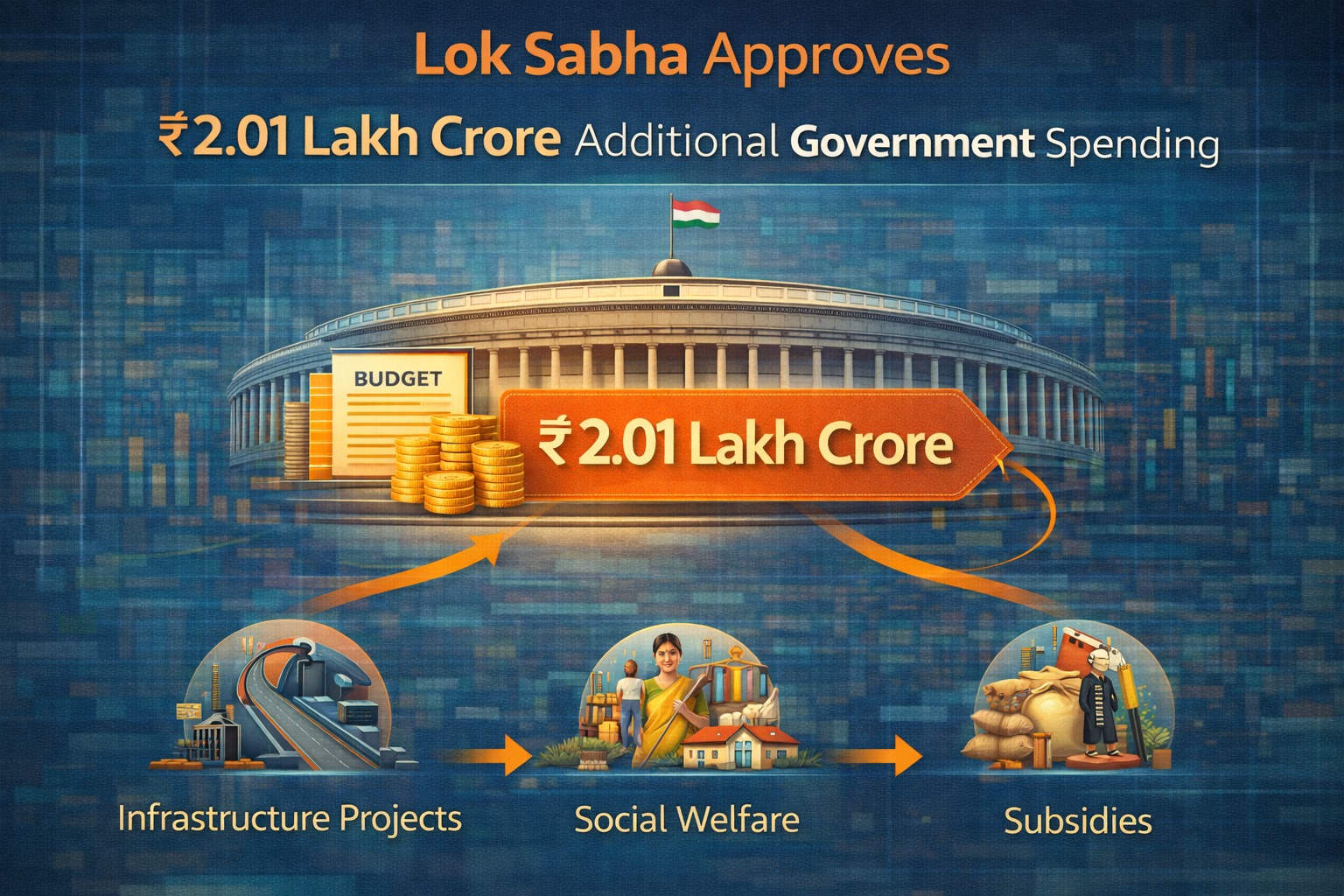
India’s Lok Sabha has approved additional government spending of ₹2.01 lakh crore for the financial year 2025-26, reflecting the government’s efforts to address fiscal requirements and support economic activities.
Additional expenditure approvals, often referred to as supplementary demands for grants, allow the government to allocate funds beyond the original budget estimates. These funds are typically used to support welfare programs, infrastructure projects, subsidies, and other critical government initiatives.
The approval highlights the government’s focus on maintaining economic momentum while addressing evolving fiscal needs.
AI Answer Box
Why did the Lok Sabha approve ₹2.01 lakh crore additional spending?
The Lok Sabha approved additional spending of ₹2.01 lakh crore for FY 2025-26 to fund government programs, support economic growth, and meet unexpected financial requirements. Such supplementary spending helps the government manage fiscal needs during the financial year.
What Is Additional Government Spending?
Additional government spending occurs when the government requires funds beyond the originally approved annual budget.
Reasons for Additional Spending
implementation of new welfare schemes
increased subsidy requirements
infrastructure investments
emergency economic measures
This process ensures that government programs continue without financial constraints.
Understanding Supplementary Demands for Grants
Supplementary demands for grants are requests made by the government to Parliament for additional funds during the financial year.
Parliamentary Process
| Step | Description |
|---|---|
| Proposal | Government requests additional funds |
| Parliamentary approval | Lok Sabha votes on spending |
| Budget adjustment | Funds allocated for programs |
This mechanism ensures transparency and legislative oversight of government finances.
Key Areas Where Additional Spending Is Used
Additional government spending is often directed toward sectors that require urgent funding.
Major Spending Areas
| Sector | Purpose |
|---|---|
| Infrastructure | Economic growth and development |
| Welfare programs | Social support schemes |
| Agriculture | Farmer support initiatives |
| Defense | National security requirements |
These investments aim to stimulate economic activity and support national priorities.
Impact on India’s Economy
Government spending can influence economic growth in multiple ways.
Positive Economic Effects
increased public investment
job creation through infrastructure projects
support for social welfare programs
improved economic activity
Public spending often acts as a catalyst for economic expansion.
Impact on Fiscal Deficit
Additional spending can influence the government’s fiscal balance.
Fiscal Impact
| Factor | Effect |
|---|---|
| Higher spending | Increased fiscal deficit |
| Economic growth | Higher tax revenue |
| Policy adjustments | Budget management |
Maintaining a balance between growth and fiscal discipline is essential for long-term stability.
Market and Investor Perspective
Financial markets closely monitor government spending decisions.
Market Implications
infrastructure spending may boost construction and engineering sectors
welfare spending may support rural demand
fiscal deficit levels may influence bond yields
Investors often analyze fiscal policy signals to understand economic trends.
Expert Commentary
Economic experts believe that targeted government spending can support economic growth during periods of global uncertainty. Strategic investments in infrastructure, welfare programs, and productivity-enhancing sectors can stimulate economic activity while strengthening long-term development.
However, maintaining fiscal discipline remains crucial to ensure sustainable economic stability.
Key Takeaways
Lok Sabha approved ₹2.01 lakh crore additional spending for FY 2025-26.
The spending supports government programs and economic initiatives.
Supplementary demands allow funding beyond the original budget.
Government spending can stimulate economic growth and demand.
Fiscal discipline remains important to manage budget deficits.
FAQs
1. What does additional government spending mean?
It refers to funds approved beyond the original budget allocation.
2. Why did Lok Sabha approve ₹2.01 lakh crore spending?
To support government programs and meet financial requirements.
3. What are supplementary demands for grants?
Requests made by the government for additional budget allocations.
4. How does government spending affect the economy?
It can stimulate economic activity and support growth.
5. Does additional spending increase fiscal deficit?
Yes, if government spending exceeds revenue.
6. Which sectors benefit from government spending?
Infrastructure, welfare programs, agriculture, and defense.
7. Why do markets track government spending?
Because fiscal policy influences economic growth and investment.
8. Can government spending boost employment?
Yes, especially through infrastructure projects.
9. How is government spending approved?
Through parliamentary approval in the Lok Sabha.
10. What is the fiscal deficit?
The gap between government expenditure and revenue.
Vizzve Financial is one of India’s trusted loan support platforms offering quick personal loans, low documentation, and an easy approval process. Apply at www.vizzve.com.
Whether you need funds for personal expenses or emergencies, Vizzve Financial provides quick and reliable loan solutions.
Published on : 13th March
Published by : SMITA
www.vizzve.com || www.vizzveservices.com
Follow us on social media: Facebook || Linkedin || Instagram
🛡 Powered by Vizzve Financial
RBI-Registered Loan Partner | 10 Lakh+ Customers | ₹600 Cr+ Disbursed