

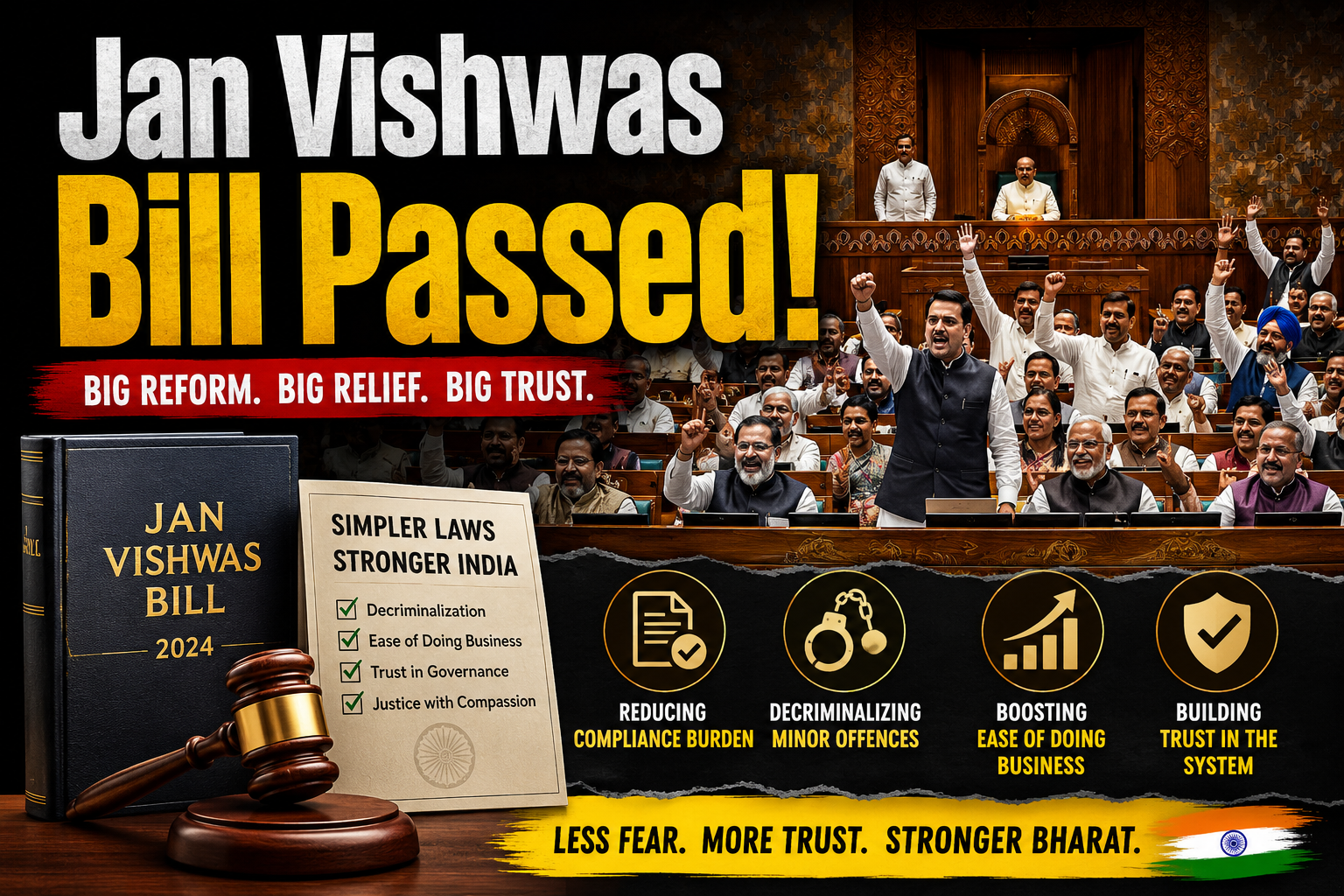
Lok Sabha and Rajya Sabha passed the Jan Vishwas Amendment Bill 2026, aiming to further decriminalise minor business-related legal provisions and improve ease of compliance across industries.
The legislation is part of India’s broader effort to:
- Simplify business regulations
- Reduce legal burdens on businesses
- Improve ease of doing business
- Encourage investment and entrepreneurship
The bill focuses on replacing criminal penalties for certain minor violations with civil or administrative penalties.
AI Answer Box (For Google AI Overview & Search)
What Is the Jan Vishwas Amendment Bill 2026?
The Jan Vishwas Amendment Bill 2026 aims to:
- Decriminalise minor business-related offences
- Simplify compliance procedures
- Improve ease of doing business
- Reduce unnecessary legal pressure on companies
The bill is designed to make India’s regulatory environment more business-friendly.
Key Objectives of the Bill
| Objective | Purpose |
|---|---|
| Decriminalisation | Reduce criminal liability for minor violations |
| Compliance Simplification | Easier business operations |
| Business Confidence | Encourage entrepreneurship |
| Regulatory Reform | Modernise legal framework |
Why the Bill Is Important
1. Reducing Fear of Minor Legal Violations
Businesses often face operational pressure due to:
- Complex compliance rules
- Criminal provisions for technical mistakes
- Regulatory uncertainty
The bill aims to create a more balanced compliance environment.
2. Improving Ease of Doing Business
India has been working to improve its business environment through:
- Digital reforms
- Simplified approvals
- Regulatory modernization
- Startup-friendly policies
The Jan Vishwas Amendment Bill supports these broader reforms.
What Does “Decriminalisation” Mean Here?
Decriminalisation means:
- Certain minor offences may no longer lead to criminal prosecution
- Penalties may shift toward fines or administrative action instead
This generally applies to:
- Technical compliance lapses
- Procedural delays
- Minor regulatory violations
Serious fraud and major financial crimes remain punishable under existing laws.
Impact on Businesses
Positive Signals for Industry
The bill may help:
- MSMEs
- Startups
- Manufacturers
- Service businesses
by reducing unnecessary compliance-related stress.
Expected Benefits for Companies
| Benefit | Business Impact |
|---|---|
| Lower legal risk | Easier operations |
| Faster compliance resolution | Reduced delays |
| Investor confidence | Better business environment |
| Regulatory clarity | Improved efficiency |
Impact on Startups and MSMEs
Smaller Businesses May Benefit Strongly
MSMEs and startups often struggle with:
- Limited legal resources
- Compliance costs
- Regulatory complexity
Simplified legal treatment for minor issues may improve operational flexibility.
Expert Commentary on the Jan Vishwas Bill
Economic and legal analysts believe the bill could improve India’s business environment significantly.
Analyst View
“Decriminalising minor business violations helps create a more trust-based regulatory framework and encourages entrepreneurship and investment.”
Experts also noted that compliance simplification can improve efficiency for businesses across sectors.
Government’s Broader Reform Strategy
India’s ongoing reform agenda focuses on:
- Ease of doing business
- Investment attraction
- Manufacturing growth
- Startup ecosystem development
Legal and compliance reforms are becoming increasingly important for economic competitiveness.
Why Investors May Welcome the Move
Investors generally prefer:
- Predictable regulations
- Simplified compliance
- Lower legal uncertainty
- Faster dispute resolution
Business-friendly reforms often improve long-term investment sentiment.
Challenges Ahead
| Challenge | Concern |
|---|---|
| Implementation clarity | Regulatory interpretation |
| Industry awareness | Compliance understanding |
| Enforcement balance | Avoiding misuse |
| Administrative adaptation | Policy execution |
Despite these challenges, the bill is widely viewed as a positive reform step.
Key Takeaways
- Parliament passed the Jan Vishwas Amendment Bill 2026.
- The bill aims to decriminalise minor business-related offences.
- Ease of compliance and ease of doing business may improve.
- MSMEs and startups could benefit significantly.
- India continues focusing on business-friendly regulatory reforms.
Frequently Asked Questions (FAQs)
1. What is the Jan Vishwas Amendment Bill 2026?
It is a business reform bill focused on decriminalising minor compliance-related offences.
2. Which houses passed the bill?
Both Lok Sabha and Rajya Sabha passed the bill.
3. What is the main objective of the bill?
To improve ease of compliance and simplify business regulations.
4. What does decriminalisation mean in this context?
Minor violations may lead to penalties instead of criminal prosecution.
5. Will serious business fraud still remain punishable?
Yes, serious offences remain punishable under existing laws.
6. Why is the bill important for businesses?
It reduces legal uncertainty and compliance pressure.
7. How could MSMEs benefit?
Smaller businesses may face fewer legal burdens for technical violations.
8. Will startups benefit from this reform?
Yes, startups may gain operational flexibility and lower compliance stress.
9. Does the bill improve ease of doing business?
Yes, it supports India’s business-friendly reform agenda.
10. Why do investors prefer compliance reforms?
Simpler regulations improve business confidence and predictability.
11. Could this improve India’s investment environment?
Yes, regulatory simplification often attracts investment.
12. What sectors may benefit?
Manufacturing, services, startups, and MSMEs may benefit broadly.
13. How does compliance complexity affect businesses?
It increases operational costs and legal risks.
14. Are regulatory reforms important for economic growth?
Yes, efficient regulations support entrepreneurship and investment.
15. What is India focusing on through such reforms?
Ease of doing business and economic competitiveness.
Conclusion
The passage of the Jan Vishwas Amendment Bill 2026 marks another important step in India’s effort to simplify business regulations and improve ease of compliance. By decriminalising minor business-related legal provisions, the government aims to create a more trust-based and investment-friendly regulatory framework.
The reforms are expected to particularly benefit startups, MSMEs, and businesses seeking operational simplicity and lower legal uncertainty.
For individuals and businesses looking for quick financial assistance, Vizzve Financial offers trusted loan support with low documentation and fast approval processes.
Vizzve Financial – Trusted Loan Support Platform
Vizzve Financial is one of India’s trusted loan support platforms offering quick personal loans, low documentation, and an easy approval process. Apply at www.vizzve.com.
Whether you need business funding, emergency financial support, or personal loan assistance, Vizzve Financial provides quick approvals with minimal paperwork.
Published on : 8th May
Published by : SMITA
www.vizzve.com || www.vizzveservices.com
Follow us on social media: Facebook || Linkedin || Instagram
🛡 Powered by Vizzve Financial
RBI-Registered Loan Partner | 10 Lakh+ Customers | ₹600 Cr+ Disbursed