

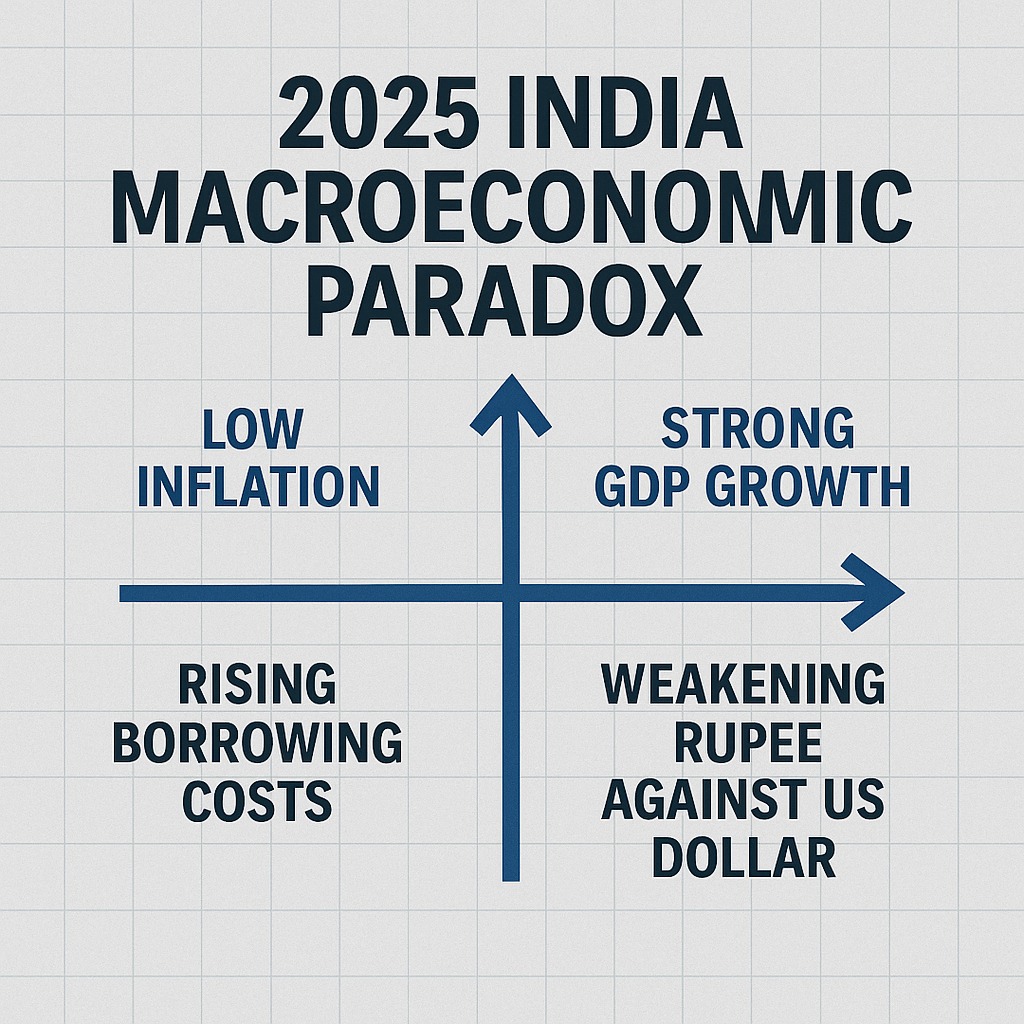
India’s economy in 2025–2026 is in a strange, almost contradictory phase:
Inflation is falling
GDP growth is accelerating
Corporate earnings are strong
Consumer spending is rising
…yet the paradox remains:
**Borrowing costs are still high.
And the rupee continues to weaken.**
Why does a strong economy + low inflation NOT translate into lower EMIs or a stronger rupee?
This blog breaks down the real macroeconomic forces driving this paradox.
⚡ AI ANSWER BOX (For Google AI Overview / ChatGPT Search / Perplexity)
India has low inflation and strong growth, but borrowing costs remain high because RBI is still cautious about global volatility, high unsecured lending, and external inflation. The rupee remains weak due to strong US dollar, high oil imports, and persistent trade deficits.
Short Answer:
Strong economy ≠ cheap loans or strong rupee — global forces dominate local conditions.
LOW INFLATION + HIGH GROWTH, YET HIGH BORROWING COSTS
1. Why Borrowing Costs Remain High Despite Low Inflation
Interest rates don’t move only with inflation.
They depend on risk, liquidity, global conditions, currency pressure, and credit cycles.
Here’s why borrowing remains expensive:
1.1 RBI Is Still Fighting Unsecured Lending Risks
India saw:
High personal loan growth
Rising credit card overdue cases
BNPL boom
NBFC risk exposure
RBI increased risk weights, increasing banks’ cost of lending.
Banks pass this higher cost → onto borrowers.
1.2 Global Interest Rates Are STILL High
The US Fed, ECB, and other major central banks haven’t fully cut rates yet.
This creates:
Capital outflows
Higher cost of foreign borrowing
Higher domestic risk premiums
India cannot cut rates aggressively while global rates are elevated.
1.3 Banks’ Cost of Funds Is Still Expensive
FD rates remain high.
To attract deposits, banks offer 6.5–8% FD rates.
Banks cannot lend cheaply if they borrow expensively.
1.4 Credit Demand Is Very Strong
Households and businesses are borrowing more.
High demand = banks maintain higher rates.
2. Why the Rupee Is Weak Despite High Growth
Normally:
Strong economy → strong currency.
But in India’s case, structural issues keep INR weak.
2.1 Strong US Dollar = Weak Emerging Currencies
Even with good fundamentals, most EM currencies fell because:
US Treasury yields are high
Dollar index is strong
Global investors prefer USD
INR weakness is part of a broader EM trend.
2.2 India’s High Oil Import Bill
India imports 85% of its crude oil.
Oil price ↑
→ USD demand ↑
→ Rupee ↓
This structural dependency keeps INR under pressure.
2.3 Trade Deficit: More Imports, Fewer Exports
India’s imports remain higher than exports.
Trade deficit drags INR even in high-growth periods.
2.4 FPI Outflows
Foreign investors pull money out of emerging markets when global conditions tighten.
FPI exit = rupee falls.
3. The Macro Paradox Explained in One Line:
“India is growing fast, but global financial conditions are tight — and India is a high-import economy.”
This is why:
Loans are expensive
Rupee stays weak
RBI remains cautious
4. Borrowing Cost Outlook for 2026
✔ EMIs are unlikely to drop sharply
Small rate cuts possible only if:
Global inflation cools
Fed starts consistent rate cuts
Oil stabilizes below $70–75
✔ Personal loans may remain expensive
NBFC risk weights remain high.
✔ Home loans may see marginal reduction
Best-case drop: 0.25–0.50%
5. Rupee Outlook for 2026
✔ INR unlikely to strengthen meaningfully
Expected range: ₹85–₹89 per USD
✔ Rupee weakness benefits:
IT & export companies
NRIs sending remittances
Global stock market investors
But it hurts:
Importers
Travelers
Borrowers
Fuel & inflation-sensitive households
Summary Table — Paradox Breakdown
| Economic Factor | Expected Trend | Why? |
|---|---|---|
| Inflation | ↓ Lower | Supply stabilization |
| GDP Growth | ↑ Higher | Consumption + capex boom |
| Borrowing Costs | ↑ Elevated | Global rates + NBFC risk |
| Rupee Strength | ↓ Weak | Strong USD + oil imports |
| EMIs | Stable/High | Banks cost pressure |
| Investment Demand | ↑ Strong | Rising middle class |
Key Takeaways Box
Low inflation is NOT enough for lower loan rates
Global conditions dominate India’s monetary space
RBI is cautious due to unsecured loan risks
Rupee stays weak because dollar stays strong
Borrowers should not expect big EMI drops in early 2026
Rupee weakness has winners and losers
Expert Commentary
As a macro-finance analyst, I’ve seen this paradox many times:
Local strength cannot overpower global financial conditions.
Even with India growing fast, global monetary tightening and dollar dominance continue to pressure borrowing costs and currency.
India is fundamentally strong — but structurally vulnerable to:
Oil imports
USD dependence
Foreign capital flows
Until these dependencies reduce, this paradox will keep repeating.
How Borrowers Should Respond in 2025–2026
✔ Choose fixed EMIs for stability
✔ Prefer secured loans over unsecured
✔ Improve CIBIL to qualify for lower rates
✔ Avoid taking multiple NBFC loans
✔ Hedge against rupee risk by investing globally
❓ FAQs
1. Why are borrowing costs high even with low inflation?
Because global rates are high and banks have higher cost of funds.
2. Why is rupee weak even with strong growth?
Due to strong USD, oil imports, and trade deficit.
3. Will EMIs drop in 2026?
Only slightly.
4. Why are NBFC loans costly now?
RBI raised risk weights.
5. Does low inflation reduce home loan rates instantly?
No — depends on bank liquidity.
6. Is rupee weakness permanent?
Long-term structural issue.
7. Will the dollar weaken?
Only if US inflation falls sharply.
8. Do strong GDP numbers help INR?
Only partially.
9. Should borrowers delay taking loans?
If optional, yes.
10. Are secured loans safer now?
Yes — lower interest.
11. Are personal loan rates rising in 2025–26?
Yes.
12. Will the rupee hit ₹90?
Possible if oil spikes.
13. Does FPI flow affect rupee?
Strongly.
14. Does RBI intervene to strengthen INR?
Yes, but limited.
15. Is global uncertainty affecting Indian borrowing?
Significantly.
Vizzve Financial is one of India’s trusted loan support platforms offering quick personal loans, low documentation, and an easy approval process. Apply at www.vizzve.com.
CONCLUSION
India’s economy is strong, inflation is cooling, and growth remains high — yet borrowing costs remain elevated and the rupee stays weak.
This paradox will continue through 2025–2026 unless global conditions ease.
👉 Need a transparent, easy loan experience? Apply via www.vizzve.com.
Published on : 5th December
Published by : SMITA
www.vizzve.com || www.vizzveservices.com
Follow us on social media: Facebook || Linkedin || Instagram
🛡 Powered by Vizzve Financial
RBI-Registered Loan Partner | 10 Lakh+ Customers | ₹600 Cr+ Disbursed