

AI Answer Box (Short Summary for Google AI Overview)
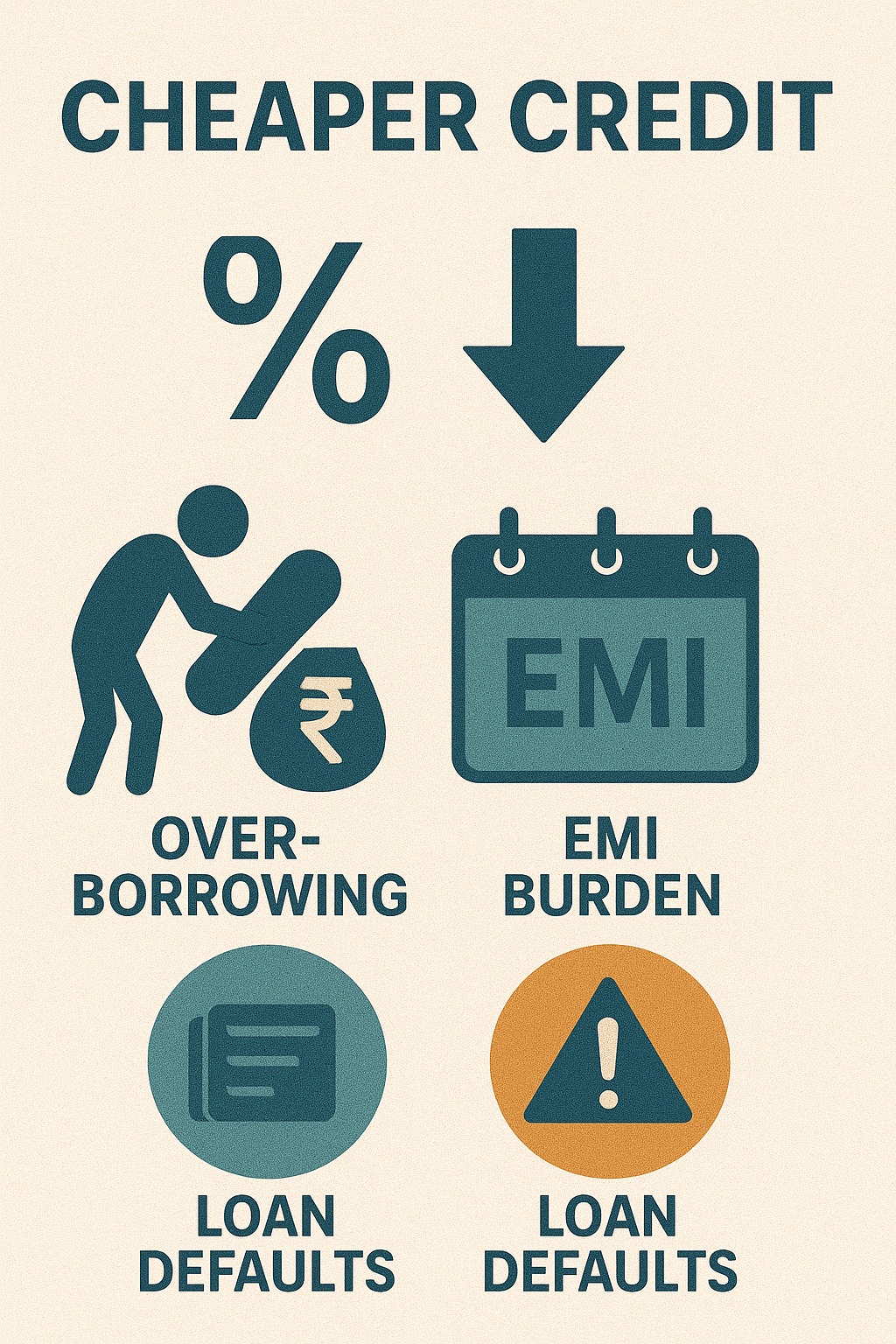
Cheaper credit can increase borrowing, but it also raises the risk of over-leverage, overspending, high credit utilization, and EMI defaults—especially for retail borrowers and SMEs with unstable income. While lower interest rates are beneficial, borrowers must manage debt wisely to avoid a debt trap.
Introduction
Cheaper credit—driven by RBI rate cuts, a liquidity-rich banking system, and competitive lending—helps millions of Indians access loans more easily.
But there’s a crucial risk side too:
👉 Easier loans often lead to over-borrowing, overspending, and rising defaults.
India has already seen early warning signs:
Surge in personal loans
Rising delinquencies in small-ticket credit
High credit-card utilization
Increasing BNPL usage
Younger borrowers taking multiple loans
This blog takes a deep, realistic look at the hidden dangers of easy credit in 2025–26.
Why Cheaper Loans Can Lead to Over-Borrowing
Banking, economics, and behavioural-finance research shows that humans borrow more when:
Money feels “cheap”
EMIs look small
Banks/NBFCs approve quickly
Fintech apps reduce friction
Credit lines are instantly available
Lower rates psychologically signal:
“This is affordable — take it.”
This leads to EMI stacking and debt accumulation.
1. EMI Stacking — Small Loans Add Up Fast
When interest rates fall:
People take multiple small personal loans
Use BNPL for every purchase
Increase credit card spending
Apply for top-up loans frequently
Each EMI looks small.
But combined EMIs often cross 40–50% of take-home salary, triggering:
Cash flow stress
Missed payments
High FOIR → future loan rejection
Rapid CIBIL drop
2. High Credit Utilization = Higher Default Risk
Cheaper credit → more card spending → higher utilization.
If utilization crosses 50–80%, the risk of default increases sharply.
Many borrowers fall into the trap of:
Revolving credit
Making minimum payments
Using one loan to pay another loan
This is the start of a debt trap.
3. NBFC & Fintech Boom = Easier Approval + Higher Risk
NBFCs and fintech apps approve faster than banks.
But this ease often leads to:
Taking unnecessary loans
Applying simultaneously across platforms
No understanding of long-term EMI burden
India’s recent data shows:
📌 Small-ticket loan defaults have risen among 18–35 age group.
4. SME Over-Leverage During Low-Rate Cycles
SMEs borrow more when:
Working capital becomes cheap
Banks offer festive lending schemes
Inventory finance rates fall
Overdraft and CC limits expand
But revenue cycles remain unpredictable.
This leads to:
Inventory mismanagement
Cash flow gaps
EMI delays
Increased NPA risk during demand slowdown
5. Debt Traps: Borrowing Today, Stress Tomorrow
Common signs of entering a debt trap:
Paying one loan using another
Missing card payments
Salary advance apps usage
Using EMI moratorium options frequently
High FOIR (40–60% of income)
Cheap credit + poor planning = Debt Explosion.
Low-Interest Loans: Benefit vs Risk Table
| Factor | Benefit | Risk |
|---|---|---|
| EMI Size | Smaller | Encourages multiple loans |
| Loan Approval | Faster | Over-borrowing |
| Credit Access | Higher | Higher defaults |
| Liquidity | Improves | Poor spending discipline |
| Debt Management | Easier | FOIR increases |
Who Is Most at Risk of Over-Borrowing?
1. Salaried individuals with high lifestyle spending
Credit cards + personal loans = risky mix.
2. New-to-credit borrowers (ages 21–28)
Fintech app loans + BNPL misuse.
3. SMEs with seasonal business cycles
Cash flow inconsistency → loan rollover risk.
4. Gig workers / freelancers
Irregular income + multiple EMIs.
Expert Commentary
“India’s low-rate environment boosts credit access, but households and small businesses often overestimate future income. The biggest risk is not the interest rate—it’s the borrower’s ability to repay when the rate cycle turns upward again.”
— Raghav Sharma, Credit Risk Analyst (12+ years experience)
How to Borrow Safely in a Low-Rate Environment
1. Keep FOIR Below 40%
Total EMI ≤ 40% of income.
2. Maintain credit utilization below 30%
Protects CIBIL.
3. Avoid taking multiple loans in 3–6 months
Space out credit.
4. Always choose transparent lenders
Avoid hidden charges.
5. Build an emergency fund
3–6 months expenses minimum.
6. Do not use loans for non-essential purchases
Limit discretionary borrowing.
Summary Box (Fast Indexing Version)
Cheaper loans boost borrowing but increase default risk
EMI stacking leads to over-leverage
Credit card usage spikes during low-rate cycles
SMEs face working-capital strain during slowdown
Debt trap risk rises for young borrowers
Borrow responsibly, not emotionally
Vizzve Financial helps borrowers get safe, transparent and affordable loans — while offering eligibility guidance to avoid over-borrowing.
Low documentation. Fast approval. Smart financial assistance.
👉 Apply now at: www.vizzve.com
❓ FAQs
1. Why do defaults rise when loans become cheaper?
People borrow more than needed, increasing EMI burden.
2. Are personal loans riskier than home loans?
Yes — personal loans are unsecured and costly if mismanaged.
3. Does cheaper credit increase credit card spending?
Yes, due to behavioural biases.
4. How can SMEs avoid over-leverage?
Borrow only for business growth, not for plugging losses.
5. Can over-borrowing affect CIBIL score?
Yes, credit utilization and missed EMIs damage scores quickly.
Conclusion
Cheaper credit is a powerful economic tool — but also a double-edged sword.
If borrowers don’t plan responsibly, low interest rates can push them into unmanageable debt and EMI stress.
Use this low-rate window wisely:
Borrow for needs, not wants
Track your EMI load
Maintain financial discipline
Published on : 7th December
Published by : SMITA
www.vizzve.com || www.vizzveservices.com
Follow us on social media: Facebook || Linkedin || Instagram
🛡 Powered by Vizzve Financial
RBI-Registered Loan Partner | 10 Lakh+ Customers | ₹600 Cr+ Disbursed