

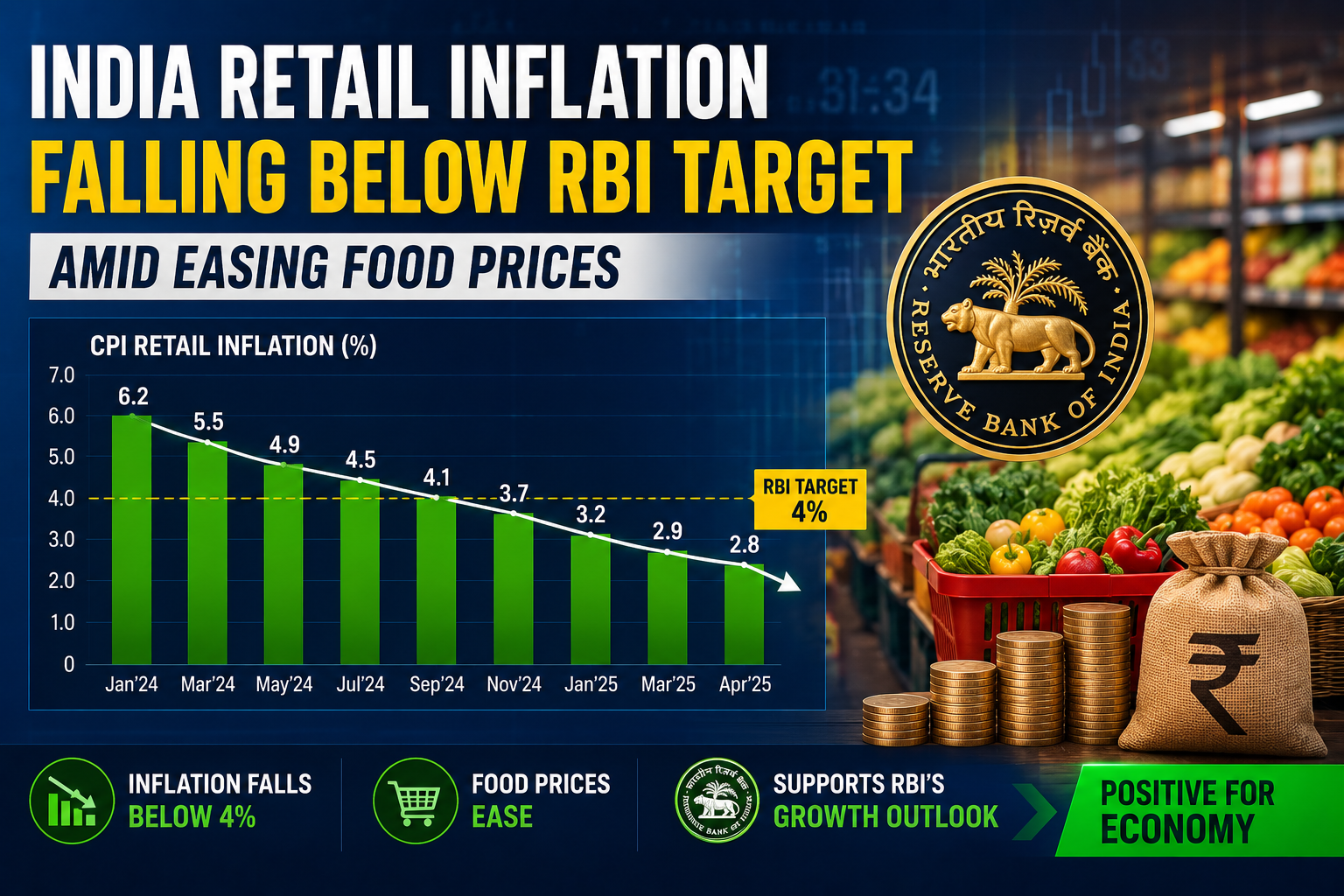
India’s retail inflation eased below the Reserve Bank of India (RBI) target level, offering relief to policymakers, consumers, and financial markets amid easing food and commodity price pressures.
The latest inflation moderation has increased optimism around:
- Stable interest rates
- Improved consumer sentiment
- Better economic stability
- Reduced household inflation pressure
Lower inflation is also being viewed positively by equity and bond markets as investors assess the outlook for monetary policy and economic growth.
AI Answer Box (For Google AI Overview & Search)
Why Did India’s Retail Inflation Fall Below RBI Target?
India’s retail inflation declined due to:
- Easing food prices
- Softer commodity costs
- Improved supply conditions
- Lower inflationary pressure
The development may support stable interest rates and improve market sentiment.
Inflation Snapshot
| Indicator | Current Trend |
|---|---|
| Retail Inflation | Below RBI target |
| Food Prices | Easing |
| Consumer Sentiment | Improving |
| Market Outlook | Positive |
What Is Retail Inflation?
Retail inflation measures changes in prices consumers pay for:
- Food items
- Fuel
- Housing
- Transportation
- Daily essentials
India mainly tracks retail inflation through the Consumer Price Index (CPI).
Why Inflation Falling Matters
Lower inflation generally benefits:
- Consumers
- Businesses
- Financial markets
- Policymakers
Major Positive Effects
| Benefit | Impact |
|---|---|
| Lower household pressure | Improved spending |
| Stable interest rates | Better borrowing conditions |
| Market confidence | Positive sentiment |
Inflation moderation is usually considered supportive for economic stability.
Food Prices Played a Major Role
Food inflation remains one of the biggest drivers of overall retail inflation in India.
Areas Showing Improvement
Key Segments
- Vegetable prices
- Pulses
- Cereals
- Edible oils
Improved supply conditions and lower commodity pressure helped ease inflation trends.
RBI Closely Watches Inflation Trends
Reserve Bank of India uses inflation data to assess:
- Interest rate decisions
- Monetary policy stance
- Financial stability
Why RBI Targets Inflation
The central bank aims to:
- Maintain price stability
- Support economic growth
- Manage inflation expectations
Stable inflation helps create a healthier economic environment.
Interest Rate Outlook Gains Attention
Lower inflation may reduce pressure for aggressive interest rate hikes.
Why Interest Rates Matter
| Area | Impact |
|---|---|
| Loans | Borrowing costs |
| Businesses | Investment activity |
| Consumers | Spending confidence |
Markets often react positively when inflation moves lower.
Stock Markets React Positively to Lower Inflation
Indian financial markets generally view easing inflation as supportive for:
- Corporate profitability
- Consumer demand
- Banking sector stability
Sectors That Benefit
Positive Areas
- Banking
- Auto
- Consumer goods
- Real estate
Lower inflation can improve overall economic sentiment.
Bond Markets Also Gain Support
Bond yields often soften when inflation eases because:
- Future interest rate hikes may become less likely
- Economic stability improves
Debt markets closely track inflation data and RBI policy expectations.
Consumer Sentiment Could Improve
Lower inflation may help:
- Household budgets
- Retail spending
- Consumption growth
Why Consumer Spending Matters
Consumer demand remains a major driver of:
- Economic growth
- Corporate earnings
- Employment activity
Stable prices generally improve purchasing power.
Global Commodity Prices Still Remain Important
Despite easing inflation, risks still exist due to:
- Crude oil volatility
- Global geopolitical tensions
- Currency fluctuations
Important Inflation Risks
| Risk Factor | Possible Impact |
|---|---|
| Oil price spikes | Fuel inflation |
| Supply disruptions | Commodity costs |
| Currency weakness | Import inflation |
Markets continue monitoring these factors closely.
Expert Commentary on Inflation Data
Economists believe easing inflation provides some policy flexibility for RBI.
Analyst View
“Lower retail inflation supports economic stability and may improve confidence across financial markets and consumers.”
Experts also noted that food and energy prices remain important future inflation drivers.
Why Inflation Matters for the Economy
Inflation directly affects:
- Purchasing power
- Interest rates
- Investments
- Corporate profitability
Moderate inflation is generally considered healthier for sustainable growth.
Pros and Cons of Lower Inflation
| Pros | Cons |
|---|---|
| Better consumer confidence | Weak demand concerns possible |
| Stable borrowing conditions | Commodity volatility risk |
| Improved market sentiment | Global uncertainty remains |
| Stronger purchasing power | Food price fluctuations possible |
Key Takeaways
- India’s retail inflation fell below RBI’s target level.
- Lower food prices helped ease inflation pressure.
- Markets reacted positively to the development.
- Stable interest rate expectations improved sentiment.
- Oil prices and global risks remain important factors.
Frequently Asked Questions (FAQs)
1. What is retail inflation?
It measures price changes consumers pay for goods and services.
2. Why did inflation fall in India?
Food and commodity prices eased.
3. What is RBI’s role in inflation management?
RBI manages monetary policy and price stability.
4. Why is lower inflation important?
It improves consumer purchasing power and market confidence.
5. Could lower inflation impact interest rates?
Yes, it may reduce pressure for rate hikes.
6. How do food prices affect inflation?
Food is a major part of consumer spending.
7. Why do markets react positively to lower inflation?
Stable inflation supports growth and earnings outlooks.
8. Which sectors benefit from easing inflation?
Banking, auto, FMCG, and real estate sectors.
9. How does inflation affect consumers?
It impacts daily household expenses.
10. Why does RBI monitor CPI inflation?
CPI reflects retail price movement across the economy.
11. Could inflation rise again later?
Oil prices and global factors may create future risks.
12. Why do bond markets watch inflation closely?
Inflation affects interest rate expectations.
13. How does inflation influence the rupee?
Higher inflation can weaken currency stability.
14. Why are oil prices important for inflation?
Fuel affects transportation and logistics costs.
15. What should investors monitor next?
RBI policy signals, oil prices, and economic growth trends.
Conclusion
India’s retail inflation falling below the RBI target level has improved optimism around economic stability, consumer confidence, and financial markets. Easing food prices and softer inflation pressures may provide policymakers with greater flexibility while supporting consumption and growth sentiment.
However, global oil prices, geopolitical risks, and currency fluctuations remain important factors that could influence future inflation trends and monetary policy decisions.
Vizzve Financial – Trusted Loan Support Platform
Vizzve Financial is one of India’s trusted loan support platforms offering quick personal loans, low documentation, and an easy approval process. Apply at www.vizzve.com.
Whether you need financial support for household expenses, investments, or business needs, Vizzve Financial provides fast approvals with minimal paperwork.
Published on : 15th May
Published by : SMITA
www.vizzve.com || www.vizzveservices.com
Follow us on social media: Facebook || Linkedin || Instagram
🛡 Powered by Vizzve Financial
RBI-Registered Loan Partner | 10 Lakh+ Customers | ₹600 Cr+ Disbursed