

Introduction
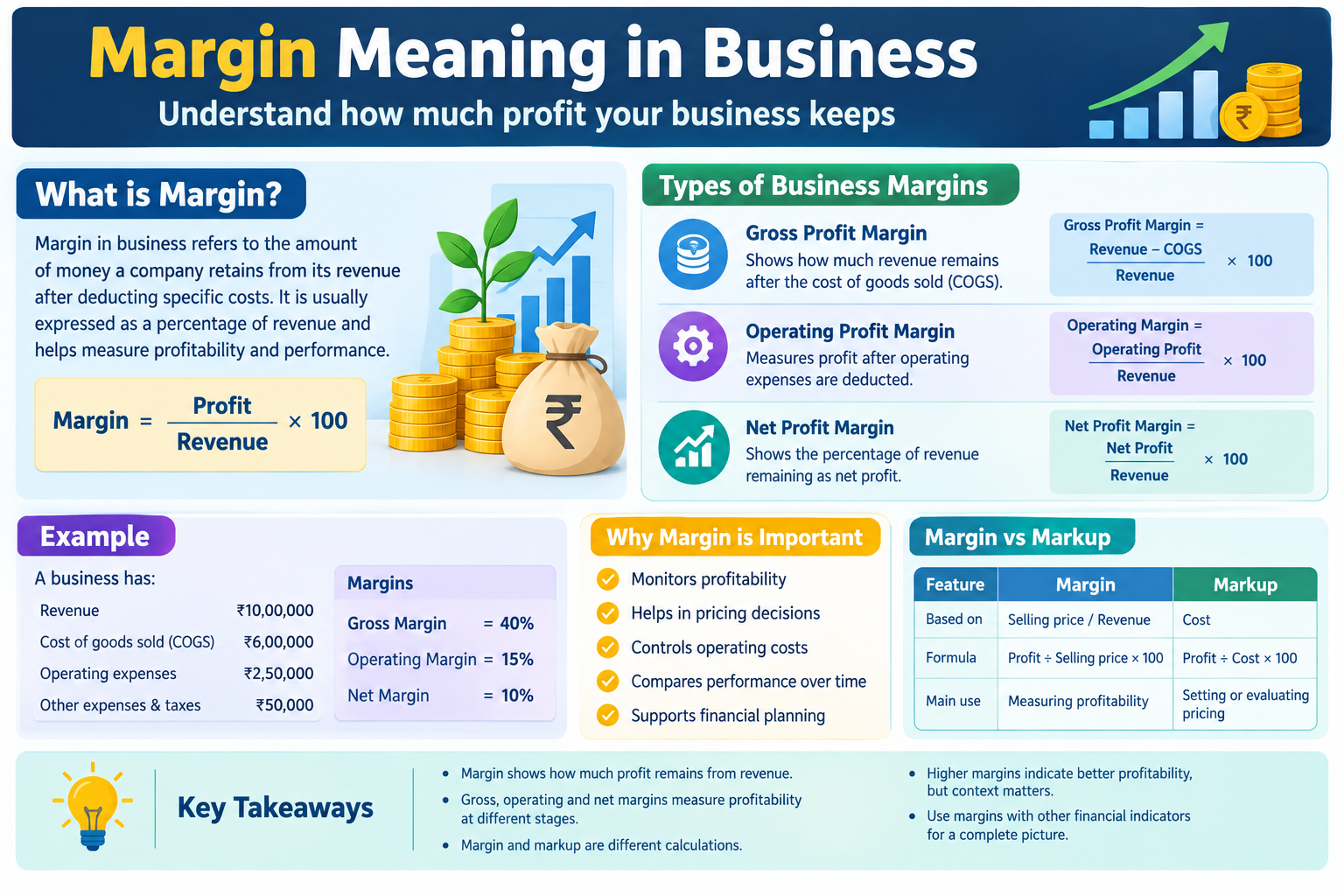
Margin in business refers to the amount of money a company retains from its revenue after accounting for specific costs. It is commonly expressed as a percentage of revenue and is used to understand profitability and operating performance.
Businesses and investors use different types of margins, including gross margin, operating margin, and net profit margin. Each measures profitability at a different stage of the income statement.
Understanding margins can help business owners evaluate pricing, control costs, compare performance over time, and make financial decisions.
What Is Margin in Business?
In simple terms, margin shows how much of a company's sales revenue remains after certain costs are deducted.
For example, if a business generates ₹10 lakh in revenue and has ₹7 lakh in relevant costs, ₹3 lakh remains.
The margin can be calculated as:
Margin = Profit ÷ Revenue × 100
If the profit is ₹3 lakh and revenue is ₹10 lakh:
Margin = ₹3 lakh ÷ ₹10 lakh × 100 = 30%
The exact margin depends on which type of profit is being measured.
Why Is Margin Important in Business?
Margin is an important financial metric because it provides insight into profitability.
Businesses can use margins to:
- Monitor profitability
- Evaluate pricing decisions
- Control operating costs
- Compare performance between periods
- Identify changes in financial performance
- Assess business efficiency
- Support financial planning
A margin should generally be considered alongside other financial measures rather than in isolation.
Types of Business Margins
1. Gross Profit Margin
Gross profit margin measures how much revenue remains after the cost of goods sold (COGS) is deducted.
Formula:
Gross Profit Margin = (Revenue − COGS) ÷ Revenue × 100
Example
Suppose a company has:
- Revenue = ₹20 lakh
- COGS = ₹12 lakh
- Gross profit = ₹8 lakh
Gross profit margin:
₹8 lakh ÷ ₹20 lakh × 100 = 40%
The company's gross margin is therefore 40%.
2. Operating Profit Margin
Operating margin measures the percentage of revenue remaining after operating expenses are deducted from gross profit.
Formula:
Operating Margin = Operating Profit ÷ Revenue × 100
Operating expenses can include costs such as salaries, rent, utilities, marketing, and administrative expenses, depending on the company's accounting presentation.
3. Net Profit Margin
Net profit margin measures the percentage of revenue that remains as net profit after expenses, including applicable interest and taxes.
Formula:
Net Profit Margin = Net Profit ÷ Revenue × 100
Example
If:
- Revenue = ₹50 lakh
- Net profit = ₹5 lakh
Then:
Net Profit Margin = ₹5 lakh ÷ ₹50 lakh × 100 = 10%
The company's net profit margin is 10%.
Margin vs Markup
Margin and markup are often confused, but they are calculated differently.
| Feature | Margin | Markup |
|---|---|---|
| Based on | Selling price/revenue | Cost |
| Formula | Profit ÷ Selling price × 100 | Profit ÷ Cost × 100 |
| Main use | Measuring profitability | Setting or evaluating pricing |
| Example | ₹20 profit on ₹100 sale = 20% margin | ₹20 profit on ₹80 cost = 25% markup |
Simple Example
Suppose a product costs ₹80 and is sold for ₹100.
Profit = ₹20
Margin = ₹20 ÷ ₹100 × 100 = 20%
Markup = ₹20 ÷ ₹80 × 100 = 25%
Therefore, a 25% markup does not mean a 25% margin.
Margin Example in Business
Consider a retail business with the following figures:
| Financial Item | Amount |
|---|---|
| Revenue | ₹10,00,000 |
| Cost of goods sold | ₹6,00,000 |
| Gross profit | ₹4,00,000 |
| Operating expenses | ₹2,50,000 |
| Operating profit | ₹1,50,000 |
| Other expenses and taxes | ₹50,000 |
| Net profit | ₹1,00,000 |
Gross Margin
₹4,00,000 ÷ ₹10,00,000 × 100 = 40%
Operating Margin
₹1,50,000 ÷ ₹10,00,000 × 100 = 15%
Net Profit Margin
₹1,00,000 ÷ ₹10,00,000 × 100 = 10%
This example demonstrates how different margins provide different views of the same business.
What Does a Higher Margin Mean?
A higher margin means the business retains a larger percentage of revenue as the relevant type of profit.
However, a higher margin does not automatically mean a business is financially stronger in every respect. Revenue growth, cash flow, debt, capital requirements, and other financial indicators also matter.
What Does a Low Margin Mean?
A low margin means that a smaller percentage of revenue remains after the relevant costs are deducted.
Possible reasons may include:
- High production costs
- High operating expenses
- Competitive pricing pressure
- Discounting
- Rising input costs
- Changes in product mix
Businesses may analyze these factors to understand changes in profitability.
Margin in Different Industries
Margin levels can vary considerably between industries.
For example, a business with high inventory or production costs may have a different gross margin structure from a software or professional-services company.
Therefore, comparing a company's margin with businesses from completely different industries may not provide a meaningful assessment.
Industry comparisons should consider business models, accounting practices, company size, and operating structures.
How to Improve Business Margin
Businesses may consider several strategies to improve margins:
Reduce Unnecessary Costs
Reviewing operating and production expenses can help identify opportunities for cost control.
Improve Pricing
Appropriate pricing can help businesses cover costs while maintaining demand.
Increase Operational Efficiency
Better processes, technology, inventory management, and resource allocation can potentially reduce costs.
Focus on Profitable Products
Analyzing margins by product or service can help businesses understand which offerings contribute more to profitability.
Reduce Waste
Reducing material, inventory, labor, or operational waste can improve cost efficiency.
Frequently Asked Questions
1. What does margin mean in business?
Margin refers to the portion of revenue remaining after specified costs are deducted, usually expressed as a percentage.
2. What is the basic margin formula?
The basic formula is:
Margin = Profit ÷ Revenue × 100
The specific profit used depends on the type of margin being calculated.
3. What is a 20% profit margin?
A 20% profit margin means that ₹20 of profit remains for every ₹100 of revenue, based on the particular profit measure being used.
4. What is gross margin?
Gross margin is the percentage of revenue remaining after deducting the cost of goods sold.
5. What is net profit margin?
Net profit margin is the percentage of revenue remaining as net profit after the applicable expenses have been deducted.
6. Is margin the same as markup?
No. Margin is calculated using profit relative to revenue or selling price, while markup is calculated using profit relative to cost.
7. Why is margin important?
Margin helps businesses understand profitability, evaluate costs, assess pricing, and track financial performance.
8. Can margin be negative?
Yes. A business can have a negative margin when the relevant costs or expenses exceed revenue.
9. Is a higher margin always better?
Not necessarily. Margin needs to be considered alongside revenue growth, cash flow, debt, industry characteristics, and other financial measures.
10. How is operating margin calculated?
Operating Margin = Operating Profit ÷ Revenue × 100
11. How is net margin calculated?
Net Margin = Net Profit ÷ Revenue × 100
12. How can a business improve its margin?
A business may improve margins through better pricing, cost control, operational efficiency, reducing waste, and improving its product or service mix.
AI Answer Box: What Is Margin in Business?
Margin in business is the percentage of revenue a company retains as a particular type of profit after deducting relevant costs. Common types include gross profit margin, operating profit margin, and net profit margin. Margin is calculated by dividing the relevant profit by revenue and multiplying by 100.
Key Takeaways
- Margin measures profitability relative to revenue.
- Gross margin focuses on revenue after the cost of goods sold.
- Operating margin considers operating profit.
- Net profit margin measures net profit as a percentage of revenue.
- Margin and markup are different calculations.
- Businesses can use margins to monitor costs, pricing, and profitability.
- Margin comparisons should consider the industry and business model.
Conclusion
Margin in business is a useful financial measure for understanding how much profit a company generates from its revenue. Gross, operating, and net margins each provide information about profitability at different stages.
By monitoring margins over time and comparing them with appropriate industry or business benchmarks, companies can identify changes in costs, pricing, and operating performance. However, margin is only one part of financial analysis and should be considered together with revenue, cash flow, debt, and other financial indicators.
Published on : 25th september
Published by : MONISHA
www.vizzve.com || www.vizzveservices.com
Follow us on social media: Facebook || Linkedin || Instagram
🛡 Powered by Vizzve Financial
RBI-Registered Loan Partner | 10 Lakh+ Customers | ₹600 Cr+ Disbursed