

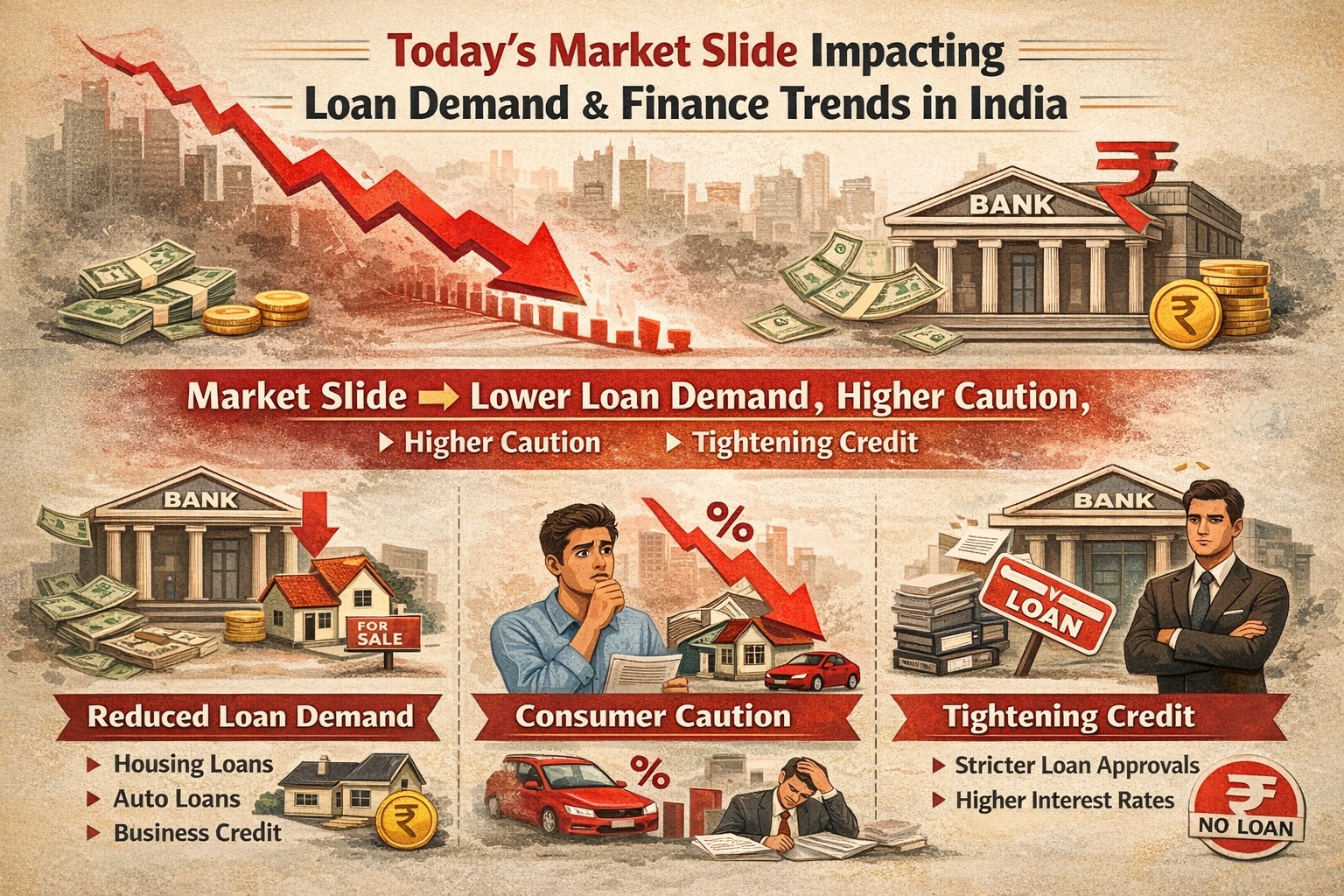
Today’s market slide can reduce risk appetite, slow discretionary borrowing, and increase demand for short-term and emergency loans. While investment-linked borrowing may pause, personal loans, refinancing, and EMI restructuring demand often rises during market uncertainty.
AI Answer Box
Impact of market slide on loans:
Loan demand becomes cautious, not absent
Emergency and liquidity loans increase
Banks tighten risk checks
Borrowers prioritise affordability over growth
Credit behaviour matters more than income
🔹 Introduction
When markets fall sharply in a single day, panic usually dominates headlines. But beyond investor losses, market slides have a direct and measurable impact on borrowing behaviour, loan demand, and finance trends.
For borrowers, lenders, and policymakers, a market downturn is not just about stocks—it’s about confidence, cash flow, and credit risk.
This blog explains what today’s market slide really means for loan demand in India and how finance trends typically shift during such phases.
🔹 Why Market Slides Influence Loan Demand
A stock market slide reflects:
Lower investor confidence
Rising economic uncertainty
Increased risk aversion
This psychological shift directly affects borrowing decisions, even for people not invested in equities.
🔹 Immediate Borrower Behaviour After a Market Fall
1. Discretionary Loans Slow Down
Borrowers postpone:
Lifestyle loans
Big-ticket consumption
Investment-backed borrowing
People prefer holding cash instead of taking new long-term liabilities.
2. Emergency & Short-Term Loan Demand Rises
Ironically, market stress increases demand for:
Personal loans for liquidity
Medical and emergency loans
Short-term working capital
📌 Reason: Income uncertainty and cash-flow gaps.
3. Refinancing & EMI Relief Enquiries Increase
Borrowers start exploring:
Balance transfer options
Lower EMI structures
Tenure extensions
During volatile periods, affordability matters more than loan size.
🔹 Impact on Different Loan Categories
🏠 Home Loans
New demand slows slightly
Existing borrowers focus on EMI management
Floating-rate sensitivity increases
👨💼 Personal Loans
Demand remains stable or rises
Used for liquidity, not consumption
Credit discipline becomes critical
🏢 Business Loans
MSMEs delay expansion loans
Working capital demand rises
Lenders tighten scrutiny
🔹 How Lenders Respond to Market Slides
Banks and NBFCs become risk-aware, not risk-averse.
Common Lender Actions:
Stricter credit checks
Higher emphasis on repayment history
Conservative loan-to-income ratios
Preference for stable borrowers
The Reserve Bank of India also closely monitors credit growth to avoid systemic stress.
🔹 Market Slide vs Loan Demand: Comparison Table
| Factor | Stable Market | Market Slide |
|---|---|---|
| Borrower Confidence | High | Cautious |
| Loan Purpose | Growth & lifestyle | Liquidity & safety |
| Credit Approval | Faster | Selective |
| EMI Sensitivity | Moderate | High |
| Risk Appetite | Higher | Lower |
🔹 Does a Market Fall Reduce Overall Loan Demand?
Short Answer: ❌ Not necessarily
Loan demand changes in nature, not volume.
Investment-linked borrowing falls
Safety-driven borrowing rises
Quality borrowers still get loans
This is why personal finance remains resilient even during market corrections.
🔹 Finance Trends Emerging After Market Slides
🔹 Trend 1: Credit Behaviour > Income
Lenders prioritise repayment discipline over salary size.
🔹 Trend 2: Smaller, Smarter Loans
Borrowers prefer manageable EMIs over large ticket sizes.
🔹 Trend 3: Financial Awareness Increases
People track:
Interest rates
EMI burden
Credit scores
Market stress improves financial maturity.
🔹 Real-World Credit Insight
From credit assessment patterns, borrowers with clean credit history face minimal disruption during market volatility, while high-income but over-leveraged borrowers face rejections.
➡️ Behaviour outperforms income in uncertain markets.
Pros & Cons of Market Slides for Borrowers
✅ Pros
Encourages disciplined borrowing
Reduces over-leveraging
Improves financial awareness
❌ Cons
Temporary uncertainty
Tighter loan approvals
EMI stress for risky borrowers
🔹 What Borrowers Should Do During Market Volatility
Smart Borrower Checklist:
Avoid unnecessary new loans
Review existing EMIs
Maintain emergency savings
Protect credit score
Borrow only if cash flow is stable
🔹 Key Takeaways
Market slides shift loan demand, not eliminate it
Liquidity loans gain importance
Lenders become selective, not restrictive
Credit discipline is your biggest asset
Borrowing smartly matters more than timing
🔹 Frequently Asked Questions (FAQs)
1. Does market fall reduce loan approvals?
Approvals become more selective.
2. Are personal loans affected by market slides?
Demand often increases for liquidity needs.
3. Should I take a loan during market volatility?
Only if affordable and necessary.
4. Do banks increase interest rates after market falls?
Not immediately; risk pricing may change.
5. Is home loan demand impacted?
Slightly, especially for new buyers.
6. Does RBI intervene during market stress?
Yes, if systemic risk rises.
7. Are EMIs affected by market movement?
Indirectly through rate expectations.
8. Should borrowers delay big loans?
If income is uncertain, yes.
9. Does credit score matter more now?
Yes, significantly.
10. Can market falls cause loan defaults?
Only for over-leveraged borrowers.
11. Is refinancing common during market stress?
Yes, for EMI relief.
12. Are NBFCs cautious during volatility?
Yes, but lending continues.
🔹 Conclusion + CTA
A market slide is not just a financial event—it’s a behavioural reset. Borrowers who stay disciplined, informed, and cautious continue to access credit smoothly, even during volatility.
Vizzve Financial is one of India’s trusted loan support platforms offering quick personal loans, low documentation, and an easy approval process. Apply at www.vizzve.com.
Published on : 8th January
Published by : SMITA
www.vizzve.com || www.vizzveservices.com
Follow us on social media: Facebook || Linkedin || Instagram
🛡 Powered by Vizzve Financial
RBI-Registered Loan Partner | 10 Lakh+ Customers | ₹600 Cr+ Disbursed