

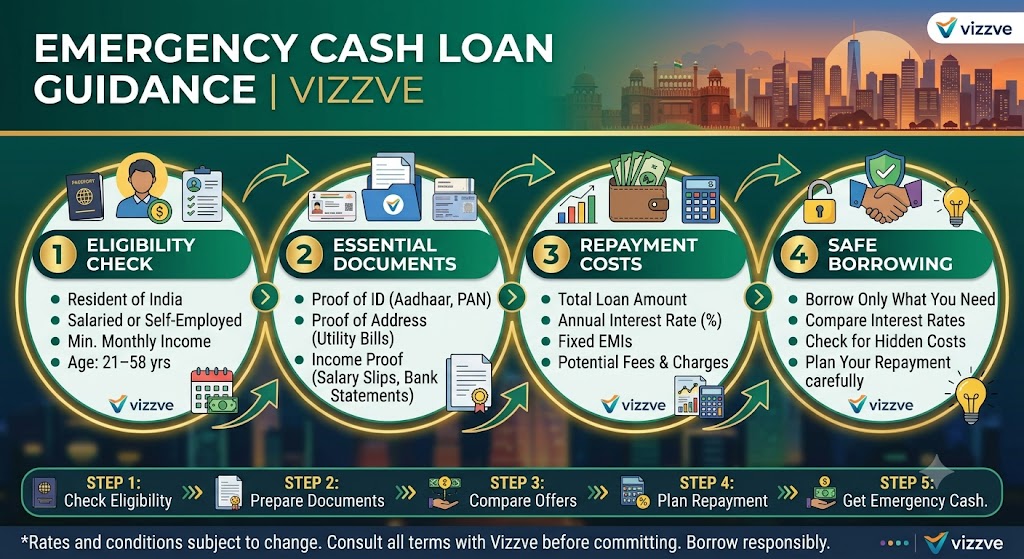
A medical emergency loan is a financial borrowing option that can help individuals cover unexpected healthcare expenses when they do not have sufficient funds available.
Depending on the lender and loan product, borrowers may be able to apply online, complete digital verification, and receive funds after approval. Personal loans are often used for medical expenses because eligible unsecured loans generally do not require collateral.
Common medical expenses that may require financial assistance include:
-
Emergency hospitalisation and treatment
-
Surgery and related medical procedures
-
Diagnostic tests and medical scans
-
Prescription medicines and medical supplies
-
Accident-related treatment
-
Follow-up consultations and recovery expenses
-
Certain eligible healthcare expenses for family members
The permitted use of funds depends on the lender's terms. Borrowers should verify the conditions before accepting a loan.
Why Do People Consider Medical Emergency Loans?
Healthcare expenses can arise unexpectedly, leaving families with limited time to arrange the necessary funds. Even individuals with regular incomes may face difficulties when treatment costs exceed their available savings.
A medical emergency loan may help in situations such as:
1. Unexpected Hospital Bills
Emergency admissions and extended hospital stays can create significant expenses. Borrowing may help eligible individuals manage costs when other funds are unavailable.
2. Urgent Surgical Procedures
Some procedures require immediate attention. A suitable loan may help cover eligible expenses not met by insurance or available savings.
3. Medical Expenses Not Covered by Insurance
Health insurance policies have specific coverage limits, exclusions, waiting periods, and other conditions. Some expenses may remain payable by the patient.
4. Diagnostic Tests and Medicines
Unexpected investigations, prescribed medicines, and other necessary medical supplies can add to the overall cost of treatment.
Before borrowing, check whether your health insurance, employer-provided medical benefits, hospital payment arrangements, or other available support can cover some of the expenses.
How Does a Medical Emergency Loan Work?
The process varies by lender, but the following steps explain how a typical personal loan for medical expenses may work.
Step 1: Estimate the Required Amount
Ask the healthcare provider for an estimate of the immediate expenses. Account for any insurance coverage, available savings, or other confirmed sources of funding.
Borrow only the amount needed to manage the uncovered costs.
Step 2: Check Your Eligibility
Lenders may assess your age, income, employment status, credit history, existing EMIs, and repayment capacity.
Eligibility requirements differ between banks and NBFCs.
Step 3: Compare Loan Options
Compare interest rates, processing fees, repayment tenure, late-payment charges, and total repayment costs. If time permits, consider more than one legitimate financing option.
Step 4: Submit Your Application
Apply through the official website or authorised digital platform of the lender. Provide accurate personal, income, and banking information.
Step 5: Complete Verification
The lender may verify your identity, income, bank account, and credit profile. Some products may require additional documentation.
Step 6: Receive Funds After Approval
If your application is approved and the necessary formalities are completed, the funds may be transferred to your bank account according to the lender's stated timeline.
Important: Approval and disbursement are not guaranteed within a particular time. If treatment is urgent, contact the hospital's billing department about available payment arrangements rather than relying entirely on loan approval.
Medical Emergency Loan Eligibility Criteria
Eligibility depends on the lender's policies and the selected loan product. Common requirements may include:
-
Being within the lender's permitted age range
-
Meeting applicable residency requirements
-
Having a regular and verifiable source of income
-
Maintaining an active bank account
-
Providing accepted identity and address documents
-
Meeting the lender's creditworthiness requirements
Salaried employees, self-employed individuals, and some freelancers may qualify for suitable personal loan products, depending on their income and documentation.
A strong credit history may improve the chances of qualifying for suitable loan terms, but applicants with different credit profiles may be assessed differently by individual lenders.
Documents Required for a Medical Emergency Loan
Applicants may be asked to submit documents to verify their identity and financial circumstances.
Commonly requested documents include:
-
Aadhaar card or another accepted identity document
-
PAN card, where required
-
Recent bank statements
-
Salary slips or other income proof
-
Employment or business details, where applicable
-
Address proof, if required
Some lenders may use digital verification to reduce paperwork. A personal loan may not require medical bills, but requirements vary by product. Healthcare-specific financing options may require hospital estimates, invoices, prescriptions, or other medical documentation.
Submit documents only through official channels, and never disclose your OTP, banking PIN, or password to a loan agent.
What Factors Affect Medical Emergency Loan Approval?
Lenders evaluate several factors when assessing applications.
1. Monthly Income
Regular income helps lenders assess whether you can manage the EMI alongside household expenses and other financial commitments.
2. Credit Score and Credit History
Your credit report provides information about your previous borrowing and repayment behaviour. A stronger credit profile may improve your eligibility for suitable loan terms.
3. Existing EMIs
If a significant portion of your income is already committed to repayments, an additional loan may be harder to qualify for or more difficult to manage.
4. Employment or Business Stability
Lenders may consider employment continuity, business activity, and consistency of income.
5. Accuracy of Application Details
Incomplete documents or discrepancies in personal and financial information may delay verification or lead to rejection.
How Much Does a Medical Emergency Loan Cost?
The cost of borrowing depends on the loan amount, interest rate, repayment period, and applicable fees.
For example, consider a hypothetical loan of ₹50,000 at an annual interest rate of 18%, repaid over 12 months using a monthly reducing-balance calculation.
Under these assumptions:
-
Loan amount: ₹50,000
-
Annual interest rate: 18%
-
Repayment tenure: 12 months
-
Approximate monthly EMI: ₹4,584
-
Approximate total repayment: ₹55,008
These figures are illustrative and exclude processing fees and other charges. Actual costs will depend on the lender's terms and calculation method.
Before accepting an offer, check the annual percentage rate (APR), where disclosed, the Key Facts Statement (KFS) for applicable digital lending products, the EMI schedule, and the total amount payable.
Alternatives to a Medical Emergency Loan
A personal loan is not the only possible way to manage unexpected healthcare expenses. Depending on your circumstances, the following alternatives may be worth exploring.
1. Health Insurance
Check your policy's coverage, exclusions, limits, and claim procedures. If hospitalisation is covered, ask the insurer or hospital about cashless treatment or reimbursement options.
2. Employer Medical Benefits
Some employers offer group health insurance, reimbursement facilities, or other employee medical benefits. Contact your HR or benefits team to understand the available support.
3. Hospital Payment Arrangements
Ask the hospital's billing department whether instalment arrangements, payment extensions, or financial assistance are available.
4. Family Support or Available Savings
If feasible, using available savings or obtaining support from trusted family members may reduce the amount you need to borrow.
5. Government Healthcare Schemes
Depending on eligibility and location, government healthcare programmes may provide financial protection or access to covered treatment. Check official scheme requirements and participating hospitals.
Compare these options alongside loan offers to determine the most affordable and practical solution for your situation.
Tips for Choosing the Right Medical Emergency Loan
When healthcare costs are urgent, making a quick but informed decision is important.
-
Borrow only what you need: Calculate the uncovered treatment costs before choosing a loan amount.
-
Compare the total cost: Consider interest, fees, and the full repayment obligation.
-
Check EMI affordability: Ensure repayments will not prevent you from meeting essential household expenses.
-
Verify the lender: Confirm the identity of the bank or RBI-regulated NBFC responsible for the loan.
-
Read the agreement: Understand repayment dates, charges, penalties, and prepayment conditions.
-
Protect your personal information: Use official platforms and avoid sharing confidential banking credentials.
-
Avoid guaranteed-approval claims: Be cautious of suspicious applications and unexplained upfront charges.
A loan that provides quick access to money may still be unsuitable if its repayment terms place excessive pressure on your finances.
Common Mistakes to Avoid
Borrowers facing medical emergencies may focus on obtaining funds quickly and overlook important financial details.
Avoid these common mistakes:
-
Borrowing more than the uncovered medical expenses require.
-
Ignoring processing fees and total interest costs.
-
Accepting offers without verifying the lender.
-
Assuming loan approval or disbursement is guaranteed.
-
Overlooking health insurance or other available support.
-
Choosing an EMI that is difficult to manage.
-
Sharing sensitive personal information with unverified agents.
Taking time to review the available options can help reduce avoidable costs and protect your financial well-being.
Is a Medical Emergency Loan Safe in India?
A medical emergency loan can be a useful financial option when obtained from a legitimate lender and repaid according to the agreed terms.
Before applying, verify the lending institution, review its official contact details, and read the loan agreement carefully. For applicable digital lending products, check the required disclosures, privacy terms, grievance redressal details, and Key Facts Statement.
Avoid loan applications that demand unnecessary access to contacts or photographs, pressure you into borrowing, or promise guaranteed approval regardless of eligibility.
If you suspect a lending scam, preserve relevant messages and transaction records and report the incident through appropriate official channels.
Frequently Asked Questions (FAQs)
1. Can I get a medical emergency loan online?
Yes, some banks and regulated NBFCs provide online personal loan applications that may be used for eligible medical expenses. Approval depends on the lender's requirements and verification process.
2. Can I get a medical emergency loan on the same day?
Some lenders may disburse approved loans on the same day, but processing times vary. Immediate approval or disbursement is not guaranteed.
3. Can I apply for a medical loan with a low credit score?
Some lenders may consider applicants with a weaker credit history. However, eligibility, interest rates, and available amounts vary. Compare costs carefully before accepting an offer.
4. Can self-employed individuals apply for a medical emergency loan?
Yes, certain lenders offer personal loans to self-employed individuals. They may request bank statements, business details, and proof of income.
5. Can I use a personal loan to pay hospital bills?
Many personal loans allow funds to be used for legitimate medical expenses, subject to the lender's terms. Confirm the permitted use before applying.
6. Should I choose a loan or use health insurance?
If the treatment is covered by your policy, insurance may reduce the amount you need to pay yourself. Review the coverage and claim conditions first. A loan may be considered for eligible uncovered expenses if repayment is affordable.
Conclusion
A medical emergency can create both emotional and financial pressure. A medical emergency loan may help eligible individuals manage unexpected healthcare expenses when savings and other funding options are insufficient.
Before applying, estimate the uncovered treatment costs, check insurance and assistance options, compare loan terms, and make sure the repayments fit your budget.
Published on : 21th October 2026
Published by : yogendra
www.vizzve.com || www.vizzveservices.com
Follow us on social media: Facebook || Linkedin || Instagram
🛡 Powered by Vizzve Financial
RBI-Registered Loan Partner | 10 Lakh+ Customers | ₹600 Cr+ Disbursed