

Introduction
MFI loans and bank loans may both provide credit—but they are designed for very different borrowers.
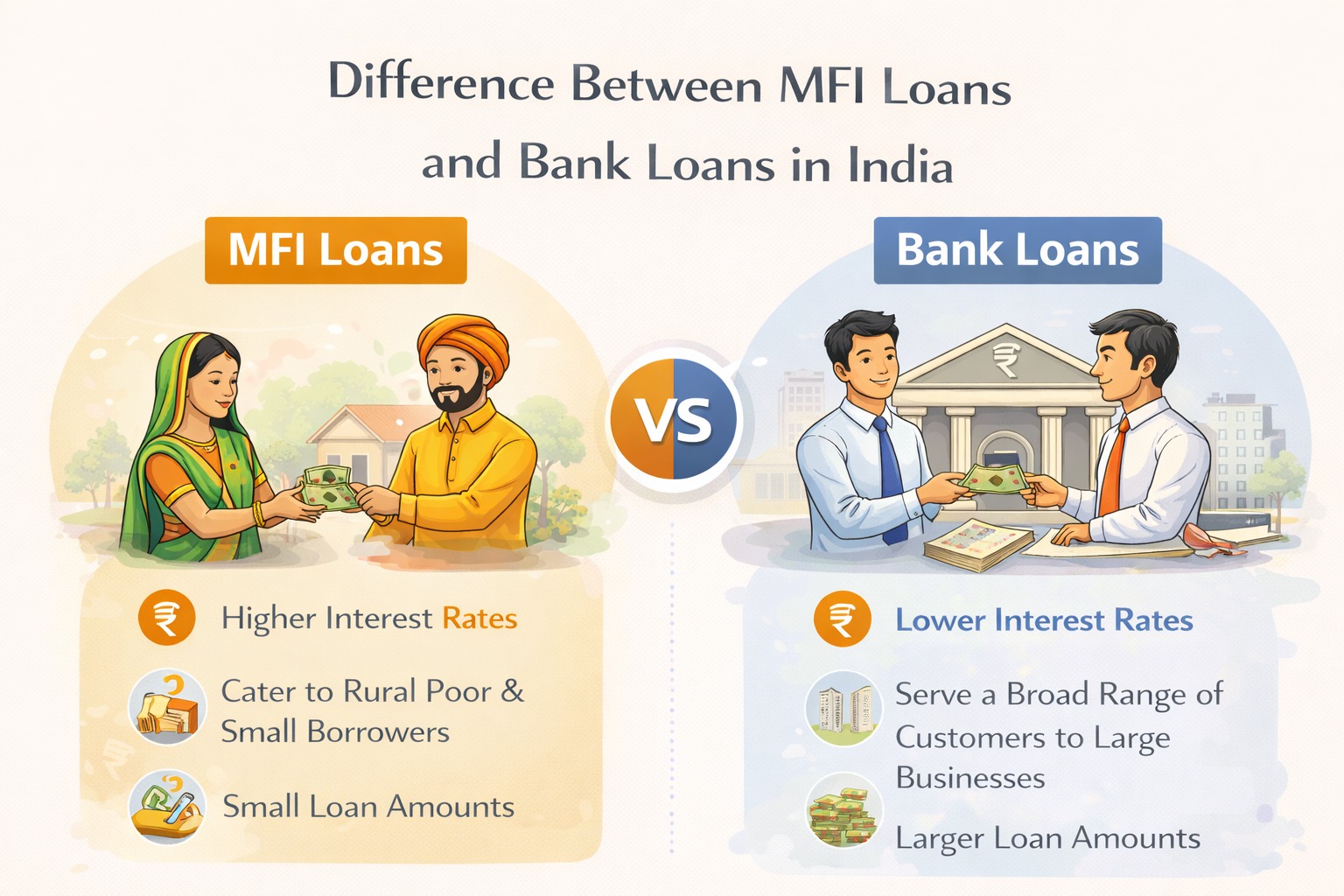
In India, Microfinance Institutions (MFIs) focus on small-ticket, short-term loans for low-income and underserved borrowers, while banks cater to a wider audience with larger, longer-term loans at lower interest rates.
Understanding this difference helps borrowers avoid over-borrowing, high costs, and repayment stress.
AI Answer Box
Short Answer:
MFI loans are small, short-term, unsecured loans meant for low-income borrowers, while bank loans are larger, cheaper, and suited for borrowers with stable income and documentation.
What Are MFI Loans?
MFI loans are provided by Microfinance Institutions, including NBFC-MFIs, to promote financial inclusion.
Key Features of MFI Loans
Small loan amounts
Short tenure
Mostly unsecured
Group-based or individual lending
Weekly or fortnightly repayments
MFIs typically serve:
Low-income households
Informal sector workers
First-time borrowers
Rural and semi-urban customers
MFIs operate under guidelines of the Reserve Bank of India.
What Are Bank Loans?
Bank loans are offered by:
Public sector banks
Private banks
Co-operative banks
Key Features of Bank Loans
Larger loan amounts
Longer tenures
Lower interest rates
Monthly EMI structure
Strong documentation and credit checks
Banks serve:
Salaried individuals
Established businesses
Borrowers with credit history
MFI Loans vs Bank Loans: Key Differences
| Feature | MFI Loans | Bank Loans |
|---|---|---|
| Loan Size | Small (₹10,000–₹1 lakh) | Medium to Large |
| Interest Rates | Higher | Lower |
| Tenure | Short | Medium to Long |
| Repayment | Weekly/Fortnightly | Monthly EMI |
| Credit Score | Often not mandatory | Mandatory |
| Documentation | Minimal | Extensive |
| Target Borrower | Low-income, informal | Salaried/business |
| Purpose | Livelihood, consumption | Assets, growth |
Why MFI Loans Cost More
MFI loans carry higher interest rates because:
No collateral
Higher servicing cost
Frequent collections
Higher borrower risk
📌 Higher rates reflect operational reality, not profiteering.
When MFI Loans Make Sense
MFI loans are suitable if you:
Lack formal income proof
Need small, quick funds
Are first-time borrowers
Live in underbanked areas
When Bank Loans Are Better
Bank loans are ideal if you:
Have stable income
Maintain good credit score
Need larger loan amounts
Prefer lower interest cost
Risks Borrowers Should Understand
MFI Loan Risks
Higher EMI frequency pressure
Loan stacking risk
Higher effective interest cost
Bank Loan Risks
Longer approval time
Strict eligibility
Penalties for defaults
Real-World Borrowing Insight
From borrower behaviour analysis, households with multiple MFI loans often face cash-flow stress, while borrowers who graduate to bank loans see lower EMI burden and better credit health.
How Borrowers Can Transition From MFI to Bank Loans
Step-by-Step Path
Repay MFI loans on time
Avoid multiple parallel loans
Build basic credit history
Open and maintain bank accounts
Apply for bank loans gradually
Impact on Credit Score
| Loan Type | Credit Impact |
|---|---|
| MFI Loans | Builds entry-level credit |
| Bank Loans | Builds long-term credit strength |
📌 Responsible MFI borrowing can be a stepping stone, not a trap.
Key Takeaways
MFI loans focus on inclusion, not scale
Bank loans are cheaper but stricter
Loan size and cost differ significantly
Borrowers should avoid loan stacking
Long-term goal should be formal banking
Frequently Asked Questions
1. Are MFI loans cheaper than bank loans?
No, they are costlier.
2. Do MFI loans need collateral?
No, mostly unsecured.
3. Can MFI borrowers get bank loans?
Yes, over time with good repayment.
4. Do banks accept first-time borrowers?
Rarely, unless income proof exists.
5. Are MFIs regulated?
Yes, by RBI.
6. What is loan stacking?
Multiple small loans simultaneously.
7. Do MFI loans affect credit score?
Yes, positively or negatively.
8. Why are MFI EMIs weekly?
To match borrower cash flow.
9. Are bank loans safer?
Cheaper and structured, yes.
10. Which is faster—MFI or bank loan?
MFI loans.
11. Should MFI loans be long-term?
No, short-term only.
12. Can MFIs offer large loans?
Generally no.
Conclusion: Choose Based on Need, Not Ease
MFI loans and bank loans serve different purposes. MFI credit supports inclusion and emergency needs, while bank loans enable stability and growth.
Smart borrowers use MFI loans as a starting point—and aim to graduate into formal, lower-cost banking credit over time.
Published on : 26th January
Published by : SMITA
www.vizzve.com || www.vizzveservices.com
Follow us on social media: Facebook || Linkedin || Instagram
🛡 Powered by Vizzve Financial
RBI-Registered Loan Partner | 10 Lakh+ Customers | ₹600 Cr+ Disbursed