

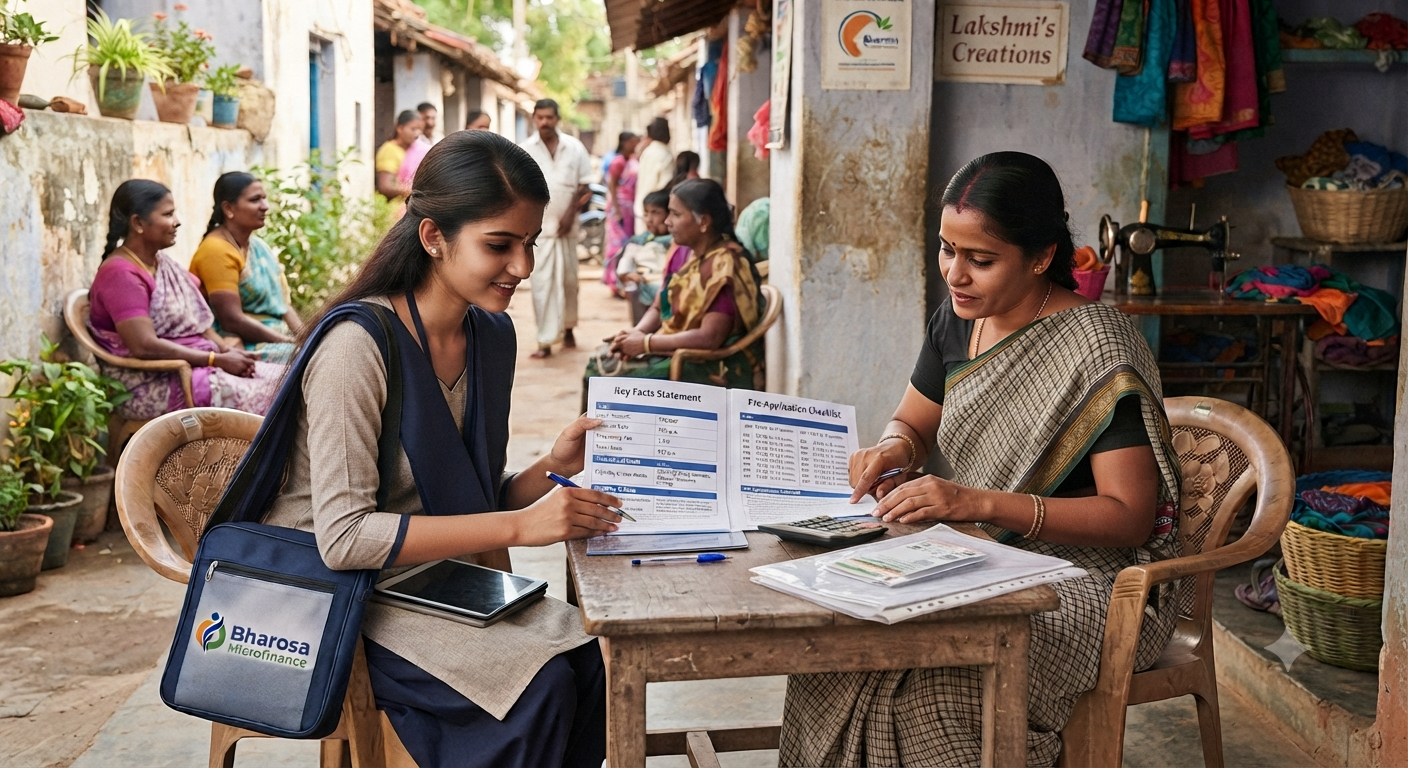
Microfinance helps low-income households, small entrepreneurs and underserved communities access small loans for income-generating activities and essential financial needs. Before applying, borrowers should understand the documents required, the possible costs involved and the checks they should complete to make an informed borrowing decision.
In India, microfinance loans are generally offered by regulated lenders such as banks and Non-Banking Financial Companies (NBFCs), including eligible NBFC-MFIs. Requirements and loan terms can vary depending on the lender, borrower profile and loan purpose.
This guide explains the documents, costs and important checks to consider before applying for a microfinance loan in India.
1. Documents Required for a Microfinance Loan
The lender may request documents to verify the applicant’s identity, address, household details and repayment capacity. Requirements differ by institution and loan product.
|
Document |
Why it may be required |
|---|---|
|
Aadhaar or other officially valid document |
Identity and address verification |
|
PAN or Form 60, where applicable |
Tax-related identification |
|
Recent photograph |
Applicant identification |
|
Bank account details |
Loan disbursement and repayment |
|
Income or household information |
Assessing repayment capacity |
|
Business or livelihood details |
Understanding the intended loan purpose |
Important: Do not assume every lender requires the same documents. Ask for the official document checklist before submitting your application. Never share your OTP, UPI PIN, ATM PIN or banking password with anyone.
2. Costs Involved in Microfinance Loans
Before accepting a loan, understand the complete cost—not just the amount you will receive.
-
Interest rate: The lender's charge for providing the loan.
-
Processing fee: A fee that may apply for processing the application, subject to applicable rules.
-
Insurance premium: An insurance cost may apply if an eligible insurance product is included.
-
Late payment charges: Additional charges may apply when repayments are delayed, according to the loan agreement.
-
Other disclosed charges: Check whether any other permitted charges apply.
Understand the Annual Percentage Rate (APR)
APR represents the annualised cost of credit, including interest and applicable charges. Compare the APR across loan offers rather than looking only at the advertised interest rate.
Example: Understanding repayment
Suppose a borrower takes a microfinance loan of ₹30,000. The actual repayment amount will depend on the interest rate, loan tenure, repayment schedule and applicable charges.
Before signing, ask the lender for a written repayment schedule showing the instalment amount, due dates, total repayment and applicable fees.
3. Important Checks Before Applying for Microfinance
Before accepting a loan offer, review these points carefully.
Check whether the lender is regulated
Confirm that the loan is being provided by a regulated bank or NBFC. If an agent or digital platform is involved, ask which regulated lender will actually provide the loan.
Review household income and existing debt
RBI's microfinance framework defines a microfinance loan as a collateral-free loan to a household with annual household income of up to ₹3 lakh. The household is defined as the individual family unit comprising the husband, wife and unmarried children. Lenders assess household income and existing debt when considering an application.
Be prepared to share accurate details of:
-
Income from employment, farming, business or other sources.
-
Income frequency, such as daily, weekly or monthly.
-
Existing loans and monthly instalments.
-
Essential household expenses and dependants.
Read the Key Facts Statement (KFS)
Ask for the Key Facts Statement before agreeing to the loan. Check the interest rate, APR, repayment schedule, fees, insurance charges, penalties and total repayment amount. Charges not disclosed in the KFS should not be added without the required explicit consent.
Understand the repayment schedule
Make sure the instalment frequency matches your income cycle. Ask whether repayments are weekly, fortnightly or monthly, and confirm the due dates and payment method.
Check the loan agreement
Read the agreement in a language you understand. Keep a copy of the signed agreement, KFS, repayment schedule and loan card. RBI's microfinance framework provides for borrower information and loan documentation in an understandable format.
4. Step-by-Step Checklist Before Taking a Microfinance Loan
-
Identify the requirement: Decide why you need the loan and how the money will be used.
-
Estimate repayment capacity: Calculate household income after essential expenses and existing loan instalments.
-
Prepare documents: Keep identity, address, bank and income-related details ready.
-
Compare lenders: Review interest rates, APR, fees, repayment periods and service quality.
-
Read the KFS: Verify the total cost and repayment schedule before signing.
-
Verify disbursement: Confirm how and when the loan amount will reach your bank account.
-
Keep records: Save receipts and proof of every repayment.
5. Common Mistakes to Avoid
-
Borrowing more than the household can comfortably repay.
-
Applying without checking existing loan obligations.
-
Comparing only interest rates instead of APR and total repayment.
-
Signing documents without understanding the terms.
-
Paying unofficial agents or intermediaries without a valid receipt.
-
Sharing OTPs, PINs or passwords with callers or agents.
-
Taking a new loan to repay an existing loan without reviewing the financial impact.
6. Benefits and Limitations of Microfinance
|
Benefits |
Limitations |
|---|---|
|
Provides access to small loans |
Loan amounts may be limited |
|
Generally does not require collateral |
Interest and charges vary by lender |
|
Can support small livelihood activities |
Repayments can strain household budgets |
|
May help underserved communities access formal credit |
Approval depends on lender assessment |
Microfinance can support financial inclusion, but it is not free money. Borrowers should consider the full cost and their ability to repay before taking a loan.
7. Frequently Asked Questions
1. What documents are required for a microfinance loan in India?
Commonly requested details include identity and address proof, bank account information, photographs and household income details. The exact checklist depends on the lender.
2. Is collateral required for a microfinance loan?
Under RBI's definition, a microfinance loan is collateral-free. The loan should not be secured by a lien on the borrower's deposit account or by hypothecation of security.
3. Are there processing fees for microfinance loans?
A lender may apply disclosed and permitted charges. Check the KFS for the exact amount and do not pay undisclosed fees.
4. How can I compare the cost of two microfinance loans?
Compare the APR, total repayment, instalment amount, tenure and all applicable charges.
5. Can a person with irregular income apply?
A person with daily, seasonal or irregular income may apply, but the lender will assess household income and repayment capacity under its policies.
6. Should I sign the loan agreement before reading it?
No. Read the KFS and loan agreement, ask questions about unclear terms and keep copies of the documents.
Conclusion
Understanding the documents, costs and checks before applying for microfinance in India can help borrowers make informed financial decisions. Verify the lender, provide accurate household income details, compare APR and repayment terms, and read the KFS before signing. A loan should support a genuine financial need without placing unnecessary pressure on the household budget.
For responsible borrowing, Vizzve encourages borrowers to understand loan terms, verify the lending institution and plan repayments carefully.
Published on : 26th November 2026
Published by : shibam nath
www.vizzve.com || www.vizzveservices.com
Follow us on social media: Facebook || Linkedin || Instagram
🛡 Powered by Vizzve Financial
RBI-Registered Loan Partner | 10 Lakh+ Customers | ₹600 Cr+ Disbursed