

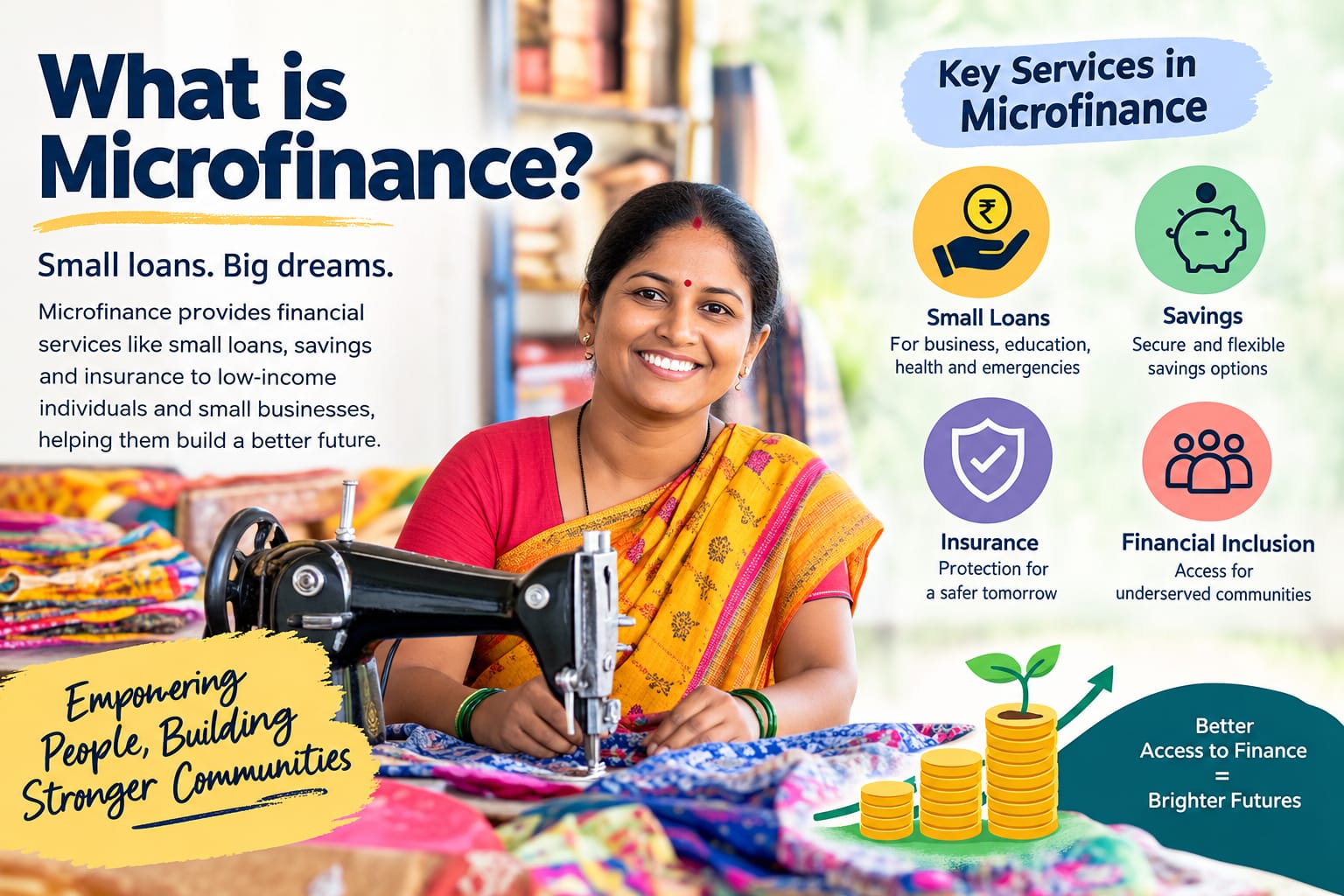
Microfinance is the provision of small-value financial services to people and households who may have limited access to traditional banking. It can include small loans, savings-related services, insurance and other financial products, depending on the institution and regulatory framework.
In India, microfinance plays an important role in expanding access to formal credit, particularly for low-income households, small entrepreneurs and women borrowers.
The modern microfinance sector has evolved significantly. Today, microfinance lending is not limited to traditional microfinance institutions. Banks, Small Finance Banks, NBFCs and NBFC-MFIs can all participate in the microfinance ecosystem.
The Reserve Bank of India (RBI) defines a microfinance loan as a collateral-free loan to an individual or household belonging to a low-income household, with annual household income up to ₹3 lakh. RBI's framework also requires lenders to ensure that a household's total monthly repayment obligations do not exceed 50% of monthly household income.
Microfinance is a financial service designed to provide small, generally collateral-free loans and other financial services to low-income households and underserved customers.
In India, under RBI's regulatory framework, collateral-free loans to individuals belonging to households with annual income up to ₹3 lakh are treated as microfinance loans. Lenders must also ensure that total monthly loan repayment obligations of the household do not exceed 50% of monthly household income.
Microfinance can help customers finance income-generating activities, household needs, education, healthcare and other legitimate expenses, subject to the lender's policies and applicable regulations.
What Is Microfinance?
Microfinance refers to financial services provided to people who may have difficulty accessing conventional financial products because of low income, limited credit history, lack of collateral or other barriers.
The most commonly discussed component is microcredit, which means providing relatively small loans to borrowers.
However, microfinance is broader than simply lending money.
It can include:
- Small loans
- Savings-related services
- Micro-insurance
- Financial literacy
- Payment services
- Credit-linked products
- Support for income-generating activities
In practical terms, microfinance aims to make formal financial services more accessible to underserved communities.
What Is a Microfinance Loan?
A microfinance loan is a loan that meets the applicable regulatory definition of microfinance.
Under the RBI framework, a collateral-free loan to an individual belonging to a household with annual household income of up to ₹3 lakh is treated as a microfinance loan. Loans backed by hypothecation of assets such as gold, equipment or other security do not qualify as collateral-free microfinance loans under this definition.
Key characteristics
| Feature | Microfinance Loan |
|---|---|
| Target customers | Low-income households |
| Collateral | Generally collateral-free |
| Household income threshold | Up to ₹3 lakh annual income under RBI definition |
| Repayment assessment | Household-level |
| Monthly repayment limit | Maximum 50% of monthly household income |
| Common borrowers | Small entrepreneurs, women borrowers, underserved households |
| Common lending model | Individual and group-based lending |
| Regulation | Applicable RBI-regulated entities follow RBI framework |
The 50% repayment obligation limit applies to the household's microfinance and non-microfinance loans when assessing lending to a low-income household.
How Does Microfinance Work in India?
Microfinance generally works by connecting underserved borrowers with regulated financial institutions or other eligible providers.
A simplified process looks like this:
Step 1: Customer applies for a loan
The borrower provides information required by the lender, such as identity, household income, existing liabilities and the intended purpose of borrowing.
Step 2: Household assessment
The lender assesses household income and existing indebtedness rather than looking only at the applicant's individual income.
Step 3: Credit assessment
The lender may use credit-bureau information and other internal information to evaluate repayment capacity.
The microfinance ecosystem has developed a substantial credit-bureau infrastructure. MFIN says more than 10 crore loans are updated weekly in the industry ecosystem, with the sector moving toward more frequent data submission.
Step 4: Loan approval
If the borrower satisfies the lender's eligibility and risk requirements, the loan may be approved.
Step 5: Disbursement
The approved amount is disbursed according to the lender's process.
Step 6: Repayment
The borrower repays according to the agreed schedule, which may vary by product and lender.
Who Provides Microfinance Loans?
Microfinance in India is supplied through several categories of institutions.
Major providers include:
- Banks
- Small Finance Banks
- NBFC-MFIs
- Other NBFCs
- Certain nonprofit organisations, subject to applicable legal and regulatory provisions
- Self-Help Group-linked financial systems
The RBI's regulatory framework for microfinance loans applies to specified regulated entities including commercial banks, cooperative banks and NBFCs.
NBFC-MFI vs Microfinance
An NBFC-MFI is a specific category of Non-Banking Financial Company whose business model involves microfinance lending.
Microfinance itself is broader.
A microfinance loan can be provided by different types of regulated lenders if the loan satisfies the applicable definition and requirements.
Microfinance vs Microcredit: What Is the Difference?
The terms are often used interchangeably, but they are not exactly the same.
| Microfinance | Microcredit |
|---|---|
| Broader financial-services concept | Primarily refers to small loans |
| May include credit, insurance and other services | Focuses on lending |
| Supports wider financial inclusion | Specifically expands access to credit |
| Can serve individuals and groups | Usually refers to small borrowers |
| Wider than lending alone | A component of microfinance |
In simple terms: microcredit is a part of microfinance.
Types of Microfinance
Microfinance can take several forms depending on the institution, product and customer.
1. Microcredit
Small loans provided to individuals or groups for approved financial needs.
2. Group Lending
A group of borrowers may collectively participate in a lending structure.
One widely used model is the Joint Liability Group (JLG).
MFIN describes JLG lending as a model in which borrowers, commonly women from economically weaker sections, form groups and provide a form of social collateral through group participation.
3. Individual Microfinance Loans
Not every microfinance loan requires group participation.
Depending on the lender's policies, an eligible borrower may receive an individual microfinance loan after income, indebtedness and repayment capacity are assessed.
4. Microenterprise Finance
Microfinance can support small income-generating activities such as:
- Small retail shops
- Livestock activities
- Tailoring
- Food businesses
- Agriculture-related activities
- Small service businesses
- Street vending
The actual permissible purpose depends on the loan product and lender.
Why Is Microfinance Important?
Microfinance can contribute to financial inclusion by giving underserved customers access to formal financial services.
Major areas of impact include:
Financial inclusion
People who have limited access to traditional banking may gain access to formal credit.
Small-business support
Small loans can help entrepreneurs purchase inventory, equipment or working capital.
Women's financial participation
Women constitute a significant share of microfinance borrowers in India. Industry data from MFIN has historically shown a strong concentration of lending among women borrowers.
Reduced dependence on informal borrowing
Formal credit can provide an alternative to certain informal sources of finance, although borrowers should always compare the total cost and terms.
Building financial records
Responsible repayment can contribute to a borrower's formal credit history where the loan is reported to credit information companies.
Microfinance Industry in India: Latest Snapshot
India's microfinance sector is large and has undergone significant changes in recent years.
According to MFIN's Q3 FY2025-26 report, the sector's microfinance portfolio stood at approximately ₹3.15 lakh crore as of December 31, 2025. The report said the portfolio had declined 7.3% from September 2025, while portfolio-quality indicators had improved compared with the previous year.
MFIN's September 2026 website update also lists its latest 58th edition of Micrometer for Q1 FY2026-27, indicating that the sector continues to be closely monitored through periodic industry data.
Important point
Industry statistics can differ depending on:
- Reporting period
- Definition of microfinance
- Institutions covered
- Whether SHG-linked lending is included
- Portfolio measurement methodology
Therefore, readers should check the reporting date before comparing figures.
What Are the Main Uses of Microfinance Loans?
Microfinance loans are commonly associated with income-generating activities, but borrowers may also use eligible loans for other household requirements depending on the product.
Examples include:
Income-generating activities
- Buying inventory
- Purchasing equipment
- Expanding a small shop
- Livestock-related activities
- Tailoring and handicrafts
Household requirements
- Education expenses
- Healthcare expenses
- Housing-related needs
- Emergency household expenses
The exact permitted use depends on the lender and product terms.
Benefits of Microfinance
1. Collateral-Free Access
One of the important characteristics of microfinance loans under the RBI definition is that they are collateral-free.
2. Supports Financial Inclusion
Microfinance can connect underserved households with the formal financial system.
3. Helps Small Entrepreneurs
A small amount of working capital can sometimes help a microenterprise purchase stock or improve its operations.
4. Can Support Women Entrepreneurs
Women are major participants in India's microfinance ecosystem, particularly through group-lending models.
5. Formal Credit History
Where lenders report repayment data to credit information companies, timely repayment can help establish or strengthen a formal credit record.
6. Structured Repayment
Unlike some informal borrowing arrangements, formal loans normally have documented repayment schedules and pricing disclosures.
Disadvantages and Risks of Microfinance
Microfinance is not free money. Borrowers need to understand the complete repayment obligation before accepting a loan.
Potential risks include:
- Interest and other applicable charges
- Multiple borrowing
- Over-indebtedness
- Irregular household income
- Repayment pressure
- Late-payment consequences
- Taking a loan without a sustainable repayment plan
The RBI's 50% household repayment-obligation rule is specifically designed to address excessive repayment burdens among low-income households.
Pros and Cons of Microfinance
| Pros | Cons / Risks |
|---|---|
| Can improve access to formal credit | Borrowing still creates a repayment obligation |
| Usually collateral-free | Interest and charges apply |
| Supports small businesses | Multiple loans can create over-indebtedness |
| Can promote financial inclusion | Income shocks can affect repayment |
| Can support women entrepreneurs | Group structures may create social pressure |
| Formal documentation | Terms must be understood carefully |
How to Apply for a Microfinance Loan
The exact procedure differs between lenders, but the general process can be explained in a few steps.
Step 1: Identify the financial requirement
Decide exactly how much you need and why.
Step 2: Check repayment capacity
Calculate household income and existing monthly debt obligations.
Step 3: Check eligibility
Review the lender's income, age, location, documentation and other requirements.
Step 4: Compare loan terms
Check:
- Interest rate
- Annualized cost where disclosed
- Processing fees
- Insurance charges, if any
- Repayment frequency
- Late-payment charges
- Total repayment amount
Step 5: Read the factsheet
RBI requires regulated lenders to provide a simplified factsheet containing pricing-related information for microfinance loans.
Step 6: Complete KYC
Submit the required identity and other documents through the lender's approved process.
Step 7: Accept only after understanding the terms
Do not borrow simply because an amount is available.
What Should You Check Before Taking a Microfinance Loan?
Before signing or accepting a loan, ask these questions:
How much will I repay in total?
Do not look only at the amount deposited into your account.
What is the interest rate?
Understand whether the quoted rate is monthly, annual or presented in another format.
What are the additional charges?
RBI says customers should pay only charges explicitly mentioned in the applicable factsheet.
What happens if I miss a payment?
Understand the applicable overdue charges and consequences.
Do I already have other loans?
Existing obligations are important because household indebtedness matters under the microfinance framework.
Is insurance compulsory?
RBI says non-credit products cannot be made a pre-condition for a microfinance loan, and such products require the borrower's consent.
RBI Rules for Microfinance Loans in India
The RBI introduced a harmonised regulatory framework for microfinance loans that became effective from April 1, 2022.
Some important customer-protection provisions include:
- Microfinance loans are collateral-free under the applicable definition.
- Low-income household status is assessed at household level.
- Annual household income must be up to ₹3 lakh for a loan to fall within the RBI definition of a microfinance loan.
- Total monthly repayment obligations cannot exceed 50% of monthly household income.
- Lenders must provide pricing information through a factsheet.
- There is no prepayment penalty on microfinance loans.
- A late-payment penalty, where applicable, is charged only on the overdue amount rather than the entire loan.
- Changes in interest rates or charges must be communicated appropriately and applied prospectively.
- Borrowers must receive information about grievance redressal.
These provisions are intended to improve transparency and responsible lending.
Microfinance and the Joint Liability Group Model
The Joint Liability Group (JLG) model is one of the most recognised approaches in Indian microfinance.
A JLG generally consists of a group of borrowers who individually receive loans but participate in a group-based structure.
How JLG lending can work
- Borrowers form a group.
- The lender assesses the borrowers.
- Loans are sanctioned individually, subject to eligibility.
- Group meetings may be conducted.
- Borrowers make repayments according to the agreed schedule.
- The group structure creates social accountability.
MFIN identifies JLGs as an important model in Indian microfinance, particularly among women borrowers.
Microfinance and Women's Financial Inclusion
Women have historically represented a major segment of India's microfinance customer base.
The model can provide women entrepreneurs with access to formal credit for activities such as:
- Small retail businesses
- Livestock
- Tailoring
- Food preparation
- Handicrafts
- Local services
However, access to credit alone does not automatically guarantee business success. Borrowers also need financial planning, market access, adequate cash flow and sustainable repayment capacity.
That distinction is important when evaluating the real-world impact of microfinance.
Expert Commentary: What Responsible Microfinance Should Look Like
From a responsible-lending perspective, the key question should not simply be "Can the borrower get a loan?"
A better question is:
"Can the household comfortably repay the loan without compromising essential expenses?"
This is consistent with the RBI's household-level approach to income and indebtedness.
The RBI specifically requires lenders to assess household income and repayment obligations. It also states that expected income from the asset or activity being financed should not simply be added to household income for calculating the relevant limit.
This highlights an important practical lesson: loan eligibility and loan affordability are not necessarily the same thing.
Real-World Example of Microfinance
Consider a small tailoring business.
A borrower already operates a tailoring service from home and wants to purchase another sewing machine and additional materials.
Suppose the household has:
- Monthly household income: ₹30,000
- Existing monthly loan obligations: ₹7,000
- Proposed new monthly repayment: ₹4,000
Total monthly repayment obligations would become:
₹7,000 + ₹4,000 = ₹11,000
As a percentage of monthly household income:
₹11,000 ÷ ₹30,000 × 100 = 36.67%
This example is below the RBI's 50% ceiling.
However, that does not automatically mean the loan should be taken. The household still needs to consider food, rent, education, healthcare, utilities, business expenses and emergency savings.
The example is illustrative only; actual lending decisions depend on the lender's policies and the borrower's complete financial profile.
Microfinance vs Traditional Personal Loan
| Feature | Microfinance | Traditional Personal Loan |
|---|---|---|
| Typical target market | Low-income/underserved households | Wider retail customer base |
| Collateral | Generally collateral-free | Usually unsecured |
| Loan size | Often relatively small | Can be substantially larger |
| Income assessment | Household-level considerations | Usually individual/applicant-focused, depending on product |
| Group lending | May be used | Usually individual |
| Purpose | Income generation and other eligible needs | Multiple personal needs |
| Regulation | Subject to applicable RBI framework for regulated entities | Subject to applicable lending regulations |
| Repayment capacity | Important | Important |
Neither product is automatically suitable for every borrower. The right choice depends on income, purpose, affordability, cost and eligibility.
Microfinance vs Informal Lending
| Factor | Formal Microfinance | Informal Lending |
|---|---|---|
| Documentation | Usually documented | May be limited |
| Pricing disclosure | Regulated lenders have disclosure requirements | Can vary significantly |
| Grievance mechanism | Formal mechanism available for regulated lenders | May be informal |
| Credit reporting | Can be reported to credit bureaus | Often not |
| Regulatory oversight | Applicable regulated entities are subject to RBI framework | Depends on lender and arrangement |
| Transparency | Standardised disclosures expected | Can vary |
Borrowers should carefully verify the identity and legitimacy of any lender before sharing financial or personal information.
How Microfinance Can Support Financial Inclusion
Microfinance can help bridge the gap between traditional banking and financially underserved communities.
Its potential contributions include:
Access
Bringing formal credit closer to underserved households.
Opportunity
Helping small businesses access working capital.
Financial identity
Creating formal financial records through regulated lending and credit reporting.
Women's participation
Expanding women's access to formal financial services.
Digital inclusion
Technology can simplify applications, KYC, payments and account servicing.
At the same time, responsible lending, accurate credit information and borrower education remain essential to maintaining a healthy ecosystem.
Common Mistakes Borrowers Should Avoid
1. Borrowing more than necessary
A higher loan amount also means a higher repayment obligation.
2. Ignoring total repayment
Focus on the complete cost rather than just the monthly instalment.
3. Taking multiple loans simultaneously
Multiple loans can quickly increase household repayment obligations.
4. Not checking the factsheet
Always understand the documented pricing and terms.
5. Paying unauthorised agents
Use only official lender channels.
6. Sharing OTPs or passwords
Never disclose sensitive authentication information to unauthorised individuals.
7. Missing payments without communicating
If a repayment problem arises, contact the lender through its official grievance or customer-service channels.
Microfinance: Key Takeaways
Summary Box
- Microfinance provides financial services to underserved and low-income customers.
- Microcredit is one component of the broader microfinance sector.
- RBI defines a microfinance loan as a collateral-free loan to an individual from a household with annual income up to ₹3 lakh.
- Household monthly repayment obligations are subject to a 50% limit under the RBI framework.
- Banks, Small Finance Banks, NBFC-MFIs and other eligible lenders participate in the sector.
- JLG lending is an important model in India's microfinance ecosystem.
- Microfinance can support small businesses and financial inclusion.
- Borrowers should compare the total cost and ensure that repayments are affordable.
- Responsible borrowing is as important as access to credit.
Published on : 26th September
Published by : Shanlee JV
www.vizzve.com || www.vizzveservices.com
Follow us on social media: Facebook || Linkedin || Instagram
🛡 Powered by Vizzve Financial
RBI-Registered Loan Partner | 10 Lakh+ Customers | ₹600 Cr+ Disbursed