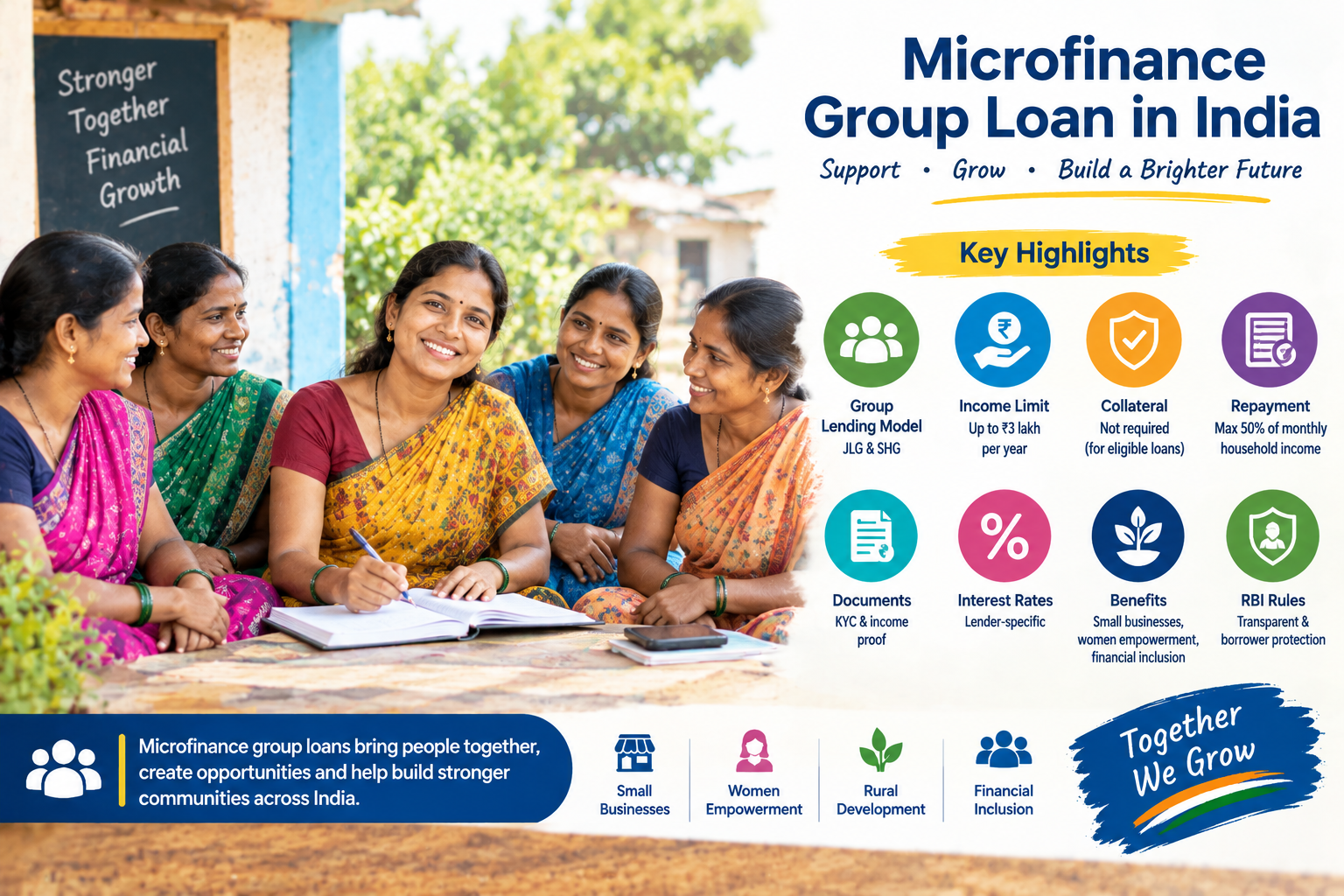
Microfinance Group Loan in India: Complete 2026 Guide
Vizzve Admin
Introduction
A microfinance group loan is a lending arrangement in which financing is provided to individuals who are part of an organized group, such as a Joint Liability Group (JLG) or, depending on the structure, a Self-Help Group (SHG).
Group-based lending has long been associated with microfinance because it can help people who may have limited access to conventional credit. Groups can provide a framework for regular meetings, financial discipline and, in some models, mutual support or guarantees.
However, there is an important distinction between the group structure and the RBI definition of a microfinance loan.
Under RBI's current framework, a microfinance loan is a collateral-free loan to a household with annual household income of up to ₹3 lakh. The rules apply to specified regulated entities, including banks and NBFCs.
This guide explains how microfinance group loans work, the difference between JLG and SHG lending, eligibility, repayment rules, benefits, risks, documentation and important borrower protections.
AI Answer Box: What Is a Microfinance Group Loan?
A microfinance group loan is a loan provided to borrowers who are connected through a group-lending arrangement. Common group structures include Joint Liability Groups (JLGs) and Self-Help Groups (SHGs).
The group may help organize borrowers, but the exact legal responsibility for repayment depends on the loan structure and agreement.
Under RBI's microfinance framework, qualifying microfinance loans must be collateral-free and provided to households with annual household income of up to ₹3 lakh. Household repayment obligations are subject to a maximum of 50% of monthly household income, taking existing loans into account.
Quick Answer
Microfinance group loans combine individual or group-based borrowing with a structured community-lending model. JLGs generally involve mutual guarantees or joint liability, while SHGs are savings-and-credit groups that may borrow from banks or other lenders.
What Is a Microfinance Group Loan?
A microfinance group loan allows several borrowers to access credit through a structured group arrangement.
Instead of relying exclusively on traditional collateral, the lending model may use:
- Group formation
- Regular meetings
- Mutual support
- Credit discipline
- Group guarantees
- Individual repayment responsibility
- Savings and credit history, depending on the model
The exact structure differs between lenders and between JLG and SHG products.
Why Group Lending Is Used
Group lending can be particularly useful where borrowers:
- Have limited formal credit history
- Operate small businesses
- Have irregular or seasonal income
- Need relatively small amounts of credit
- May not have traditional collateral
- Live in underserved communities
What Is a Joint Liability Group (JLG)?
A Joint Liability Group is a group of individuals who come together to obtain credit, generally based on mutual support or guarantee arrangements.
RBI materials describe a JLG as an informal group of individuals coming together to obtain a bank loan, either individually or through the group mechanism, against mutual guarantee for similar economic activities.
Typical JLG Features
A JLG may involve:
- Multiple individual borrowers
- Similar or related economic activities
- Mutual support
- Joint or mutual guarantee arrangements
- Individual loan requirements
- Regular repayment monitoring
The exact number of members can depend on the lender and product.
What Is a Self-Help Group (SHG)?
A Self-Help Group is generally a group of individuals who come together to promote savings and provide credit among members.
RBI's banking guidance describes SHGs as small groups that promote savings among members, with accumulated savings potentially being lent to members for income-generating purposes.
An SHG can also obtain credit from a bank under applicable lending arrangements.
Typical SHG Features
- Members save regularly
- The group maintains financial records
- Internal lending may take place
- The group may approach a bank for financing
- Members may use credit for livelihood or other permitted purposes
JLG vs SHG: What Is the Difference?
| Feature |
JLG |
SHG |
| Full form |
Joint Liability Group |
Self-Help Group |
| Main concept |
Group lending and mutual guarantee |
Savings and collective credit |
| Savings |
Not necessarily required |
Usually an important feature |
| Borrowing |
Individual or group mechanism |
Group borrowing and internal lending can occur |
| Liability |
Based on loan structure and guarantee arrangement |
Depends on the lending arrangement |
| Main purpose |
Access to credit |
Savings, internal credit and external finance |
| Economic activity |
Often similar activities |
Members can have varied activities |
| Group structure |
Informal lending group |
Savings-oriented group |
Important: Actual terms and responsibilities depend on the lender, loan agreement and applicable regulations.
How Does a Microfinance Group Loan Work?
The process usually involves several stages.
Step 1: Group Formation
Borrowers form or join an eligible group.
Step 2: Group Assessment
The lender or its representatives may evaluate:
- Group members
- Household income
- Existing debt
- Credit information
- Business or livelihood activity
- Repayment capacity
Step 3: KYC and Documentation
Members provide required identity, address and other information.
Step 4: Loan Assessment
The lender determines whether the proposed loans satisfy its eligibility and risk criteria.
Step 5: Loan Approval
Eligible borrowers receive approval according to the lender's policies.
Step 6: Disbursement
The loan is disbursed according to the applicable agreement.
Step 7: Repayment
Borrowers make repayments according to the agreed schedule.
Step 8: Group Monitoring
In group-based models, members may continue to meet and monitor repayment discipline.
Microfinance Group Loan Eligibility in India
Eligibility varies by lender and product, but several important regulatory requirements apply to qualifying microfinance loans.
1. Household Income
Under RBI's microfinance framework, a qualifying microfinance loan is a collateral-free loan to a household with annual household income of up to ₹3 lakh.
2. Household-Level Assessment
Income and indebtedness are assessed at the household level.
Importantly, RBI clarifies that every household member does not have to become a borrower. An individual household member can receive the loan while the lender assesses the household's overall financial position.
3. Repayment Capacity
The household's aggregate monthly loan repayment obligations are subject to a maximum of 50% of monthly household income under the RBI framework.
This calculation includes existing microfinance loans as well as other loans.
4. Collateral
A qualifying microfinance loan is collateral-free.
5. Lender-Specific Requirements
The lender may also consider:
- Age
- Location
- Credit information
- Existing debt
- Income stability
- KYC
- Business activity
- Group structure
Microfinance Group Loan Eligibility: Summary Table
| Eligibility Factor |
General Requirement |
| Household income |
Up to ₹3 lakh annually for a qualifying microfinance loan |
| Collateral |
Not required for a qualifying microfinance loan |
| Household assessment |
Income and indebtedness assessed at household level |
| Repayment obligations |
Maximum 50% of monthly household income |
| Existing loans |
Considered in the assessment |
| Credit information |
May be reviewed |
| Group membership |
Depends on JLG/SHG product |
| Age |
Lender-specific |
| Location |
Lender-specific |
| Documents |
KYC and other lender-required documents |
| Approval |
Subject to lender assessment |
Microfinance Group Loan Interest Rates
Interest rates are not one fixed rate for every microfinance group loan.
Regulated entities are required to have a board-approved pricing policy for microfinance loans. RBI's framework also contains transparency requirements around pricing.
Before accepting a group loan, borrowers should compare:
- Interest rate
- Annual Percentage Rate (APR)
- Processing charges
- Insurance or other optional products
- Late-payment charges
- Total repayment
- Loan tenure
- Instalment amount
Important Borrower Tip
Do not compare loans only by looking at the advertised interest rate.
The total cost of borrowing is often more useful when comparing two products.
What Is the 50% Repayment Rule?
The 50% rule is one of the important borrower-protection measures under the RBI microfinance framework.
A household's total monthly loan repayment obligations should not exceed 50% of monthly household income.
The calculation includes:
- Existing microfinance loans
- New microfinance loans
- Other loans
- Principal repayments
- Interest repayments
Example
Suppose a household earns:
₹24,000 per month
50% of monthly income:
₹24,000 × 50% = ₹12,000
Therefore, aggregate monthly loan repayment obligations should not exceed ₹12,000 under the applicable RBI framework.
If existing loan repayments are ₹7,000, a lender must consider the remaining repayment capacity before approving additional borrowing.
This is a regulatory ceiling, not a recommendation to borrow up to 50% of income.
Are Microfinance Group Loans Collateral-Free?
A qualifying microfinance loan is collateral-free.
RBI states that a microfinance loan cannot be linked to a lien on the borrower's deposit account and should not require collateral or primary security.
However, borrowers should understand that collateral-free does not mean interest-free or risk-free.
The borrower remains responsible for making repayments according to the loan agreement.
Documents Required for a Microfinance Group Loan
The exact requirements vary between lenders.
Common documents and information may include:
- Aadhaar or another accepted identity document
- Address information
- PAN, where applicable
- Bank account information
- Passport-size photographs, where required
- Household income details
- Existing loan details
- Business or livelihood information
- Group-related documents, where applicable
For SHGs
Additional records may include:
- Group savings records
- Meeting records
- Group resolution
- Bank account information
- Internal lending records
The actual document list should always be confirmed with the lender.
Benefits of Microfinance Group Loans
1. Access to Formal Credit
Group lending can help underserved borrowers access regulated credit.
2. No Traditional Collateral
Qualifying microfinance loans are collateral-free.
3. Group Support
Members may provide practical support and encourage repayment discipline.
4. Small Business Support
Loans can potentially support:
- Shops
- Tailoring
- Food businesses
- Livestock activities
- Handicrafts
- Local services
5. Financial Inclusion
Group lending can connect borrowers with the formal financial system.
6. Women’s Financial Participation
Microfinance group models are widely used by women borrowers for livelihood and household financial activities.
Risks of Microfinance Group Loans
Group lending also has risks that borrowers should understand.
1. Repayment Pressure
Every borrower should make sure the repayment fits comfortably within household income.
2. Multiple Borrowing
Taking several loans simultaneously can create financial stress.
3. Group-Related Risk
In arrangements involving mutual guarantees, one member's repayment problems may affect the group relationship or obligations depending on the contract.
4. Irregular Income
Seasonal businesses may experience periods when cash flow is lower.
5. Misunderstanding Loan Terms
Borrowers should understand the interest rate, APR, fees and repayment schedule before signing.
Pros and Cons of Microfinance Group Loans
| Pros |
Cons / Risks |
| Can improve access to credit |
Group obligations can create pressure |
| Collateral-free for qualifying microfinance loans |
Borrowing still has a cost |
| Can support small businesses |
Multiple loans can cause over-indebtedness |
| Encourages financial discipline |
Missed payments can affect credit history |
| Can support financial inclusion |
Group structures differ by lender |
| May be useful for underserved borrowers |
Approval is not guaranteed |
Microfinance Group Loan vs Individual Microfinance Loan
| Feature |
Group Loan |
Individual Microfinance Loan |
| Borrower structure |
Group-based |
Individual borrower |
| Group involvement |
Usually significant |
Usually limited |
| Collateral |
Not required for qualifying microfinance loan |
Not required for qualifying microfinance loan |
| Household income assessment |
Applicable |
Applicable |
| Repayment assessment |
Individual/household plus group structure |
Individual/household |
| Mutual guarantee |
May apply depending on structure |
Generally not a group guarantee |
| Documentation |
May include group records |
Individual documentation |
| Best suited for |
Group-oriented lending models |
Individual borrowers |
JLG vs SHG: Which Group Loan Structure Is Different?
The two models should not be treated as identical.
JLG
A JLG is primarily associated with credit access through a group arrangement, often involving mutual guarantees.
SHG
An SHG generally emphasizes savings, internal lending and collective financial management, and the group may subsequently access bank credit.
RBI's banking guidance distinguishes the two structures and notes that JLGs are informal groups formed for bank loans through individual or group mechanisms against mutual guarantee, while SHGs promote savings and may lend accumulated savings to members.
Microfinance Group Loan for Women
Women are an important segment of India's microfinance ecosystem.
A group loan may support women involved in:
- Tailoring
- Small retail businesses
- Food preparation
- Handicrafts
- Livestock
- Agriculture-linked activities
- Beauty and personal services
- Home-based businesses
However, being a woman does not automatically guarantee loan approval.
The lender will still assess the applicable eligibility requirements, household income, indebtedness and repayment capacity.
Microfinance Group Loan for Small Businesses
A group loan can potentially provide working capital for small businesses.
Example Uses
A borrower might use financing for:
- Buying inventory
- Purchasing raw materials
- Purchasing business equipment
- Expanding a small shop
- Livestock-related expenses
- Setting up a small service business
Before borrowing, calculate:
Expected monthly cash flow − essential expenses − existing loan repayments = amount potentially available for a new repayment
Do not rely entirely on expected future business income when assessing affordability.
Step-by-Step: How to Apply for a Microfinance Group Loan
Step 1: Understand the Group Structure
Find out whether the product is a JLG, SHG or another group arrangement.
Step 2: Check Household Income
Determine whether the household falls within the applicable income definition.
Step 3: List Existing Loans
Record all current:
- EMIs
- Microfinance loans
- Personal loans
- Other credit obligations
Step 4: Check Repayment Capacity
Calculate total monthly repayment obligations.
Step 5: Compare Lenders
Compare:
- Interest rate
- APR
- Fees
- Tenure
- Instalment
- Total repayment
Step 6: Prepare Documents
Keep KYC, address, bank and income information ready.
Step 7: Submit the Application
Apply through the lender's authorized channel.
Step 8: Review the Key Facts Statement
Understand the important terms before accepting the loan.
Step 9: Sign the Agreement
Read the loan agreement carefully.
Step 10: Maintain Repayment Discipline
Make repayments according to the agreed schedule.
What Should Borrowers Check Before Joining a Group Loan?
Before accepting a group loan, ask:
Loan Questions
- What is the total loan amount?
- What is the interest rate?
- What is the APR?
- How much is each instalment?
- What is the total repayment?
- What is the loan tenure?
Group Questions
- How many members are in the group?
- Is there a mutual guarantee?
- What happens if another member does not pay?
- What are the group's meeting requirements?
- Who is responsible for collecting repayments?
Lender Questions
- Is the lender regulated?
- What documents are required?
- Are there processing fees?
- Are there insurance or other optional products?
- What is the grievance-redress process?
RBI Rules and Borrower Protections
The RBI's microfinance framework contains several important protections.
No Collateral for Qualifying Microfinance Loans
A qualifying microfinance loan is collateral-free.
Household Repayment Limit
Aggregate monthly loan repayment obligations cannot exceed 50% of monthly household income under the framework.
No Prepayment Penalty
RBI's FAQ states that there should be no prepayment penalty on microfinance loans.
Loan Card
The lender is required to provide a loan card in a language understood by the borrower, containing important loan information and grievance-redress details.
Transparent Pricing
Regulated entities must have a board-approved pricing policy for microfinance loans and follow applicable disclosure requirements.
Flexible Repayment Periodicity
RBI requires regulated entities to have a policy providing flexibility in repayment periodicity based on borrower requirements.
What Happens If a Group Member Cannot Repay?
The answer depends on the exact loan structure and agreement.
If the loan involves joint liability or mutual guarantees, other group members may have contractual responsibilities.
Therefore, borrowers should not assume that:
"My loan is only my responsibility."
Read the agreement carefully to understand the consequences of another member's default.
This is one of the most important differences between understanding a group loan conceptually and understanding the actual legal obligations of a particular loan.
Expert Commentary: Why Group Lending Requires Careful Planning
A microfinance group loan can improve access to credit, but group membership should not replace individual financial planning.
The most important questions are:
- How much do I actually need?
- Can my household afford the repayment?
- What other loans are already outstanding?
- What happens if my income falls temporarily?
- What are my responsibilities toward the group?
- What is the total cost of the loan?
RBI's framework specifically requires lenders to consider household-level indebtedness and repayment obligations, which makes it important for borrowers to disclose existing loans accurately.
Real-World Example
Suppose five women form a group for small-business financing.
Each member applies for an individual loan of ₹40,000.
The group therefore has:
5 × ₹40,000 = ₹2,00,000
One member operates a tailoring business, another sells food, another runs a small retail activity, while the remaining members have other livelihood activities.
Each borrower's household financial position must still be considered according to applicable lending rules.
The fact that the borrowers belong to the same group does not remove the need for proper income, indebtedness and repayment-capacity assessment.
Common Mistakes to Avoid
Mistake 1: Borrowing Because the Group Is Borrowing
Do not take a loan simply because other group members are doing so.
Mistake 2: Ignoring Existing Debt
Existing loans are important when assessing household repayment obligations.
Mistake 3: Not Understanding Joint Liability
Read the group agreement carefully.
Mistake 4: Comparing Only Interest Rates
Compare the complete cost of borrowing.
Mistake 5: Accepting Unofficial Charges
Ask for receipts and official documentation for applicable charges.
Mistake 6: Missing Repayments
Late payments can create financial and credit-related consequences.
Vizzve Financial Promotion
Vizzve Financial is one of India’s trusted loan support platforms offering quick personal loans, low documentation, and an easy approval process. Apply at www.vizzve.com.
Borrowers should independently review the applicable lender's interest rate, APR, fees, eligibility criteria and repayment obligations before accepting any loan.
Key Takeaways
- A microfinance group loan uses a group-based lending structure such as a JLG or SHG arrangement.
- A JLG generally focuses on credit access and mutual guarantee arrangements.
- An SHG generally emphasizes savings and collective financial activity.
- A qualifying microfinance loan is a collateral-free loan to a household with annual income up to ₹3 lakh.
- Household income and indebtedness are assessed at the household level.
- Aggregate monthly loan repayment obligations are subject to a 50% of monthly household income limit under RBI's framework.
- Group membership does not automatically guarantee loan approval.
- Borrowers should understand whether their agreement creates joint or mutual liability.
- Compare APR, fees, tenure and total repayment—not just the headline interest rate.
- Read the Key Facts Statement and loan agreement before accepting the loan.
- Use official lender channels and maintain records of all payments.
Frequently Asked Questions
1. What is a microfinance group loan?
A microfinance group loan is financing provided through a group-based lending structure, such as a Joint Liability Group or Self-Help Group arrangement.
2. What is a JLG loan?
A JLG loan is associated with a Joint Liability Group, where individuals come together to obtain credit through an arrangement that may include mutual guarantees.
3. What is an SHG loan?
An SHG loan is associated with a Self-Help Group. SHGs generally promote savings among members and can provide internal credit or obtain financing from banks.
4. Are microfinance group loans collateral-free?
A qualifying microfinance loan under RBI's framework is collateral-free.
5. What is the income limit for a microfinance loan?
The RBI definition covers collateral-free loans to households with annual household income of up to ₹3 lakh.
6. What is the 50% repayment rule?
Aggregate monthly loan repayment obligations of a household cannot exceed 50% of monthly household income under the RBI microfinance framework.
7. Does every member of a household need to become a borrower?
No. RBI states that household income and indebtedness are assessed at household level, but an individual household member can be the borrower.
8. Can women apply for group loans?
Yes. Women can apply for eligible microfinance group loans if they meet the applicable lender and regulatory requirements.
9. Can a group loan be used for a small business?
Depending on the product and lender, microfinance credit can support livelihood and small-business activities.
10. What documents are needed for a group loan?
Requirements vary but can include identity proof, address information, bank details, household income information and group-related documents.
11. Can a person with an existing loan apply for a group loan?
Potentially yes. However, existing loans and total household repayment obligations must be considered.
12. Is a group loan the same as a personal loan?
No. A group loan uses a group-based lending structure, while a conventional personal loan is generally an individual borrowing product.
13. What happens if one group member defaults?
The consequences depend on the loan agreement. Where mutual or joint liability applies, other members may have contractual responsibilities.
14. Are microfinance group loan interest rates fixed by RBI?
RBI does not set one universal interest rate for every microfinance group loan. Regulated entities have board-approved pricing policies and applicable disclosure requirements.
15. Is there a prepayment penalty on microfinance loans?
RBI's microfinance FAQ states that there should be no prepayment penalty on microfinance loans.
Conclusion
Microfinance group loans provide a structured way for individuals to access formal credit through arrangements such as Joint Liability Groups and Self-Help Groups.
The group model can support financial inclusion and small-business activity, but borrowers should understand their individual repayment obligations and any mutual or joint-liability provisions before signing a loan agreement.
Under RBI's framework, qualifying microfinance loans are collateral-free and are available to households with annual income of up to ₹3 lakh, while total monthly loan repayment obligations are subject to the 50% household-income limit.
Before borrowing, compare the complete cost of the loan, understand the group structure, disclose existing debt honestly and review the Key Facts Statement and loan agreement carefully.
For loan support, Vizzve Financial offers quick personal-loan support with low documentation and an easy application process. Visit www.vizzve.com and review the applicable terms before applying.
Published on : 28th september
Published by : Bhargavi
www.vizzve.com || www.vizzveservices.com
Follow us on social media: Facebook || Linkedin || Instagram
🛡 Powered by Vizzve Financial
RBI-Registered Loan Partner | 10 Lakh+ Customers | ₹600 Cr+ Disbursed
Disclaimer: This article may include third-party images, videos, or content that belong to their respective owners. Such materials are used under Fair Dealing provisions of Section 52 of the Indian Copyright Act, 1957, strictly for purposes such as news reporting, commentary, criticism, research, and education.
Vizzve and India Dhan do not claim ownership of any third-party content, and no copyright infringement is intended. All proprietary rights remain with the original owners.
Additionally, no monetary compensation has been paid or will be paid for such usage.
If you are a copyright holder and believe your work has been used without appropriate credit or authorization, please contact us at grievance@vizzve.com. We will review your concern and take prompt corrective action in good faith... Read more

